wayground logo

Free Printable Worksheets

Font size

S
M
L
XL
Worksheets

AP - Unit 3: Photosynthesis

Total questions: 38

Worksheet time: 36mins

Name
Class
Date
1.
Which of the following are products of the light reactions of photosynthesis that are utilized in the Calvin cycle?
a)
CO2 and glucose
b)
H2O and O2
c)
electrons and H+
d)
ATP and NADPH
2.
Where does the Calvin cycle take place?
a)
stroma of the chloroplast
b)
thylakoid membrane
c)
outer membrane of the chloroplast
d)
interior of the thylakoid membrane
3.
When oxygen is released as a result of photosynthesis, it is a direct by-product of
a)
reducing NADP+
b)
splitting water molecules
c)
chemiosmosis
d)
electron transfer in photosystem II and I
4.
In a plant cell, where are ATP synthase complexes located?
a)
thylakoid membranes only
b)
inner mitochondrial membranes only
c)
thylakoid membrane and inner mitochondrial membranes
d)
thylakoid membrane and plasma membranes
5.

In photosynthetic cells, synthesis of ATP occurs during

a)

photosynthesis only

b)

cellular respiration only

c)

both photosynthesis and cellular respiration

d)

photophosphorylation only

6.
What is the primary function of the Calvin cycle?
a)
regenerate ATP for use in the light reactions of photosynthesis
b)
produce carbon dioxide for use in the light reactions of photosynthesis
c)
produce oxygen by oxidizing water
d)
produce simple sugars from carbon dioxide
7.
Reactions that consume CO2 take place in
a)
the light reactions of photosynthesis only
b)
the calvin cycle only
c)
the light reactions and the calvin cycle
d)
the calvin cycle and the citric acid cycle
8.
CAM plants keep stomata closed in daytime, thus reducing loss of water. They can do this because they
a)
fix CO2 into organic acids during the night when temperatures are cooler.
b)
fix CO2 into by combining it with RuBP in the Calvin cycle.
c)
obtain CO2 through their roots during the day.
d)
fix CO2 into organic acids in the mesophyll cells, which do not rely on stomata.
9.

Compared to C3 plants, C4 plants

a)

have higher rates of photorespiration.

b)

can continue to fix CO2 even at relatively low CO2 concentrations and high oxygen concentrations.

c)

do not use rubisco for carbon fixation.

d)

grow better under cool, moist conditions.

10.
What supplies the electrons that are lost in PS I?
a)
the electrons from PS II
b)
water
c)
glucose
d)
oxygen
11.
What is the function of NADP+?
a)
It absorbs light
b)
It is an electron carrier
c)
It is a light-reflecting pigment
d)
It acts as long-term energy storage
12.

What is the name of a pigment-containing complex found in a thylakoid?

a)

chlorophyll a

b)

photosystem

c)

grana

d)

stroma

13.

RuBisCO is the most abundant enzyme on the planet.

a)

True

b)

False

14.
The enzyme responsible for Carbon Fixation in C3 Photosynthesis is
a)
RuBisCo
b)
PEP Carboxylase
c)
Hexokinase
d)
Pyruvate DeHydrogenase
15.
Which of the following molecules is not needed for the Calvin Cycle?
a)
CO2
b)
ATP
c)
NADPH
d)
H2O
16.
Where does carbon dioxide enter plants?
a)
The leaves
b)
Stomata
c)
Roots
d)
Stem
17.
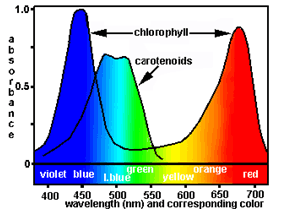
Most plants appear green because chlorophyll
a)
absorbs green light.
b)
absorbs violet light.
c)
does not absorb green light.
d)
does not absorb violet light.
18.
If an aquatic plant is placed into a test tube with water near a light source, what will it produce?
a)
Glucose and Oxygen
b)
Carbon dioxide and ATP
c)
Water and Oxygen
d)
Glucose and ATP
19.
Photosynthesis and Cellular Respiration are cyclic processes because
a)
the products of one are the reactants of the other
b)
They don't have anything to do with each other.
c)
the reactants and products are the same
d)
none of the above
20.
__________ is a stack of thylakoids
a)
Granum
b)
Stomata
c)
Stroma
d)
Chloroplast
21.
What is represented by "E" in this image?
a)
ATP
b)
NADPH
c)
Light Energy
d)
Glucose
22.
Use the diagram to answer the question. Between which parts of the molecule must the bonds be broken to form an ADP molecule?
a)
A and B
b)
A and C
c)
B and C
d)
C and D
23.
Which of the following is the correct equation for PHOTOSYNTHESIS?
a)
6CO2 + 6H2O --> 6O+ C6H12O6
b)
6CO+ C6H12O6 + 6H2O --> O
c)
6O2 + 6H2O --> 6CO+ C6H12O6
d)
C6H12O6 + 6O2 ---> 6H2O + 6CO2 
24.
Which gas is removed from the atmosphere during photosynthesis?
a)
hydrogen
b)
oxygen
c)
nitrogen
d)
carbon dioxide
25.
Organisms, such as plants, that make their own food are called
a)
autotrophs
b)
heterotrophs.
c)
thylakoids.
d)
pigments.
26.
Which of the following best describes photosynthesis?
a)
Photosynthesis converts radiant energy into chemical energy.
b)
Photosynthesis produces carbohydrates.
c)
Plants need sunlight, carbon dioxide, water, nutrients, and chlorophyll to complete photosynthesis.
d)
Plants use chlorophyll, water, and carbon dioxide to make sugar.
27.
The H+ concentration gradient is used to 
a)
make NADPH
b)
split a water molecule
c)
generate ATP
d)
form water
28.
How many sugar molecules are produced from every six molecules of carbon dioxide that enter the Calvin cycle?
a)
1
b)
3
c)
6
d)
12
29.
What is one function of the other pigments  besides chlorophyll, in the chloroplast?
a)
to block damaging wavelengths of light
b)
to absorb different wavelengths than the chloroplasts
c)
to provide different colors to the leaves
d)
to transfer energy to a separate photosystem beside the one using chlorophyll a and b.
30.
The light reactions occur in the ________ and the dark reactions take place in the ________.
a)
Chloroplast / thylakoid membrane
b)
stroma / thylakoid
c)
mesophyl / stomata
d)
thylakoid membrane / stroma
31.
Where does the carbon come from that is used to form glucose?
a)
The soil
b)
CO2 in the air
c)
From other carbohydrates
d)
Calvin Cycle
32.
oxygen becomes attached to RuBP during...
a)
C3 pathway
b)
C4 pathway
c)
Calvin-Benson Cycle
d)
Photorespiration
33.

What is represented by "D" in this image?

a)

ATP

b)

NADPH

c)

CO2

d)

Glucose

34.
The color of light least effective in driving photosynthesis is _________
a)
blue
b)
red
c)
orange
d)
green
35.

C4 and CAM plants use which enzyme(s) for photosynthesis?

a)

PEP Carboxylase

b)

PEP Carboxylase and Rubisco

c)

Rubisco

d)

Neither PEP Carboxylase and Rubisco

36.
During which phase of photosynthesis is O2 created?
a)
Light dependent reactions
b)
Calvin Cycle
c)
Citric Acid Cycle
d)
Glycolysis
37.
Which of these conditions would decrease the rate of photosynthesis in a plant?
a)
Above average precipitation
b)
Changing the daylight hours from 14 hrs to 10 hrs
c)
Changing the CO2 concentration from 380 ppm to 410 ppm
d)
All of these choices
38.

Why does photorespiration occur?

a)

stomata are closed and CO2 levels are too low.

b)

stomata are closed and O2 levels are too low.

c)

stomata are open and too much water is leaving the plant

d)

stomata are open and the plant receives too much CO2