
 Worksheets
Plant Tissues and Processes Practice
Total questions: 35
Worksheet time: 33mins
A twig of white-coloured flowers is placed in a beaker containing coloured water. After some time, the white petals become coloured. Which tissue is responsible for this?
Xylem
Phloem
cork
cambium
Which of the following is not a function of epidermal tissue?
Protection
Absorption of water
Transport of water
Gaseous exchange
The outermost layer of CELLS of the leaf is the
cuticle
epidermis
spongy mesophyll
bundle sheath
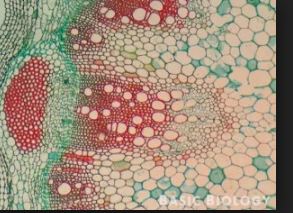
_____________________ is a vascular tissue that carries sugars and other foods throughout a plant.
stems
phloem
roots
xylem
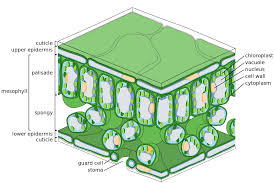
This tissue covers the outside of a plant in a single layer of cells called the epidermis.
Dermal tissue
Meristematic tissue
Ground tissue
Vascular tissue
This tissue makes up much of the interior of a plant and carries out basic metabolic functions. In stems, it provides support and may store food or water. In roots, it may also store food.
Dermal tissue
Ground tissue
Meristematic tissue
Vascular tissue
This tissue runs through the ground tissue inside a plant. It is made up of vessels that transport water, minerals, and nutrients through the plant.
Dermal tissue
Ground tissue
Meristematic tissue
Vascular tissue

This vessel makes up part of the vascular tissue of a plant. It carries water and dissolved ions from the roots to the stems and leaves.
Meristem
Xylem
Cambium
Phloem

This vessel carries dissolved sugars from the leaves to all other parts of the plant.
Meristem
Xylem
Cambium
Phloem
Epidermal cells secrete a waxy substance called _____, which coats, waterproofs, and protects the above-ground parts of plants.
Dermis
Stomata
Cuticle
Phloem

Within the epidermis, thousands of pairs of bean-shaped cells called ________, swell and shrink by osmosis to open and close tiny pores which control the exchange of gases and the release of water vapor.
stomata
guard cells
Schwann cells
prokaryotic cells

Within the epidermis, thousands of pairs of bean-shaped cells swell and shrink to open and close _______, which are tiny pores that control the exchange of oxygen and carbon dioxide gases and the release of water vapor.
stomata
stamen
stigma
style
This type of tissue is capable of cell division (mitosis).
Ground tissue
Vascular tissue
Dermal tissue
Meristematic tissue
What process do plants go through to create glucose
Cellular Respiration
Photosynthesis
Light Reaction
Calvin Cycle

Organisms that collect the energy from the sun and turn it into organic compounds.
Autotrophs
herbivores
SUnlight
Consumers
The sugar produced by plants from photosynthesis that gives the plant energy/food
Glucose
Carbon Dioxide
Oxygen
Process plants use to make their own “food” from the sun's energy, carbon dioxide, & water.
Photosynthesis
Cellular respiration
Sunlight
Oxygen
The location in which photosynthesis takes place; uses light energy to make food(glucose)
chloroplast
vein
stem
roots
Chemicals on the left side of the chemical equation (CO2, Water, Sunlight)
Product
Reactant
Chemical
Chemicals on the right side of the equation; what is produced (Oxygen and Glucose)
Product
Reactant
Oxygen
Located in the leaf and lets in carbon dioxide and lets out oxygen
Stomata
vein
leaf
roots
Plants benefit animals & atmosphere by producing ________.
oxygen
carbon dioxide
stomata
chorophyll
Sunlight enters the plant through the
stomata
chloroplasts
roots
petal
Oxygen is released into the air through the
stomata
chorophyll
roots
petal
Solar energy is converted into _____and water through photosynthesis.
solar
chemical
wind
physical

