
 Worksheets
Aaaahhh!!! SOL!!!!
Total questions: 85
Worksheet time: 1hrs 9mins
Name
Class
Date
1.
What is the area underground where there is not any water?
a)
Zone of Saturation
b)
Zone of Aeration
c)
Water
2.
The name of the area that is the upper level of the zone of saturation:
a)
Zone of Saturation
b)
Zone of Aeration
c)
Water Table
3.
Water stored below the Earth's surface is called:
a)
Groundwater
b)
Bogs
c)
Water in the ground
4.
When water soaks the ground it becomes groundwater through what process?
a)
Runoff
b)
Infiltration
c)
Transpiration
5.
The amount of space between soil is:
a)
Porosity
b)
Permeability
6.
The ability of a liquid to flow through a substance is:
a)
Porosity
b)
Permeability
7.
What is water that seeps into the ground into spaces between bits of rocks and soil?
a)
Water table
b)
Spring
c)
Aquifer
d)
Groundwater
8.
What is an underground layer of rock or soil filled with water called?
a)
Aquifer
b)
Spring
c)
Well
d)
Reservoir
9.
What is a place where groundwater seeps out of the ground called?
a)
Well
b)
Reservoir
c)
Aquifer
d)
Spring
10.
What do we call the land area that supplies water to a river system?
a)
runoff
b)
recharge
c)
watershed
d)
valley
11.

Suppose there is a drought in this area. The level of the river drops because of it.
What else could happen here?
What else could happen here?
a)
The river will immediately rise again.
b)
The water table will rise.
c)
The water table will fall.
d)
A new aquifer will form.
12.

What could happen if the water table lowers?
a)
There would be more precipitation.
b)
A lake could form in the valley.
c)
The river level could lower.
d)
Transpiration would stop.
13.

Able to allow water to pass through
a)
Permeability
b)
Runoff
c)
Pores
d)
Permeable
14.

The outside layer of the earth is called ______________________.
a)
core
b)
crust
c)
mantle
d)
outer core
15.
The epicenter of an earthquake is
a)
The point below the surface where rock begins to break and the first motion occurs
b)
The seismic station closest to the earthquake
c)
The place where the greatest damage occurs
d)
The point on the surface directly above the focus
16.

Waves move out through the ground from the ..........
a)
rift
b)
hypocenter
c)
epicenter
d)
fault line
17.

This famous transform fault is located in the western United States creates significant earthquake activity for California
a)
New Madrid
b)
Denali Fault
c)
Ramapo Seismic Zone
d)
San Andreas
18.

Many earthquakes happen along the borders of...
a)
Countries
b)
Tetonic Plates
c)
Climate Zones
d)
None of the above.
19.

What type of fault is this?
a)
Normal
b)
Reverse
c)
Strike-slip
20.

What type of fault is this?
a)
Normal
b)
Reverse
c)
Strike-slip
21.
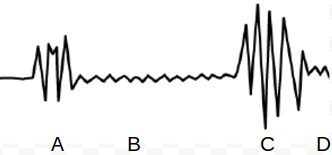
Where are the P-waves located on this seismogram?
a)
A
b)
B
c)
C
d)
D
22.

This is the area beneath the Earth's surface where the earthquake begins
a)
epicenter
b)
focus
c)
fault line
d)
tectonic plate
23.

What is one part of a volcano?
a)
Vent
b)
Wave
c)
Shake
d)
Gas
24.
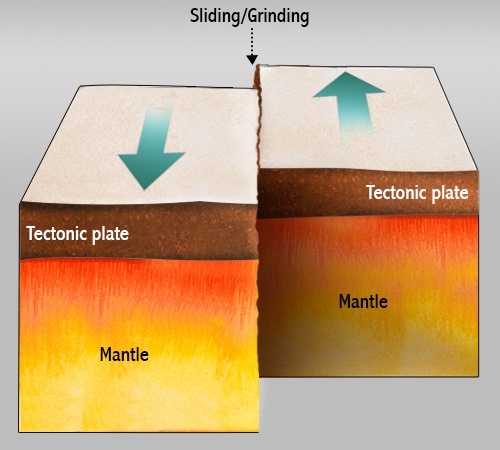
Which Plate Boundary does the picture illustrate?
a)
Spreading Boundary
b)
Fault Boundary
c)
Colliding Boundary
d)
Seismic Boundary
25.

What is the name of the geologic process when one plate slips underneath another plate?
a)
Subduction
b)
Subway
c)
Convergence
d)
Slip
26.

What are the puzzle pieces of the Earth's surface called?
a)
Tectonic plates
b)
Puzzles
c)
Earthquakes
27.
Liquefaction is when...
a)
the soil behaves like liquid
b)
the ground becomes liquid
c)
magma rises to the surface
d)
buildings are damaged, crumbling like liquid
28.
Which type of volcano is Paricutin in Mexico?
a)
Caldera
b)
Cinder Cone
c)
Composite Volcano
d)
Shield Volcano
29.
Which type of volcano is Crater Lake in Oregon?
a)
Caldera
b)
Cinder Cone
c)
Composite Volcano
d)
Shield Volcano
30.
What type of volcano is Mt. Fuji in Japan?
a)
Caldera
b)
Cinder Cone
c)
Composite Volcano
d)
Shield Volcano
31.
Where do volcanoes come from?
a)
Places where plates move apart
b)
Places where plates are moving together
c)
Hot Spots
d)
All of these options
32.
What do you call a large crater formed by the collapse of a volcano?
a)
Caldera
b)
Cinder Cone
c)
Composite Volcano
d)
Shield Volcano
33.
What type of volcano is Mount St. Helens?
a)
Caldera
b)
Cinder Cone
c)
Composite Volcano
d)
Shield Volcano
34.
What is molten rock that has reached the Earth's surface?
a)
Aa
b)
Lava
c)
Magma
d)
Pahoehoe
35.
Where are most volcanoes found?
a)
Southern Hemisphere
b)
Ring of Fire
c)
Mid-Atlantic Ridge
d)
Hot Spots
36.
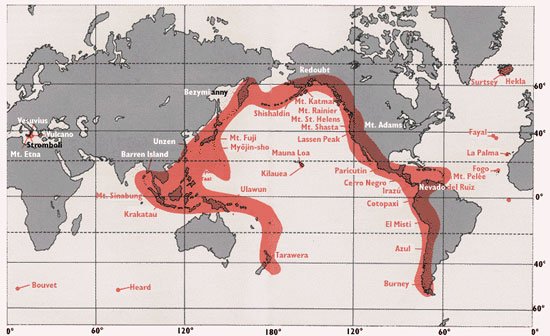
This is the name for the chain of volcanos around the edge of the Pacific Plate.
a)
Circle of Fire
b)
Ring of Lava
c)
Ring of Fire
d)
Circle of Magma
37.

A volcano that has steep sides and is formed from lava chunks is called
a)
a shield volcano
b)
a cinder cone volcano
c)
a composite volcano
38.

A volcano that is made from layers of both runny lava and lava chunks is called
a)
a shield volcano
b)
a cinder cone volcano
c)
a composite volcano
39.

What are scientists that study volcanoes called?
a)
doctor
b)
vet
c)
volcanologist
d)
volcano scientist
40.

A volcano that has gentle sloping sides and is formed from runny lava
a)
Shield volcano
b)
Cinder cone
c)
Composite
d)
None of these
41.

When an explosive eruption forms a mixture of hot rock, ash, and gas, this material is called a...?
a)
Land slide
b)
Lava
c)
Eruption trail
d)
Pyroclastic flow
42.

Dormant volcanoes might erupt in the future.
a)
True
b)
False
43.

Where is Mt. St Helens located?
a)
New Jersey
b)
Nebraska
c)
Washington state
d)
I didn't learn this so I give up
44.

This city was destroyed in 79 A.D. by the eruption of Mt. Vesuvius.
a)
Rome
b)
Munich
c)
Pompeii
d)
Naples
45.

Volcanoes are found...
a)
on land
b)
under water
c)
on islands
d)
all of the above
46.
Takes millions of years to form.
a)
hydroelectric
b)
renewable
c)
solar
d)
fossil fuels
47.
Solid fossil fuel formed from ancient plants.
a)
coal
b)
oil
c)
petroleum
d)
natural gas
48.
Heat produced from magma within the earth.
a)
solar
b)
biofuel
c)
hydroelectric
d)
geothermal
49.
Why are fossil fuels classified as nonrenewable?
a)
They are made of animal remains.
b)
People use them daily.
c)
They are quickly replaced.
d)
They take millions of years to make.
50.
A farmer decides that he is going to produce his own energy on the farm by using a type of renewable energy. The renewable energy could come from--
a)
setting up wind turbines
b)
having a coal furnace
c)
using natural gas
d)
burning oil
51.

This picture shows which type of alternative energy?
a)
Wind
b)
Solar
c)
Hydroelectric
d)
Geothermal
52.

Trees, crops, garbage, & landfill gas are all examples of
a)
Energy
b)
Biomass
c)
Heat
d)
Nuclear waste
53.

Energy from the sun.
a)
wind
b)
hydroelectric
c)
solar
d)
biofuel
54.

This picture shows how we can harness_________________ to help conserve Earth's resources.
a)
wind
b)
water
c)
sunlight
d)
coal
55.

What are Biofuels Made of?
a)
Natural Gas
b)
Coal
c)
Oil
d)
Plants & Animal Waste
56.
What percent of the Earth's surface is covered in water?
a)
71
b)
82
c)
50
d)
63
57.

This image shows
a)
sea floor is spreading
b)
continental shelf
c)
continental slope
d)
sea mount
58.
Scientists use ______ to determine the oceans depth.
a)
Submarine
b)
Sonar
c)
Helicopter
d)
Light
59.

What is the red arrow pointing too?
a)
Seamounts
b)
Hills
c)
Abyssal Plain
d)
Underwater volcanoes
60.

What is the green arrow pointing too?
a)
Ocean basin
b)
Seamounts
c)
Volcanoes
d)
Abyssal Plain
61.

Which ocean feature is circled?
a)
Rough zone
b)
Rift zone
c)
Mid-ocean range
d)
Trench
62.

Which ocean feature is circled?
a)
Continental Shelf
b)
Mid-ocean ridge
c)
Continental slope
d)
Rift zone
63.

What ocean feature is circled?
a)
Continental slope
b)
Continental shelf
c)
Ocean basin
d)
Abyssal Plain
64.
An Abyssal Plain is similiar to...
a)
Cont. Shelf
b)
The Grand Canyon
c)
The Great Plains
d)
Hidden Valley
65.
Mid-Ocean Ridge is similiar to ...
a)
Seamount
b)
Wizard Island
c)
Stone Mountain
d)
The Rocky Mountains
66.
mountain ranges in the ocean
a)
mid -ocean ridge
b)
trenches
c)
rift
d)
ocean basin
67.
a vallley found in the middle of the mid-ocean riage
a)
rift
b)
trenches
c)
abyssal plain
d)
ocean basin
68.
the deepest part of the ocean
a)
trenches
b)
abyssal plain
c)
ocean basin
d)
rift
69.
The Geologic Time Scale is a record of what?
a)
old geologists
b)
sweet geology music
c)
the known history of rocks and fossils
d)
a list of every living thing ever
70.

A bug stuck in amber is an example of what type of fossil?
a)
cast
b)
mold
c)
trace
d)
preserved remains
71.
Which organism first appeared in the Mesozoic?
a)
Trilobites
b)
Dinosaurs
c)
Cyanobacteria
d)
Humans
72.

Which era ended with the K-T extinction, probably due to an asteroid?
a)
Paleozoic
b)
Phanerozoic
c)
Cenozoic
d)
Mesozoic
73.
Which era are we in now?
a)
Precambrian
b)
Mesozoic
c)
Paleozoic
d)
Cenozoic
74.

Woolly mammoths appeared in the
a)
Paleogene
b)
Quaternary
c)
Cretaceous
d)
Neogene
75.

Pangea broke up in the
a)
Paleozoic
b)
Mesozoic
c)
Archean
d)
Cenozoic
76.

We think our atmospheric oxygen came from
a)
asteroids
b)
comets
c)
cyanobacteria
d)
vascular plants
77.

Which period are we currently in?
a)
Quaternary
b)
Holocene
c)
Jurassic
d)
Tertiary
78.

Which layer is the oldest and youngest?
a)
C and B
b)
C and E
c)
D and E
d)
A and B
79.

Which era is the longest?
a)
Cenozoic
b)
Cambrian
c)
Precambrian
d)
Phanerozoic
80.

Which layer is a result of an igneous intrusion?
a)
B
b)
C
c)
D
d)
E
81.
Paleontologists infer that the earth is approximately how many years old?
a)
4.5 million years
b)
450 million years
c)
450 billion years
d)
4.5 billion years
82.

Eras of the geologic time scale are
divided into ______.
divided into ______.
a)
periods
b)
ages
c)
units
d)
epochs
83.

Which fossil is an impression left by the original organism?
a)
cast
b)
mold
c)
trace
d)
preserved remains
84.

Which fossil is a replica of the original shape of the organism?
a)
cast
b)
mold
c)
trace
d)
preserved remains
85.

According to the law of superposition, which layer is the youngest?
a)
A
b)
B
c)
C
100 %

