Wayground logo

Free Printable Worksheets

Font size

S
M
L
XL
Worksheets

Blood, Cardiovascular system, Respiratory System

Total questions: 80

Worksheet time: 12hrs 9mins
Name
Class
Date
1.
What is the main function of the respiratory system?
a)
to provide oxygen and remove carbon dioxide from the body
b)
to bring oxygen to the body
c)
to break down food and absorb nutrients
d)
to remove oxygen from the body and deliver carbon dioxide
2.
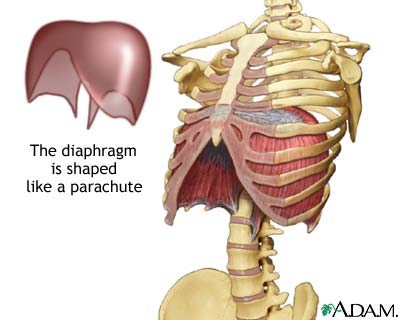
What is function of the dome-shaped diaphragm?
a)
This is where gas exchange happens.
b)
Air passes through the diaphragm on the way to the lungs.
c)
It attaches to the lungs to help in breathing.
d)
It is under the lungs and keeps them from falling down to your stomach.
3.
When you breathe, your lungs take in ___ and remove ___. 
a)
air/oxygen
b)
oxygen/carbon dioxide 
c)
carbon dioxide/waste 
d)
waste/air 
4.
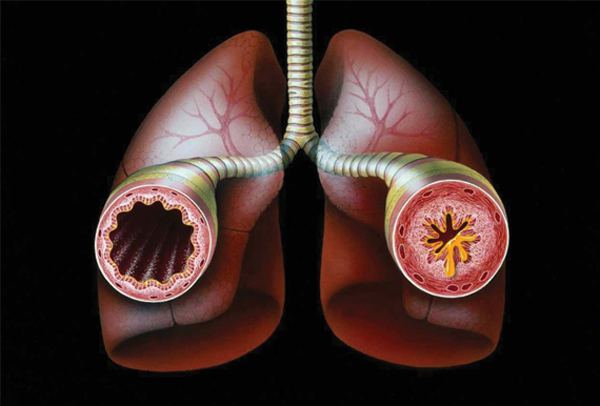
A disorder of the lungs called ____ causes the bronchi to become restricted (get smaller) so air can't get to the lungs.
a)
asthma 
b)
cold
c)
influenza 
d)
bronchitis 
5.
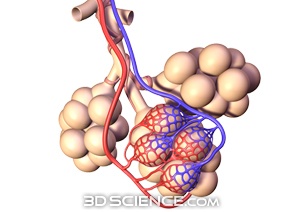
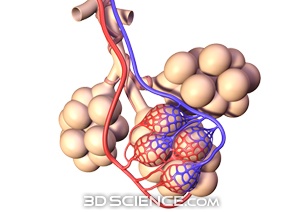
The air sacs that are covered with capillaries where gas exchange takes place
a)
bronchi
b)
lungs
c)
oxygen
d)
alveoli
6.
Within the lungs, the exchange of oxygen and carbon dioxide occurs between the ___ and the capillaries. 
a)
trachea 
b)
bronchi 
c)
alveoli
d)
diaphragm
7.
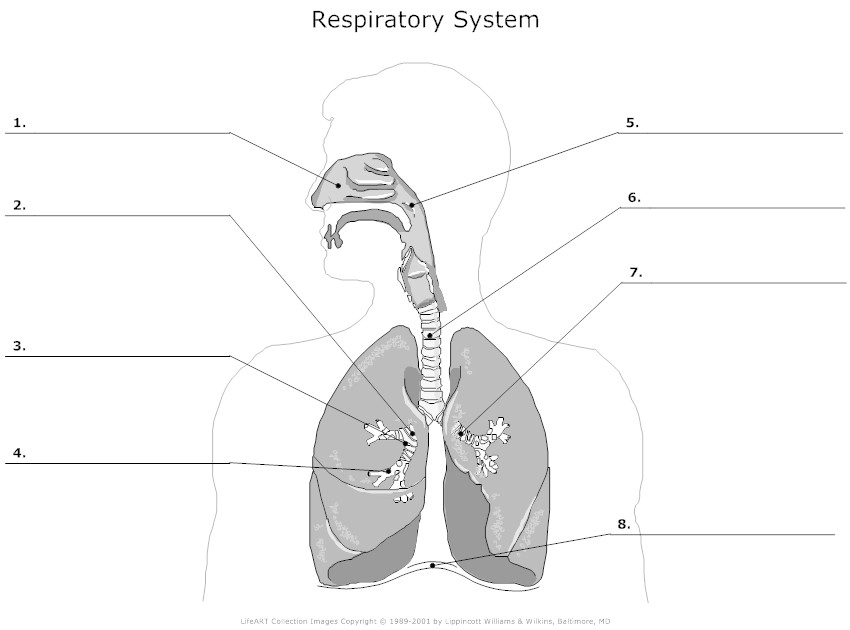
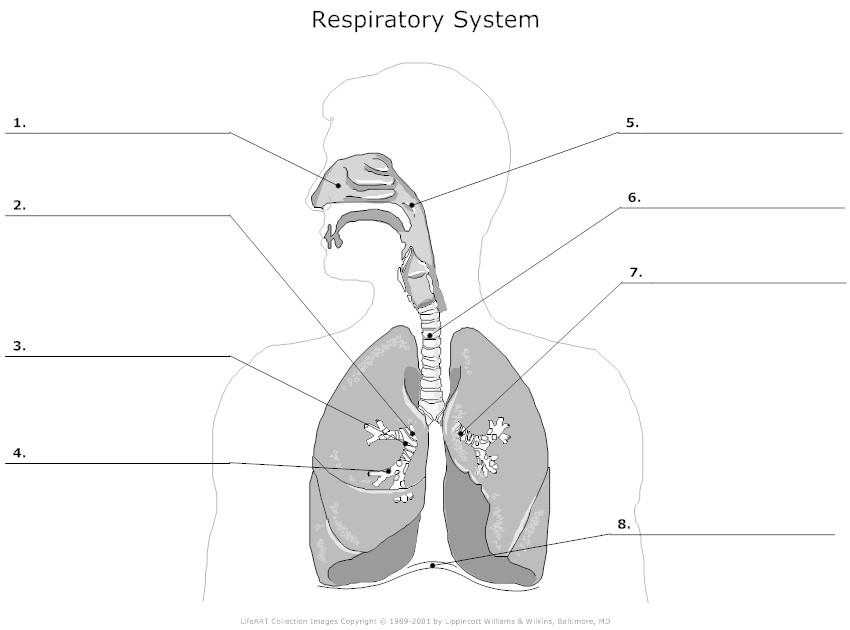
Name the organ label # 6. 
a)
alveoli 
b)
bronchi 
c)
trachea 
d)
lungs 
8.
What is tube that is also known as your wind pipe?
a)
esophogus
b)
bronchi
c)
trachea
d)
alveoli
9.
Name the structure labeled 8 
a)
lungs 
b)
trachea 
c)
diaphragm 
d)
alveoli 
10.
Flap of skin that covers the opening to the windpipe during swallowing
a)
Stomach
b)
Trachea
c)
Pancreas
d)
Epiglottis
11.
The Pharynx is the muscle that moves the lungs
a)
True
b)
False
12.
tiny hairlike structures that filter inhaled air to trap dust and other particles; push trapped particles toward the esophagus
a)
sinuses
b)
cilia
c)
mucus
d)
pharynx
13.
provides for a passageway for both food and air; throat
a)
pharynx
b)
larynx
c)
trachea
d)
bronchi
14.
leaflike piece of cartilage that closes the opening into the larynx during swallowing; prevents food and liquids from entering the respiratory tract
a)
bronchi
b)
bronchioles
c)
alveoli
d)
epiglottis
15.
The trachea divides into two _______________ near the center of the chest that carries air into the lungs.
a)
bronchi
b)
bronchioles
c)
alveoli
d)
trachea
16.
tiny air sacs in the lungs that allow for the exchange of oxygen and carbon dioxide
a)
trachea
b)
bronchi
c)
bronchioles
d)
alveoli
17.
the process of breathing in air; inhalation
a)
ventilation
b)
inspiration
c)
 expiration
d)
 respiration
18.
exhalation; air is forces out of the lungs and air passages
a)
ventilation
b)
inspiration
c)
expiration
d)
respiration
19.
Which system works closely with the respiratory system?
a)
skeletal system
b)
circulatory system
c)
excretory system
d)
digestive system
20.
The two main branches from the trachea (one to each lung)
a)
bronchi
b)
alveoli
c)
capillaries
d)
bronchioles
21.
Name the organ labeled #8
a)
alveoli 
b)
bronchi 
c)
trachea 
d)
lungs 
22.
The beginning of the respiratory system that warms and moistens the air.
a)
trachea
b)
nose
c)
bronchi
d)
diaphragm
23.
What is the main bone structure that protects the lungs
a)
Vertebrae
b)
Rib cage
c)
Skull
d)
Pelvis
24.
a dome shaped sheet of muscle, the _________, separates the chest from the abdomen
a)
diaphragm
b)
epiglottis
c)
alveoli
d)
bronchial tubes
25.
After air moves through the pharynx it continues downward. The _____, or windpipe, directs the air into 2 separate branches or tubes.
a)
mucus
b)
trachea
c)
larynx
d)
epiglottis
26.
the ____ look like a wasp's nest and is where the exchange of oxygen and carbon dioxide takes places.
a)
alveoli
b)
bronchial tubes
c)
lung
d)
diaphragm
27.
The air sacs that are covered with capillaries where gas exchange takes place is called what?
a)
bronchi
b)
lungs
c)
oxygen
d)
alveoli
28.
When you breathe, your lungs take in ___ and remove ___. 
a)
air/oxygen
b)
oxygen/carbon dioxide 
c)
carbon dioxide/waste 
d)
waste/air 
29.
Muscle mainly responsable for your ventilations
a)
Diaphragm
b)
Bronchi
c)
Pleura
d)
Alveoli
30.
Number 10 in the diagram is pointing to the ...
a)
bronchi
b)
trachea
c)
pharynx
d)
bronchioles
31.
-pnea
a)
sleep
b)
breath
c)
eyes
d)
feet
32.
tachypnea
a)
rapid breathing
b)
trouble breathing
c)
without breath
33.
Which of the following structures is not effected by URI
a)
trachea
b)
bronchi
c)
larynx
d)
pharynx
34.
All but one is a Sx of layngitis
a)
fever
b)
throat pain
c)
hoarse voice
d)
mucus in sinuses
35.
Sepsis
a)
infection of the blood
b)
infection of the lungs
c)
infection of the intestines
36.
The pleural cavity
a)
lies between the diaphragm and the heart
b)
lies between the chest wall and the lungs
c)
contains water
d)
contains blood
37.
pneumothorax
a)
blood in the pleural cavity
b)
collection of air in the pleural cavity
c)
water in the pleural cavity
d)
air in the lungs
38.
Name the structure labeled 8 
a)
lungs 
b)
trachea 
c)
diaphragm 
d)
alveoli 
39.
Tube that carries oxygen from the mouth to the Bronchi. (#5)
a)
Bronchioles
b)
Alveoli
c)
Esophagus
d)
Trachea
40.
What is the gas that we inhale?
a)
Oxygen
b)
Gasoline
c)
Carbon Dioxide
d)
Methane
41.
What is the gas we exhale?
a)
Carbon Dioxide
b)
Gasoline
c)
Oxygen
d)
Methane
42.
Number 6 is pointing to which organ of the Respiratory System
a)
Nose
b)
Lung
c)
Diaphragm
d)
Bronchi Tube
43.
Number 1 is pointing at which Respiratory organ?
a)
Diaphragm
b)
Lung
c)
Bronchi Tubes
d)
Nose
44.
Letter D is pointing to which Respiratory organ?
a)
Alveoli
b)
Diaphragm
c)
Lung
d)
Bronchi
45.
Letter B is pointing to which organ of the Respiratory System?
a)
Nose
b)
Trachea
c)
Lungs
d)
Diaphragm
46.
Number 7 is pointing to which organ of the Respiratory System?
a)
Lung
b)
Bronchi Tube
c)
Trachea
d)
Nose
47.
8
a)
Liver
b)
Gallbladder
c)
Appendix
d)
Pancreas
48.
A TINY blood vessel that allows for exchange between blood and cells in the tissue in the body  is ...
a)
capillary
b)
vein
c)
blood vessel
d)
artery
49.
The upper chambers of the heart are the...
a)
artery
b)
ventricle
c)
vesticle
d)
atrium
50.
How many chambers does the human heart have?
a)
2
b)
3
c)
4
d)
5
51.
The lower chambers of the heart are called the ...
a)
artery
b)
ventricle
c)
atrium
d)
vesticle
52.
A blood vessel that carries blood TO the heart is called ...
a)
vein
b)
capillary
c)
blood vessel
d)
artery
53.
When the heart pumps blood to the lungs (oxygen enters the blood) and then the blood is pumped back to the heart is ...
a)
Circulation
b)
Pulmonary Circulation
c)
Systemic Circulation
d)
Heart Circulation
54.
What type of blood vessel takes blood AWAY from the heart?
a)
vein
b)
capillary
c)
artery
d)
blood vessels
55.
What is the blood type of the Universal Recipient?
a)
O-
b)
O+
c)
A+
d)
AB+
56.
What is the blood type of the Universal Donor?
a)
O-
b)
O+
c)
A-
d)
AB-
57.

Structure that surrounds the heart (sac)

a)

Pericardium

b)

Epicardium

c)

Myocardium

d)

Endocardium

58.

Which side of the heart pumps oxygenated blood to the body?

a)

Right

b)

Left

59.

What is the largest vessel in the human body?

a)

Artery

b)

Aorta

c)

Carotid

d)

Arteriole

60.

The top number on a blood pressure reading is __________?

a)

Systolic

b)

Diastolic

c)

Asystolic

61.

The bottom number of a blood pressure reading is __________?

a)

Systolic

b)

Diastolic

c)

Asystolic

62.

Red blood cells produced by the red bone marrow

a)

Leukocytes

b)

Erythrocytes

c)

Thrombocytes

d)

Cyanocytes

63.

White blood cells that protect against harmful invaders such as bacteria

a)

Erythrocytes

b)

Leukocytes

c)

Thrombocytes

d)

Cyanocytes

64.

What keeps blood flowing in the right direction?

a)

Atria

b)

Chambers

c)

Valves

d)

Veins

65.
a)
Pulmonary veins
b)
Pulmonary artery
c)
Aorta
d)
Vena cava
66.
a)
Pulmonary veins
b)
Pulmonary artery
c)
Aorta
d)
Vena cava
67.
a)
Left atrium
b)
Right atrium
c)
Left ventricle
d)
Right ventricle
68.
What creates the "lub dub" heart sounds?
a)
Flow of blood
b)
Closing of valves
c)
Opening of valves
d)
Breathing
69.
Blood type A+ has which antigens?
a)
B, Rh
b)
A, B, Rh
c)
A, Rh
d)
None
70.
Systolic pressure measures which of the following?
a)
atrial contraction
b)
atrial relaxation
c)
ventricular contraction
d)
ventricular relaxation
71.
Blood enters the right atrium through 
a)
pulmonary veins
b)
vena cavaes
c)
pulmonary arteries
d)
aorta
72.
Your best friends needs a blood transfusion.  She has Type O blood.  What type blood can they give her?
a)
A, B, AB, and O
b)
only O
c)
A and O
d)
B and O
73.
______ helps your wounds stop bleeding.
a)
Plasma
b)
Red blood cells
c)
Platelets
d)
White blood cells
74.
_______________________ is a measure of the force of blood pushing on artery walls
a)
Blood Pressure
b)
Pulse
c)
Heartbeat
d)
Diastolic
75.

An individual who is Type O blood has

a)

A antibodies

b)

B antibodies

c)

Both A and B antibodies

d)

Neither A nor B antibodies

76.

Using the diagram to determine the blood type

a)

A+

b)

A-

c)

B+

d)

B-

77.

Using the diagram to determine the blood type

a)

AB+

b)

AB-

c)

O+

d)

O-

78.

How does the heart work?

a)

It pumps blood first to the lungs, back to the heart and then around the rest of the body.

b)

It pumps blood first to the rest of the body, back to the lungs and then to the heart.

c)

It pumps blood around the rest of the body, back to the heart and then to the lungs,

79.
Deoxygenated blood
a)
travels through veins
b)
has little oxygen because the O2 was delivered to cells
c)
all of these are true
d)
is indicated by blue on anatomical diagrams
80.

Which part of the heart pumps the oxygen-riched blood to all parts of the body?

a)

right ventricle

b)

left ventricle

c)

right atrium

d)

left atrium