
 Worksheets
Stars and Galaxies
Total questions: 80
Worksheet time: 2hrs 0mins


The Sun is the biggest star in the sky.
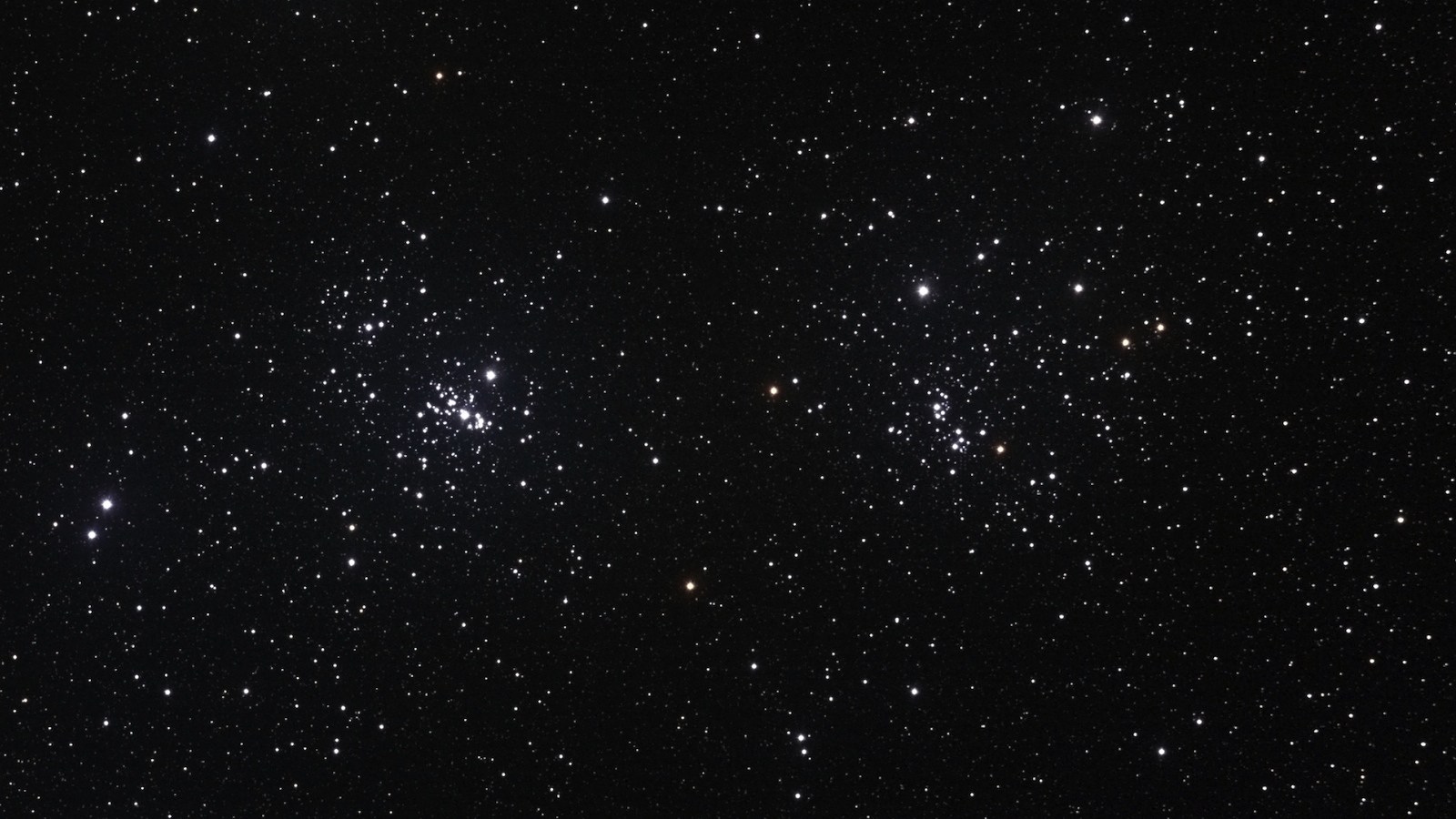
Stars are really close together in outer space.

Constellations are stars that appear to be in a pattern.

A) Temperature
B) Size and shape
C) Actual brightness
D) Distance from Earth
AbduAllah notices that two stars appear to have the same brightness. He knows that one of the stars is much farther away than the other. What could he conclude about the two stars?
A) Both stars must have the exact same actual brightness.
B) The one that is farther away must be brighter.
C) The one that is closer must be brighter.
D) Both stars must five off the exact same amount of energy.

Choose more than one answer.
Stars look different because of mass.
Stars look different because of distance.
Stars look different because of color.
Stars look different because of brightness.
Stars look different because they're hot.

Consider the color of the sun. Based on this color, what is the sun's approximate surface temperature?
10,000-30,000
6000-7500
30000-60000
<3500
Omar and Khadijah examined several photos of stars. To compare their temperatures, they looked at the colors of the stars. They organized the photos in order from coolest to hottest. Which of these answers shows the correct order?
red, yellow, white, blue
white, blue, yellow, red
yellow, white, blue, red
blue, yellow, white, red

Which of the following statements best relates a star’s color to its surface temperature?
blue stars have a relatively low temperature
red stars have a relatively high temperature
blue-white stars have a relatively low temperature
yellow stars have a relatively low temperature

A scientist discovers a new star. It is blue-white and is about 20,000 K. Which star is it most similar to?
Sun
Rigel
Vega
Canopus

Based on evidence in the table, which star would appear the dimmest from Earth’s surface?
Star A
Star B
Star C
Star D
Absolute magnitude is defined as…
mass of a star
color of a star
brightness of a star, as it appears from Earth
brightness of a star independent from the distance of Earth
About 90 percent of the stars in the universe, including the sun, are main sequence stars. What do all main sequence stars have in common?
All main sequence stars are yellow like our sun.
All main sequence stars are as bright as our sun.
They are all undergoing fusion of helium into carbon within their cores
They are undergoing fusion of hydrogen into helium within their cores
Which of the following correctly ranks astronomical objects by size, starting with the smallest?
earth, sun, solar system, galaxy, universe
sun, solar system, earth, universe, galaxy
universe, galaxy, solar system, earth, sun
solar system, earth, sun, universe, galaxy

On an HR diagram, stars at the same temperature are found...
aligned horizontally (next to each other)
aligned vertically (one above the other)
along the main sequence
spread through the diagram

White dwarfs stars are
hot and dim
cool and dim
hot and bright
cool and bright
Stars are made of mostly which two gases?
Hydrogen and Helium
Hydrogen and Oxygen
Hydrogen and Nitrogen
Hydrogen and Carbon
A star is born in a cloud of gas and dust called a __________.
nebula
galaxy
asteroid
black hole
Stars give off heat and light in a process called ___________.
nuclear fusion
supernova
luminosity
spectroscopy

How many stars are in space?
10,000
millions
trillions
The smallest and the most common stars giving off very little light.
Blue Giant stars
Red Dwarf stars
White Dwarf stars
Neutron stars

Stars appear to twinkle because
of their temperature
their light is passing through our atmosphere
they constantly change direction
to make a wish on

The closer a star is
the larger it appears
the more hydrogen is in the star

The sun is a star about ________ kilometer away from Earth
60 thousand
22 trillion
149 million
4 billion

The main gases that burn within the sun are
Oxygen and Nitrogen
Hydrogen and Oxygen
Neon and Sulfur
Hydrogen and Helium

The atmosphere of the sun has three parts
corona, chromosphere, photosphere
corona, core, hydrosphere
corona, magnitude, mantle
corona, geosphere, biosphere,

Diameter of the sun is about 108 times bigger than Earth, about _________ Earth's would fit inside the sun.
500
1 thousand
1 million
1 billion

The sun's yellow color indicates that it is a
star made up of stable gases
that it is a mid-range temperature star
that it is a low-range temperature star
that it is a high-range temperature star


All stars begin their life in a
Main Sequence
Nebula
Protostar
Black Dwarf
Hertzsprung-Russell Diagrams show
The electromagnetic spectrum with wave frequencies.
The average surface temperature of stars and their absolute magnitude.
The total amount of valence electrons an element from the periodic table has.
A diagram of the temperatures of layers of the earth.

The Magnitude (brightness) of the Sun is what number on the apparent magnitude scale?
0
+25
-25
None of the above

What does this diagram show?
the morphological classification of galaxies
the evolutionary sequence of galaxies
the color classification of stars
the life cycle sequence of stars

An average star’s life would follow which order
white dwarf, main sequence (average star), giant
main sequence (average star), white dwarf, red giant
main sequence (average star), red giant, white dwarf
red giant, main sequence (average star), white dwarf

Which of the following stars are in correct order from least to most absolute magnitude:
Giants, Super Giants, White Dwarfs
Super Giants, White Dwarfs, Giants
White Dwarfs, Giants, Super Giants
White Dwarfs, Super Giants, Giants

Which set of stars would burn at higher
surface temperatures?
White Dwarfs
Super giants
Giants
None of the above

Which characteristics best describe white dwarfs as compared to giants?
White dwarfs are cooler and dimmer than giants
White dwarfs are cooler and brighter than giants
White dwarfs are warmer and dimmer than giants
White dwarfs are warmer and brighter than giants

Which star is the hottest?
Betelguese
Rigel
The Sun
Aldebaran

Which star is dimmer?
Rigel
Sirius
Sun
Barnard's Star

Which type of galaxy is pictured?
Elliptical
Irregular
Spiral
Barred-Spiral

Which type of galaxy is pictured?
Elliptical
Spiral
Barred-Spiral
Irregular

Which type of galaxy is pictured
Irregular
Spiral
Barred-Spiral
Elliptical
A gravitationally-bound system of stars, gas, & dark matter is called a...
Galaxy
Universe
Solar System
Nebula
The Milky Way is a/an...
Irregular Galaxy
Spiral Galaxy
Barred-Spiral Galaxy
Elliptical Galaxy
The largest connected system of galaxies is called a...
MIllicluster
Supercluster
Megacluster
Gigacluster
The closest star to our Solar System is...
Proxima Centauri
rho Cassiopeiae
Andromeda
The North Star
How many stars are in our Solar System?
1
1 million
1 billion
1 trillion
An arrangement of stars in a specific spot in the night sky is called a...
Constellation
Solar System
Galaxy
Local Group
Describe the difference between luminosity and magnitude.
Luminosity measures energy, magnitude measures brightness
Luminosity measures brightness, magnitude measures energy
Luminosity measures distance, magnitude measures time
Luminosity measures time, magnitude measures distance
Stars that are further away...
Will be more blueshifted
Will display less parallax
Will always appear dimmer
Will have a greater magnitude
According to Hubble's Law...
Most galaxies are moving towards the Earth
Galaxies further away from the Earth are moving away at a faster rate
Galaxies are blueshifted
Only galaxies close to the Earth are redshifted

