
 Worksheets
Class v. Class Interim Review
Total questions: 52
Worksheet time: 2hrs 36mins
Name
Class
Date
1.
Unit 5 - DAY 054
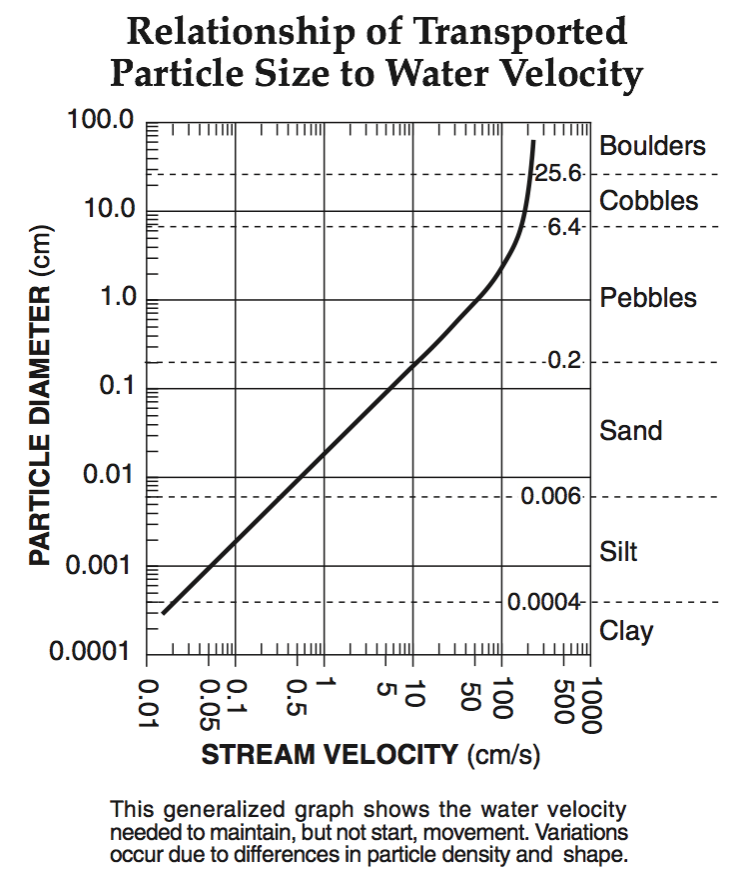
A particle diameter of 0.7 cm corresponds to which sediment classification?
A particle diameter of 0.7 cm corresponds to which sediment classification?
a)
sand
b)
silt
c)
clay
d)
pebble
2.
Unit 5 - DAY 058
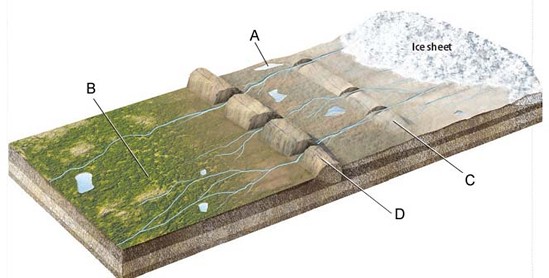
What glacial features are indicated by the labels C and D on the figure?
What glacial features are indicated by the labels C and D on the figure?
a)
moraines
b)
outwash plains
c)
kettle lakes
d)
ice sheets
3.
Unit 5 - DAY 057
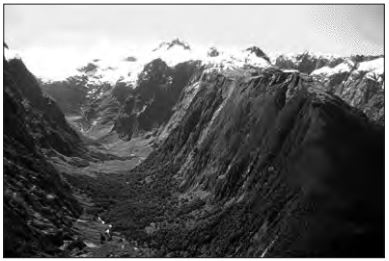
The photograph below shows a valley. Which agent of erosion most likely produced this valley’s shape?
The photograph below shows a valley. Which agent of erosion most likely produced this valley’s shape?
a)
blowing wind
b)
ocean waves
c)
moving ice
d)
running water
4.
Unit 5 - DAY 056
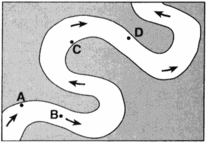
At which location is the greatest amount of sediment most likely being deposited?
At which location is the greatest amount of sediment most likely being deposited?
a)
A
b)
B
c)
C
d)
D
5.

Unit 3 - DAY 033
The ozone layer protects life on Earth by absorbing harmful ultraviolet radiation. The ozone layer is located between 17 kilometers and 35 kilometers above Earth’s surface in which atmospheric temperature zone?
The ozone layer protects life on Earth by absorbing harmful ultraviolet radiation. The ozone layer is located between 17 kilometers and 35 kilometers above Earth’s surface in which atmospheric temperature zone?
a)
troposphere
b)
stratosphere
c)
mesosphere
d)
thermosphere
6.

Unit 1 - DAY 011 CW
(p. 43) - An instrument used to measure a weather variable is shown in the picture. Which weather variable is measured by this instrument?
(p. 43) - An instrument used to measure a weather variable is shown in the picture. Which weather variable is measured by this instrument?
a)
wind direction
b)
air pressure
c)
wind speed
d)
amount of rainfall
7.

Unit 1 - DAY 014 Exit Task (p. 65)
State the present weather indicated by the present weather symbol at station C.
State the present weather indicated by the present weather symbol at station C.
a)
rain
b)
cloudy
c)
drizzle
d)
sleet
8.
Unit 1 - DAY 017 CW (p. 83)
Encode the following air pressure into the code shown on a weather station model: 992.1 mb.
Encode the following air pressure into the code shown on a weather station model: 992.1 mb.
a)
992
b)
092
c)
991
d)
921
9.

Unit 1 - DAY 017 Exit Task (p. 86)
What is the barometric pressure indicated by this station model?
What is the barometric pressure indicated by this station model?
a)
0.029 mb
b)
902.9 mb
c)
1002.9 mb
d)
1029.0 mb
10.

Unit 1 - DAY 017 Exit Task (p. 86)
What was the actual barometric pressure, according to the station model, to the nearest tenth of a millibar?
What was the actual barometric pressure, according to the station model, to the nearest tenth of a millibar?
a)
0.021 mb
b)
902.1 mb
c)
1002.1 mb
d)
1021.0 mb
11.

Unit 1 - DAY 018 Exit Task (p. 96)
Which map view best represents the pattern of isobar values, in millibars, and the pattern of wind flow, shown by arrows, at Earth’s surface surrounding a Northern Hemisphere low-pressure center?
Which map view best represents the pattern of isobar values, in millibars, and the pattern of wind flow, shown by arrows, at Earth’s surface surrounding a Northern Hemisphere low-pressure center?
a)
Diagram 1
b)
Diagram 2
c)
Diagram 3
d)
Diagram 4
12.

Unit 2 - DAY 031 CW (p.153)
The graph below shows the average monthly temperatures for two cities, A and B, which are both located at 41° north latitude.
Which statement best explains the difference in the average yearly temperature range for the two cities?
The graph below shows the average monthly temperatures for two cities, A and B, which are both located at 41° north latitude.
Which statement best explains the difference in the average yearly temperature range for the two cities?
a)
City B is located near a large body of water.
b)
City B is located in a different planetary wind belt.
c)
City B receives less yearly precipitation.
d)
City B has a greater yearly duration of insolation.
13.

Unit 2 - DAY 030 Exit Task (p. 146)
Identify one labeled latitude on this continent where a high-pressure zone exists and dry air is sinking to the surface. Include both the unit and compass direction in your answer.
Identify one labeled latitude on this continent where a high-pressure zone exists and dry air is sinking to the surface. Include both the unit and compass direction in your answer.
a)
30°N
b)
45°N
c)
0°
d)
60°S
14.

Unit 2 - DAY 029
The cross section below represents prevailing winds moving over a coastal mountain range. Letters A through D represent locations on Earth’s surface.
Which location will most likely have the least annual precipitation?
The cross section below represents prevailing winds moving over a coastal mountain range. Letters A through D represent locations on Earth’s surface.
Which location will most likely have the least annual precipitation?
a)
A
b)
B
c)
C
d)
D
15.

Unit 2 - DAY 024 CW
(p. 105) - The map shows a low-pressure system with two fronts extending from its center (L). Two different air masses are labeled. Name the geographic region over which the mT air mass most likely formed. [1]
(p. 105) - The map shows a low-pressure system with two fronts extending from its center (L). Two different air masses are labeled. Name the geographic region over which the mT air mass most likely formed. [1]
a)
Gulf of Mexico
b)
Gulf of Canada
c)
Mexico
d)
Canada
16.

Unit 2 - DAY 025 Exit Task
(p. 114) - Which weather-map symbols best represent air-mass X and the frontal boundary shown on the map?
(p. 114) - Which weather-map symbols best represent air-mass X and the frontal boundary shown on the map?
a)
(1)
b)
(2)
c)
(3)
d)
(4)
17.

Unit 2 - DAY 025 CW
(p. 113) Which type of front is located between Buffalo and Detroit?
(p. 113) Which type of front is located between Buffalo and Detroit?
a)
stationary
b)
cold
c)
warm
d)
occluded
18.

Unit 2 - DAY 027 Exit Task
(p. 122) During which season does city B usually experience the month with the highest average precipitation?
(p. 122) During which season does city B usually experience the month with the highest average precipitation?
a)
winter
b)
spring
c)
summer
d)
fall
19.
Unit 2 - DAY 030 Exit Task (p. 146)
Identify one factor that causes a colder climate at location B than at location A. [1]
Identify one factor that causes a colder climate at location B than at location A. [1]
a)
B is high in the mountains.
b)
Winds are going in a different direction at B.
c)
B is on the equator.
d)
B is low in the mountains.
20.
Unit 3 - DAY 039 HW (p.210)
The ozone layer helps life on Earth because ozone
The ozone layer helps life on Earth because ozone
a)
modifies the normal El Niño weather pattern
b)
absorbs damaging ultraviolet radiation from the Sun
c)
reflects insolation from the Sun
d)
deflects winds from a straight line to a curved path
21.

Unit 3 - DAY 038 CW (p. 202)
Which statement explains how this volcanic eruption could have caused the general decrease in temperature shown by the graph.
Which statement explains how this volcanic eruption could have caused the general decrease in temperature shown by the graph.
a)
Lava from the volcano cools down the atmosphere
b)
Released gases from the volcano cools down the atmosphere
c)
Released particles from the volcano cool down the area beneath the ash cloud
d)
Released energy from the volcano cools down the atmosphere
22.
Unit 3 - DAY 038 CW (p. 202)
Great volcanic eruptions send dust and ash into the stratosphere. Weeks after such great eruptions, air temperatures are often
Great volcanic eruptions send dust and ash into the stratosphere. Weeks after such great eruptions, air temperatures are often
a)
cooler than normal because the atmosphere is more transparent
b)
cooler than normal because the atmosphere is less transparent
c)
warmer than normal because the atmosphere is less transparent
d)
warmer than normal because the atmosphere is more transparent
23.
Unit 3 - DAY 037 CW (p.193)
Explain how the effect of global warming on present-day continental glaciers (Large pieces of ice) could affect New York City and Long Island.
Explain how the effect of global warming on present-day continental glaciers (Large pieces of ice) could affect New York City and Long Island.
a)
It will cause the glaciers to freeze, drying up NYC and Long Island
b)
It will cause the glaciers to freeze, flooding NYC and Long Island
c)
It will cause the glaciers to melt, drying up NYC and Long Island
d)
It will cause the glaciers to melt, flooding NYC and Long Island
24.
Unit 3 - DAY 035 HW (p.170)
How does increasing the amount of greenhouse gases in Earth’s atmosphere increase global temperatures.
How does increasing the amount of greenhouse gases in Earth’s atmosphere increase global temperatures.
a)
It causes the atmosphere to absorb more infrared radiation.
b)
It causes the atmosphere to reflect more infrared radiation.
c)
It causes the atmosphere to absorb more ultraviolet radiation.
d)
It causes the atmosphere to reflect more ultraviolet radiation.
25.
Unit 3 - DAY 035 CW (p.169)
Which two gases have been added to Earth’s atmosphere in large amounts and are believed to have increased global warming by absorbing infrared radiation?
Which two gases have been added to Earth’s atmosphere in large amounts and are believed to have increased global warming by absorbing infrared radiation?
a)
methane and carbon dioxide
b)
hydrogen and helium
c)
chlorine and nitrogen
d)
neon and argon
26.

Unit 3 - DAY 033 (ESRT W)
Which layer of the atmosphere is at an altitude of 45 kilometers?
Which layer of the atmosphere is at an altitude of 45 kilometers?
a)
the troposphere
b)
the stratosphere
c)
the mesosphere
d)
the thermosphere
27.
Unit 3 - DAY 033 (ESRT W)
Which layer of the atmosphere is at an altitude of 10 miles?
Which layer of the atmosphere is at an altitude of 10 miles?
a)
the troposphere
b)
the stratosphere
c)
the mesosphere
d)
the thermosphere
28.
Unit 3 - DAY 036 CW (p.186)
In which list are the forms of electromagnetic energy arranged in order from longest to shortest wavelengths? HINT: Use ESRT (Y)!
In which list are the forms of electromagnetic energy arranged in order from longest to shortest wavelengths? HINT: Use ESRT (Y)!
a)
gamma rays, x rays, ultraviolet rays, visible light
b)
radio waves, infrared rays, visible light, ultraviolet rays
c)
x rays, infrared rays, blue light, gamma rays
d)
infrared rays, radio waves, blue light, red light
29.

Unit 3 - DAY 035 (ESRT Y)
Which energy on the electromagnetic spectrum has a long wavelength?
Which energy on the electromagnetic spectrum has a long wavelength?
a)
ultraviolet
b)
x rays
c)
radio waves
d)
gamma rays
30.
Unit 3 - DAY 035 (ESRT Y)
Some microwave wavelengths are between the wavelengths of
Some microwave wavelengths are between the wavelengths of
a)
visible light and ultraviolet
b)
microwaves and visible light
c)
radio waves and infrared
d)
gamma rays and ultraviolet
31.

Unit 3 - DAY 35:
Base your answers to the question below on the diagram, which represents the greenhouse effect in which heat energy is trapped in Earth’s atmosphere.
Which type of radiation from Earth is the long-wave radiation absorbed by greenhouse gases?
Base your answers to the question below on the diagram, which represents the greenhouse effect in which heat energy is trapped in Earth’s atmosphere.
Which type of radiation from Earth is the long-wave radiation absorbed by greenhouse gases?
a)
ultraviolet
b)
infrared
c)
visible light
d)
radio waves
32.

Unit 3 - DAY 36:
The diagram shows a greenhouse.
What is the primary function of the clear glass of the greenhouse?
The diagram shows a greenhouse.
What is the primary function of the clear glass of the greenhouse?
a)
The glass reduces the amount of insolation entering the greenhouse.
b)
The glass allows all wavelengths of radiation to enter and all wavelengths of radiation to escape.
c)
The glass allows long wavelengths of radiation to enter, but reduces the amount of short- wavelength radiation that escapes.
d)
The glass allows short wavelengths of radiation to enter, but reduces the amount of long- wavelength radiation that escapes.
33.

Unit 4 - DAY 044
Process 2 is known as...
Process 2 is known as...
a)
runoff
b)
infiltration
c)
condensation
d)
transpiration
34.

Unit 4 - DAY 044
Process 1 is known as...
Process 1 is known as...
a)
precipitation
b)
infiltration
c)
condensation
d)
transpiration
35.
Unit 4 - DAY 044
Process 5 is known as...
Process 5 is known as...
a)
precipitation
b)
runoff
c)
condensation
d)
transpiration
36.
Unit 4 - DAY 044
One way to directly increase runoff is to increase
One way to directly increase runoff is to increase
a)
precipitation
b)
infiltration
c)
condensation
d)
evaporation
37.

Unit 4 - DAY 045
Which has a higher porosity?
Which has a higher porosity?
a)
Sample A
b)
Sample B
c)
They have the same porosity
38.
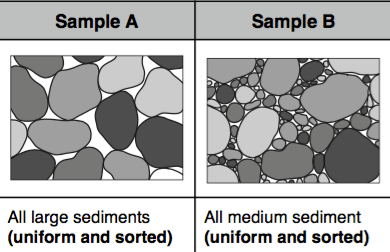
Unit 4 - DAY 045
Which has a higher porosity?
Which has a higher porosity?
a)
Sample A
b)
Sample B
c)
They have the same porosity
39.

Unit 4 - DAY 045
Which has the highest retention?
Which has the highest retention?
a)
Sample A - because it has largest pore space
b)
Sample B - because it has uniform sediment sizes
c)
Sample C - because it has uniform sediment sizes
d)
Sample D - because it has smallest pore spaces
40.

Unit 4 - DAY 045
Which has a higher retention?
Which has a higher retention?
a)
Sample A
b)
Sample B
c)
They have the same retention
41.
Unit 4 - Day 049
Chemical weathering is defined as...
Chemical weathering is defined as...
a)
Wear and tear on rocks primarily by forces.
b)
Wear and tear on rocks primarily by weather.
c)
Wear and tear on rocks primarily by reactions with water.
d)
All of the above.
42.
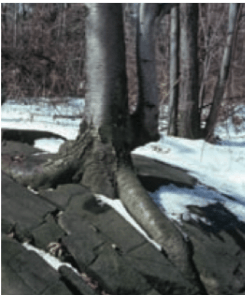
Unit 4 - Day 048
The picture shown is an example of what type of weathering?
The picture shown is an example of what type of weathering?
a)
Physical - Root Action
b)
Physical - Abrasion
c)
Chemical - Root Action
d)
Chemical - Abrasion
43.
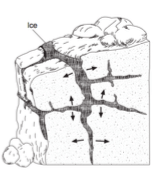
Unit 4 - Day 048
The picture shows ice breaking apart a piece of solid bedrock. This is an example of what type of weathering?
The picture shows ice breaking apart a piece of solid bedrock. This is an example of what type of weathering?
a)
Physical - Frost Action
b)
Physical - Carbonation
c)
Chemical - Frost Action
d)
Chemical - Carbonation
44.
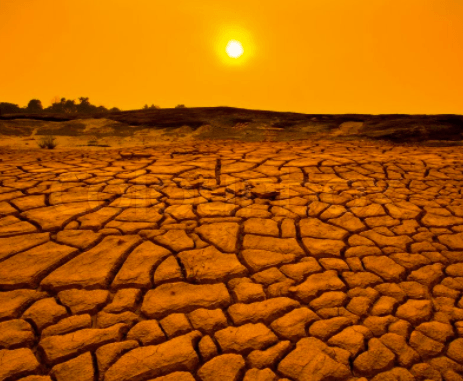
Unit 4 - Day 050
ARID environments may have lots of...
ARID environments may have lots of...
a)
BOTH chemical and physical weathering
b)
physical BUT NOT chemical weathering
c)
chemical BUT NOT physical weathering
45.
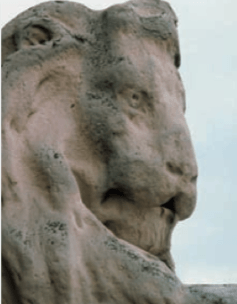
Unit 4 - Day 049
The picture shows a limestone statue that has been weathered. This is an example of what type of weathering?
The picture shows a limestone statue that has been weathered. This is an example of what type of weathering?
a)
Physical - Acid Precipitation
b)
Physical - Abrasion
c)
Chemical - Acid Precipitation
d)
Chemical - Abrasion
46.
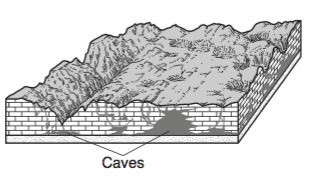
Unit 4 - Day 049
What type of weathering was responsible for the development of these caves?
What type of weathering was responsible for the development of these caves?
a)
chemical weathering of limestone
b)
physical weathering of limestone
c)
chemical weathering of sandstone
d)
physical weathering of sandstone
47.
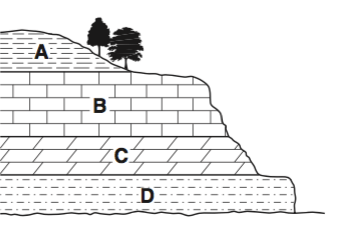
Unit 4 - Day 05
Which layer is MOST resistant to weathering?
Which layer is MOST resistant to weathering?
a)
Layer A
b)
Layer B
c)
Layer C
d)
Layer D
48.
Unit 4 - Day 046
Permeability is defined as...
Permeability is defined as...
a)
The process of water soaking into a soil sample
b)
The ability of a soil sample to permit water to flow through it
c)
The percentage of empty space in a soil sample
d)
What happens to water that cannot soak through a soil sample
49.

Unit 4 - Day 046
The letter with the lowest permeability is...
The letter with the lowest permeability is...
a)
A - loosely packed, well structured soil
b)
B - loosely packed soil with uniform particle size
c)
C - tightly packed soil with uniform particle size
d)
D - tightly packed soil with mixed particle size
50.
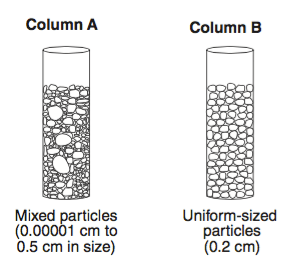
Unit 4 - Day 045
Which has a higher retention?
Which has a higher retention?
a)
Sample A
b)
Sample B
c)
They have the same retention
51.
Unit 4 - Day 045 - 046
When permeability increases, the retention decreases.
This means that there is a(n) ________ relationship between these two variables because ____ _________________________.
When permeability increases, the retention decreases.
This means that there is a(n) ________ relationship between these two variables because ____ _________________________.
a)
direct - an increase in one causes a decrease in the other
b)
inverse - an increase in one causes a decrease in the other
c)
direct - an increase in one causes an increase in the other
d)
inverse - an increase in one causes an increase in the other
52.

Unit 4 - Day 047
Describe the general relationship between the amount of infiltration and the amount of infiltration represented by B.
Describe the general relationship between the amount of infiltration and the amount of infiltration represented by B.
a)
Direct -
as infiltration increases, runoff decreases
as infiltration increases, runoff decreases
b)
Direct -
as infiltration increases, runoff also increases
as infiltration increases, runoff also increases
c)
Inverse -
as infiltration increases, runoff decreases
as infiltration increases, runoff decreases
d)
Inverse -
as infiltration decreases, runoff also decreases
as infiltration decreases, runoff also decreases
100 %

