
 Worksheets
8th Sci Midterm Review 17-18
Total questions: 68
Worksheet time: 49mins
Name
Class
Date
1.
AA and Aa always show up as
a)
dominant
b)
recessive
2.
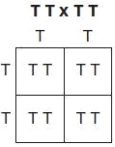
What ratio of the offspring from the cross shown will be homozygous recessive for the trait of tallness?
a)
0 in 4
b)
1 in 4
c)
2 in 4
d)
4 in 4
3.
Which of the following genotypes is heterozygous?
a)
Bb
b)
BB
c)
bb
d)
B
4.
What gender has an X and a Y chromosome?
a)
male
b)
female
c)
transgender
d)
all of the above
5.
Different forms of the same gene
a)
recessive
b)
dominant
c)
alleles
d)
genes
6.
Weak and can be overpowered
a)
dominant
b)
recessive
c)
chromosome
d)
DNA
7.
A chart that shows all the possible combinations of alleles from parents
a)
T-square
b)
Gene Chart
c)
Punnett Square
d)
DNA organizer
8.
the genetic makeup of an organism
a)
genotype
b)
phenotype
9.
How the trait appears or looks like
a)
genotype
b)
phenotype
10.
Strong and cannot be overpowered
a)
dominant
b)
recessive
c)
trait
d)
gene
11.
___________ is the idea that the earth changes very rapidly over short periods of time.
a)
uniformitarianism
b)
catrastorphism
c)
superposition
d)
disconformities
12.
A fault is always _________ than the layers of sedimentary rock it cuts through.
a)
older than
b)
younger than
c)
the same age as
13.

What is the correct name for this tool?
a)
triple beam balance
b)
fish hook
c)
thermometer
d)
spring scale
14.

What is the correct name for this tool?
a)
scale
b)
triple beam balance
c)
hot plate
d)
spring scale
15.

What is the correct name for this tool?
a)
graduated cylinder
b)
beaker
c)
flask
d)
test tube
16.
In an experiment, the one factor changed by the person doing the experiment is called the:
a)
independent variable
b)
dependent variable
c)
controlled variable (constant)
d)
experimental variable
17.
In an experiment, the factor that is being measured is called the:
a)
independent variable
b)
dependent variable
c)
controlled variable (Constant)
d)
experimental variable
18.
In an experiment, the factors that stay the same and do NOT change are called:
a)
independent variable
b)
dependent variable
c)
controlled variable (constant)
d)
experimental variable
19.
Which reproduction takes Time & Energy?
a)
Sexual
b)
Asexual
20.
Mountains form from ...
a)
plates sliding past one another
b)
collision of plates
c)
plates moving away from each other
21.
What are some of the facts about asexual reproduction?
a)
Takes only one mate to reproduce and takes a longer time to reproduce
b)
Takes a shorter amount of time to reproduce and it takes two mates to reproduce
c)
Reproduces diverse offspring and takes a longer time to reproduce
d)
Takes only one mate to reproduce and takes a shorter time to reproduce
22.
James Hutton Was A _________
a)
Astronomer
b)
Geologist
c)
Meme
d)
Philosopher
23.
Creates the greatest diversity, & therefore the ability to survive changing environments is
a)
sexual reproduction
b)
asexual reproduction
c)
cloning
d)
fragmentation
24.
Which of the following describes the main advantages of sexual reproduction?
a)
requires lots of time/energy
b)
no new gene combos can arise
c)
diversity
d)
looks identical to the parent
25.
In a heterozygous genotype, the ___________ allele takes over in the phenotype.
a)
recessive
b)
dominant
c)
lower case letter
d)
both
26.
Which one is the BEST definition of the word adaptation?
a)
a behavior that helps a living thing survive
b)
body part or behavior that helps a living thing survive
c)
a body part that helps a living thing survive
d)
a feature that helps a plant survive
27.

Which is NOT true about peppered moths?
a)
many with light colors died during the Industrial Revolution
b)
the moths adapted to the changes in the environment
c)
the moths changed color overnight
28.

How does a population change over time?
a)
Survivors reproduce and pass their traits on to offspring.
b)
organisms get smarter.
c)
It always gets bigger.
29.

Giraffes with longer necks have an advantage in:
a)
adaptation
b)
feeding
c)
protection
d)
competition
30.
What traits listed are always considered dominant traits in humans?
a)
blonde hair and blue eyes
b)
attached earlobes and unable to roll tongue
c)
brown hair and brown eyes
d)
none of these answers
31.
Pick the homozygous alleles
a)
Tt
b)
Ff
c)
dd
d)
Ii
32.
What does homozygous mean?
a)
Having two identical alleles
b)
Having two different alleles for a trait.
c)
A segment of DNA on a chromosome that codes for a specific trait.
d)
An organism's genetic makeup.
33.
What does heterozygous mean?
a)
Having two identical alleles for a trait.
b)
Having two different alleles for a trailt
c)
An organizm that always produces offspring with the same form of a trait as the parent.
d)
A condition in which neither of two alleles of a gene is dominant or recessive.
34.
In which type of cells will mitosis occur?
a)
egg cells
b)
sperm cells
c)
jail cells
d)
Body cells except the sperm and egg cells
35.
When you start with 1 cell, at the end of mitosis, how many identical cells will you have?
a)
1
b)
2
c)
3
d)
4
36.
After meiosis is complete how many cells will there be?
a)
1
b)
2
c)
3
d)
4
37.
Another name for a sex cell is a:
a)
gamete
b)
embryo
c)
bone cell
d)
muscle cell
38.
Which of the following is NOT an advantage of asexual reproduction?
a)
More efficient.
b)
All organisms can reproduce
c)
No wasted effort finding a mate.
d)
Population has variety to survive in a changing environment.
39.
Why do we need meiosis?
a)
To double the number of chromosomes going into sex cells
b)
To halve the number of chromosomes going into sex cells
c)
To triple the number of chromosomes going into sex cells
d)
To not change the number of chromosomes going into sex cells
40.
The union of male and female gametes to form a zygote
a)
sperm
b)
egg
c)
fertilization
d)
tetrads
41.
Who is the Father of Genetics?
a)
van Luen Hoeck
b)
Galieo
c)
Kietzerow
d)
Mendel
42.
To see a dominant trait, how many parents must contribute a dominant allele?
a)
1
b)
2
c)
3
d)
0
43.
offspring are identical to the parent.
a)
sexual
b)
asexual
44.
occurs in more simple organisms.
a)
sexual
b)
asexual
45.
occurs in more complex organisms.
a)
sexual
b)
asexual
46.
What happens to the temperature as you go deeper in the Earth?
a)
decreases
b)
increases
c)
remains the same
47.
Who suggested the Continental Drift theory?
a)
Isaac Newton
b)
Alfred Wegener
c)
George Williams
d)
IDK 😭
48.
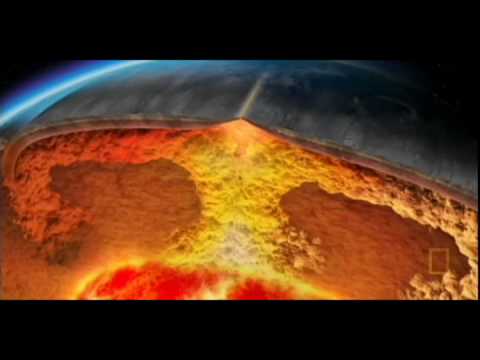
Convection currents that move tectonic plates flow in which layer of the Earth?
a)
Outer Core
b)
Oceanic crust
c)
Mantle
d)
Lithosphere
49.
This layer of Earth is made of solid Iron and Nickel.
a)
Inner Core
b)
Mantle
c)
Outer Core
d)
Crust
50.
If you traveled from the center of Earth up to the surface, the pressure would...
a)
increase
b)
decrease
c)
stay the same
51.
These usually occur at transformation boundaries.
a)
Volcanoes
b)
mountains
c)
trenches
d)
earthquakes
52.

What type of boundary is this?
a)
Divergent
b)
Transformation
c)
Subduction
53.
Which tectonic boundary occurs when two plates separate, or pull away from each other?
a)
Divergent
b)
Transformation
c)
Subduction
54.
A series of steps designed to help you solve problems and answer questions is called the:
a)
experiment
b)
scientific method
c)
observation
d)
hypothesis
55.
States that younger rocks lie above older rocks if the layers have not been disturbed
a)
Law of crosscutting
b)
Law of superposition
c)
Relative Dating
d)
Unconformity
56.
A break in the geologic record that is made when rock layers are eroded over a long period of time
a)
Law of Superposition
b)
Law of Crosscutting
c)
Relative Dating
d)
Unconformity
57.
How does the law of crosscutting explain the age of a fault?
a)
The fault is younger than the rocks above it.
b)
The fault is younger than the rocks it cuts through.
c)
The fault is older than the rocks above it.
d)
The fault is older than the rocks it cuts through.
58.
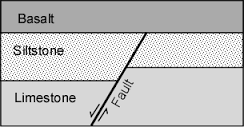
What are the relative ages of the features in order from oldest to youngest?
a)
Limestone, Basalt, Fault, Siltstone
b)
Siltstone, Fault, Basalt, Limestone
c)
Limestone, Fault, Basalt, Siltstone
d)
Limestone, Siltstone, Fault, Basalt
59.
Relative dating of rock layers tells us that the deeper we dig, _______.
a)
the younger the rocks get
b)
the smellier the rocks get
c)
the harder the rocks get
d)
the older the rocks get
60.
The Geologic Time Scale is a record of what?
a)
old geologists
b)
sweet geology music
c)
the known history of rocks and fossils
d)
a list of every living thing ever
61.

Which of the following is the oldest?
a)
Layer L
b)
Intrusion D
c)
Intrusion H
d)
Layer E
62.

Which of the following correctly lists the layers in order from oldest to youngest?
a)
A, B, C, D, E
b)
E, B, C, D, A
c)
E, D, C, B, A
d)
C, B, A, D, E
63.
The main branch of Science that includes Physics, Chemistry and Astronomy.
a)
Physical Science
b)
Life Science
c)
Earth Science
d)
Potato Science
64.
Botany, Zoology, Genetics and Medicine are all parts of this main branch of Science.
a)
Physical Science
b)
Life Science
c)
Earth Science
d)
Toenail Science
65.
Paleontolgy, Geology, Oceanography and Meteorology are all parts of this branch of Science.
a)
Physical
Physical Science
Physical Science
b)
Life Science
c)
Earth Science
d)
Whip Nae Nae Science
66.
___________ states that the earth has changed gradually, in the same ways, over long periods of time.
a)
uniformitarianism
b)
catrastorphism
c)
superposition
d)
disconformities
67.
Zoology, paleontology, meteorology.... what do you think the suffix (end part of the word) "logy" means?
a)
Logic
b)
The study of
c)
Science
68.

What is the correct name of this tool?
a)
beaker
b)
flask
c)
graduated cylinder
d)
test tube
100 %

