
 Worksheets
Unit 3 Review
Total questions: 81
Worksheet time: 3hrs 6mins
Name
Class
Date
1.
What does your teach like to be called?
a)
Miss
b)
Miss A
c)
Miss Alexander
d)
Miss Alex
2.
How many shielding electrons does carbon have? (hint: write its configuration first)
a)
1
b)
2
c)
3
d)
4
3.
How many valence electrons does carbon have?
a)
3
b)
4
c)
5
d)
6
4.
As you go down a group, the amount of shielding....
a)
increases
b)
decreases
c)
stays the same
5.
As you go across a period, the amount of shielding...
a)
Increases
b)
decreases
c)
stays the same
6.
What is the Nuclear charge of yttrium?
a)
40
b)
41
c)
38
d)
39
7.
What is EFFECTIVE nuclear charge
a)
The charge that actually matters
b)
The sharge of an element
c)
The charge felt by the valence electrons
d)
The charge felt by the inner orbital electrons
8.
As you move down a group, the effective nuclear charge....
a)
increase
b)
decreases
c)
stays the same
9.
As you move across a period, the effective nuclear charge...
a)
increases
b)
decreases
c)
stays the same
10.
Which of the following elements has the most "shielding" electrons?
a)
Nitrogen
b)
Phosphorus
c)
Arsenic
d)
Bismuth
11.
Which of the following elements has the most "shielding" electrons?
a)
Neon
b)
flourine
c)
oxygen
d)
They have the same
12.
Which of the following elements has a greater effective nuclear charge?
a)
Radium
b)
Francium
c)
copernicium
d)
actinium
13.
Which of the following elements has the lowest amount of shielding electrons?
a)
Argon
b)
Neon
c)
Helium
d)
Radon
14.
Which of the following elements has the lowest amount of shielding electrons?
a)
Hafnium
b)
Titanium
c)
Zirconium
d)
Rutherfordiu
15.
The concept of shielding happens because of
a)
attraction between nucleus and valence electrons
b)
attraction between nucleus and core electrons
c)
repulsion between valence electrons and other valence electrons
d)
repulsion between core electrons and valence electrons
16.

Shielding electrons are:
a)
Electrons in the highest energy level
b)
Electrons in the lower energy levels
c)
Electrons that just come and go - they don't stay with the atom
d)
Electrons that are excited
17.
The modern periodic table is arranged by the
a)
atomic mass
b)
alphabetically
c)
element name
d)
atomic number
18.
Elements in the same vertical columns are called
a)
groups/families
b)
periods
19.
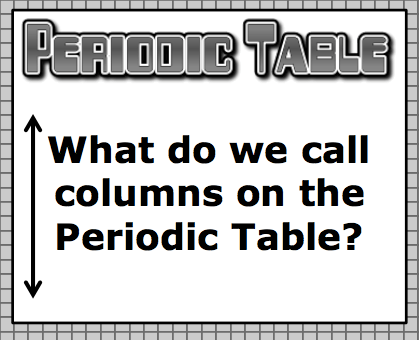
a)
Periods
b)
Groups
20.
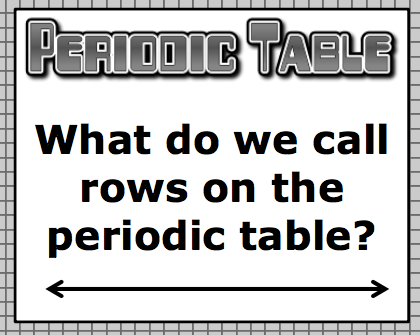
a)
Periods
b)
Groups
21.

a)
energy levels
b)
valence electrons
c)
protons
d)
neutrons
22.
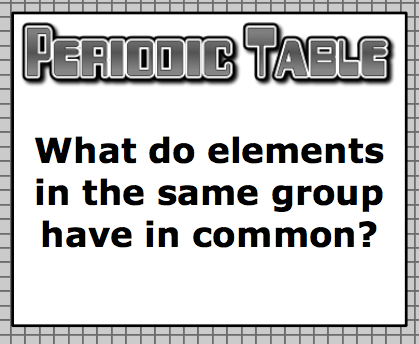
a)
energy levels
b)
valence electrons
c)
protons
d)
neutrons
23.
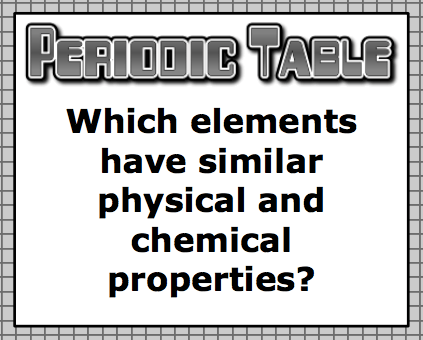
a)
Same group
b)
Same period
24.

How many elements follow the periodic law?
a)
7
b)
98
c)
110
d)
All of them
25.

A rule that states that repeating chemical and physical properties of elements change periodically with the atomic number of the elements is the _________.
a)
periodic law
b)
alkaline-earth metals
c)
actinide
d)
group rule
26.
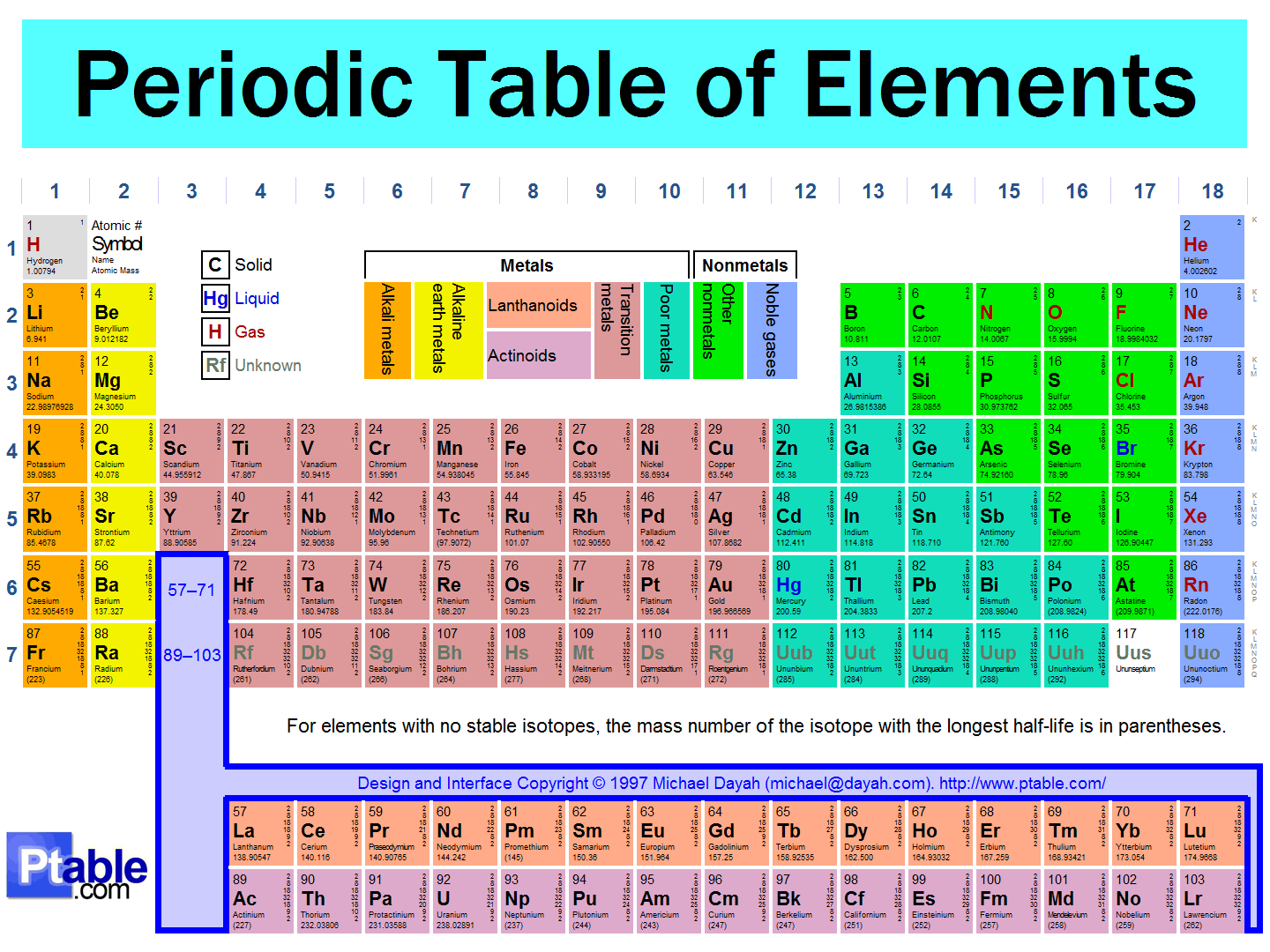
The horizontal row on the periodic table is called a
a)
group
b)
family
c)
period
d)
atomic number
27.

A vertical column is called...
a)
group
b)
tower
c)
period
d)
crew
28.
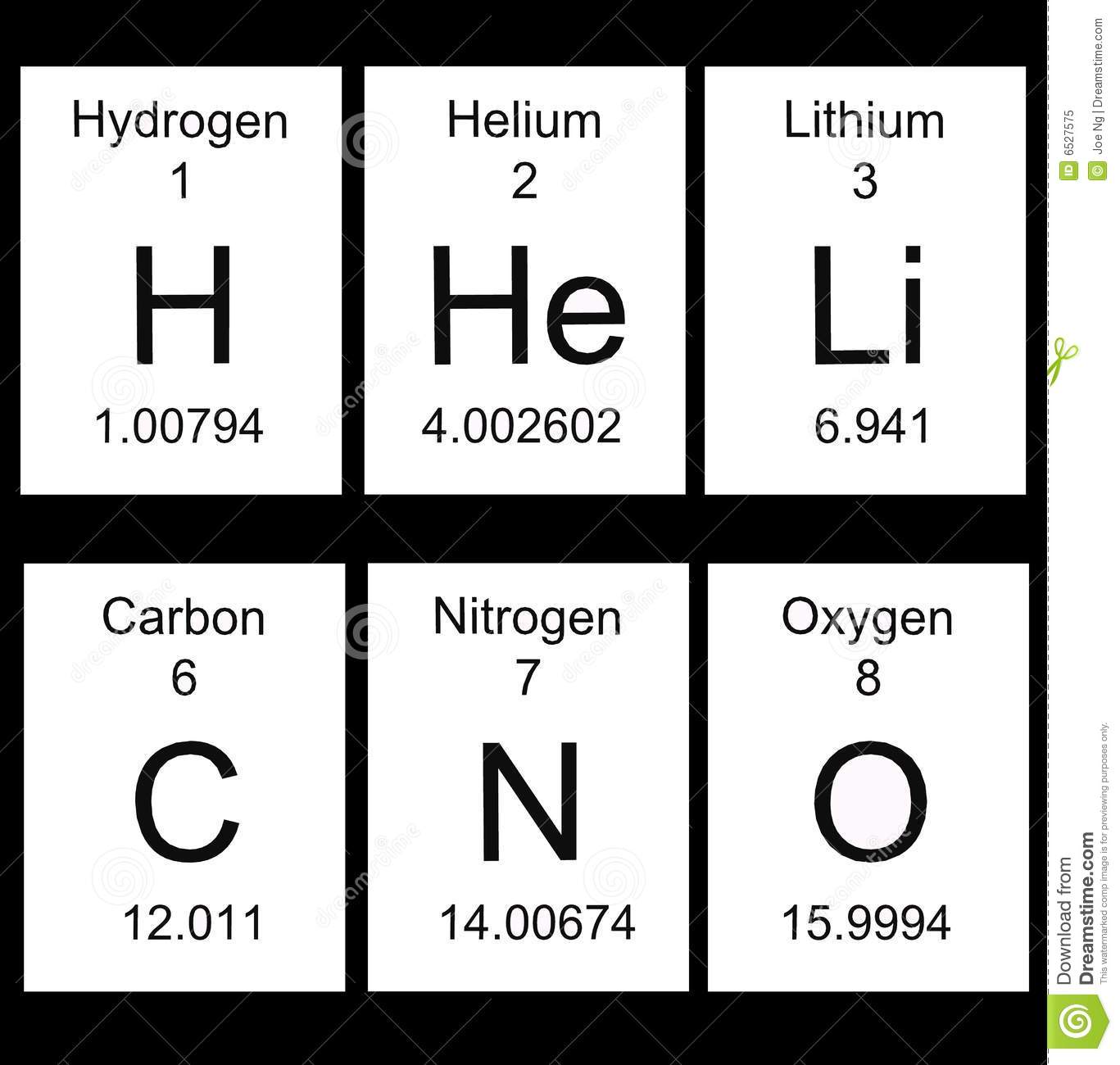
The number at the bottom of each square on the periodic table is the ...
a)
atomic number
b)
atomic mass
c)
chemical symbol
d)
element name
29.
Name the family that is used to make coins, pipes, wire, and jewelry.
a)
Alkali Metal
b)
Alkaline Earth Metals
c)
Transition Metals
d)
Halogens
30.
The atomic number in a box on the periodic table can tell you the the number of which 2 subatomic particles.
a)
proton and neutrons
b)
neutrons and electrons
c)
protons and electrons
d)
nucleus and neutrons
31.
Physical or Chemical
Ductile- can be stretched into wire
Ductile- can be stretched into wire
a)
physical
b)
chemical
32.
Physical or Chemical
Malleable-can be pounded into shapes
Malleable-can be pounded into shapes
a)
physical
b)
chemical
33.
Physical or Chemical
Has the ability to burn different colors
Has the ability to burn different colors
a)
physical
b)
chemical
34.
Physical or Chemical
Soft (can be cut with a butter knife)
Soft (can be cut with a butter knife)
a)
physical
b)
chemical
35.
If there is an aqueous solution that is colored it is most likely apart of which group of elements?
a)
Transitional Metals
b)
Halogens
c)
Alkali
d)
Alkaline
36.
Physical or Chemical
Very dense (high density)
Very dense (high density)
a)
physical
b)
chemical
37.
Group Name and Number for Neon
a)
Alkaline Earth Metals 2 or 2A
b)
Noble Gases 18 or 8A
c)
Halogens 17 or 7A
d)
Alkali Metals 1 or 1A
38.
Group Name and Number for Flourine
a)
Transition Metals 3-12
b)
Noble Gases 18 or 8A
c)
Halogens 17 or 7A
d)
Alkali Metals 1 or 1A
39.
Group Name and Number for Magnesium
a)
Alkaline Earth Metals 2 or 2A
b)
Noble Gases 18 or 8A
c)
Halogens 17 or 7A
d)
Alkali Metals 1 or 1A
40.
Group Name and Number for Potassium
a)
Alkaline Earth Metals 2 or 2A
b)
Noble Gases 18 or 8A
c)
Halogens 17 or 7A
d)
Alkali Metals 1 or 1A
41.
Which element is not in the Alkali metal family?
a)
Li
b)
H
c)
Fr
d)
Cs
42.
Elements on the right side of the of the zigzag line are normally?
a)
non metals
b)
metals
c)
metalloids
d)
rare earth metals
43.
Which element is not a metal?
a)
Hg
b)
Re
c)
Al
d)
B
44.

The period for Bromine is ___________.
a)
3
b)
2
c)
4
45.
Elements in the same ________ are more chemically similar.
a)
group
b)
period
c)
club
d)
table
46.
Which atom has the largest atomic radius?
a)
potassium
b)
rubidium
c)
francium
d)
cesium
47.
As you move down the periodic table atoms get bigger. This is because ____________.
a)
The atoms have more mass.
b)
The atoms have more protons.
c)
The atoms have more energy levels
d)
The atoms have more nuetrons
48.
As you move across the periodic table atoms tend to get smaller because, ______________.
a)
the atoms have more mass.
b)
the atoms have less mass
c)
the atoms have more protons.
d)
the atoms have less electrons.
49.
Metals are good conductors of heat and electricity.
a)
true
b)
false
50.
The atom with the largest atomic radius in Group 18 is -
a)
Ar
b)
He
c)
Kr
d)
Rn
51.
Which statement correctly and completely identifies a trend?
a)
Atomic radius decreases across a period and increases down a group.
b)
Electronegativity decreases across a period and decreases down a group.
c)
Ionization energy increases across a period and increases down a group.
d)
Ionic radius increases across a period and increases down a group.
52.
Which periodic group has the smallest atomic radius?
a)
Alkali metals
b)
Halogens
c)
Noble Gases
d)
Transition metals
53.
Atomic radius generally increases as we move __________.
a)
down a group and from right to left across a period
b)
up a group and from left to right across a period
c)
down a group and from left to right across a period
d)
up a group and from right to left across a period
54.
Order the following in increasing atomic radii:
Ra, Be, Ca, Rb, H
Ra, Be, Ca, Rb, H
a)
Ra, Be, Rb, H, Ca
b)
Rb, H, Ca, Be, Ra
c)
Ra, Rb, Ca, Be, H
d)
H, Be, Ca, Rb, Ra
55.
The more protons there are, the ____ .
a)
Weaker the pull
b)
Smaller the electrons
c)
Stronger the pull
d)
The bigger the electrons
56.
Which one has the largest radius?
a)
Lithium (Li, atomic #3)
b)
Boron (B, atomic #5)
c)
Neon (Ne, atomic #10)
d)
Nitrogen (N, atomic #7)
57.
Which has the greater EN:
N or C?
N or C?
a)
C
b)
N
58.
Which has the greater EN:
H or F?
H or F?
a)
H
b)
F
59.
Put these in increasing order:
F, N, B
F, N, B
a)
B < N < F
b)
B < F < N
c)
N < F < B
d)
F < N < B
60.
Put these in increasing order:
C, H, and O
C, H, and O
a)
H < C < O
b)
H < O < C
c)
O < C < H
d)
C < H < O
61.
Which has the greater EN:
Cl or Al?
Cl or Al?
a)
Cl
b)
Al
62.
Choose the set that goes from lowest to highest electronegativity?
a)
Cu, Mg, Sr, Ca
b)
F, Cl, Br, Si
c)
Cs, Rb, Ca, Mg
d)
Zn, Cd, Ag, Cu
63.
The element with the lowest electronegativity in Period 3 is -
a)
Na
b)
Cl
c)
Ar
d)
Mg
64.
Which of the following generally applies to the noble gases?
a)
high ionization energy, low electronegativity, high reactivity
b)
high ionization energy, high electronegativity, high reactivity
c)
low ionization energy, low electronegativity, low reactivity
d)
high ionization energy, low electronegativity, low reactivity
65.
Elements closer to the noble gases have stronger attraction for electrons.
a)
True
b)
False
66.
Which of the following is the least electronegative element?
a)
oxygen
b)
potassium
c)
fluorine
d)
nitrogen
67.
Which of the following is the most electronegative element?
a)
nitrogen
b)
phosphorus
c)
arsenic
d)
lithium
68.

The graph above shows the ionization energy values as the elements are arranged on the periodic table. Which conclusion cannot be drawn from the graph?
a)
The ionization energy drops significantly as you move down a group because the valence electrons are in a shell further from the nucleus.
b)
The ionization energy increases gradually as you move right across a period because the valence electrons are in a shell further from the nucleus.
c)
The ionization energy increases gradually as you move right across a period because you are adding more protons.
d)
The ionization energy increases when the valence electrons are more attracted to the nucleus.
69.

The bar graph above represents four elements and their respective ionization energies. Based on the organization of the modern periodic table, how would these elements be found on the periodic table?
a)
They are in the same period with W being furthest left.
b)
They are in the same period with W being furthest right.
c)
They are in the same group with W being furthest to the bottom.
d)
They are in a diagonal line with W being at the bottom right.
70.
Which of the following is true for alkaline earth metals as their atomic number increases?
a)
The atomic radius decreases.
b)
Ionization energy decreases.
c)
The number of valence electrons increases.
d)
The Coulombic attraction increases.
71.
Which of the following sequences corresponds to a correct trend in ionization energy?
a)
Cl > S > P > Al
b)
Sr > Ca > Mg > Be
c)
Rb > K > Na > Li
d)
Rb > Sr > I > Xe
72.
Which of the following is true about a sulfur atom and a chlorine atom?
a)
Sulfur is larger and has higher ionization energy.
b)
Sulfur is larger and has lower ionization energy.
c)
Sulfur is smaller and has higher ionization energy.
d)
Sulfur is smaller and has lower ionization energy.
73.
Which element has the greater ionization energy?
a)
Strontium
b)
Boron
74.
Which element has the greater ionization energy?
a)
Lead
b)
Silicon
75.
Put the following in order of increasing ionization energy:Neon, Lithium, Carbon
a)
Lithium, Carbon, Neon
b)
Carbon, Lithium, Neon
c)
Neon, Carbon, Lithium
d)
Lithium, Neon, Carbon
76.
Put the following in order of increasing ionization energy:Strontium, Aluminum, Indium
a)
Strontium, Indium, Aluminum
b)
Strontium, Aluminum, Indium
c)
Indium, Aluminum, Strontium
d)
Aluminum, Indium, Strontium
77.
Put the following in order of increasing ionization energy:Strontium, Aluminum, Indium
a)
Strontium, Indium, Aluminum
b)
Strontium, Aluminum, Indium
c)
Indium, Aluminum, Strontium
d)
Aluminum, Indium, Strontium
78.
Put the following in order of increasing ionization energy:Tellurium, Sulfur, Selenium
a)
Tellurium, Sulfur, Selenium
b)
Selenium, Sulfur, Tellurium
c)
Sulfur, Selenium, Tellurium
d)
Tellurium, Selenium, Sulfur
79.
Put the following in order of increasing ionization energy:Cobalt, Tungsten, Ruthenium
a)
Tungsten, Ruthenium, Cobalt
b)
Cobalt, Tungsten, Ruthenium
c)
Ruthenium, Cobalt, Tungsten
d)
Cobalt, Ruthenium, Tungsten
80.
Put the following in order of increasing ionization energy:Sodium, Oxygen, Boron
a)
Sodium, Boron, Oxygen
b)
Oxygen, Boron, Sodium
c)
Sodium, Oxygen, Boron
d)
Oxygen, Sodium, Boron
81.

With which element will Hydrogen most likely bond?
a)
Chlorine
b)
Sulfur
c)
Argon
d)
Silicon
100 %

