
 Worksheets
Chemistry Unit 2 AP
Total questions: 82
Worksheet time: 2hrs 42mins
What type of alloy is made when the radii of the atoms are similar in size?
interstitial
substitutional

Which atom has the negative dipole in this molecule?
Hydrogen
Fluorine
Neither

In this molecule, Carbon has a formal charge of ____ and Nitrogen has a formal charge of _____.
0, 0
1, 0
0, -1
-1, 0
As the electronegativity difference between 2 atoms increases, the polarity of the bond ____________________
increases
decreases
What type of bond forms between hydrogen and chlorine?
polar covalent
non-polar covalent
ionic
hydrogen bond

What type of alloy is this?
Interstitial
Substitutional
What is the total # of covalent bonds carbon can form when drawing a Lewis structure?
12
6
4
8
What is the bond angle in BF3?
90
120
109.5
180
What is the bond angle in H2O?
120
90
180
104.5
What is the bond angle in NH3
120
107.3
180
90
What is the hybridization of carbon in CH4?
sp3
sp
sp2
What is the hybridization for carbon in CO2
sp3
sp
sp2

Count the number of sigma and pi bonds in this molecule:
13 sigma, 1 pi
14 sigma, 2 pi
1 sigma, 14 pi
2 sigma, 13 pi
What is the hybridization for an oxygen in CO2
sp3
sp
sp2


What type of bonding is represented by the model above?
Covalent
Ionic
Metallic
Based on atom type, what type of bond occurs in Ca ?
Ionic
Covalent
Metallic

What type of bonding is represented by the model above?
Covalent
Ionic
Metallic
Using electronegativity values, what type of bond is C–O?
Non-polar covalent
Polar covalent
Ionic
Metallic
Which bond type has electrons that are shared equally?
Metallic
Non-polar covalent
Polar covalent
Ionic

What type of bonding is represented by the model above?
Covalent
Ionic
Metallic
Based on atom type, what type of bond occurs between Si and O ?
Ionic
Covalent
Metallic
As two oppositely charged particles approach each other, what happens to the electrical force between them?
The attractive force increases
The magnitude of the electric force decreases
The repulsive force increases
The magnitude of their charges increases

As the value of r increases, what happens to the value of F?
F increases
F decreases
F never changes, q does
Cannot know from the information
What does q measure?
the distance between the two charged objects
the amount of charge carried by the object
the amount of force between two charged objects

What correctly describes the interaction between two atoms at point C on the curve above ?
two atoms are far away; weakly interacting
two atoms are close; strongly interacting
two atoms are very close; strongly interacting
two atoms are far away; strongly interacting
What correctly describes the interaction between two atoms at point A on the curve above ?
two atoms are far away; weakly interacting
two atoms are close; strongly interacting
two atoms are very close; strongly interacting
two atoms are far away; strongly interacting
What correctly describes the potential energy at point A on the curve above ?
relatively low
relatively high
What correctly describes the potential energy at point C on the curve above ?
relatively low
relatively high
At what point on the curve are the attractive force equal to the repulsive forces ?
A
B
C
All of the above
At what point on the curve are the repulsive forces the larger than attractive forces ?
A
B
C
All of the above
What is the correct unit for potential energy ?
Newton (N)
electron
Joule (J)
Nanometer (nm)
Which of the following noble gas elements will have the strongest interaction with a second atom of itself ?
He
Ne
Ar
Kr
Which of the following elements will have the smallest distance between atoms when two atoms interact ?
nitrogen
oxygen
fluorine
chlorine
Which pair of atoms will have a weaker interaction compared to the Cl-Cl interaction ?
Br-Br
I-I
F-F
What atom pair will have a larger potential energy "dip" compared to the O-O interaction ?
F-F
N-N
H-H
Why is the Xe-Xe interaction stronger than the Ne-Ne interaction ?
Xe can form a diatomic molecule while Ne can not
Ne can form a diatomic molecule while Ne ca not
Xe has more charged particles than Ne
Ne has more more charged particles than Xe
Why is the Kr-Kr interaction weaker than the Br-Br interaction ?
Kr can form a diatomic molecule while Br can not
Br can form a diatomic molecule while Kr can not
Kr has more charged particles than Br
Br has more charged particles than Kr

If curve A is for the Ne-Ne interaction, what interaction can curve B be for ?
Br-Br
He-He
H-H
Ar-Ar

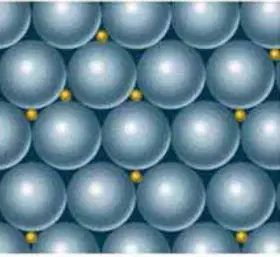
What type of alloy is shown in the diagram?
Substitutional alloy
Interstitial alloy
Covalent alloy
Ionic alloy
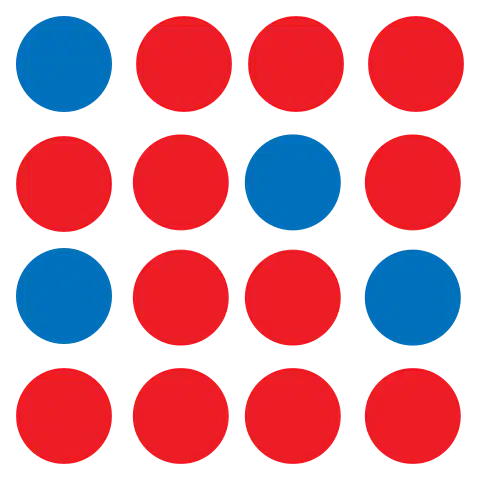
What type of alloy is shown in the diagram?
pure substance
metal
substitutional alloy
interstitial alloy

How many total valence electrons are participating in bonding in the molecule above?
8
4
2
3


Why is this Lewis Structure incorrect? Select all that appy.
There should be a single bond between H and C.
There should be a triple bond between C and N.
Carbon has too many bonds around it.
Hydrogen needs more electrons.

Why is this Lewis Structure incorrect? Choose all that apply.
There are too many bonds around Si.
There should only be single bonds in this Lewis Structure.
The Structure is missing a triple bond.
Chlorine only has 6 electrons surrounding it.

Which image could be a representation of NH3?
A
B
C


What is the formal charge on the oxygen atom at the top of this Lewis dot structure?
0
-1
+1
-3

What is the formal charge on the phosphorus atom in this Lewis dot structure?
0
-1
+1
-3

What is the formal charge on the oxygen atom at the top of this Lewis dot structure?
0
+1
-1
-2

What is the picture showing?
All of the resonance structures for carbonate.
The formal charge on each atom in carbonate.
The electronegativity for carbonate.
The ionization energy for carbonate.


Compounds that are composed of the same number and type of atoms but have them arranged in different ways are ___________.
isomers
isotopes
polymers
alkanes


Are CH3OCH3 and CH3CH2OH isomers?
yes
no
Which bond is the strongest?
single
double
triple
Which bond is the weakest?
single
double
triple
Which bond is the shortest?
single
double
triple
Which bond is the longest?
single
double
triple
5, 4, 1
seesaw
T-shaped
square pyramid
square planar
5, 3, 2
seesaw
T-shaped
square pyramid
square planar
6, 5, 1
seesaw
T-shaped
square pyramid
square planar
6, 4, 2
seesaw
T-shaped
square pyramid
square planar

In the resonance form of ozone shown, the formal charge on the central oxygen atom is _______.
0
+1
-1
+2
-2
The Lewis structure of the CO32- ion is


The electrons in a polar covalent molecule are shared...
Evenly
Unevenly
Electrons are not shared
None of the Above
The electrons in a nonpolar covalent molecule are shared...
Evenly
Unevenly
Electrons are not shared
None of the Above
Which diagram shows the bond with the correct dipole arrows and partial charge


The direction of the dipole arrow in this image tells us that
H is the more electronegative atom in the bond
Cl is the more electronegative atom in the bond
H is the more polar atom in the bond
Cl is the more polar atom in the bond
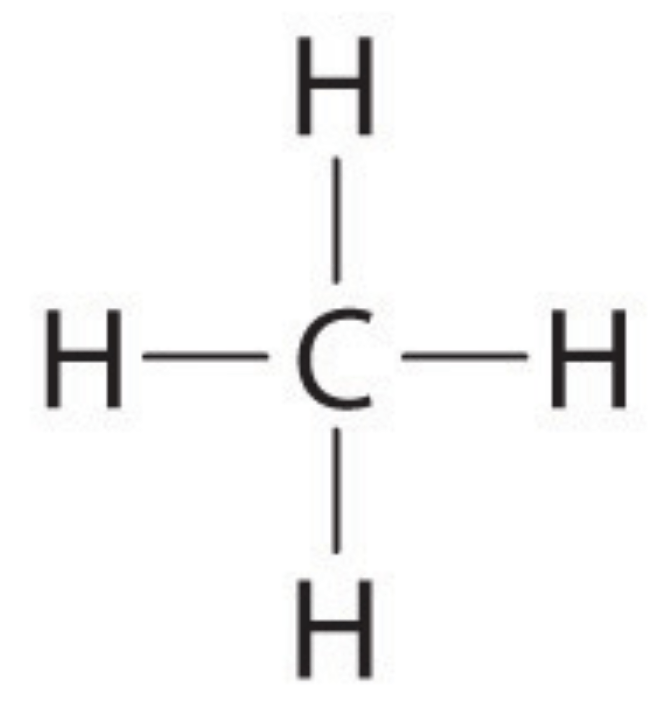
Classify the following molecule.
polar
nonpolar
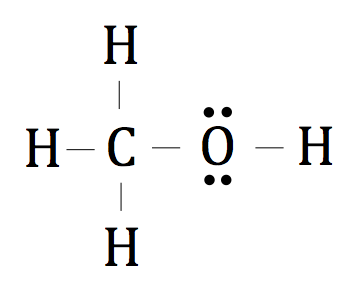
Is the following molecule polar or nonpolar?
polar
nonpolar

Is the following molecule polar or nonpolar?
polar because there are different types of elements bonded to the central atom
nonpolar because the central atom has no lone pairs of electrons
polar because the central atom has a lone pair of electrons
nonpolar because there are no lone pairs on the central atom and the atoms bonded to the central atom are all the same

Why is the molecule polar?
There is a lone pair of electrons on the central atom.
There are different types of elements bonded to the central atom.
There are no lone pairs of electrons on the central atom and all of the atoms bonded to the central atom are the same.
Draw SF6. What is the molecular geometry?
octahedral
trigonal bipyramid
tetrahedral
trigonal planar
Draw PCl5. What is the molecular geometry?
octahedral
trigonal bipyramid
tetrahedral
trigonal planar
Draw CCl4. What is the molecular geometry?
octahedral
trigonal bipyramid
tetrahedral
trigonal planar
Draw BCl3. What is the molecular geometry?
octahedral
trigonal bipyramid
tetrahedral
trigonal planar

