wayground logo

Free Printable Worksheets

NEW

Font size

S
M
L
XL
Worksheets

Year 10A Chemistry Unit 1 Revision

Total questions: 77

Worksheet time: 2hrs 45mins

Name
Class
Date
1.

What is the formula for magnesium chloride?

a)

MgCl

b)

Mg2Cl

c)

MgCl2

d)

Mg(ClO3)2

2.

Because the overall charge in a compound must be zero, the charge of iron in Fe2O3 must be:

a)

3+

b)

2+

c)

1+

d)

3-

3.

Which of these compounds has covalent bonding?

a)

NaCl

b)

Pb(NO3)2

c)

CO2

d)

AlCl3

4.
When an atom loses a valence electron, it becomes a(n) _____________ ion.
a)
positive
b)
negative
c)
neutral
d)
polyatomic
5.

Predict the type of bond that will form between Be and F.

a)

Ionic

b)

Covalent

c)

Metallic

d)

James

6.
What type of bond is this?
a)
ionic
b)
covalent
7.
Where are metals located on the periodic table?
a)
Blue
b)
Green
c)
Red
8.
Where are the nonmetals located on the periodic table? 
a)
Blue
b)
Red
c)
Green
9.

What sort of bonding would LiF have?

a)

Ionic Bond

b)

Covalent Bond

c)

Both bonds

d)

Neither bond

10.

Group 15 elements have what charge in ionic form?

a)

-1

b)

-3

c)

+3

d)

+4 or -4

11.
In the equation,          2Mg + O2 ---> 2MgO, which are the reactants?
a)
Mg and O
b)
MgO
c)
Mg and MgO
d)
O and MgO
12.
When balancing equations a ____ can be placed to the left of a formula of a substance to make the equations balanced
a)
charge
b)
subscript
c)
random number
d)
coefficient
13.
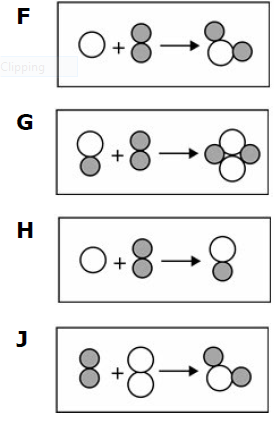
Which of the following models best demonstrates a balanced chemical equation?
a)
F
b)
G
c)
H
d)
J
14.
All of the following reactions are correctly balanced except-
a)
A
b)
B
c)
C
d)
D
15.
Balance this equation-
__P+ __O--> __P2O3
a)
it is already balanced
b)
2, 1, 3
c)
1, 2, 3
d)
1, 3, 2
16.
Balance this equation
_Al +_HCl --> _H+_AlCl3
a)
2, 6, 3, 2
b)
it is already balanced
c)
4, 12, 3, 4
d)
2, 1, 4, 5
17.
Balance this equation.
_CF+ _Br-- _CBr+ _F2
a)
2,1,2,1
b)
1,2,2,1
c)
1,2,1,2
d)
2,2,2,2
18.
What is a coefficient?
a)
The small number on the right of the chemical symbol.
b)
The large number to the left of a formula.
19.

___Na3PO4+___KOH ---> ___NaOH + ___ K3PO4

a)

1 , 3 , 3, 1

b)

2 , 2 , 3, 1

c)

1 , 2 , 2, 1

d)

3 , 3 , 3, 1

20.
_P4+_O2
     --->  
_P2O3
a)
3 P4+1 O---> 2 P2O3
b)
1 P4+1 O---> 2 P2O3
c)
1 P4+ 3 O2 ---> 2 P2O3
d)
1 P4+ 2 O---> 3 P2O3
21.

Which of the following set of coefficients would correctly balnce this equation?

_AgNO3 + _Cu ---> _Cu(NO3)2 + _Ag

a)

2, 2, 3, 1

b)

2, 1, 1, 2

c)

1, 2, 2, 1

d)

3, 2, 3, 2

22.

Which of the following set of coefficients would correctly balance this equation?

_BaS + _PtF2 ---> _BaF2 + _PtS

a)

1, 1, 1, 1

b)

4, 2, 1, 1

c)

1, 2, 2, 2

d)

1, 1, 1, 2

23.
In the equation,          2Mg + O2 ---> 2MgO, which are the reactants?
a)
Mg and O
b)
MgO
c)
Mg and MgO
d)
O and MgO
24.

How many total atoms are represented? 4Al2O3

a)

5

b)

7

c)

10

d)

20

25.
What is the atomic number of this atom?
a)
1
b)
3
c)
4
d)
7
26.
What is the mass number of this atom?
a)
4
b)
5
c)
9
d)
none of the above
27.
What is the atomic number of this atom?
a)
9
b)
10
c)
19
d)
27
28.
What is the mass number of this atom?
a)
9
b)
10
c)
19
d)
27
29.
What is the atomic number of Nickel?
a)
110
b)
28
c)
46
d)
78
30.
Most of the mass in an atom is made up of _____________________?
a)
protons and electrons
b)
protons and neutrons
c)
neutrons and electrons
d)
electrons and quarks
31.
Atoms of the same element which have a different number of neutrons are called _________________.
a)
ions
b)
isotopes
c)
quarks
d)
molecules
32.
Which subatomic particle has a negative charge in the atom?
a)
proton
b)
neutron
c)
electron
d)
quark
33.
What is the electrical charge of a proton?
a)
1+
b)
1-
c)
neutral
d)
2-
34.
an element has nucleon number 12 and atomic number  6. the number of neutrons in it is:
a)
6
b)
10
c)
4
d)
8
35.
In a correctly written symbol what would be located in the "A" position?
a)
number of neutrons
b)
atomic number
c)
number of electrons 
d)
mass number
36.
What are valence electrons?
a)
electrons on the first orbital always
b)
nucleus
c)
the outermost shell
d)
the number of electrons on the outermost orbital
37.
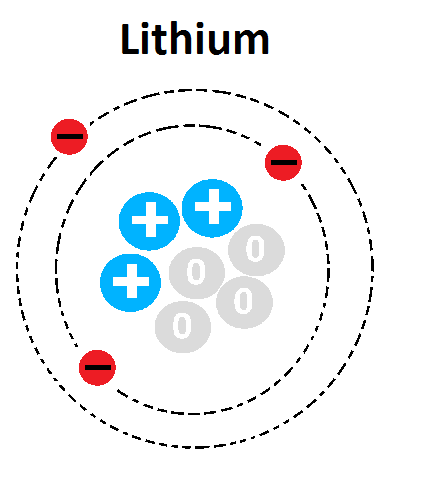
How many neutrons does the isotope of lithium have?
a)
8
b)
3
c)
4
d)
5
38.
How many protons does this isotope of titanium have?
a)
48
b)
22
c)
26
d)
70
39.
Changing the number of electrons in an atom changes its...
a)
element type.
b)
charge.
c)
isotope type.
d)
atom type.
40.
Changing the number of neutrons in an atom changes its...
a)
element type.
b)
mass (weight).
c)
charge.
d)
atom type.
41.
When there are more protons than electrons in an atom it is a...
a)
positive ion.
b)
negative ion.
c)
unstable isotope.
d)
neutral atom.
42.
How many electrons can the first energy level hold?
a)
1
b)
2
c)
8
d)
0
43.
Which coefficients balance this equation?
_N+ _H→ _NH3
a)
1,2,3
b)
1,3,2
c)
1,1,2
d)
2,1,1
44.
Name the following:
CBr4
a)
carbon bromide
b)
monocarbon bromide
c)
monocarbon tetrabromide
d)
carbon tetrabromide
45.
Name the following:
N2O5
a)
dinitrogen tetroxide
b)
dinitrogen pentoxide
c)
nitrogen (II) pentoxide
d)
nitrogen pentoxide
46.
Name the following:
Cl2H8
a)
dichloride octahydride
b)
dichlorine octahydride
c)
chlorine hydrogen
d)
dichlorine octahydrogen
47.
Name the following:
Cl2H8
a)
dichloride octahydride
b)
dichlorine octahydride
c)
chlorine hydrogen
d)
dichlorine octahydrogen
48.
Name the following:
OF2
a)
oxygen difluoride
b)
monoxygen difluoride
c)
oxygen fluoride
d)
oxygen difluorine
49.
What is the formula for
carbon tetrabromide
a)
CBr5
b)
CaBr5
c)
CBr4
d)
CBr3
50.
What is the formula for
trinitrogen tetroxide
a)
N3O4
b)
N2O4
c)
N3O5
d)
N3O3
51.
What is the formula for
dichlorine heptoxide
a)
Cl2O6
b)
Cl3O7
c)
Cl3O6
d)
Cl2O7
52.
What is a cation
a)
a metal with a negative (-) charge
b)
a non-metal with a negative (-) charge 
c)
a metal with a positive (+) charge 
d)
a non-metal with a positive (+) charge
53.
What is a anion
a)
a metal with a negative (-) charge
b)
a non-metal with a negative (-) charge 
c)
a metal with a positive (+) charge 
d)
a non-metal with a positive (+) charge
54.
Why does K become positive when it bonds to Cl to form KCl?
a)
Because it loses an electron to have a full valence shell 
b)
Because it gains an electron to have 2 valence electrons
c)
Because it loses an electron to become negatively charged
d)
Because Cl gives away its 7 electrons to Na to form an equal charge 
55.
Ionic compounds tend to be _________ whereas covalent compounds tend to be ______ or _____
a)
solids // liquids or gases
b)
liquids // solids or gases
c)
gases // solids or liquids
d)
solids // solids or liquids 
56.
Why does CO2 not have a charge? 
a)
The metal gives away an electron to the non-metal
b)
The metal takes the electron from the non-metal
c)
The non-metals equally share electrons
d)
The metal and the non-metal equally share electrons
57.
What is the correct name for NO?
a)
Mononitrogen Monoxide
b)
Nitrogen Monoxide
c)
Mononitrogen Dioxide
d)
Nitrogen Oxide
58.
Which of the following is NOT an ionic compound:
a)
CaO
b)
NaOH
c)
BaCl2
d)
Br2
59.
In general, this type of bond will form a compound with a high melting point.
a)
Ionic
b)
Covalent
60.
Which of the following properties of metal means it can be drawn into wires?
a)
malleability
b)
ductility
c)
electrical conductivity
d)
flexibility
61.
The ability of metal to be hammered into thin sheets is called _________________.
a)
ductility
b)
malleablility
c)
moving electrons
d)
construction work
62.
A group of covalently bonded atoms that acts together as one charged atom is a ______.
a)
crystal
b)
molecule
c)
negative ion
d)
polyatomic ion
63.

Name the following compound: CaBr2

a)

calcium bromide

b)

calcium dibromide

c)

carbon bromide

d)

carbon dibromide

64.
An acid reacts with metal to produce 
a)
Carbon dioxide 
b)
Hydrogen gas
c)
Hydrogen gas and water 
d)
Salt and hydrogen gas 
65.
A neutralisation reaction is a reaction between 
a)
Acid and a Base 
b)
Acid and water 
c)
Base and water 
d)
None of the above 
66.
Complete the following reaction:
Sulphuric acid + sodium carbonate --> 
a)
Carbon dioxide + water 
b)
calcium carbonate + water + carbon dioxide 
c)
Sodium sulphate + water + carbon dioxide 
d)
Sodium chloride + water + carbon dioxide 
67.
Complete the following reaction:
Hydrochloric acid + magnesium hydroxide --> 

a)
Magnesium chloride + water 
b)
Magnesium + water
c)
Magnesium chloride + hydrogen gas 
d)
Magnesium chloride + water + carbon dioxide 
68.
A salt is formed when nitric acid combines with sodium hydroxide. What are present in the salt that forms?
a)
Sodium chloride
b)
sodium ions and nitrate ions
c)
only sodium ions
d)
only nitrate ions
69.
If an acid is combined with a base of equal strength, the result will most likely be
a)
a neutral solution.
b)
a stronger acid.
c)
impossible to tell without testing the pH.
d)
a stronger base
70.
The formula HCl stands for ____.
a)
hydrochloric acid
b)
hydrogen peroxide
c)
sodium hydroxide
d)
the hydronium ion
71.

sodium hydrogen carbonate when added to ethanoic acid evolves a gas .which of the statement is true about the gas evolved

a)

it turns lime water milky

b)

it burns with a pop sound

c)

it changes the soln colorless

d)

it has a pungent smell

72.
What gas is produced when sodium reacts with water?
a)
Hydrogen
b)
Carbon dioxide
c)
Carbon monoxide
d)
Water vapour
73.
Name the salt produced when reacting potassium hydroxide and phosphoric acid?
a)
Potassium chloride
b)
potassium nitrate
c)
potassium sulfate
d)
potassium phosphate
74.
Why must chemical equations be balanced?
a)
So that the equation doesn't explode
b)
The reaction won't happen until it is balanced
c)
Matter cannot be created or destroyed
d)
None of these
75.
A salt is formed when nitric acid combines with sodium hydroxide. What is the name of the salt?
a)
Sodium chloride
b)
Sodium nitrate
c)
Hydrogen Nitrate
d)
Nirate
76.
Complete the following reaction:
Sulphuric acid + sodium carbonate --> 
a)
Carbon dioxide + water 
b)
calcium carbonate + water + carbon dioxide 
c)
Sodium sulphate + water + carbon dioxide 
d)
Sodium chloride + water + carbon dioxide 
77.
Complete the following reaction:
Hydrochloric acid + magnesium hydroxide --> 
a)
Magnesium chloride + water 
b)
Magnesium + water
c)
Magnesium chloride + hydrogen gas 
d)
Magnesium chloride + water + carbon dioxide