Wayground logo

Free Printable Worksheets

Font size

S
M
L
XL
Worksheets

Unit 2 Pre-assessment/Review

Total questions: 52

Worksheet time: 37mins

Name
Class
Date
1.

Subatomic particles found in the nucleus are _________.

a)

protons and neutrons

b)

electrons and neutrons

c)

protons and electrons

d)

electrons only

2.
Total number of  ______ is equal to the atomic number of an element.
a)
protons
b)
protons and neutrons
c)
neutrons
d)
electrons
3.
What charge does a proton have?
a)
positive
b)
negative
c)
no charge
d)
neutral
4.
What charge does an electron have?
a)
positive
b)
negative
c)
neutral
d)
no charge
5.
What charge does a neutron have?
a)
positive
b)
negative
c)
neutral (no charge)
6.
The size of a neutron is about the same size as a(n) _______.
a)
electron
b)
proton
c)
atom
7.
Where are valence electrons found?
a)
in the outermost energy level
b)
in the innermost energy level
c)
in the nucleus
d)
in the electron cloud
8.

Where is the atomic number of an element found on the periodic table?

a)

at the top of an element's box

b)

at the bottom of an element's box

c)

not on the periodic table

d)

to the left of the row the element is in

9.
Horizontal rows are called _____.
a)
periods
b)
groups
c)
families
d)
atomic numbers
10.
Vertical columns are called _____.
a)
groups
b)
periods
c)
atomic numbers
d)
atomic columns
11.

Isotopes of the same element must always have the same number of _________ but different _________ numbers.

a)

electrons, proton

b)

neutrons, mass

c)

isotopes, atomic

d)

protons, mass

12.
What is true about a neutral atom?
a)
The number of protons equal the number of neutrons
b)
The number of protons equal the number of electrons
c)
The number of neutrons equal the number of electrons
d)
The number of protons, neutrons, and electrons are all different
13.

Which subatomic particle decides the identity of an atom/element?

a)

proton

b)

neutron

c)

electron

d)

All of the above.

14.
The modern periodic table is organized with the elements in order of increasing _____.
a)
atomic number
b)
atomic mass
c)
nuclear number
d)
quantum number
15.
The period number tells ____.
a)
atomic number
b)
the number of energy levels
c)
the number of valence electrons
d)
the number of protons
16.

The subgroup number tells ______.

a)

number of atoms

b)

number of valence electrons

c)

number of protons

d)

number of energy levels

17.
The number '14' in the name Carbon-14 represents the ______.
a)
mass number
b)
atomic number
c)
number of protons
d)
number of electrons
18.
How many neutrons does  Fluorine-19 contain?
a)
9
b)
19
c)
10
19.
How many protons does Fluorine-19 contain?
a)
9
b)
19
c)
10
20.
What is the atomic number of Fluorine-19?
a)
9
b)
19
c)
10
21.
What is the mass number of Fluorine-19?
a)
9
b)
19
c)
10
22.
If X is the symbol for an element, which of the following two symbols represent    isotopes of the same element?     I. 7735X  II. 7733X  III. 8137X  IV. 8135 X
a)
I and II
b)
III and IV
c)
I and IV
d)
I and III
23.
How many neutrons does the isotope below have?     89 36Kr
a)
53
b)
36
c)
89
d)
125
24.
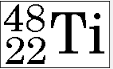
How many protons does this isotope of titanium have?
a)
48
b)
22
c)
26
d)
70
25.
What is the name of the pictured isotope?
a)
Chlorine-Schmorine
b)
Chlorine-17
c)
Chlorine-35
d)
Chlorine-18
26.
Two atoms of the same element but with different mass numbers are called________
a)
electrons
b)
isotopes
c)
variables
d)
electron cloud
27.
When an electron moves from a higher energy level such as n=5 to a lower energy level such as n=2 in the hydrogen atom, is energy released or absorbed?
a)
released
b)
absorbed
28.
Light is emitted from an atom when an electron _____.
a)
drops from a higher to a lower energy level
b)
jumps from a lower to a higher energy level
c)
moves within its atomic orbital
d)
falls into the nucleus
29.

In the Bohr model of the hydrogen atom, when an electron moves from n=5 to n=3, what type of radiation is produced?

a)

IR

b)

UV

c)

Visible Light

d)

A combination of IR and UV radiation

30.

In the Bohr model of the hydrogen atom, when an electron moves from n=5 to n=2, what type of radiation is produced?

a)

IR

b)

UV

c)

Visible Light

d)

A combination of IR and UV radiation

31.

In the Bohr model of the hydrogen atom, when an electron moves from n=5 to n=1, what type of radiation is produced?

a)

IR

b)

UV

c)

Visible Light

d)

A combination of IR and UV radiation

32.
Which element has the electron configuration1s22s22p63s23p3?
a)
phosphorous
b)
nitrogen
c)
silicon
d)
silver
33.
How many unpaired electrons would be found on the electron dot diagram of Selenium?
a)
0
b)
1
c)
2
d)
3
34.
Which of the following elements has the largest atomic radius, vanadium or iron?
a)
vanadium
b)
iron
35.
Which of the following elements has the highest first ionization energy boron or aluminum?
a)
boron
b)
aluminum
36.
Which element has the largest electronegativity value strontium or zirconium?
a)
strontium
b)
zirconium
37.

What is the approximate mass of an alpha particle?

a)

4amu

b)

2amu

c)

1.00amu

d)

9.11 x 10⁻²⁸ amu

38.
The least penetrating form of radiation is _____.
a)
alpha
b)
beta
c)
gamma
d)
UV
39.
The most penetrating form of radiation is _____.
a)
alpha
b)
beta
c)
gamma
d)
UV
40.
Alpha radiation consists of a ______.
a)
helium nucleus
b)
pure energy
c)
high velocity electron
d)
sunlight
41.
What is the product of the alpha decay of Gold-175?
a)
Ir-171
b)
Tl-179
c)
Au179
d)
Au171
42.
What happens to the atomic number during alpha decay?
a)
The atomic number decreases by 4
b)
The atomic number increases by 1
c)
The atomic number decreases by 2.
d)
The atomic number stays the same.
43.
Arrange in order of increasing ability to penetrate matter.
a)
Beta, gamma, alpha
b)
Alpha, gamma, beta
c)
Gamma, beta, alpha
d)
Alpha, beta, gamma
44.

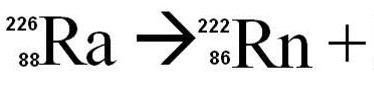
Complete the nuclear equation and determine the type of decay that is occurring in this reaction.

a)

alpha

b)

beta

c)

gamma

d)

none

45.
What does the symbol -10e represent
a)
alpha
b)
beta
c)
gamma
d)
the zero element
46.
Balance the following equation:
146C --> 0-1e + ________
a)
145B
b)
146C
c)
147N
d)
42He
47.
What is the symbol for an alpha particle?
a)
42He
b)
0-1e
c)
0+1 e
d)
10n
48.
The half-life of sodium-24 is 15 hours, how much remains from a 16.00-g sample after 30 hours?
a)
2 grams
b)
4grams
c)
0.53 grams
d)
1.06 grams
49.

How much of a 20.00-gram sample of Americium-241 remains after 3 half lives? Americium-241 radioisotope commonly used in smoke detectors and has a half-life of 430 years.

a)

5.000 g

b)

2.500 g

c)

1.250 g

d)

0.625 g

50.

The splitting of the nuclei of isotopes is called ____.

a)

fission

b)

fusion

c)

ionization

d)

hydrolysis

51.

The fusing of the nuclei of isotopes is called ____.

a)

fission

b)

fusion

c)

ionization

d)

hydrolysis

52.
When a nuclear reaction occurs and mass is lost, it is converted into _____.
a)
energy
b)
kilograms
c)
moles
d)
volume