
 Worksheets
Classification of Organisms
Total questions: 50
Worksheet time: 47mins
Name
Class
Date
1.
Which of the following characteristic needs is shared by all organisms?
a)
energy from food
b)
cold temperature
c)
light
d)
carbon dioxide
2.
Plants are autotrophs because they __________.
a)
eat other plants
b)
absorb food from the soil
c)
make their own food
d)
eat animals
3.
In the modern system of classification, the largest/broadest division of living organisms is a(n) _____.
a)
genus
b)
kingdom
c)
order
d)
species
4.
Organisms of the same _______ are similar and can breed with one another to produce fertile offspring.
a)
kingdom
b)
phylum
c)
family
d)
species
5.

Which Kingdom of life would the illustration be classified as?
a)
Bacteria
b)
Plantae
c)
Protista
d)
Animalia
6.

Why is a rock not considered a living organism?
a)
It does not move
b)
I cannot do photosynthesis
c)
It does not breathe
d)
It is not composed of one or more cells
7.

Humans belong to this Kingdom of life because they are eukaryotic, multicellular organisms that are heterotrophic. Also, because they reproduce mostly sexually.
a)
Animalia
b)
Plantae
c)
Fungi
d)
Eukarya
8.
An organism that is composed of more than one cell is also known as a _____ organism.
a)
Prokaryotic
b)
Unicellular
c)
Multicellular
d)
Autotrophic
9.
True or False: A mushroom is classified as a plant.
a)
True
b)
False
10.
What do ferns have that apple trees do not have?
a)
Stems
b)
Roots
c)
Flowers
d)
Spores
11.
What is a frog classified as?
a)
Amphibian
b)
Reptile
c)
Fish
d)
Mollusk
12.
What is the largest invertebrate?
a)
Giant Squid
b)
King Snake
c)
Killer Whale
d)
Great White Shark
13.
Scientists observe an animal with hair and wings. This animal is a ________.
a)
Bat
b)
Eagle
c)
Butterfly
d)
Penguin
14.
Which statement BEST tells why reptiles lay in the sun?
a)
Reptiles use the sun's light rays to make food
b)
Reptiles need heat from the sun to stay warm
15.
Insects, arachnids, worms and mollusks all belong to which group?
a)
Vertebrates
b)
Invertebrates
c)
Vascular
d)
Nonvascular
16.
Which statement about animals is FALSE?
a)
Animals use sunlight to produce their own food
b)
Animals are multicelled
c)
Animals have the ability to reproduce
d)
Animal cells have cell membranes
17.
Which is a characteristic of snakes?
a)
Snakes have slimy skin
b)
Snakes use lungs to breathe
c)
Snakes do not have a backbone
d)
Snakes are warm-blooded
18.
Which of these animals would be considered a vertebrate?
a)
Catfish
b)
Clam
c)
Sponge
d)
Octopus
19.
Scientists classify organisms to ____________.
a)
Count the organisms quicker
b)
Catch the organisms in the wild
c)
Train the organisms to behave
d)
See how organisms are alike and different from each other
20.
Which group of animals has a backbone?
a)
Vertebrates
b)
Invertebrates
c)
Vascular
d)
Nonvascular
21.
Vertebrate animals that nurse babies from mammary glands, have hair and are born alive are called _____________.
a)
Reptiles
b)
Birds
c)
Mammals
d)
Amphibians
22.
Fish, amphibians, reptiles, birds and mammals all belong to which group?
a)
Vascular
b)
Vertebrates
c)
Invertebrates
d)
Nonvascular
23.

A dichotomous key for trees is provided. Hikers found a tree that has large brown cones and single sharp needles. What species of tree have the hikers found?
a)
Juniper
b)
Pine
c)
Spruce
d)
Fir
24.
Which of the following characteristics will most likely be helpful in identifying a butterfly using a dichotomous key?
a)
Migrates north every spring
b)
hangs on branches
c)
flutters wings fast on hot days
d)
Wings have long extensions
25.

A dichotomous key for insects is given. To what order does an insect with two pairs of scaly wings belong?
a)
Coleoptera
b)
Heteroptera
c)
Diptera
d)
Lepidoptera
26.

A student discovers an arachnid with a segmented abdomen, long legs, and a tail with no stinger. The student uses the dichotomous key below to identify it. Which arachnid has the student found?
a)
Whip Scorpion
b)
Wind Scorpion
c)
Daddy long legs
d)
Scorpion
27.

An illustration and a dichotomous key are given. What is the correct classification for this organism?
a)
Class Insecta
b)
Order Amblygygi
c)
Order Araneae
d)
Order Scorpiones
28.

A labeled diagram of a fiddler crab is provided. Which of the following is an accurate observation of the structures of a fiddler crab? Fiddler crabs have -
a)
five pairs of walking legs on each side.
b)
an enlarged propodus on both front legs.
c)
a pair of eyes on stalks at the top of the body.
d)
two pairs or chelipeds for a total of four.
29.
When using a dichotomous key to identify organisms, what do we look at?
a)
physical features
b)
weather patterns
c)
environment
d)
diet
30.
What is the purpose of a dichotomous key?
a)
to find a common ancestor
b)
to show the evolution of organisms
c)
to show relationships between organisms
d)
to identify organisms
31.

From the table, which two animals are MOST CLOSELY related
a)
House Cate and Red Fox
b)
Red Fox and Dog
c)
Dog and Wolf
d)
Wolf and Gopher
32.

Using this dichotomous key, identity the name of the circled fish.
a)
band-tail puffer
b)
spotted goat fish
c)
peacock flounder
d)
trumpet fish
33.
The first part of a scientific name is an organism's _______________ and the second part is its ________________.
a)
species, genus
b)
phylum, order
c)
class, spices
d)
genus, species
34.
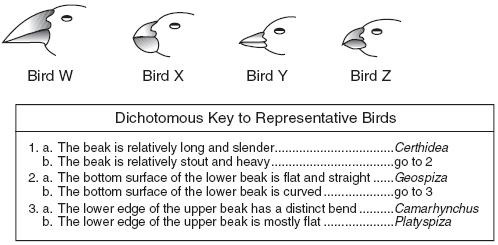
What is the name of bird W?
a)
Certhidea
b)
Geospiza
c)
Camarhynchus
d)
Platyspiza
35.

What is the name of bird Z?
a)
Certhidea
b)
Geospiza
c)
Camarhynchus
d)
Platyspiza
36.

In the energy pyramid here, which organisms have the most energy available?
a)
Producers
b)
Carnivores
c)
Herbivores
d)
Top Predator
37.

Using this dichotomous key, identify the name of the circled Fish, J.
a)
peacock flounder
b)
band-tail puffer
c)
trumpet fish
d)
spotted goat fish
38.

Using this dichotomous key, identity the name of the circled fish.
a)
band-tail puffer
b)
spotted goat fish
c)
peacock flounder
d)
trumpet fish
39.

Take your time and read carefully! Timer is 3 minutes!
---------
A student discovers an arachnid with a segmented abdomen, long legs, and a tail with no stinger. The student uses the dichotomous key below to identify it. Which arachnid has the student found?
---------
A student discovers an arachnid with a segmented abdomen, long legs, and a tail with no stinger. The student uses the dichotomous key below to identify it. Which arachnid has the student found?
a)
Whip Scorpion
b)
Wind Scorpion
c)
Tick
d)
Scorpion
40.
What is the name of bird W?
a)
Certhidea
b)
Geospiza
c)
Camarhynchus
d)
Platyspiza
41.
If you are creating a dichotomous key, you should create one that goes from _________ to more ________.
a)
detailed to broad
b)
small to large
c)
broad to detailed
d)
happy to sad
42.
Binomial nomenclature means
a)
2 names
b)
2 species
c)
2 systems
d)
2 people
43.

A table of arachnid and insect characteristics is shown. Which characteristic could be used to distinguish between
arachnids and insects?
arachnids and insects?
a)
Jointed legs
b)
Body segments
c)
Presence of eyes
d)
Presence of antennae
44.
The female part of the flower as a whole is called the _____.
a)
style
b)
filament
c)
pistil
d)
sepal
45.
Monocotyledons have all of the following characteristics EXCEPT _____.
a)
flower parts in multiples of 3
b)
parallel veins in the leaves
c)
one seed leaf
d)
vascular bundles arranged in a circle
46.
_____ produces the female sex cells in a flower.
a)
Stigma
b)
Ovary
c)
Anther
d)
Filament
47.

A flowering plant with leaves that have parallel veins and flower parts that are usually in multiples of threes are called what?
a)
Gymnosperms
b)
Angiosperms
c)
Dicots
d)
Monocots
48.

Plants with leaves that are not veined and the flowering parts usually in fours or fives are called what?
a)
Monocots
b)
Dicots
c)
Angiosperms
d)
Gymnosperms
49.

All flowering plants are ________________.
a)
gymnosterms
b)
angiosperms
c)
ugly
d)
non-vascular
50.

Which of these is not a plant?
a)
evergreen
b)
flower
c)
wheat
d)
mushroom
100 %

