
NEW
Font size
S
M
L
XL
 Worksheets
UCEA - Year 10 - B1b & B2
Total questions: 49
Worksheet time: 38mins
Name
Class
Date
1.

Fruit fly body cells have 8 chromosomes. After mitosis, you would expect a resulting fruit fly daughter cell to have ...
a)
16 chromosomes.
b)
46 chromosomes.
c)
8 chromosomes.
d)
4 chromosomes.
2.
The process by which the nuclear material is divided equally between two new cells
a)
mitosis
b)
cancer
c)
spindle
d)
centromere
3.

This picture shows a ____.
a)
chromosome
b)
chromatid
c)
centromere
4.

Why would it be important to replicate DNA before a cell divides in mitosis or meiosis?
a)
In order for genetic information to be transferred into daughter cells.
b)
In order for the cell to be able to increase in size.
c)
In order for the DNA to be contained in the nucleus.
d)
In order for the cell to re-order the DNA sequencing in the new cells.
5.

In mitosis, the two resulting cells are
a)
different from the starting cell and identical to each other.
b)
different from the starting cell and different from each other.
c)
identical to the starting cell and different from each other.
d)
identical to the starting cell and identical to each other.
6.

How many chromosomes do humans have?
a)
46
b)
21
c)
10
7.
The time between cell divisions in the life cycle of the cell is called
a)
anaphase
b)
interphase
c)
prophase
d)
metaphase
8.
A chromosome is a single, long DNA molecule in a compact formation
a)
True
b)
False
9.
Where does a cell contain it's genetic material?
a)
nucleus
b)
nucleolus
c)
cytoskeleton
d)
golgi
10.
How many cells are produced by mitosis?
a)
8
b)
4
c)
1
d)
2
11.
In what form is human DNA stored?
a)
Alleles
b)
RNA
c)
Chromosomes
d)
Genes
12.
How many chromosomes do humans have in every cell?
a)
46
b)
23
c)
26
d)
43
13.
How many chromosomes does a human sperm cell have?
a)
23
b)
43
c)
46
d)
26
14.
Which of these lists presents the stages of the cell cycle in the correct order?
a)
interphase, mitosis, cytokinesis
b)
cytokinesis, mitosis, interphase
c)
mitosis, interphase, cytokinesis
d)
interphase, cytokinesis, mitosis
15.
What phase is a cell in 90% of the time?
a)
Interphase
b)
Prophase
c)
metaphase
d)
telophase
16.
The final stage of mitosis, when the cytoplasm divides and new cell forms.
a)
Interphase
b)
Cytokinesis
c)
meiosis
17.
The chromosomes line up at the ____________.
a)
Equator
b)
cell membrane
c)
prime meridian
18.
All the stages of cell growth and division is called the ___________.
a)
Cell cycle
b)
replication
c)
mitosis
d)
meiosis
19.

When cells become specialised for a particular role, it is known as ...?
a)
cell differentiation
b)
cell replication
c)
cell reproduction
d)
cell mitosis
20.
Which of the following is the correct statement?
a)
Both plant and animal cells differentiate at an early stage.
b)
Animal cells differentiate early, whilst many plant cells can differentiate throughout life.
c)
Plant cells differentiate early, many animal cells can differentiate throughout life.
d)
The majority of both plant and animals cells can differentiate later in life.
21.
Unspecialised cells that can differentiate to form many different types of cell are known as...?
a)
Stem cells
b)
Specialised cells
c)
Differential cells
d)
Special cells
22.
Which type of human stem cell would be able to differentiate into the most type of specialised cells?
a)
Embryonic stem cells
b)
Adult bone marrow stem cell
23.
What is the difference between embryonic stem cells and adult stem cells?
a)
Embryonic stem cells can differentiate into more cell types than adult stem cells
b)
Adult stem cells are pluripotent, just like embryonic stem cells
c)
Adult stem cells can differentiate into more cell types than embryonic stem cells
d)
Adult stem cells grow bigger than embryonic stem cells
24.
Which is true about Adult Stem Cells.
a)
They no longer do mitosis, their cell type is set and can not change
b)
They are limited to the type of cell they can become.
c)
They can become any cell type in the body
d)
They are found in embryos
25.
Which is true about Embryonic Stem Cells.
a)
They no longer do mitosis, their cell type is set and can not change
b)
They are limited to the type of cell they can become
c)
They can become any cell type in the body
d)
They are found in adults
26.
From what type of cell do all our tissues come from?
a)
Myocytes
b)
Tissue cells
c)
Adipose cells
d)
Stem cells
27.
What is the process by which stem cells divide?
a)
Mitosis
b)
Differentiation
c)
Meiosis
d)
Binary fission
28.
What is the process by which cells become specialised?
a)
Ligation
b)
Differentiation
c)
Special process
d)
Stemnation
29.
Which type(s) of cells replicate frequently?
a)
liver
b)
skin
c)
blood
d)
bone
30.
Stem cells can be obtained from
a)
embryos
b)
some adult tissues
c)
umbilical cord blood
d)
all of the above
31.
Why is using umbilical cord blood beneficial?
a)
non-invasive
b)
can be stored & used later
c)
contains stem cells
d)
all of the above
32.
How do stem cells know what type of cells to differentiate into?
a)
The nucleus has instructions to turn some genes on and some genes off.
b)
Signals from chemicals in the organism or from the environment determine which genes will be turned on and off.
c)
Genes turn on and off randomly.
d)
The cell has unique DNA that determines what the cell will become.
33.
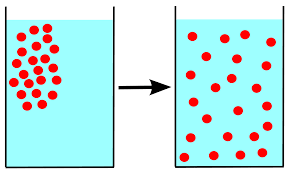
The picture below is an example of _________________.
a)
osmosis
b)
isotonic
c)
diffusion
d)
active transport
34.
Osmosis is the movement of _____ across a membrane.
a)
food
b)
energy
c)
oxygen
d)
water
35.
During osmosis
a)
water moves from high to low concentration
b)
large or oddly shaped molecules move across a cell membrane
c)
water moves when energy is used
d)
proteins are built
36.
Permeable means
a)
things can pass through
b)
the concentration levels are different
c)
it is permanent
d)
things are stuck
37.
The diffusion of water through a semi-permeable membrane is called?
a)
Osmosis
b)
Cell wall
c)
Diffusion
d)
Respiration
38.
A person should never drink salty water because their cells would
a)
shrink
b)
expand
39.
If there is 5 percent water inside a cell and 5 percent water outside a cell
a)
more water will move inside the cell
b)
more water will move outside the cell
c)
There will be no movement of water cells
40.
Passive transport requires no
a)
concentration gradients
b)
osmosis
c)
motion
d)
energy
41.
Which processes involve carrier proteins
a)
Active transport and facilitated diffusion
b)
Osmosis and active transport
c)
Diffusion and active transport
d)
Facilitated diffusion and osmosis
42.
What process is defined as passive movement of substances down a concentration gradient?
a)
Osmosis
b)
Diffusion
c)
Active transport
43.
Which of the following molecules can diffuse freely across a cell membrane?
a)
Sodium ions
b)
Water
c)
Glucose
d)
Oxygen
44.
By which process does water move into the roots of a plant?
a)
Facilitated diffusion
b)
Diffusion
c)
Active transport
d)
Osmosis
45.
The net movement of water from a high to low water potential across a partially permeable membrane is...
a)
Active transport
b)
Water transport
c)
Osmosis
d)
Refraction
46.
Which cell is likely to burst when it is placed in a hypotonic solution?
a)
Neither cell
b)
Both cells
c)
Animal cell
d)
Plant cell
47.
Osmosis involves the diffusion of which molecule...
a)
All of them
b)
Ions
c)
Sugars
d)
Water
48.
Which of these is an example of active transport?
a)
Small intestine, pumping in glucose
b)
All of the above
c)
Kidney - pumping out glucose
d)
Root hair cells - pumping in mineral ions
49.
Which process provides active transport with its energy?
a)
Respiration
b)
Contraction
c)
Breathing
d)
Photosynthesis
Reset

