
 Worksheets
Gas Laws Review
Total questions: 64
Worksheet time: 1hrs 25mins
Name
Class
Date
1.
Molecules are in constant motion and collide frequently with other molecules in a gas.
a)
True
b)
False
2.
Which of the following has the greatest amount of movement at a given temperature?
a)
Gas
b)
Liquid
c)
Solid
d)
They all have the same movement
3.
The amount of force pushing on an area is the definition of....
a)
Fluid
b)
Viscosity
c)
Barometer
d)
Pressure
4.
How can we increase the gas pressure inside a sealed container?
a)
Increase the number of particles inside the container
b)
Increase the temperature
c)
Decrease the volume of the container
d)
All of these
5.
Which state of matter has a definite volume but no real shape of its own?
a)
solid
b)
liquid
c)
gas
6.
At sea level, Earth's atmosphere actually exerts a pressure of
a)
14.7 psi
b)
15.7 psi
c)
13.7 psi
d)
17.4 psi
7.
Pressure is because of the collisions between the gas particles and the walls of their container.
a)
true
b)
false
8.
Pressure is equal to....
a)
Force/Area
b)
Volume/Time
c)
Force/Density
d)
Force times gravity
9.
If a nitrogen gas occupies a volume of 500ml at a pressure of 0.971atm. What volume will the gas occupy at a pressure of 1.50 atm, assuming the temperature remains constant?
a)
323.6 ml
b)
728.25 ml
c)
772.39 ml
d)
None of the above
10.
An increase in temperature does what to diffusion?
a)
Speeds it up
b)
Slows it down
c)
Has no effect
d)
I wish i knew. Really I do.
11.
Molecules are in constant motion and collide frequently with other molecules in a gas.
a)
true
b)
false
12.
When two gases are mixed
a)
The heavier gases sink to the bottom while lighter gases remain at the top
b)
the gases only mix along the plane where they meet
c)
the gases will mix evenly
d)
the gases will remain wherever they were released.
13.
Kinetic molecular theory
a)
is useful all day every day
b)
is always entirely correct
c)
is useful for ideal gases
d)
is hardly ever useful
14.
If air is removed from a rigid container, the pressure inside will
a)
increase
b)
decrease
c)
remain the same
d)
vary
15.
In what direction(s) does air exert pressure?
a)
everywhere
b)
no where
c)
there is no pressure
d)
downward
16.
When particles move from areas of high concentration to areas less concentrated, this has taken place.
a)
diffusion
b)
mitosis
c)
endocytosis
d)
photosynthesis
17.
Diffusion is the movement of molecules from an area of _____ concentration to an ______ concentration
a)
High, low
b)
Low, high
c)
Low, low,
d)
High, high
18.
You have a gas that has a pressure of 2 ATM and a volume of 10L. What would be the new volume if the pressure was changed to 1 ATM?
a)
5 L
b)
20 L
c)
It would stay at 10L
d)
1 L
19.
Which of the following would increase the pressure on a system?
a)
Increase the Temperature
b)
Pump in more gas
c)
Decrease the volume
d)
All of these
20.
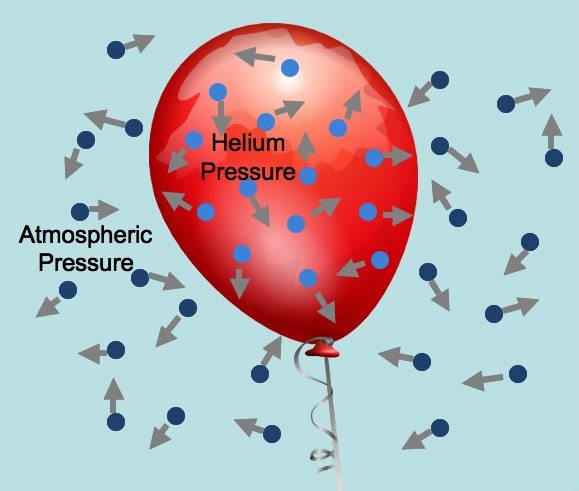
What causes pressure?
a)
The walls of the container
b)
The vacuum in the container
c)
The collisions of the particles
d)
Atmospheric pressure acting on the outside walls
21.
In order to solve gas law calculations, temperature must be measured in:
a)
Fahrenheit
b)
Celsius
c)
Kelvin
d)
It doesn't matter
22.

Graph A shows
a)
Charle's Law where volume and temperature are directly proportionate.
b)
Charle's Law where volume and temperature are inversely proportionate.
c)
Boyle's law where pressure and volume are inversely proportionate
d)
Boyle's law where pressure and volume are directly proportionate
23.
Graph B shows
a)
Charle's Law where volume and temperature are directly proportionate.
b)
Charle's Law where volume and temperature are inversely proportionate.
c)
Boyle's law where pressure and volume are inversely proportionate
d)
Boyle's law where pressure and volume are directly proportionate
24.
STP refers to
a)
100 degrees C and 0 atm
b)
0 atm and 273 K
c)
0 degrees C and 273 mm Hg
d)
273 K and 760 mm Hg
25.
At constant pressure, the temperature of 4.8 L of an ideal gas is 500K. What will the volume be at standard temperature?
a)
2.6 L
b)
2.8 L
c)
2.0 L
d)
3.2 L
26.
If 200 mL of a gas at 27°C is cooled to -33°C at a constant pressure, the volume will be
a)
250 mL
b)
204 mL
c)
196 mL
d)
160 mL
27.

What happens to the average kinetic energy of matter when it is heated?
a)
It increases
b)
It decreases
c)
It doesn't change
d)
It cannot be determined
28.

At higher temperatures...
a)
particles in an object have less energy
b)
particles in an object move faster
c)
a gas contracts
29.
What will happen to the volume of a gas under constant temperature if the pressure increases?
a)
Increase
b)
Decrease
c)
Nothing
d)
Explosion!
30.
At STP, 4.8 L of CO2 contains the same number of molecules as
a)
2.4 L of CH4
b)
4.8 L of Hydrogen
c)
9.6 L of O3
d)
1.2 L of Neon
31.
Why do scientists have standard values for gas temperatures and presures?
a)
So that properties of gases can be easily compared.
b)
Gases behave the same under all conditions.
c)
Pressures are unchanging under normal conditions.
d)
Temperatures change frequently, but gases do not.
32.
Convert 273 K to oC
a)
0oC
b)
100oC
c)
-273oC
d)
50oC
33.
Convert -89 oC to K
a)
184K
b)
362K
c)
-362K
d)
-184K
34.
Convert 180oC to K
a)
453 K
b)
-93 K
c)
93 K
d)
453 K
35.
Absolute zero is the
a)
temperature at which oxygen freezes
b)
Temperature when Neon evaporates
c)
Highest possible temperature
d)
Lowest possible temperature
36.

Each of these flasks contains the same number of gas molecules. In which would the pressure be lowest?
a)
Flask 1
b)
Flask 2
c)
Flask 3
d)
Flask 4
37.

Each of these flasks contains the same number of molecules. In which container is the pressure highest?
a)
Flask 1
b)
Flask 2
c)
Flask 3
d)
Flask 4
38.
What is 0.00 degrees Kelvin known as
a)
No such thing
b)
Very cold
c)
Freezing point of Water
d)
Absolute Zero
39.
Absolute zero is...
a)
-273º C
b)
0º C
c)
-373º C
d)
273º C
40.
Absolute zero is...
a)
0º C
b)
0º F
c)
0º K
d)
0º O
41.
Which temperature is absolute zero?
a)
0 oC
b)
0 Kelvins
c)
273 Kelvins
d)
273 oC
42.
What happens when an object reaches absolute zero?
a)
The molecules stop moving
b)
The molecules move faster
c)
Water freezes
43.
Temperature at which ALL molecules stop moving.
a)
100ºC
b)
Absolute zero
c)
0ºC
d)
32ºF
44.

Scientists' favorite temperature scale, because it begins at the absolute coldest anything can get.
a)
Celsius
b)
Fahrenheit
c)
Kelvin
d)
All of them
45.
You have a gas that has a pressure of 2 ATM and a volume of 10L. What would be the new volume if the pressure was changed to 1 ATM?
a)
5 L
b)
20 L
c)
It would stay at 10L
d)
1 L
46.
If 200 mL of a gas at 27°C is cooled to -33°C at a constant pressure, the volume will be
a)
250 mL
b)
204 mL
c)
196 mL
d)
160 mL
47.
4. A gas occupies 4.31 liters at a pressure of 0.755 atm. Determine the volume if the pressure is increased to 1.25 atm.
a)
2.6L
b)
2.6mL
c)
2.6kL
d)
260L
48.
1. If a gas at 25.0 °C occupies 3.60 liters at a pressure of 1.00 atm, what will be its volume at a pressure of 2.50 atm?
a)
1.5L
b)
45 L
c)
1.44L
d)
27.4L
49.
If a room with 1atm, 23 degree celsius, and in a beaker there are 22 L of water, suddenly drop to 260 Kelvin but the pressure stay the same. What is the volume?
a)
20.9
b)
250
c)
20
50.
If 10L of O2 at 273K and 1 atm is compressed to a 7L container at 250K, what is the new pressure?
a)
1.31 atm
b)
9.16 atm
c)
0.76 atm
d)
6.0 atm
51.
A weather balloon has a volume of 105L at 0.97 atm when the temperature is 318K. What is the volume at 293K and 1.05 atm?
a)
89.4 L
b)
0.32 L
c)
93.8 L
d)
3.13 L
52.
If the pressure exerted by a gas at 25 degrees C in a volume of 0.044 L is 3.81 atm, how many moles of gas are present?
a)
.002766 mole
b)
.0069 mol
c)
2.766 mol
d)
9.887 mol
53.
At STP, what is pressure in atmospheres?
a)
1 atm
b)
10 atm
c)
0 atm
d)
100 atm
54.
Determine the Kelvin temperature required for 0.0470 mol of gas to fill a balloon to 1.20 L under .998 atm pressure.
a)
0 K
b)
107 K
c)
207 K
d)
307 K
55.
What is 50 C in Kelvin?
a)
223
b)
323
c)
100
d)
50
56.
Which of the following has the greatest amount of movement at a given temperature?
a)
Gas
b)
Liquid
c)
Solid
d)
They all have the same movement
57.
What will happen to the volume of a gas under constant temperature if the pressure increases?
a)
Increase
b)
Decrease
c)
Nothing
d)
Explosion!
58.
If you increase the pressure of a constant volume of gas, what will happen to the temperature?
a)
Increase
b)
Decrease
c)
Stay the same
d)
It will Blow Up
59.
How do you convert Celsius to Kelvin?
a)
Add 273
b)
Subtract 273
c)
You can't convert those
d)
They are the same thing
60.
Which is a quality that only gasses display
a)
Spread out to fill all available space
b)
Take the shape of their container
c)
Can't be compressed
d)
All of these
61.
What is 0.00 degrees Kelvin known as
a)
No such thing
b)
Very cold
c)
Freezing point of Water
d)
Absolute Zero
62.
How are pressure and volume related?
a)
Directly
b)
Indirectly
c)
They aren't related
63.
You have a gas that has a pressure of 2 ATM and a volume of 10L. What would be the new volume if the pressure was changed to 1 ATM?
a)
5 L
b)
20 L
c)
It would stay at 10L
d)
1 L
64.
Which of the following would increase the pressure on a system?
a)
Increase the Temperature
b)
Pump in more gas
c)
Decrease the volume
d)
All of these
100 %

