
 Worksheets
Unit 1 Practice Test Genetics Biology 2018
Total questions: 85
Worksheet time: 2hrs 0mins
Name
Class
Date
1.
The cells produced via meiosis are called:
a)
sex cells
b)
somatic cells
c)
body cells
d)
skin cells
2.
A human usually has xx amount of chromosomes.
a)
6
b)
22
c)
4
d)
46
3.

Meiosis makes sperm and egg cells. In humans, sperm and egg cells each have _____ chromosomes. Therefore a fertilized human egg cell (sperm and egg cell combined) would create a cell with _____ chromosomes.
a)
23, 46
b)
46, 23
c)
2, 4
d)
50, 100
4.
What causes genetic variation in meiosis?
a)
chromosomes lining up
b)
crossing over of chromosomes
c)
separation of chromosomes
d)
chromosomes pulling apart
5.
Unlike mitosis, meiosis in male mammals results in the formation of
a)
one haploid gamete
b)
three diploid gametes
c)
four diploid gametes
d)
four haploid gametes
6.
What kind of cells are made in MEIOSIS?
a)
Haploid Gametes
b)
Diploid Somatic Cells
c)
Skin Cells
d)
Liver Cells
7.

When an area of a chromatid is exchanged with the matching area on a chromatid of its homologous chromosome, _________________ occurs
a)
crossing over
b)
mutagenesis
c)
hybridization
d)
fertilization
8.
Diploid Cells are represented by
a)
2n
b)
n
c)
4n
d)
1/2 n
9.
If the Diploid number of Carrots is 18, the haploid number is
a)
18
b)
9
c)
27
d)
36
10.
Goes through P.M.A.T two rounds
a)
Mitosis
b)
Meiosis
c)
Osmosis
d)
Transcription
11.

Which process and type of resulting cells are represented?
a)
mitosis, gametes
b)
mitosis, body cells
c)
meiosis, gametes
d)
meiosis, body cells
12.
If a somatic cell in a butterfly contains 24 chromosomes, a butterfly egg would contain
a)
3
b)
6
c)
12
d)
24
13.
The chromosomes that pair up during meiosis, are called __________ chromosomes.
a)
homozygous
b)
asexual
c)
homologous
d)
genes
14.
Crossing over helps promote
a)
male genotype
b)
genetic variation
c)
DNA replication
d)
mitosis
15.
A male shark has 40 chromosomes in each of its sex cells. How many would be present in its body cells?
a)
20
b)
40
c)
80
d)
160
16.
What is another reason we need meiosis?
a)
So the offspring has genes from both parents
b)
So the offspring has genes from one parent
c)
So the offspring has genes from neither parents
d)
So the offspring makes its own genes
17.
Why do we need meiosis?
a)
To double the number of chromosomes going into sex cells
b)
To halve the number of chromosomes going into sex cells
c)
To triple the number of chromosomes going into sex cells
d)
To not change the number of chromosomes going into sex cells
18.
Chromosomes exchange genetic material during
a)
crossing over
b)
replication
c)
synthesis
d)
translation
19.

When an area of a chromatid is exchanged with the matching area on a chromatid of its homologous chromosome, _________________ occurs
a)
crossing over
b)
mutagenesis
c)
hybridization
d)
fertilization
20.

A human usually has xx amount of chromosomes.
a)
6
b)
22
c)
4
d)
46
21.
What kind of cells are made in MEIOSIS?
a)
Haploid Gametes
b)
Diploid Somatic Cells
c)
Skin Cells
d)
Liver Cells
22.
______________ is the normal number of chromosomes or 2n.
a)
haploid
b)
daughter
c)
diploid
d)
gamete
23.
Mitosis has ___ division(s). Meiosis has ___ division(s).
a)
1 ; 2
b)
2 ; 1
c)
1 ; 1
d)
2 ; 2
24.
What is the haploid number of chromosomes for a human cell?
a)
46
b)
23
c)
9
d)
2
25.
What is crossing-over?
a)
DNA twisting and switching places when homologoues pair up
b)
Homologues randomly lining up
c)
When genetic information moves from one cell to a difference cell
d)
The creation of eggs
26.
When does crossing-over occur?
a)
Anaphase I
b)
Telophase II
c)
Prophase I
d)
Prophase II
27.

This picture shows which process?
a)
mitosis
b)
meiosis
c)
the cell cycle
28.
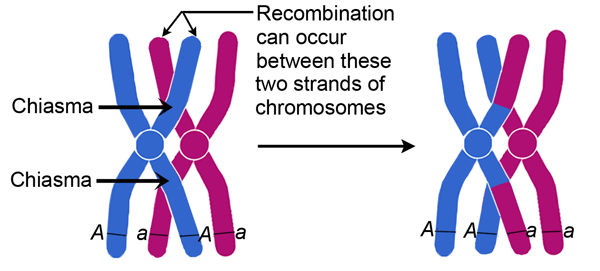
This image shows chromosomes during Prophase 1. Which of the following correctly describes the process shown?
a)
segregation of sister chromatids
b)
condensation and segregation of alleles
c)
mutationin which the DNA content of the gene is altered
d)
crossing - over in which alleles are exchanged
29.
Which of the following produces identical nuclei in cells?
a)
pollination
b)
mitosis
c)
osmosis
d)
fertilization
30.

Which cellular process is shown?
a)
meiosis
b)
endocytosis
c)
mitosis
d)
phagocytosis
31.
Which statement correctly describes meiosis?
a)
cells divide only once
b)
meiosis does not occur in reproductive cells
c)
the cells produced at the end of meiosis are genetically identical to the parent cell
d)
The cells produced at the end of meiosis contain half the number of chromosomes as the parent cell
32.
Aa, DD, bB, yy are all examples of
a)
genotypes
b)
phenotypes
33.
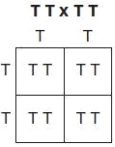
What ratio of the offspring from the cross shown will be homozygous recessive for the trait of tallness?
a)
0 in 4
b)
1 in 4
c)
2 in 4
d)
4 in 4
34.
Which of the following genotypes is homozygous dominant?
a)
A
b)
Aa
c)
AA
d)
aa
35.
Which of the following genotypes is heterozygous?
a)
Bb
b)
BB
c)
bb
d)
B
36.
In a flowering plant species, red flower color (R) is dominant over white flower color (r). What is the genotype of any red-flowering plant resulting from this species?
a)
rr
b)
R
c)
RR
d)
RR or Rr
37.
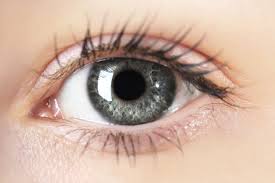
What you see, or the physical appearance.
a)
Genotype
b)
Phenotype
c)
Homozygous
d)
Heterozygous
38.
B = brown eyes
b = blue eyes
What is true about these two brothers that have brown eyes?
One has genotype BB the other Bb.
b = blue eyes
What is true about these two brothers that have brown eyes?
One has genotype BB the other Bb.
a)
they have same phenotype and genotype
b)
they have different genotypes and phenotypes
c)
they have same phenotype but different genotypes
d)
they have same genotype but different phenotypes
39.
aa always shows up as
a)
dominant
b)
recessive
40.
Aa is
a)
homozygous
b)
heterozygous
41.
How many alleles (letters) do each person carry for a trait?
a)
1
b)
2
c)
3
d)
4
42.
What is probabilty?
a)
is the mathematical chance of a specific outcome in relation to the total number of possible outcomes.
b)
is the mathematical formula to additional and subtraction of genotypes
c)
is the mathematical chance of a specific relationship between genotype and phenotype
d)
All of the above
43.
Aa, DD, bB, yy are all examples of
a)
genotypes
b)
phenotypes
44.
In a flowering plant species, red flower color (R) is dominant over white flower color (r). What is the genotype of any red-flowering plant resulting from this species?
a)
rr
b)
R
c)
RR
d)
RR or Rr
45.
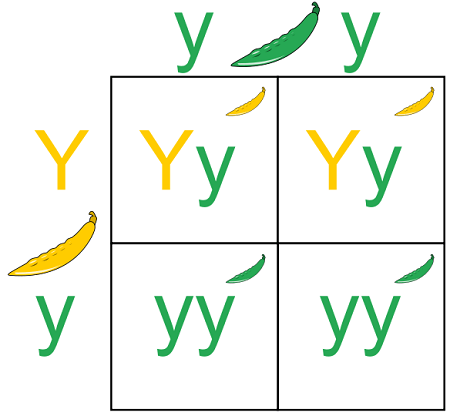
Which choice best represents the genotype of this cross?
a)
1 Yy: 2 yy: 0 YY
b)
2 Yy: 2 yy: 0 YY
c)
3 Yy: 1 yy: 0 YY
d)
1 Yy: 3 yy: 0 YY
46.
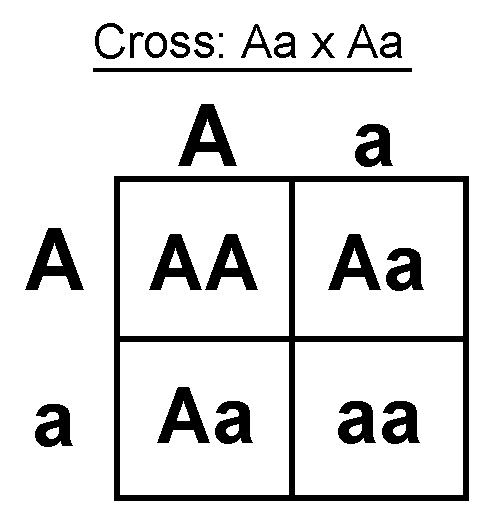
What is the phenotype of the offspring? (A-Brown hair; a-blond hair)
a)
50 % Brown Hair and 50% Blond Hair
b)
25 % Brown Hair and 75% Blond Hair
c)
75 % Brown Hair and 25% Blond Hair
d)
0% Brown Hair and 100% Blond Hair
47.

What is the probability of heterozygous offspring?
a)
25%
b)
50%
c)
0%
d)
100%
48.
Which of the following is NOT a genotype?
a)
heterozygous
b)
a trait
c)
Bb
d)
homozygous recessive
49.
Which of the following alleles is homozygous (purebred) recessive?
a)
Tt
b)
tt
c)
TT
d)
t
50.
Different forms of a gene
a)
genetics
b)
genes
c)
alleles
d)
trait
52.
The scientific study of heredity
a)
genetics
b)
genes
c)
alleles
d)
trait
52.
The scientific study of heredity
a)
genetics
b)
genes
c)
alleles
d)
trait
53.
Having two identical alleles for a trait
a)
homozygous
b)
heterozygous
c)
dominant allele
d)
recessive allele
54.
What is the probability of heterozygous offspring?
a)
25%
b)
50%
c)
0%
d)
100%
55.

What is the probability of homozygous dominant offspring?
a)
0%
b)
100%
c)
50%
d)
25%
56.

What allele combination should go in the missing box?
a)
AA
b)
Aa
c)
aa
d)
none of these
57.

If B = brown hair and b = blonde hair, what is the probability of blonde hair?
a)
100%
b)
50%
c)
25%
d)
75%
58.
B - black, b - brown. Two black mice mate and have some black and some brown mice. What is the genotype of the parents?
a)
BB x Bb
b)
BB x bb
c)
Bb x Bb
d)
Bb x bb
59.
Which of the following terms refers to the different possibilities of a gene?
a)
chromosome
b)
DNA
c)
Punnett Squares
d)
allele
60.
What does a Punnett Square help you do?
a)
Determine the ratio of phenotypes
b)
Determine the ratio of genotypes
c)
Predict possible traits the offspring will have
d)
All of the above
61.
What is a phenotype?
a)
The expression of a trait; what you see.
b)
refers to the genetic makeup of an individual
c)
An organism that has the same genes for a trait (ex. TT or tt)
d)
the passing of traits from parent to offspring
62.

a person's child or children
a)
offspring
b)
blending
c)
incomplete dominance
d)
phenotype
63.

Incomplete dominance or co-dominance?
A calico cat shows both the traits for orange fur and black fur.
A calico cat shows both the traits for orange fur and black fur.
a)
Incomplete Dominance
b)
Co dominance
64.

This type of inheritance pattern shows BOTH traits in possible offspring
a)
complete dominance
b)
incomplete dominance
c)
co-dominance
d)
dominant pattern
65.

Incomplete dominance or co-dominance?
This type of inheritance pattern is a MIXTURE of both traits.
This type of inheritance pattern is a MIXTURE of both traits.
a)
incomplete dominance
b)
co-dominance
66.

Incomplete dominance or co-dominance?
a)
Incomplete dominance
b)
Co-dominance
67.

Ratios:
A roan cow shows co-dominance in fur color (orange and white). What is the phenotype ratio expected if a roan cow and a roan steer mate together?
A roan cow shows co-dominance in fur color (orange and white). What is the phenotype ratio expected if a roan cow and a roan steer mate together?
a)
4: Orange and White
b)
1: Orange : 1 White
c)
2 Orange: 2 Orange and White: 0 White
d)
1: Orange: 2 Orange and White: 1 White
68.

If you cross a black chicken with a white chicken, only checkered chickens would be produced. What kind of inheritance pattern does this follow?
a)
incomplete Dominance
b)
Co-Dominance
69.
How are Incomplete Dominance and Co Dominance different than a normal Mendelian cross?
a)
There is no difference
b)
The heterozygous genotype has a unique phenotype
c)
There is no heterozygous genotype
d)
There is only one phenotype regardless of genotype.
70.
Which type of inheritance causes both traits to be expressed equally in the heterozygote?
a)
Complete Dominance
b)
Incomplete Dominance
c)
Co-Dominance
d)
Sex-linked
71.
A tall plant (TT) is crossed with a short plant (SS) and a medium plant (TS) results. This is what type of inheritance pattern?
a)
Incomplete Dominance
b)
Codominance
72.

A red flowered plant (RR) breeds with a White flowered plant (WW). The gene for petal color in these plants expresses incomplete dominance. What percentage of the offspring will have pink (RW) flowers?
a)
0%
b)
25%
c)
50%
d)
100%
73.
What type of inheritance do two alleles have if their traits blend together?
a)
Incomplete Dominance
b)
Co-Dominance
c)
Mendelian Inheritance (Complete Dominance)
d)
Homozygous Inheritance
74.

SpongeBob and his pal Patrick love to go jellyfishing at Jellyfish Fields! The fields are home to a special type of green jellyfish known as Goobers and only really great jellyfishermen are lucky enough to catch some on every trip. Many of the jellyfish are yellow (YY) or blue (BB), but some end up green as a result of incomplete dominance. Use this information to help you complete each section below.
I.) What would the phenotypes of the F-1 offspring be if SpongeBob and Patrick crossed two “goobers” or green jellyfish? Complete a Punnett square chart to help you determine the probability for each color of jellyfish.
I.) What would the phenotypes of the F-1 offspring be if SpongeBob and Patrick crossed two “goobers” or green jellyfish? Complete a Punnett square chart to help you determine the probability for each color of jellyfish.
a)
The F-1 offspring from the two "goobers", or green jellyfish would have all of the colored traits including: two green jellyfish, one blue jellyfish, and one yellow jellyfish.
b)
The F-1 offspring from the two "goober" jellyfish would have only one of the colored traits, which would be blue (BB).
c)
The F-1 offspring from the two "goober" jellyfish would have only one of the colored traits, which would be yellow (YY).
d)
The F-1 offspring from the two "goober" jellyfish would have two of the colored traits, which would be yellow (YY) at 50%, and blue (BB) at 50%.
75.
Due to incomplete dominance in the dragon breath trait, what would the F1 offsprings dragon breath genotype trait be if you bred a P1 generation that consists of a Fire Breathing Dragon (FF), and a Blizzard Breathing Dragon (BB)?
a)
The genotype of the F1 offspring would be 25% BB, 50% FF, and 25% FB.
b)
The Genotype of the F1 offspring would be 50% BB, and 50% FF.
c)
All of the F1 offspring's genotype would be 100% FB.
d)
The genotype of the F1 offspring would be 50% FB, and 50% FF
76.
If a Homozygous red snapdragon and a Heterozygous pink snapdragon were crossed-what percentage of the offspring would be homozygous white?
a)
0%
b)
25%
c)
50%
d)
75%
77.
If a Homozygous red snapdragon and a Heterozygous pink snapdragon were crossed-what percentage of the offspring would be homozygous red?
a)
0%
b)
25%
c)
50%
d)
75%
78.
If a Homozygous red snapdragon and a Heterozygous pink snapdragon were crossed-what would the parent genotypes be?
a)
RRxR1R1
b)
RR1x RR1
c)
RRxRR1
d)
R1R1xRR
79.
If a Homozygous red snapdragon and a Heterozygous pink snapdragon were crossed-what percentage of the offspring would be homozygous red?
a)
0%
b)
25%
c)
50%
d)
75%
80.

If I water the plant more often, then it will grow taller. Name the dependent variable.
a)
The amount of water.
b)
The amount of soil.
c)
The height of the plant.
d)
The amount of water.
81.

The parts of the experiment that remains the same.
a)
controlled variables
b)
data
c)
independent variables
d)
dependent variables
82.

Mr. Gomez sets up an experiment to see how the mass of a ball affects the distance it rolls off a ramp. Identify the independent variable.
a)
distance traveled by the ball
b)
height of the ramp
c)
mass of the ball
d)
all of the above
83.

When experimenting with the growth of a plant, a scientist uses three of the same type of plants, the same amount of light, same amount of water, and two different fertilizers. What type of variable is the fertilizer?
a)
Responding or Dependent
b)
Manipulated or Independent
c)
Control
d)
Compound
84.

This variable in an experiment is the one being deliberately changed by the scientist.
a)
dependent variable
b)
independent variable
c)
data
d)
control group
85.

A study was done to find if different types of tires affect the breaking distance of a car. What is the independent variable?
a)
Type of tire
b)
Breaking Distance
c)
the type of car
100 %

