
 Worksheets
Historical Period 1
Total questions: 80
Worksheet time: 48mins
Name
Class
Date
1.
Politics over religion is known as
a)
politique
b)
real politik
c)
augsleich
d)
nationalism
2.
Joint Stock companies encouraged investment and the growth of the mercant class by...
a)
reducing risk
b)
guaranteeing profit
c)
only trading for gold
d)
limiting exports
3.
In response to the reforms of the 16th century, the Catholic Church...
a)
compromised with reformers
b)
re-established Catholic unity in Europe
c)
reasserted traditional doctrine
d)
dissolved
4.
In the Holy Roman Empire, the charge against Reformation ideals was led by...
a)
Charles V
b)
Pope Leo X
c)
Henry VIII
d)
Catherine de Medici
5.
What type of math was Newton known for developing?
a)
Geometry
b)
Trigonomety
c)
Calculus
d)
Addition
6.
Mother Country sought to control trade, create favorable balance of trade, and build up supplies of gold and silver bullion. Which statement best defines this term?
a)
Communism
b)
Feudalism
c)
Mercantilism
d)
Capitalism
7.
He issued the Edict of Nantes
a)
Philip II
b)
Louis XIII
c)
Henry IV
d)
William the Silent
8.
Who was the "Most Catholic King" that tried to invade England?
a)
Philip II
b)
Henry IV
c)
Louis XIV
d)
Ivan IV
9.
Who strengthened the French monarchy during the reign of Louis XIII?
a)
Colbert
b)
Rousseau
c)
Mazarin
d)
Richelieu
10.
Which one was NOT a Catholic monarch?
a)
Henry IV
b)
Louis XIV
c)
James I
d)
Philip II
11.
Poor, single women were more likely to be accused of witchcraft than a man.
a)
True
b)
Fals
12.
Elizabeth supported the Netherlands in its rebellion against Spain.
a)
True
b)
False
13.
Philip II put William the Silent in charge of crushing the rebellion in the Netherlands.
a)
True
b)
False
14.
The Sistine Chapel was painted by...
a)
Michalangelo
b)
Albrecht Durer
c)
Miguel Cervantes
d)
Leonardo DaVinci
15.
Italian artist who also excelled in astronomy, engineering, and anatomy
a)
Michelangelo
b)
Raphael
c)
Johann Guttenberg
d)
Leonardo da Vinci
16.
When & where was the Thirty Years’ War fought?
a)
1588-1648, in France.
b)
1618-1648, in the Holy Roman Empire (Germany).
c)
1939-1945, in Europe, North Africa, & East Asia.
d)
1775-1781, in British North America.
17.

Why did France enter the Thirty Years War?
a)
To defend Catholicism
b)
To spread democracy
c)
To push back the Islamic Ottoman Empire
d)
To increase its own power and weaken the Habsburgs
18.
Dutch humanist who wrote "In Praise of Folly"
a)
More
b)
Erasmus
c)
Machiavelli
d)
Van Eyck
19.
central European banking family
a)
Habsburgs
b)
Fuggars
c)
Medici
d)
Tudors
20.
group of Protestant princes who fought against Catholics in Germany during Reformation
a)
Protestant Union
b)
Protestant League
c)
Schmalkaldic League
d)
Lutherans
21.
The Defenstration of Prague did not result in any deaths because the two men landed on piles on manure in the street
a)
True
b)
False
22.
The ultimate winner of the Thirty Years' War is the Catholics.
a)
True
b)
False
23.
What provided the major economic support for the Renaissance?
a)
wealthy patrons
b)
church officials
c)
government grants
d)
kings competing for prestige
24.
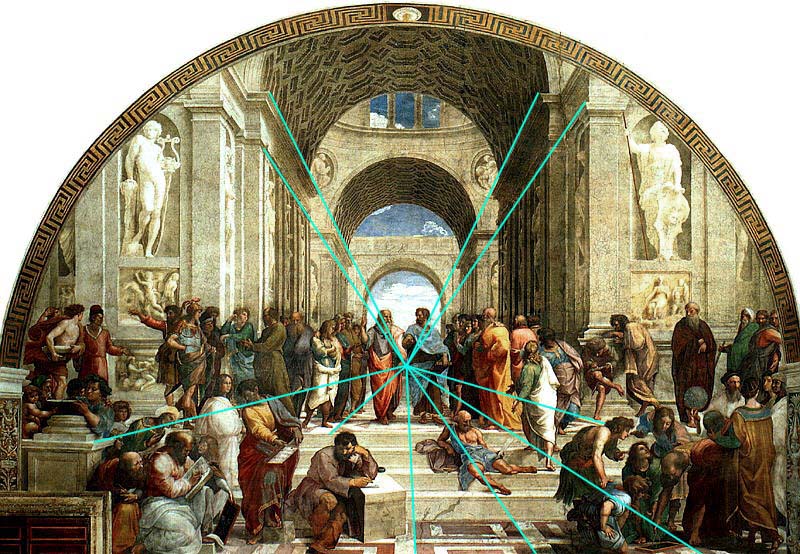
What is the artistic technique that is used to show depth and distance on a flat surface?
a)
realism
b)
perspective
c)
idealism
d)
distancism
25.
Raphael is best known for his creation of which of the following?
a)
Mona Lisa
b)
Last Supper
c)
Murals of the Sistine Chapel
d)
School of Athens
26.
Which of the following is a synonym best used to describe the word "secular"
a)
Worldly
b)
Religious
c)
Chivalry
d)
Rebirth
27.
Galileo was tried for heresy because he argued
a)
That heaven did not exist
b)
That Earth revolved around the sun
c)
Against the law of gravity
d)
That the sun revolved around the Earth
28.
The idea that the earth is the center of the universe is the ___________ theory.
a)
geocentric
b)
heliocentric
c)
earthcentric
d)
world's worst
29.
What is vernacular?
a)
a made up language
b)
Latin
c)
a foreign language
d)
a person's native language
30.
Under the Treaty of Tordesillas, the Pope divided the world between Spain and _____________ to settle competing claims of Atlantic discoveries. (The nation that inspired Spain’s trade and search for wealth)
a)
Italy
b)
Netherlands
c)
Portugal
d)
English
31.
Built a observatory in Europe in 1572, proposed the idea that planets revolved around the sun but the sun moved around the motionless Earth
a)
Kepler
b)
Galen
c)
Newton
d)
Brahe
32.
"I think, therefor I am" science should be based on the human mind's ability to arrive at clear and distinct ideas
a)
Aristotle
b)
Descartes
c)
Galen
d)
Boerhaave
33.
The war between Protestants and Catholics that killed 1/3 of Germany's population.
a)
Hundred Years War
b)
Thirty Years War
c)
Seven Years War
d)
St. Bartholomew's Day Massacre
34.
How does Mary Tudor earn her title "Bloody Mary?"
a)
She killed her father for revenge
b)
She burned 300 Protestants
c)
By looking in the mirror and saying her name three times
d)
She killed 300 Spainiards for invading England
35.
This is a state of death according to the Roman Catholic belief in which the souls of the people who die are made pure through suffering before going to heaven.
a)
Simony
b)
Nepotism
c)
Indulgence
d)
Purgatory
36.
Which was traded from the Old World to the New World?
a)
horses and major diseases
b)
squash, pumpkins, and turkeys
c)
cocoa and horses
d)
cocoa and llamas
37.
Brunelleschi is best known for
a)
"The Prince."
b)
the statue of David
c)
the Dome of Santa Maria del Fiore
d)
"The Divine Comedy"
38.
What is Columbus known for?
a)
finding a sea route to Asia
b)
sailing around the world
c)
accidentally discovering the Americas
d)
discovering Brazil
39.
What do Petrarch and Pico della Mirandola have in common?
a)
Italian humanists promoting a revival in classical themes
b)
Christian humanists who tried to reform the church
c)
Habsburg rulers who tried to restore Catholic unity
d)
Artists who employed naturalism and geometric perspective
40.
Niccolo Machiavelli is representative of individuals who
a)
received financial support from the Church for their scholarship
b)
attempted to reform the church in the Italian Renaissance
c)
promoted secular models for individual and political behavior
d)
articulated new theories of inductive and deductive reasoning
41.
Baldassare Castiglione's "The Book of the Courtier" was important because it
a)
provided a new definition of the "civilized" and "refined" man
b)
called for a new social system based on communal charity
c)
celebrated the great emperors of classical Rome
d)
advocated Neo-Platonism, emphasizing ideal forms
42.

The painting, "The Harvesters" by Pieter Bruegel the Elder is indicative of artists who
a)
employed naturalism, emphasizing the reality of life
b)
employed distortion, drama, and illusion to depict nature
c)
sought to portray elites who commissioned their works
d)
promoted biblical themes and landscapes to strengthen religious belief
43.
The Edict of Nantes and the Treaty of Westphalia were similar because they
a)
reaffirmed a measure of religious pluralism
b)
renounced Protestantism and promoted one Church over all
c)
strengthened two empires and upset the balance of power
d)
enhanced the power of parliaments and shared governance
44.
Which state allowed a large degree of religious pluralism?
a)
The Netherlands
b)
England
c)
France
d)
Spain
45.
The portolani, lateen, and astrolabe allowed Europeans to
a)
establish overseas colonies and empires.
b)
challenge the geocentric view of the universe.
c)
discredit ideas of a predictable universe.
d)
challenge traditional views of astrology and alchemy.
46.
The enclosure movement is an example of
a)
greater commercialization of agriculture.
b)
new secular laws regulating private life.
c)
communal leisure activities reflecting folk ideas.
d)
rituals of public humiliation to enforce communal norms.
47.
Which of the following captures social patterns from the 16th century forward?
a)
delaying of marriage and childbearing
b)
codification and reestablishment of serfdom in Western Europe
c)
greater social cohesion with the expansion of cities
d)
migrants to cities strengthened the position of craft guilds
48.
Which of the following was a major factor in the spread of humanist culture in late fifteenth and early sixteenth centuries?
a)
The creation of new religious orders by the papacy
b)
A major increase in government funding for elementary education
c)
The development of the printing press
d)
The sale of basic textbooks written in the vernacular
49.
1588
a)
Edict of Nantes
b)
Spanish Armada defeated by Elizabeth I
c)
Glorious Revolution
d)
Wealth of Nations
50.
1492
a)
Columbus sails to the West
b)
Edict of Nantes
c)
St. Bartholomew's Day Massacre
d)
95 Theses
51.
1517
a)
Edict of Nantes
b)
Edict of Fountainbleu
c)
95 Theses
d)
Act of Supremacy
52.
1555
a)
Act of Supremacy
b)
Peace of Westphalia
c)
Peace of Augsburg
d)
Edict of Fountainbleu
53.
1648
a)
Peace of Westphalia
b)
Treaty of Versailles
c)
Edict of Fountainbleu
d)
Act of Supremacy
54.
The selling of church positions is known as _________________.
a)
absenteeism
b)
pluralism
c)
ignorance
d)
simony
55.
Man seen as most responsible, although not the sole cause, of the Reformation was _______.
a)
Calvin
b)
Luther
c)
Albert of Hohenzollern
d)
Pope Boniface VIII
56.
Johann Tetzel was a church official most noted for selling these: __________________.
a)
indulgences
b)
conciliar idols
c)
church positions
d)
girl scout cookies
57.
Luther argued that man could not be saved by faith alone (true or false)
a)
TRUE
b)
FALSE
58.
Luther refused to recant at the _______and was forced into exile.
a)
peace of augsburg
b)
wittenberg conferences
c)
diet of worms
d)
ecunemical council
59.
Luther was in favor of the German Peasants Revolt and sided with them throughout the event: (true or false)
a)
TRUE
b)
FALSE
60.
A strict Calvinist government was set up in _____, Switzerland and imposed harsh penalties on immoral behavior.
a)
belmont
b)
paris
c)
london
d)
geneva
61.
Anabaptists were persecuted by both Protestants and Catholics due to their belief in the separation of this: _______.
a)
church and state
b)
protestants and catholics
c)
The Holy Roman Empire from the Catholic Church
d)
from the concept of predestination
62.
John Knox is most noted for bringing the Presbyterian Church to this country: ________.
a)
ireland
b)
scotland
c)
wales
d)
ukraine
63.
The Act of Supremacy officially made _______ the head of the church in England.
a)
henry VIII
b)
Calvin
c)
the Pope
d)
Holy Roman Emperor
64.
The Index of Prohibited Books was authorized by this institution: ____________________.
a)
Calvin's Geneva Conciliatory
b)
Catholic Church
c)
Luthern Church
d)
Jewish ecunemical Council
65.
The _____ were a religious order of the Catholic Church designed to stop the spread of Protestantism and served as missionaries.
a)
Calvinists
b)
Jesuits
c)
Lutherans
d)
Anglican Order
66.
The Reformation soon turned into a Civil War in this country
a)
England
b)
Austria
c)
France
d)
Germany
67.
All are not created on equal terms, but some are preordained to eternal life, others to eternal damnation; and accordingly, as each has been created for one or other of these ends, we say that he has been predestined to life or death. This sattement reflects:
a)
Zwingli
b)
Erasmus
c)
Luther
d)
Calvin
68.
Who built the Palace of Versailles?
a)
Louis XIII
b)
Henry IV
c)
Louis XIV
d)
Ivan IV
69.

Romeo and Juliet was one of the most famous plays of this Renaissance author.
a)
Francesco Petrarca
b)
Christopher Marlowe
c)
Edmund Spencer
d)
William Shakespeare
70.

English physician who came up with the circulatory system.
a)
Harvey
b)
Frisius
c)
Leibniz
Leibniz
Leibniz
d)
Pascal
71.
Scientists began using _____________ and _______________ instead of placing their beliefs in faith.
a)
History and faith
b)
Math and Science
c)
Math and History
d)
reason and logic
72.
This term refers to an early form of Chemistry primarily concerned with transforming basic metals into gold.
a)
Alchemy
b)
Witchcraft
c)
Physics
d)
Trigonometry
73.
Became known for work in anatomy; Used dead bodies of executed criminals for dissection
a)
Newton
b)
Kepler
c)
Vesalius
d)
Brahe
74.
Which of the following cities played a key role in the trade between Europe and the Near East?
a)
Bologna
b)
Venice
c)
Florence
d)
Milan
75.
Cosimo de’ Medici brought stability to which city after his rise to power in 1434?
a)
Bologna
b)
Venice
c)
Florence
d)
Milan
76.
The term “Machiavellian” has become synonymous with ________.
a)
tools made by machinists
b)
ruthless political expediency
c)
welfare policies
d)
slow decision-making
77.
Whose most famous painting is the Mona Lisa?
a)
da Vinci
b)
Michelangelo
c)
Donatello
d)
Raphael
78.
The new Protestant schools and universities of the 1500s were most likely to teach ________.
a)
the ideas of Scholasticism
b)
strict church doctrine
c)
the ideas of humanism
d)
Roman Catholicism
79.
Which of the following pairs of thinkers had the greatest impact on the development of the scientific method?
a)
A. Copernicus and Galileo
b)
A. Copernicus and Kepler
c)
A. Bacon and Descartes
d)
A. Bacon and Galileo
80.
Although he invented analytic geometry, whose most important contribution was to develop a scientific method that relied more on deduction?
a)
René Descartes
b)
Francis Bacon
c)
Isaac Newton
d)
Johannes Kepler
100 %

