
 Worksheets
Earth System Review
Total questions: 53
Worksheet time: 2hrs 15mins
Name
Class
Date
1.
The ability to do work.
a)
System
b)
Work release
c)
Plate techtonics
d)
Energy
2.
The group of parts that work together as a whole.
a)
Constructive forces
b)
Biosphere
c)
Energy
d)
System
3.
The thin envelope of gases forming Earth's outermost layer.
a)
Hemisphere
b)
Biosphere
c)
Atmosphere
d)
Hydrosphere
4.
Earth's metal core, solid middle layer, and outer rocky layer.
a)
Biosphere
b)
Geosphere
c)
Hydrosphere
d)
Atmosphere
5.
Which is the main source of energy that drives the Earth system?
a)
energy of moving water
b)
oil from inside earth
c)
gases in the atmosphere
d)
heat from the sun
6.
An erupting volcano is an example of Rock in the geosphere erupting into the?
a)
biosphere
b)
hemisphere
c)
atmosphere
d)
hydrosphere
7.
A alligator in a ocean is an example of the biosphere interacting with?
a)
Hemisphere
b)
geosphere
c)
atmosphere
d)
hydrosphere
8.
Where is water in the gaseous state found?
a)
hydrosphere and geosphere
b)
hydrosphere and atmosphere
c)
hydrosphere and hemisphere
d)
hydrosphere and biosphere
9.

Which layer of the Earth is represented by letter C?
a)
Crust
b)
Mantle
c)
Inner Core
d)
Outer Core
10.

Which process in the water cycle forms clouds?
a)
precipitation
b)
evaporation
c)
sublimation
d)
condensation
11.
What is the outer most main layer of Earth's atmosphere?
a)
Thermosphere
b)
Troposphere
c)
Stratosphere
d)
Mesosphere
12.
In which layer of the atmosphere does weather occur?
a)
Mesosphere
b)
Thermosphere
c)
Stratosphere
d)
Troposphere
13.
What is the percentage of nitrogen in Earth's atmosphere?
a)
1%
b)
21%
c)
78%
d)
90%
14.
What is the percentage of oxygen in Earth's atmosphere?
a)
1%
b)
21%
c)
78%
d)
90%
15.
What percentage of our atmosphere is made up of other gases such as argon, water vapor, and carbon dioxide?
a)
1%
b)
21%
c)
78%
d)
90%
16.
What is the part of our atmosphere that protects us from comets because it acts like a shield. It is also very cold. There are actually ice particles in the air.
a)
Atmosphere
b)
Stratosphere
c)
Mesosphere
d)
Thermosphere
17.

Why is MOST of the freshwater on Earth not available for our use?
a)
All freshwater on Earth is easily accessible for use.
b)
It is frozen in the icecaps and glaciers.
c)
It is surface water.
d)
It is underground.
18.

Study the graph below. Where is most of the Earth's water located?
a)
Rivers and Lakes
b)
Glaciers and Icecaps
c)
oceans
d)
groundwater
19.
The total amount of water on Earth
a)
is increasing
b)
is fairly constant
c)
is decreasing
d)
depends on the weather
20.
a lake that stores water for human use is called a
a)
reservoir
b)
dam
c)
crater lake
d)
pond
21.
What is the process during which water cools and turns from a gas to a liquid?
a)
Codensation
b)
Runoff
c)
Precipitation
d)
Evaporation
22.
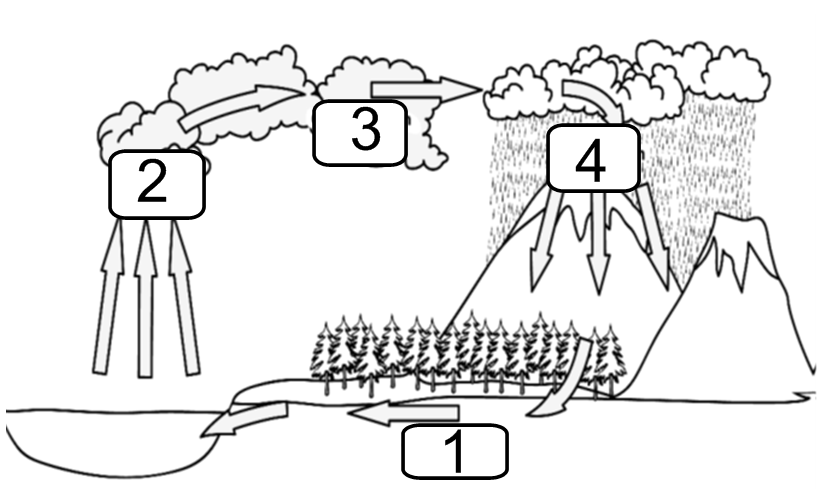
Which stage does the #2 show in the diagram?
a)
condensation
b)
evaporation
c)
precipitation
d)
run off
23.

Which stage does the #3 show in the diagram?
a)
condensation
b)
evaporation
c)
precipitation
d)
run off
24.

what does the #4 show in the diagram?
a)
condensation
b)
evaporation
c)
precipitation
d)
run off
25.
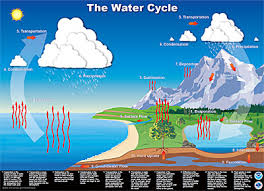
During which stage do clouds form?
a)
condensation
b)
evaporation
c)
precipitation
26.
What is the water cycle?
a)
the 3 forms of water
b)
the movement of water on, above, or below the surface of the Earth
c)
when water melts
d)
when clouds form
27.
When water _________, dew forms.
a)
Melts
b)
Evaporates
c)
Condenses
d)
Precipitates
28.

What is it called when plants give off water vapor as a waste product?
a)
condensation
b)
evaporation
c)
sublimation
d)
transpiration
29.

What does groundwater do?
a)
It sends water to our buildings, houses, and water transplant places
b)
to the sky
c)
to the sun
d)
To the Earth's surfaces
30.
Which best explains why runoff is important?
a)
It returns water to other locations on Earth
b)
It increases the chance of flooding
c)
It makes evaporation occur faster
d)
It increases condensation
31.
What is Cryosphere?
a)
All the water on Earth
b)
All the air of Earth
c)
All the living things on Earth
d)
All the frozen water on Earth
32.
What is Geosphere?
a)
Solid part of Earth
b)
Liquid part of Earth
c)
Frozen Portion of the Earth
d)
Air around the Earth
33.
What is Biosphere?
a)
All the living things on Earth
b)
Soils and Rocky parts of Earth
c)
Sea water of Earth
d)
Frozen Mountains on Earth
34.
What is Geosphere?
a)
Solid part of Earth
b)
Liquid part of Earth
c)
Frozen Portion of the Earth
d)
Air around the Earth
35.
What is Density?
a)
The amount of mass in a material per unit volume
b)
The destiny of a person explained by future science
c)
How much weight an object can pull or push to move it
d)
A standard for how popular a personality can get
36.
Cold air is more_____ than warm air
a)
Dense
b)
Stale
c)
Colorful
37.
When going up in an elevator, your ears 'pop' because the air pressure
a)
Remains the same
b)
Decreases
c)
Increases
38.
Air pressure decreases as what increases
a)
Water Vapor
b)
Altitude
c)
Radiation
39.
As the air is warmed how does it density change?
a)
It increases (Sinks)
b)
It Remains the same
c)
It decreases (Rises)
40.
What layer of the atmosphere contains the ozone layer?
a)
Mesosphere
b)
Stratosphere
c)
Thermosphere
d)
Exosphere
41.
A gradual increase in average global temperatures is called...
a)
global warming
b)
global heating up
c)
global cooling
d)
global hotness
42.
As you go higher in the troposphere, the temperature _______________.
a)
decreases
b)
increases
c)
stays the same
d)
gets very hot
43.
This is the layer where most commercial jet airliners fly.
a)
Troposphere
b)
Stratosphere
c)
Mesosphere
d)
Thermosphere
44.
Which layer exits into space?
a)
exosphere
b)
thermosphere
c)
troposphere
d)
mesosphere
45.
Which layer of the atmosphere contains the greatest amount of water vapor?
a)
Thermosphere
b)
Troposphere
c)
Mesosphere
d)
Stratosphere
46.

What layer of the atmosphere is the lowest (letter D)?
a)
mesosphere
b)
stratosphere
c)
thermosphere
d)
troposphere
47.

Which is the opposite of condensation?
a)
runoff
b)
evaporation
c)
precipitation
d)
transpiration
48.
What is it called when plants give off water vapor as a waste product?
a)
condensation
b)
evaporation
c)
sublimation
d)
transpiration
49.

The image is a model showing the processes of the water cycle. Water uptake to the atmosphere occurs through the processes of evaporation and transpiration from plants where it condenses to form clouds. Clouds release the water through precipitation. During a summer of extreme drought, what can we expect to happen to the surface ground water stored in ponds and lakes?
a)
water levels will increase because there is more precipitation
b)
animals won't drink as much to save water, so water levels remain the same
c)
water levels will increase because there is more evaporation and transpiration
d)
water levels will decrease because there is more evaporation and transpiration
50.

A model of the water cycle was made using an aquarium with a glass cover, a container of ice cubes, water, and a lamp.
Which part of the water cycle causes the water droplets to form on the glass cover?
Which part of the water cycle causes the water droplets to form on the glass cover?
a)
condensation
b)
evaporation
c)
precipitation
d)
runoff
51.
Rivers, springs, and aquifers are all fresh water components of the hydrologic cycle/water cycle. As this water progresses through the cycle, it will eventually ___________ into the atmosphere before ____________ and falling back to the earth as precipitation.
a)
condense; evaporating
b)
evaporate; condensing
c)
dissolve; cloud-forming
d)
condense; precipitating
52.
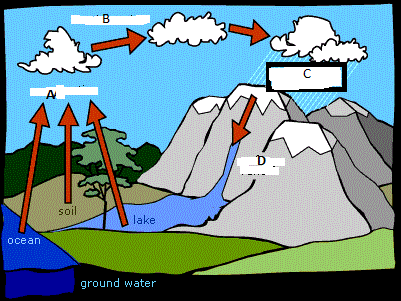
What is D?
a)
Evaporation
b)
Condensation
c)
Precipitation
d)
Runoff
53.
What factors determine the type of precipitation an area receives?
a)
Cloud and land altitude
b)
Cloud and air temperature
c)
Only land temperature
d)
Only cloud altitude
100 %

