
 Worksheets
Test Review DNA and Protein Synthesis
Total questions: 78
Worksheet time: 2hrs 56mins
Name
Class
Date
1.
What kind of organic molecule is DNA?
a)
Protein
b)
Nucleic Acid
c)
Lipid
d)
Carbohydrate
2.
What kind of sugar is found in DNA?
a)
Glucose
b)
Fructose
c)
Sucrose
d)
Deoxyribose
3.
What are the four bases found in DNA?
a)
Adenine, Thymine, Guanine and Cytosine
b)
Uracil, Thymine, Adenine and Guanine
c)
Guanine, Phosphate, Adenine, Thymine
d)
Adenine, Uracil, Guanine and Cytosine
4.
This is the process of using a DNA template to make a strand of mRNA
a)
Translation
b)
Transcription
c)
Replication
d)
Mitosis
5.

Which amino acid sequence will be made if the mRNA strand reads GGG UGU?
a)
Phe-Iso
b)
Val-Ala
c)
Val-Cys
d)
Gly-Cys
6.
Which two scientist developed the double helix model of DNA?
a)
Watson and Crick
b)
Darwin and Wallace
c)
Franklin and McDermitt
d)
Perry and Tyler
7.
The function of tRNA is to......
a)
produce a copy of mRNA
b)
break the hydrogen bonds of DNA
c)
transfer amino acids during translation
d)
separate sister chromatids
8.
Which sequence of DNA would be complementary to this sequence?
ATG TGA CAG
ATG TGA CAG
a)
ATG TGA CAG
b)
TAC ACT GTC
c)
GTA AGT GAC
d)
CAT TCA CTG
9.
Guanine bonds with ______________.
a)
Adenine
b)
Guanine
c)
Cytosine
d)
Thymine
10.
The five carbon sugar found in RNA
a)
Ribose
b)
Deoxyribose
c)
Glucose
11.

Why is DNA important?
a)
it is very small and very complicated
b)
it's in everything
c)
it serves as the blueprint for traits of all living things
d)
because we eat it every day for energy
12.
A process in which DNA has the unique ability to make an exact copy of itself.
a)
Replication
b)
Translation
c)
Transcription
13.
The building blocks of DNA & RNA consisting of a five-carbon sugar, a phosphate group, and a nitrogen-containing base.
a)
Genetics
b)
Replication
c)
Nucleotides
14.
Where does protein synthesis take place?
a)
Ligase
b)
Ribosomes
c)
Codon
d)
Endoplasmic Reticulum
15.
mRNA stands for
a)
my RNA
b)
messenger RNA
c)
mitosis RNA
d)
mutated RNA
16.
RNA is different from DNA in ___
a)
RNA is single stranded
b)
RNA has uracil
c)
RNA has the sugar ribos
d)
All of these
17.
In DNA which is a correct base pairing?
a)
A with G
b)
G with T
c)
A with U
d)
A with T
18.
Protein synthesis takes place in two parts:
a)
Transcription then translation
b)
Replication then transcription
c)
Translation then transcription
d)
Replication then translation
19.

which process is shown?
a)
diffusion
b)
repiration
c)
recombination
d)
translation
20.
True/False: The genetic code is common to all living things.
a)
True
b)
False
21.
What mutation has occurred here?
T-G-A-C-C-A
T-G-A-G-C-A
T-G-A-C-C-A
T-G-A-G-C-A
a)
Substitution
b)
Deletion
c)
Insertion
d)
Frameshift
22.
Are all mutations bad?
a)
Yes
b)
No
23.
Which of the following would result in a frameshift mutation?
a)
Insertions only
b)
Substitution only
c)
Deletion only
d)
Insertions and Deletions
24.
A type of substitution in which no amino acids change is called
a)
Missense
b)
Nonsense
c)
Silent
d)
Deletion
25.
This type of substitution codes for a stop codon
a)
Missense
b)
Nonsense
c)
Silent
d)
Deletion
26.
If one amino acid is substituted for another, this is referred to as a
a)
insertion mutation
b)
missense mutation
c)
nonsense mutation
d)
nondisjunction mutation
27.
What is a codon?
a)
It is a three letter section of bases that are read by ribosomes to stamp amino acids into a protein
b)
They are the codes on the DNA (hence "code-on"
c)
It is a type of mutation that occurs when there has been a substitution, deletion or insertion.
d)
It is a made up word for this quiz. Nice try, Wampler.
28.
Why are insertion and deletion (frameshift) mutations so harmful?
a)
They change all of the codons from the mutation on down the line, which changes the amino acid sequence
b)
They insert things that an organism doesn't need.
c)
They often delete things that organisms need.
d)
Insertion and deletions are not any more harmful than substitution mutations.
29.
ATTTGAGCC- Original
ATTGAGCC - Mutated
The example above is an example of a
ATTGAGCC - Mutated
The example above is an example of a
a)
Insertion- Frameshift
b)
Deletion- Substitution
c)
Deletion -Frameshift
d)
All of the above
30.
DNA molecule segment is : TTACGCAAG
The mutated DNA segment is TTACGCAAC. This is an example of ___ mutation.
The mutated DNA segment is TTACGCAAC. This is an example of ___ mutation.
a)
Substitution
b)
Insertion
c)
Inversion
d)
Translocation
31.
In DNA, Adenine bonds with ______________.
a)
Guanine
b)
Thymine
c)
Cytosine
d)
Adenine
32.
Guanine bonds with ______________.
a)
Adenine
b)
Guanine
c)
Cytosine
d)
Thymine
33.

What molecule is shown in the double helix diagram shown?
a)
DAN
b)
RAN
c)
DNA
d)
RNA
34.
Which of these bases does not exist in RNA?
a)
C
b)
T
c)
U
d)
A
35.

Which amino acid is made from the RNA codon ACC?
a)
Tyrosine
b)
Isoleucine
c)
Threonine
d)
Valine
36.
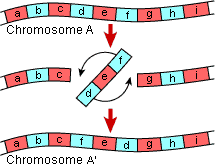
What type of chromosomal mutation is this?
a)
Translocation
b)
Inversion
c)
Deletion
d)
Duplication
37.
Chromosomes are
a)
Tightly wound strands of DNA
b)
Tightly wound proteins
c)
Found in the mitochondria
d)
Not important for cell division
38.
How does DNA create proteins for a cell?
a)
by creating a new double helix
b)
by using phosphate and sugar molecules
c)
by adding more hydrogen bonds
d)
by arranging certain nitrogen bases in a particular order
39.
What is produced during transcription?
a)
RNA molecules
b)
DNA molecules
c)
RNA polymerase
d)
proteins
40.
What is the correct sequence?
a)
protein-->DNA-->RNA
b)
RNA-->DNA-->protein
c)
DNA-->RNA-->protein
d)
RNA-->protein-->DNA
41.
How many nucleotides are needed to specify THREE amino acids?
a)
3
b)
6
c)
9
d)
12
42.
Which base sequence cannot occur in RNA?
a)
GCUAGG
b)
TGCTAT
c)
CCUAAC
d)
AAGCCC
43.
Which of these is NOT a possible cause of DNA mutation?
a)
extreme hot temperatures
b)
extreme cold temperatures
c)
radiation
d)
toxic chemicals
44.
Which best describes the initial change created by a DNA mutation?
a)
change in production of enzymes
b)
change in sequence of base pairs
c)
change in number of nucleosomes
d)
change in number of hydrogen bonds
45.
Unlike DNA, RNA contains
a)
adenine
b)
uracil
c)
phosphate groups
d)
thymine
46.
Which best describes the relationship between DNA, RNA, and protein?
a)
proteins combine to produce cells which produce DNA
b)
proteins are made of DNA, which determines the cells that are produced
c)
DNA is made of protein, which tells a cell how to function
d)
Cells contain DNA, which controls the production of protein in a cell
47.
What happens during translation?
a)
mRNA is made from a DNA code
b)
cell uses mRNA code to make proteins
c)
cell division occurs
d)
copies of DNA are made
48.
The DNA sequence below is part of a gene. How many amino acids does it code for?
ATGCATGGCATA
ATGCATGGCATA
a)
4
b)
8
c)
12
d)
20
49.
What is the correct base sequence if the segment below is transcribed into mRNA?
TAGCTAAAG
TAGCTAAAG
a)
AUCGAUUUC
b)
AUGCATTTC
c)
TAGCTAAGC
d)
AUCGUTTTG
50.
Which of the following processes produces the nucleotide sequence UUA from the DNA sequence AAT?
a)
meiosis
b)
translation
c)
transcription
d)
replication
51.
Which type of RNA brings the information in the genetic code from the nucleus to other parts of the cell?
a)
rRNA
b)
tRNA
c)
mRNA
d)
RNA polymerase
52.
From which molecule are mRNA molecules transcribed?
a)
tRNA
b)
rRNA
c)
DNA
d)
proteins
53.
Which molecules are involved in protein synthesis?
a)
tRNA, introns, mutagens
b)
mRNA, introns, rRNA
c)
rRNA, tRNA, mutagens
d)
mRNA, rRNA, tRNA
54.
Genes contain instructions for assembling
a)
operons
b)
nucleosomes
c)
proteins
d)
mutagens
55.
Which of the following processes links amino acids into a protein using an mRNA template?
a)
replication
b)
meiosis
c)
translation
d)
transcription
56.
Which of the following are found in both DNA and RNA?
a)
ribose, phosphate groups, adenine
b)
deoxyribose, phosphate groups, guanine
c)
phosphate groups, guanine, cytosine
d)
phosphate groups, guanine, thymine
57.
Most mutations
a)
have no effect on an organism
b)
are fatal
c)
are helpful
d)
are harmful
58.
Which of the following is a nucleotide found in DNA?
a)
adenine+phosphate+thymine
b)
cytosine+phosphate+guanine
c)
deoxyribose+phosphate+polymerase
d)
deoxyribose+phosphate group+cytosine
59.
What stores information in a cell?
a)
proteins
b)
carbohydrates
c)
lipids
d)
DNA
60.
What happens when a piece of DNA is missing?
a)
genetic information is stored
b)
genetic information is copied
c)
genetic information is lost
d)
genetic information is transmitted
61.
Which forms a base pair with thymine?
a)
deoxyribose
b)
adenine
c)
guanine
d)
cytosine
62.
DNA replication results in 2 DNA molecules
a)
each with 2 new strands
b)
1 with 2 new strands and 1 with 2 original strands
c)
each with 1 new and 1 original
d)
each with 2 original
63.
What type of bond holds the 2 strands together?
a)
peptide
b)
hydrogen
c)
ionic
d)
strong
64.
The diffusion of WATER across a selectively permeable membrane is called
a)
osmotic pressure
b)
osmosis
c)
pinocytosis
d)
active transport
65.
During DNA replication, a DNA strand that has the bases CTAGGT produces a strand with the bases
a)
TCGAAC
b)
GATCCA
c)
AGCTTG
d)
GAUCCA
66.
In eukaryotes, DNA
a)
is in the nucleus
b)
floats freely in the cytoplasm
c)
is located in the ribosomes
d)
is circular
67.
Which forms a base pair with guanine?
a)
cytosine
b)
adenine
c)
thymine
d)
uracil
68.
Which is a heterotroph?
a)
alligator
b)
algae
c)
wheat
d)
sunflower
69.
During DNA replication, a DNA strand that has the bases TTTAAACC produces a strand with which bases?
a)
TTTAAACC
b)
AAAAAACC
c)
AAATTTGG
d)
AAATTTUU
70.
Which organelles converts the energy stored in food into compounds more convenient for the cell to use?
a)
chloroplast
b)
Golgi apparatus
c)
endoplasmic reticulum
d)
mitochondira
71.
Where is DNA replicated?
a)
ribosome
b)
golgi
c)
nucleus
d)
Cell membrane
72.
Which term describes the relatively constant internal physical conditions of an organism?
a)
cell specialization
b)
homeostasis
c)
organ system
d)
unicellularity
73.
Organisms that make their own food are
a)
autotrophs
b)
heterotrophs
c)
thylakoids
d)
pigments
74.
DNA mutations can be caused by all but which of the following?
a)
X-rays
b)
high temperatures
c)
freezing temperatures
d)
UV radiation
75.
Which is one of the ways that cellular respiration and photosynthesis are related?
a)
photosynthesis releases energy and cellular respiration stores energy
b)
Photosynthesis removes CO2 from the atmosphere and cellular respiration puts it back
c)
Photosynthesis removes O from the atmosphere and cellular respiration puts it back
d)
photosynthesis consumes glucose and cellular respiration produces glucose
76.
photosynthesis is to chloroplasts as cellular respiration is to
a)
chloroplasts
b)
cytoplasm
c)
mitochondria
d)
nuclei
77.
A student is studying how temperature affects the number of chirps a cricket makes. What would be an appropriate control group?
a)
a group at near freezing
b)
a group at very hot temperatures
c)
a group at boiling temperatures
d)
a group at room temperature
78.
A scientist wants to test the effect of a new drug on cancer cells. What is the dependent variable?
a)
a new drug
b)
time of experiment
c)
growth of cancer cells
d)
size of test tube
100 %

