
 Worksheets
Solar System & Exploration
Total questions: 84
Worksheet time: 1hrs 15mins
Name
Class
Date
1.
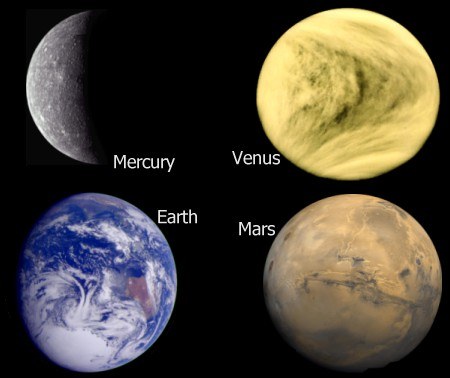
Earth and the other planets closest to the Sun are made mostly of _______
a)
gas
b)
metal
c)
water
d)
rock
2.

Earth's ________ on its axis causes day and night.
a)
rotation
b)
revolution
c)
phase
d)
comet
3.

One full orbit of an object around another object is called a ________.
a)
axis
b)
rotation
c)
revolution
d)
satellite
4.

The __________ has planets, moons, comets, and asteroids.
a)
solar system
b)
earth
c)
rotation
d)
United States
5.
One of the main differences between the outer and inner planets is __________.
a)
The inner planets all have water
b)
the inner planets are much bigger than the outer planets
c)
the outer planets are gas planets
d)
the outer planets have rings, and the inner planets don't
6.
Where is the asteroid belt found?
a)
between earth and mars
b)
Between Uranus and Neptune
c)
Between Mercury and Venus
d)
Between Mars and Jupiter
7.
Select the order from smallest to largest.
a)
Sun, Milky Way, solar system, universe
b)
Sun, Milky Way, universe, solar system
c)
Sun, solar system, Milky Way, universe
d)
Sun, solar system, universe, Milky Way
8.
Why does Earth have different seasons?
a)
because of the distance between Earth and the sun
b)
because of the speed of Earth as it rotates on its axis
c)
because of the amount of light blocked by the moon on its axis
d)
because of the tilt of Earth on its axis as it moves around the sun
9.
Which factor makes Earth different from all the other planets in the solar system in its ability to support life?
a)
The Earth is exposed to rays from the sun.
b)
The Earth has only one moon that orbits around it.
c)
The Earth rotates in an elliptical orbit around the sun.
d)
The Earth has a breathable atmosphere.
10.
Which best explains why the moon has phases?
a)
The moon’s position changes in relation to the sun and Earth.
b)
The sun’s position changes in relation to the moon and Earth.
c)
The Earth casts a shadow on the moon as it rotates.
d)
The moon rotates along its axis
11.
Day and night is caused by the _____________ of earth on its axis.
a)
revolution
b)
orbit
c)
rotation
12.
Which outer planets have rings?
a)
Just Saturn
b)
Saturn and Jupiter
c)
Jupiter, Neptune, and Saturn
d)
all 4 of them
13.

a pattern of stars that form an imaginary picture or design in the sky
a)
Orbit
b)
Rotate
c)
constellation
d)
Milky Way
14.
A spiral galaxy of stars that contains our Sun
a)
Planisphere
b)
Intensity
c)
Star
d)
Milky Way
15.
The pattern of stars in a constellation stays the same, but a planet can be seen in different locations at different times because _______________.
a)
Stars don't move; planets revolve and rotate
b)
Stars and planets revolve and rotate.
c)
Stars not planets move
d)
Planets don't move; Stars revolve and rotate.
16.
Which color star has medium temperature?
a)
Bluish-White
b)
Yellow
c)
Reddish-Orange
17.
Which of the following causes seasons?
a)
the earths tilt
b)
the earths rotation
c)
the earths revolution around the sun
d)
the earths size
18.
What is at the center of our solar system?
a)
Earth
b)
Sun
c)
Nebula
d)
Black Hole
19.
Which planet has life?
a)
Uranus
b)
Earth
c)
Jupiter
d)
Saturn
20.
Which planet is known for its rings?
a)
Saturn
b)
Uranus
c)
Jupiter
d)
Venus
21.
a large ball of ice and dust that orbits the sun
a)
asteroid
b)
meter
c)
comet
22.
Which of the following is an accurate model of how the Sun, Earth, and Moon move?
a)
Sun and moon orbit Earth
b)
Earth and moon orbit Sun
c)
Earth orbit's the Sun and the moon orbits Earth
d)
Earth and sun orbit moon
23.

What is a solar eclipse?
a)
When the earth passes between the moon and the sun
b)
When the moon passes between the sun and the earth
c)
When there's a full moon
d)
When the sun changes positions
24.
What is an astronomical unit?
a)
distance between the moon and earth
b)
distance between the earth and pluto
c)
distance between the earth and sun
d)
distance between NJ and Cali
25.
What keeps a planet moving on its path around the sun
a)
gravity & inertia
b)
heat & pressure
c)
inertia & pressure
d)
gravity & heat
26.
Which best explains why the moon has phases?
a)
The moon’s position changes in relation to the sun and Earth.
b)
The sun’s position changes in relation to the moon and Earth.
c)
The Earth casts a shadow on the moon as it rotates.
d)
The moon rotates along its axis
27.
What happens when the Earth's Northern Hemisphere is tilted toward the sun?
a)
We have winter
b)
We have summer
c)
We have bad weather
28.
The stars appear to move across Earth’s sky. Which statement explains why this happens?
a)
The stars orbit Earth
b)
Earth rotates on its axis and orbits the sun.
c)
The sun orbits Earth.
29.
The stars appear to move across Earth’s sky. Which statement explains why this happens?
a)
The stars orbit Earth
b)
Earth rotates on its axis and orbits the sun.
c)
The sun orbits Earth.
30.
How long does a year take on Mars? (1 round around the sun)
a)
379.92 days
b)
3,718.15 days
c)
686.98 days
31.
Why is the daily temperature variation on Mars so much larger than we experience on Earth?
a)
Mars spins slowly, so its nights are very long
b)
Mars is much darker than the Earth, so it absorbs more sunlight
c)
Mars' atmosphere is too thin to insulate the surface
32.
Planets that are farther from the sun
a)
take more time to orbit
b)
take less time to orbit
33.

Which of the following are characteristics of the planet Mars?
a)
breathable atmosphere and water
b)
rocky,rusty , soil and ice caps
c)
large blue storm and methane gas
34.
Why do Mercury and the Moon lack an atmosphere?
a)
They formed after all the gas had been used up.
b)
They are so cold that all their gases have frozen into deposits below their surface.
c)
They formed before the solar nebula had captured any gas.
d)
They are so small that their gravity is too weak to retain an atmosphere.
35.
In the late 1600's, Sir Isaac Newton proposed that movements of the bodies in the Solar System are controlled by an invisible universal force called
a)
nuclear force
b)
electrical force
c)
gravitational force
d)
magnetic force
36.
Gravity on the moon is about 1/6 the gravity felt on the earth. This is because
a)
the moon is much less massive than the earth
b)
the earth has a molten core and the moon doesn't
c)
the moon is so much further from the sun than the earth.
37.
When riding your bike and you brake suddenly, your body keeps going forward because of
a)
inertia
b)
gravity
c)
friction
d)
speed
38.
On Saturn, you would weigh more because
a)
Saturn has more mass and less gravity
b)
Saturn has more mass and gravity
c)
Saturn has less mass and more gravity
39.

If Earth's mass was cut in half, what would happen to your weight?
a)
Increase because gravitational force increases
b)
decrease because gravitational force decreases
c)
decrease because gravitational force increases
d)
nothing, weight is not affected by gravitational force
40.

If a feather and a hammer are dropped at the same time on the moon, where there is no atmosphere, which one will hit the ground first?
a)
Neither, there is no gravity on the moon.
b)
hammer because it has more mass
c)
feather because it has less mass
d)
both will hit at the same time
41.
The order of the planets is:
a)
Mars,Venus,Earth,
Mercury,Saturn
Jupiter, Uranus, Neptune
Mercury,Saturn
Jupiter, Uranus, Neptune
b)
Earth,Venus,Mars
Jupiter, Neptune,
Mercury,Saturn,
Uranus
Jupiter, Neptune,
Mercury,Saturn,
Uranus
c)
Mercury,Venus,Earth
Mars,Jupiter,
Saturn,Uranus
Neptune
Mars,Jupiter,
Saturn,Uranus
Neptune
42.
The earth orbits around...
a)
the sun.
b)
the moon
c)
other planets
d)
the Milky Way
43.
Which is the largest object in our solar system?
a)
Sun
b)
Jupiter
c)
Earth
d)
Pluto
44.
A ball of ice and dust with a tail of gas and dust pointing away from the sun.
a)
Asteroid
b)
Comet
c)
Moon
d)
Meteor
45.
A small rocky object orbiting the sun.
a)
Asteroid
b)
Comet
c)
Moon
d)
Meteor
46.
Earth and the other planets closest to the Sun are made mostly of _______
a)
gas
b)
metal
c)
water
d)
rock
47.
The __________ has planets, moons, comets, and asteroids.
a)
solar system
b)
earth
c)
rotation
d)
United States
48.
One of the main differences between the outer and inner planets is __________.
a)
The inner planets all have water
b)
the inner planets are much bigger than the outer planets
c)
the outer planets are gas planets
d)
the outer planets have rings, and the inner planets don't
49.
Where is the asteroid belt found?
a)
between earth and mars
b)
Between Uranus and Neptune
c)
Between Mercury and Venus
d)
Between Mars and Jupiter
50.
In what form does the Sun's energy travel to Earth?
a)
Heat
b)
Electrical energy
c)
Electromagnetic radiation
d)
Mechanical energy
51.
Which of the following is an accurate model of how the Sun, Earth, and Moon move?
a)
Sun and moon orbit Earth
b)
Earth and moon orbit Sun
c)
Earth orbit's the Sun and the moon orbits Earth
d)
Earth and sun orbit moon
52.

The moon is a natural ______ of Earth.
a)
comet
b)
axis
c)
satellite
d)
space probe
53.
Which planet in our solar system is closest to the Sun?
a)
Earth
b)
Jupiter
c)
Mercury
d)
Saturn
54.
Which of the following is an accurate model of how the Sun, Earth, and Moon move?
a)
Sun and moon orbit Earth
b)
Earth and moon orbit Sun
c)
Earth orbit's the Sun and the moon orbits Earth
d)
Earth and sun orbit moon
55.
How many days does it take the Earth to revolve around the Sun?
a)
30 days
b)
365 days
c)
100 days
d)
40 days
56.
What is the Hottest planet in our solar system?
a)
Mercury
b)
Earth
c)
Venus
d)
Mars
57.
Why is Venus so hot?
a)
Volcanic Activity
b)
Hydrogen Core
c)
Fast Rotation
d)
Metal Atmoshpere
58.
Meteorites
a)
are in space
b)
crossed atmosphere
c)
hit the ground
59.
Meteors
a)
are in space
b)
crossed the atmosphere
c)
hit the ground
60.
Name of the most famous comet in our solar system
a)
Cassinni
b)
Halley
c)
Hayakutake
d)
Heavens
61.
Which is not a minor member of our solar system?
a)
Comets
b)
Asteroids
c)
Meteoroids
d)
Stars
62.
What are the inner planets called?
a)
Jovian
b)
Gas Giants
c)
Terrestrial
d)
Ice Giants
63.
What are the inner planets made of?
a)
Rock
b)
Ice
c)
Gas
d)
Ammonia
64.
What are the Outer Planets called?
a)
Jovian
b)
Terrestrial
c)
Rocky Giants
d)
Metal Giants
65.
What is the Red planet?
a)
Venus
b)
Neptune
c)
Jupiter
d)
Mars
66.
Which planet has life?
a)
Uranus
b)
Earth
c)
Jupiter
d)
Saturn
67.
Which planet rotates on it's side?
a)
Venus
b)
Jupiter
c)
Saturn
d)
Uranus
68.
Which planet is the "Windy Planet"?
a)
Mars
b)
Saturn
c)
Neptune
d)
Uranus
69.
Earth's ________ on its axis causes day and night.
a)
rotation
b)
revolution
c)
phase
d)
comet
70.
Which is the sixth planet from the sun?
a)
Earth
b)
Uranus
c)
Saturn
d)
Neptune
71.
Which planet is fifth from the sun?
a)
Saturn
b)
Jupiter
c)
Mars
d)
Earth
72.
Which is the fourth planet from the sun?
a)
Mars
b)
Saturn
c)
Earth
d)
Jupiter
73.
Which planet is farthest from the sun?
a)
Neptune
b)
Pluto
c)
Earth
d)
Uranus
74.
A ball of ice and dust with a tail of gas and dust pointing away from the sun.
a)
Asteroid
b)
Comet
c)
Moon
d)
Meteor
75.
Which is the sixth planet from the sun?
a)
Earth
b)
Uranus
c)
Saturn
d)
Neptune
76.
Which is the largest object in our solar system?
a)
Sun
b)
Jupiter
c)
Earth
d)
Pluto
77.
Which is not a terrestrial planet?
a)
Earth
b)
Mars
c)
Neptune
d)
Venus
78.
How many days does it take the Earth to revolve around the Sun?
a)
30 days
b)
365 days
c)
100 days
d)
40 days
79.
The __________ has planets, moons, comets, and asteroids.
a)
solar system
b)
earth
c)
rotation
d)
United States
80.
Which of the following is an accurate model of how the Sun, Earth, and Moon move?
a)
Sun and moon orbit Earth
b)
Earth and moon orbit Sun
c)
Earth orbit's the Sun and the moon orbits Earth
d)
Earth and sun orbit moon
81.
The farther from the sun the _____________ the revolution (year)
a)
shorter
b)
longer
82.
What holds the moon, the planets, and all other objects in orbit around the sun?
a)
ocean tides
b)
magnetism
c)
gravity
d)
the sun's heat and light
83.
The inner planets are:
a)
Jupiter, Earth, Mars, Mercury
b)
Saturn, Uranus, Mars, Earth
c)
Earth, Pluto, Neptune, Mars
d)
Mercury, Venus, Earth, Mars
84.
The GAS GIANTS or Outer planets are:
a)
Mercury, Earth, Jupiter, Saturn
b)
Saturn, Neptune, Pluto, Mars
c)
Saturn, Jupiter, Uranus, Neptune
d)
Earth, Mars, Saturn, Neptune
100 %

