
 Worksheets
1st 9 Weeks Review
Total questions: 80
Worksheet time: 1hrs 23mins
Name
Class
Date
1.
Extreme Heat and Pressure creates a _________ rock.
a)
Igneous
b)
Metamorphic
c)
Sedimentary
d)
Mineral
2.
True or False: Once a rock is sedimentary, it cannot become an igneous rock.
a)
True
b)
False
3.
What rock type would be commonly found around volcanoes?
a)
Igneous
b)
Sedimentary
c)
Metamorphic
d)
None of the above
4.
When inside a volcano, the hot liquid that can cool to form rocks is called __________.
a)
lava
b)
magma
c)
extrusive
d)
liquid goo
5.

This rock was formed by lots of fossils that settled on top of each other over time. What type of rock is this?
a)
Sedimentary
b)
Igneous
c)
Metamorphic
6.
A mineral is a living object
a)
True
b)
False
7.

This rock is made from tiny pieces of other rocks that settled to the bottom of a valley millions of years ago. What type of rock is this?
a)
Sedimentary
b)
Igneous
c)
Metamorphic
8.
An igneous rock can become ______.
a)
metamorphic
b)
sedimentary
c)
igneous
d)
all of these
9.
The name rock is given when it is broken down into smaller pieces.
a)
texture
b)
weathering
c)
sediment
d)
erosion
10.
What does it mean for a rock to be extrusive?
a)
Have layers
b)
Have Rounded Edges
c)
Form from Lava
d)
Form By Sediment
11.
What process(es) make sediment?
a)
Weathering
b)
Erosion
c)
Weathering & Erosion
12.
A natural mixture of minerals.
a)
erosion
b)
magma
c)
alloys
d)
rock
13.
What does it mean for a rock to be intrusive?
a)
Made by lava
b)
Made by magma
c)
Made by erosion
d)
Made by heat and pressure
14.
Which of the following is NOT a rock type?
a)
Sedimentary Rock
b)
Igneous Rock
c)
Metamorphic Rock
d)
Stone Rock
15.
What is the rock cycle?
a)
molten rock that is stored underground.
b)
rock material that forms where rocks are broken down into smaller pieces.
c)
a process that changes one type of rock into another type of rock.
16.

Is this metamorphic rock foliated or non-foliated?
a)
foliated
b)
non-foliated
17.

Is this metamorphic rock foliated or non-foliated?
a)
foliated
b)
non-foliated
18.
Is lava above or below ground
a)
below
b)
above
19.
The process by which igneous rocks are formed...
a)
heat and pressure
b)
melting and cooling
c)
compaction and cementation
20.
What step changes sediment into sedimentary rock.
a)
Cementation
b)
Compaction
c)
Erosion
d)
Both cementation and compaction
21.
What mineral is known as "fools gold"?
a)
graphite
b)
quartz
c)
galena
d)
pyrite
22.
The color of a mineral in powder form is called?
a)
hardness
b)
specific gravity
c)
luster
d)
streak
23.
How light reflects off of a mineral is called?
a)
luster
b)
streak
c)
cleavage
d)
fracture
24.
Occurs when a mineral breaks along a smooth, flat surface
a)
cleavage
b)
fracture
c)
streak
d)
luster
25.
A mineral's resistance to being scratched is called?
a)
streak
b)
luster
c)
hardness
d)
heft
26.

By definition, a mineral has which of the following characteristic(s)?
a)
chemical composition
b)
crystalline structure
c)
natural occurring
d)
all of the above
27.
Which of the following is NOT a characteristic of a mineral?
a)
Naturally Occurring
b)
Organic
c)
Chemical Composition
d)
Solid
28.
What are the two types of luster?
a)
Metallic and Metallic
b)
Nonmetallic and Shiny
c)
Metallic and Nonmetallic
d)
Shiny and Dull
29.

Diamond has a hardness of ___ on Mohs Hardness Scale.
a)
1
b)
5
c)
8
d)
10
30.
The tenancy for a mineral to break along curved, irregular shaped surfaces refers to?
a)
mineral
b)
luster
c)
hardness
d)
fracture
31.

Which mineral property is being shown here?
a)
luster
b)
hardness
c)
cleavage
d)
streak
32.
the ratio of mass to volume of a substance
a)
Speed
b)
Solid
c)
Weight
d)
Density
33.
used to determine a mineral's resistance to being scratched
a)
Hardness
b)
Streak Plate
c)
Moh's Hardness Scale
d)
Hammer
34.
Approved eye protection devices (such as goggles) are worn in the laboratory
a)
to improve vision
b)
only if you don't wear glasses
c)
anytime heat, chemicals, or glassware are used
d)
to avoid eye strain
35.
You are heating a substance in a test tube. Always point the open end of the tube
a)
towards your body
b)
toward your lab partner
c)
towards another classmate
d)
away from all people
36.
You have been injured in the laboratory (cut, burn, etc.). First you should
a)
visit school nurse
b)
text your parent
c)
see a doctor after school
d)
tell teacher immediatly
37.

Report any accident or injury to the teacher _______________, no matter how small it may appear
a)
at the end of the period
b)
immediately
c)
eventually
d)
after you get the situation under control
38.

The proper technique for smelling chemicals is ______________
a)
keeping your nose close to the glassware
b)
wafting
c)
to sniff only a small amount
d)
Trick question; you never are allowed to smell chemicals in class
39.

If you break a glass container during lab, you should ___________________
a)
clean it up immediately
b)
yell "Code One" and letting your teacher clean it up
c)
alert your lab partners and other groups near you and tell your teacher
d)
leave it and tell your teacher after the lab is completed
40.

Perform only ______________________
a)
safe experiments
b)
experiments authorized by your teacher
c)
if you are a good actor
d)
experiments that cause FIRE!!!
41.
A testable prediction about a scientific investigation complete with an educated guess about the results
a)
Question
b)
Observation
c)
Hypothesis
d)
Experiment
42.
What is the first step in the scientific method?
a)
Develop a question that you want answered
b)
Design and conduct an experiment
c)
Make an hypothesis
d)
Share your results
43.
This step should be done more than once to ensure accurate results
a)
Conduct an experiment
b)
Ask a question
c)
Record data
d)
Clean up after your investigation
44.
What equipment is used to measure mass?
a)
ruler
b)
graduated cylinder
c)
scale
d)
triple beam balance
45.
What is the abbreviation for milliliter?
a)
mL
b)
ml
c)
mm
d)
L
46.
What is mass?
a)
the distance between two points
b)
the amount of matter (stuff) in an object
c)
the amount of space an object takes up
d)
the distance between three points
47.
What units do we use to measure mass?
a)
milliliters (mL)
b)
liters (L)
c)
centimeters (cm)
d)
grams (g)
48.
In which state of matter do the particles spread apart and fill all the space available to them?
a)
crystal
b)
liquid
c)
gas
d)
solid
49.
How is a solid defined?
a)
Indefinite shape and indefinite volume
b)
Definite shape and definite volume
c)
Found in the stars
d)
Definite volume, indefinite shape
50.
anything that has mass and takes up space
a)
mass
b)
volume
c)
matter
d)
particles
51.
The process that breaks down rocks and other materials on Earth's surface is called
a)
weathering
b)
erosion
c)
soil conservation
d)
decomposition
52.

What is mechanical weathering?
a)
Process through which rocks are physically broken into smaller pieces.
b)
Rocks are broken down through chemical changes.
c)
Rocks are worn away from acid in plant roots.
d)
Rocks broken down by machinery.
53.
How does freezing water cause the weathering of rocks? The freezing water—
a)
keeps the rocks in place
b)
makes the rocks last longer
c)
expands cracks and breaks rocks
d)
causes rocks to fall in landslides
54.
Rain washing away soil from a hillside
a)
Weathering
b)
Erosion
c)
Deposition
55.
Waves dropping sand on the beach
a)
Weathering
b)
Erosion
c)
Deposition
56.
Wind blowing sand from one location to another
a)
Weathering
b)
Erosion
c)
Deposition
57.
Muddy water being carried away by a fast-moving river
a)
Weathering
b)
Erosion
c)
Deposition
58.
Flood waters moving soil from one location to another
a)
Weathering
b)
Erosion
c)
Deposition
59.
Wind blasting sand at rock and carving out arches
a)
Weathering
b)
Erosion
c)
Deposition
60.
Weathering involves the movement of rocks and minerals by agents such as water, wind and gravity.
a)
True
b)
False
61.
What is the process of moving sediments from location to another?
a)
Deposition
b)
Erosion
c)
Weathering
d)
Compaction
62.
What is the correct order of the processes?
a)
they all happen at the same time
b)
erosion, weathering, deposition
c)
weathering, erosion, deposition
d)
weathering, deposition, erosion
63.
What is the small broken down pieces of rock called?
a)
dirt
b)
grime
c)
sediment
d)
popcorn
64.
What force lays down sediment in new locations?
a)
Erosion
b)
Weathering
c)
Deposition
d)
Abrasion
65.
Weeds growing into the cracks in a sidewalk and the sidewalk begins to crumble is an example of:
a)
mechanical weathering
b)
chemical weathering
66.
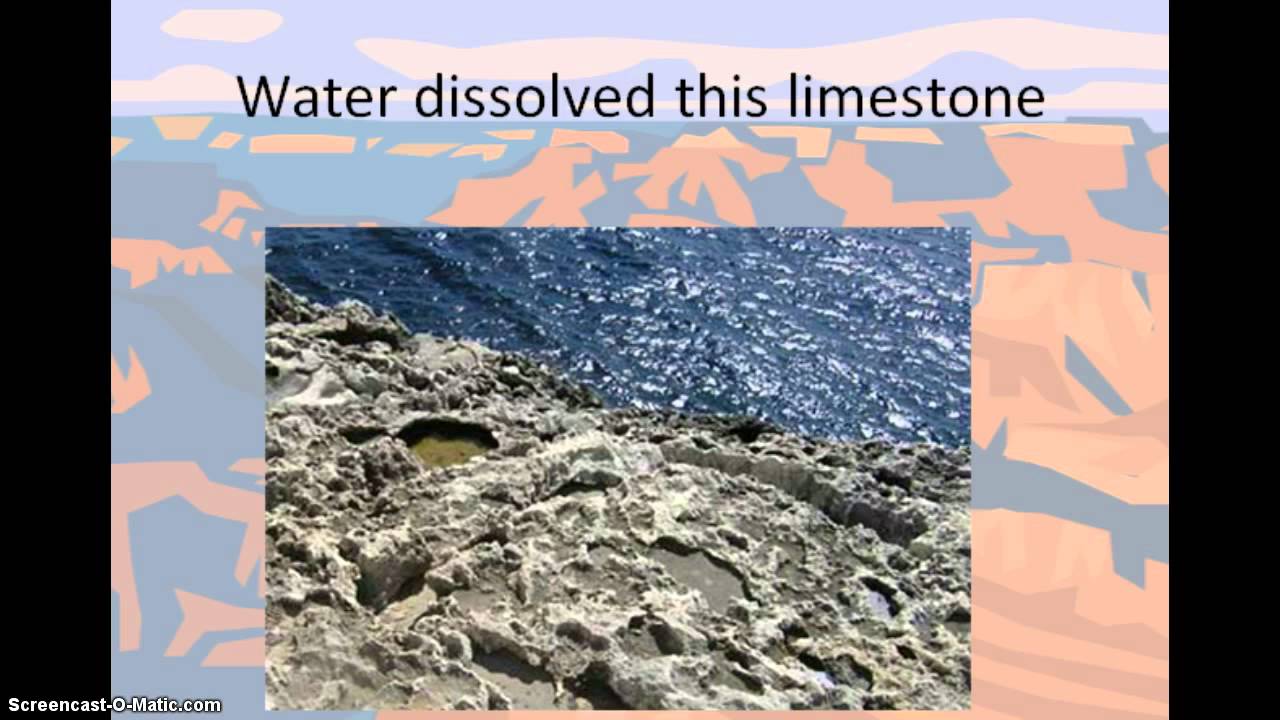
Is this an example of physical or chemical weathering?
a)
Physical
b)
Chemical
67.
Caves being formed by acid rain dissolving underground limestone
a)
Weathering
b)
Erosion
c)
Deposition
68.
Deltas forming at the mouths of rivers
a)
Weathering
b)
Erosion
c)
Deposition
69.
A metal statue slowly turning green after years of being outside is an example of:
a)
physical weathering
b)
chemical weathering
70.
Lichens (small green plants) growing on a large boulder release enzymes and other acids that slowly break the rock apart. This is an example of:
a)
physical weathering
b)
chemical weathering
71.
Exposure to rain and oxygen causes the metal minerals in rocks to rust and fall apart. This is an example of:
a)
physical weathering
b)
chemical weathering
72.
What would the INDEPENDENT variable be in an experiment testing which types of paper airplane goes furthest?
a)
the paper used
b)
the type of paper airplane
c)
the distance of each plane's flight
d)
how hard the plane is thrown
73.
When experimenting with the growth of a plant, a scientist uses three (of the same type of) plants, two different fertilizers, equal light, and equal water. What type of variable is the fertilizer?
a)
Dependent
b)
Independent
c)
Control
d)
Compound
74.
The independent variable is the ONE thing you _____.
a)
change
b)
keep the same
c)
experiment with
d)
investigate
75.
The measurable factor in an experiment is known as the:
a)
Control
b)
Independent Variable
c)
Constant
d)
Dependent Variable
76.
Walker is testing which fertilizer will grow the tallest grass. The height of the grown grass is the __ variable.
a)
constant (same)
b)
independent (changes)
c)
dependent (measured)
77.
A comprehension test was given to students after they had studied textbook material either in silence or with the television turned on. What is the dependent variable?
a)
silence
b)
television turned on
c)
score on test
d)
textbook material
78.
Weathering and erosion are the same thing.
a)
True
b)
False
79.

The diagrams shows a rock with water trapped in the cracks during the day and at night.
Which statement best explains why this process results in weathering?
Which statement best explains why this process results in weathering?
a)
frozen water acts as a solute
b)
water expands when it freezes
c)
the mass of water increases when it freezes
d)
frozen water dissolves most types of rock
80.

How do plants weather rocks?
a)
during photosynthesis
b)
when roots grow into cracks of rocks and expand the rock
c)
when the plant moves water from the roots to the leaves
100 %

