Wayground logo

Free Printable Worksheets

Font size

S
M
L
XL
Worksheets

PASS Blast Study Guide - Weather

Total questions: 80

Worksheet time: 1hrs 23mins

Name
Class
Date
1.

List the 5 layers from the surface of the earth to space

a)

Thermosphere, Mesosphere, Stratosphere, Troposphere, Exosphere

b)

Magnetosphere, Exosphere, Ionosphere, Ozonosphere, Troposphere

c)

Troposphere, Stratosphere, Mesosphere, Thermosphere, Exosphere

2.
Which layer does most weather occur in?
a)
thermosphere
b)
troposphere
c)
stratosphere
d)
ionosphere
3.
The layers of the atmosphere are separated according to  changes in. 
a)
Altitude 
b)
Elevation
c)
Temperature
d)
Distance from the sun
4.
This is the layer where most commercial jet airliners fly.
a)
Troposphere
b)
Stratosphere
c)
Mesosphere
d)
Thermosphere
5.
As you go higher in the troposphere, the temperature _______________.
a)
decreases
b)
increases
c)
stays the same
d)
gets very hot
6.
What's the hottest layer of the Earths Atmosphere
a)
Stratosphere
b)
Ozone Layer
c)
Exosphere
d)
Thermosphere
7.
Which layer is the outermost sub-layer expanding into outer space?
a)
troposphere
b)
thermosphere
c)
exosphere
d)
mesosphere
8.
The layer of the atmosphere in which weather change occurs is the?
a)
mesosphere
b)
troposphere
c)
thermosphere
d)
stratosphere
9.

What's the third layer from the earth's surface called?

a)

Meosphere

b)

Troposphere

c)

Stratosphere

d)

Exosphere

10.

Which layer of the atmosphere is the layer that supports our life?

a)

stratosphere

b)

thermosphere

c)

troposphere

d)

mesosphere

11.
The trapping of heat due to gases in the atmosphere is called the _______________________________________
a)
Coriolis effect
b)
El Nino
c)
Greenhouse effect
d)
La Nina
12.
What is the function of the ozone layer?
a)
to allow UV rays to get to Earth
b)
to block UV rays from getting to Earth
c)
To keep oxygen in
d)
to allow meteors to get to Earth
13.
Where I find clouds.
a)
thermosphere
b)
stratosphere
c)
troposphere
d)
ionosphere
14.

As altitude increases what happens to pressure

a)

increases

b)

nothing

c)

decreases

d)

depends on which layer you are in

15.
What are the two most common gasses in the air?
a)
Hydrogen and oxygen
b)
Argon and carbon dioxide
c)
Oxygen and nitrogen
d)
Oxygen and water vapor
16.
Where is the altitude the greatest?
a)
1
b)
2
c)
3
d)
4
17.
Where is the air pressure the greatest?
a)
1
b)
2
c)
3
d)
4
18.
This is a thin layer of gasses surrounding Earth, made up of nitrogen, oxygen, carbon dioxide, water vapor and other gases.  
a)
atmosphere
b)
stratosphere
c)
mesophere
d)
Exosphere
19.
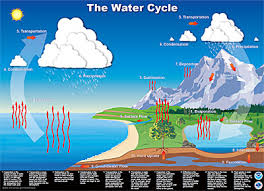
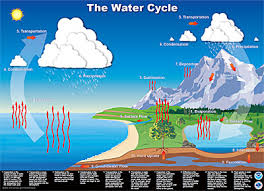
What is the water cycle?
a)
the 3 forms of water
b)
the movement of water on, above, or below the surface of the Earth
c)
when water melts
d)
when clouds form
20.

What is the step called when WATER is FORMED from a LIQUID to a WATER VAPOR?

a)

EVAPORATION

b)

PRECIPITATION

c)

TRANSPIRATION

21.
Snow, sleet, hail, and rain are all examples of  ________________. 
a)
evaporation
b)
condensation
c)
accumulation
d)
precipitation
22.
During which stage do clouds form?
a)
condensation
b)
evaporation
c)
precipitation
23.
Which stages does liquid water from the ocean turn into water vapor?
a)
condesantion
b)
evaporation
c)
precipitation
d)
run off
24.
Which stage does the #3 show in the diagram?
a)
condensation
b)
evaporation
c)
precipitation
d)
run off
25.
what does the #4 show in the diagram?
a)
condensation
b)
evaporation
c)
precipitation
d)
run off
26.
They are highest clouds in the sky. They look curly, white and feathery. Usually mean good weather.
a)
Cumulus
b)
Cumulonimbus
c)
Cirrus
d)
Stratus
27.
This is sometimes called a thunderhead cloud. It looks very tall like mountains and heavy rain comes from it. 
a)
Cumulus
b)
Cirrus
c)
Stratus
d)
Cumulonimbus
28.
They are low in the sky and look soft and fluffy. 
a)
Cirrus
b)
Cumulonimbus
c)
Cumulus 
d)
Stratus
29.
These clouds are the closest to the ground. Their name means layer- or sheet like. They bring rain or snow and cover most of the sky. 
a)
Cirrus
b)
Stratus
c)
Cumulonimbus
d)
Cumulus
30.
Which cloud brings nice weather?
a)
Cumulonimbus
b)
Cumulus
c)
Stratus
31.
Low clouds (like fog), that are thick, cover the sky, and block the sun.  Usually bring continuous precipitation (rain or snow).
a)
stratus
b)
cumulus
c)
cirrus
d)
nimbo
32.
what type of cloud is shown?
a)
cumulus
b)
cirrus
c)
stratus
33.
what type of cloud is shown?
a)
cumulus
b)
cirrus
c)
stratus
34.
what type of cloud is shown?
a)
cumulus
b)
cirrus
c)
stratus
35.
What type of front is this? 
a)
warm front
b)
cold front
c)
stationary front
d)
occluded front
36.
What type of front is this?
a)
warm front
b)
cold front
c)
stationary front
d)
occluded front
37.
What does this symbol represent?
a)
High Pressure
b)
Warm Front
c)
Cold Front
d)
Mountains
38.
Which front is this?
a)
Warm front
b)
Cold front
c)
Occluded front
d)
Stationary Front
39.
Which type of front is displayed?
a)
Cold
b)
Warm
c)
Stationary
d)
Occluded
40.
Which type of front is displayed?
a)
Cold
b)
Warm
c)
Stationary
d)
Occluded
41.
a)
Low Clouds
b)
Low Temperatures
c)
Light Wind
d)
Low Air Pressure
42.
a)
High Air Pressure
b)
High Temperatures
c)
Heavy Rain
d)
Hail
43.
Why does warm air rise?
a)
Warm air is more dense than cooler air.
b)
Warm air has more pressure than cooler air.
c)
Warm air is less dense than cooler air.
d)
Warm air has a higher dew point than cooler air.
44.
The jet stream usually moves from 
a)
north to south
b)
west to east
c)
east to west
d)
south to north
45.
Air always blows from 
a)
a. High pressure to low pressure
b)
b. Hot air to cold air
c)
c. low pressure to high pressure
d)
d. East to west
46.
Name this tool. 
a)
Barometer
b)
Hygrometer
c)
Thermometer
d)
Ruler
47.
What tool is used to measure the amount of rain that has fallen? 
a)
Rain Gauge
b)
Barometer
c)
Wind Vane
d)
Precipitation
48.
What tool is used to measure wind speed? 
a)
Wind Vane
b)
Anemometer
c)
Thermometer
d)
Barometer
49.

What is the name of this weather tool?

a)

Rain Gauge

b)

Telescope

c)

Wind Vane

d)

Anemometer

50.
This weather instrument is an...
a)
wind vane
b)
anemometer
c)
barometer
d)
thermometer
51.
A(n) ________________ measures relative humidity, using the cooling effect of evaporation.
a)
hygrometer
b)
sling psychrometer
c)
anemometer
d)
barometer
52.
What am I?
a)
thermometer
b)
anemometer
c)
barometer
d)
wind vane
53.
Air pressure is measured using a...
a)
thermometer
b)
barometer
c)
rain gauge
d)
anemometer
54.
Wind speed is measured using a...
a)
thermometer
b)
barometer
c)
rain gauge
d)
anemometer
55.
Which is the warm front?
a)
1
b)
2
c)
3
d)
4
56.
Which number is the cold front?
a)
1
b)
2
c)
3
d)
4
57.
Which is the stationary front?
a)
1
b)
2
c)
3
d)
4
58.
What direction does weather in the USA usually move?
a)
east to west
b)
west to east
c)
northeast
d)
southwest
59.
The curving of air to the right in the Northern hemisphere is caused by ___________ and is called the _________ effect.
a)
Earth's rotation...Coriolis
b)
Earth's revolution...Coriolis
c)
Earth's rotation...Doppler
d)
Earth's revolution...Doppler
60.
Which diagram shows the formation of a land breeze?
a)
diagram Y
b)
diagram X
c)
neither 
d)
both
61.
Which diagram shows the formation of a sea breeze?
a)
diagram Y
b)
diagram X
c)
neither
d)
both
62.
Which global winds directly effect weather in the U.S.?
a)
Trade Winds
b)
Prevailing Westerlies
c)
Polar Easterlies
d)
Doldrums
63.
The tropical winds running from 0 to 30 degrees latitude are called:
a)
subtropical westerlies
b)
polar westerlies
c)
trade winds
d)
polar winds
64.
This is a lava lamp. When the light bulb heats the wax, the wax rises. When the wax cools, it falls. This cycle of rising/falling is an example of:
a)
Conduction.
b)
Convection.
c)
Radiation.
65.
The baby chickens are kept warm from the heat lamps demonstrates what type of heat transfer?
a)
conduction
b)
convection
c)
radiation
66.
Walking on the warm sand sand with your bare feet.
a)
conduction
b)
convection
c)
radiation
67.
A group of friends gather around a fire to stay warm.
a)
conduction
b)
convection
c)
radiation
68.
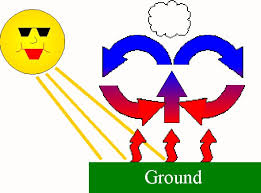
Warm air rises and the cool air sinks.
a)
conduction
b)
convection
c)
radiation
69.

Tropical climates are typically located

a)

straddling the equator between 20° N/S.

b)

all areas of the Earth influenced by a subtropical high-pressure system.

c)

primarily in areas associated with cold ocean currents.

d)

higher latitudes influenced by continental tropical air masses.

70.
The average weather of a region over a long period of time.
a)
polar region
b)
mesosphere
c)
altitiude
d)
climate
71.
The most common gas in the atmosphere; 78% of the gases
a)
oxygen
b)
cardon dioxide
c)
nitrogen
d)
helium
72.
The 2nd most common gas in the atmosphere; 21% of the gases
a)
oxygen
b)
argo
c)
ozone
d)
water
73.
The convection region that forms between the polar and tropical regions
a)
tropical region
b)
temperate region
c)
polar region
d)
south pole region
74.
Atmospheric layer that contains protective ozone gas
a)
thermosphere
b)
mesosphere
c)
exosphere
d)
stratosphere
75.
The current condition of the atmosphere
a)
climate
b)
weather
c)
temperature
d)
region
76.
The convection region that forms in the arctic and Antarctic latitudes
a)
tropical regions
b)
temperate region
c)
convection regions
d)
polar region
77.
Predictable patterns of winds that flow over thousands of miles
a)
fronts
b)
air masses
c)
trade winds
d)
global winds
78.
A device that is used to measure atmospheric pressure is a ___________.
a)
barometer
b)
thermometer
c)
kilometer
d)
micrometer
79.

High Pressure Systems on Earth's surface are caused by...

a)

air rising away from Earth's surface.

b)

air sinking towards Earth's surface.

c)

air not moving.

d)

air moving horizontally.

80.

Low Pressure Systems on Earth's surface are caused by...

a)

air rising away from Earth's surface.

b)

air sinking towards Earth's surface.

c)

air not moving.

d)

air moving horizontally.