wayground logo

Free Printable Worksheets

Font size

S
M
L
XL
Worksheets

Earth and Space

Total questions: 82

Worksheet time: 3hrs 39mins

Name
Class
Date
1.
Which of the following is one day on Earth? The time it takes for ___. 
a)
Earth to orbit the Sun 
b)
The Sun to orbit Earth 
c)
Earth to completely rotate around its axis 
d)
The Sun to completely rotate around its axis 
2.
Which of the following causes the ocean’s tides? 
a)
Earth’s revolution around the Sun 
b)
The magnetic field between Earth’s north and south poles 
c)
The gravitational pull between Earth and the Sun and the Moon 
d)
Changes in atmospheric pressure 
3.
About how long does one cycle of the Moon’s phases last? 
a)
A Year
b)
A Month
c)
Two Weeks
d)
A Day
4.
There is a full moon on October 9 and November 6. What phase is the Moon in on October 23? 
a)
New
b)
Crescent
c)
Quarter
d)
Full
5.
The phases of the Moon are caused by which of the following?
a)
Earth’s orbit (revolution) around the Sun
b)
Earth’s rotation around its axis 
c)
The Moon’s orbit (revolution) around Earth 
d)
Earth’s shadow falling on the Moon 
6.
Which of the following results from the tilt of Earth? Earth’s tilt causes _______________.
a)
More daylight in summer than in winter
b)
A bulge at the equator 
c)
A longer year every fourth year 
d)
The phases of the Moon
7.
Changing seasons are caused by which of the following?
a)
Changes in the Sun’s energy 
b)
Solar wind patterns 
c)
The tilt of Earth’s axis 
d)
The distance from Earth to the Sun 
8.
If Earth revolved more slowly in its orbit around the Sun, which of the following would be likely to result? 
a)
A longer year
b)
A longer winter
c)
A longer average day length
d)
A longer year and a longer winter 
9.
The spinning of Earth on its axis is called
a)
Rotation
b)
Revolution
c)
Gravity
d)
Nuclear Fusion 
10.
This occurs when the Moon is between the Sun and Earth and the Moon’s shadow falls on Earth
a)
Lunar eclipse
b)
Apogee
c)
Solar eclipse 
d)
Perigee
11.
Explain the difference between Earth’s revolution and Earth’s rotation.
a)
Revolution is the movement of Earth around the Sun; and a rotation is the movement of Earth around the Sun. There is no real difference
b)
Revolution is the movement of Earth around the Sun; and a rotation is the spinning of Earth on its axis. 
c)
Rotation is the movement of Earth around the Sun; and a Revolution is the spinning of Earth on its axis. 
d)
Rotation and revolution are both spinning motions of the moon around the earth
12.
You are standing on Earth on a particular night and observe the Moon at “A”. Thirteen days later you observe the Moon at “B”. On each night there were no clouds in the sky what moon phases would you say that letters “A” and “B” were?
a)
Letter “A” is called a waxing gibbous and letter “B” is called a full moon 
b)
Letter “A” is called a new moon and letter “B” is called a full moon. 
c)
Letter “A” is called a full moon and letter “B” is called a new moon
d)
Letter “A” is called a waning gibbous and letter “B” is called a waxing crescent
13.
We know that it takes the Earth roughly 365 days to travel one revolution around the Sun, so how many days will it take the Earth to travel from letter G to letter H or one fourth of the distance? 
a)
182.5 Days
b)
91.25 Days
c)
273.75 Days
d)
365.5 Days
14.
Which letter above best represents when it is winter in the Northern Hemisphere? 
a)
Letter G
b)
Letter I
c)
Letter J
d)
Letter H
15.
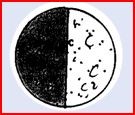
What phase of the moon is this?
a)
first quarter 
b)
waning gibbous 
c)
last quarter 
d)
new moon 
16.
What phase of the moon is this? 
a)
last quarter 
b)
waning crescent 
c)
waxing crescent 
d)
waning gibbous 
17.
Time which earth takes to complete its one revolution is 
a)
365 1/4 days 
b)
365 days
c)
28 days
d)
1 day 
18.
What season is it in North America? 
a)
Spring
b)
Fall
c)
Summer
d)
Winter
19.
The amount of direct sunlight the Northern Hemisphere receives changes throughout the year. The diagram shows Earth revolving around the Sun. In which month will the Southern Hemisphere receive the greatest amount of direct sunlight? 
a)
March
b)
June
c)
September
d)
December
20.
Paul built this model of the Sun, the Moon, and Earth. Which phase of the Moon is shown in Paul’s model? 
a)
Full Moon
b)
New Moon
c)
First Quarter
d)
Third Quarter
21.
Why do places near the equator tend to be warm year-round? 
a)
Solar eclipses cause sun to shine most of the day 
b)
The sun's rays hit the equator directly
c)
The equator is closer to the sun than other parts of the earth 
d)
The sun's rays barely strike this part of the earth Page 6 of 6
22.

The Milky Way, a spiral galaxy, is the galaxy in which our solar system is located. The diameter of the Milky Way is estimated to be between 100,000 and 120,000 light years. Our solar system is between 50,000 and 60,000 light years from the galatic center. Based on this information, where is our solar system most likely located in the Milky Way?

a)

Just outside the galaxy

b)

Near the center of the galaxy

c)

Near the edge, about half way from the center

d)

Between the edge and the center of the Milky Way

23.

Which group below correctly lists structures in space from smallest to largest?

a)

Star, planet, Milky Way, galaxy

b)

Planet, Solar System, Glaaxy, Star

c)

Moon, Planet, Solar System, Galaxy

d)

Galaxy, Planet, Milky Way, Solar System

24.
1)  When it is summer in the northern hemisphere,  it is
a)
winter in the southern hemisphere
b)
spring in the southern hemisphere
c)
summer in the southern hemisphere
d)
fall in the southern hemisphere
25.
What causes Earth's seasons?
a)
A.  The straight alignment of the Sun, Moon, and Earth
b)
A.  The tilt of the Earth on its axis as it revolves around the Sun
c)
A.  Regularly timed solar flares from the sun
d)
A.  The retrograde motion of Jupiter
26.
What type of event will occur at this boundary?
a)
Earthquake
b)
Volcano Eruption
c)
Tornado
d)
Mountain Building
27.
A divergent boundary occurs when plates ....
a)
Pull apart
b)
Come together
c)
Slide past each other
d)
subducting
28.
Mountains are created when....
a)
Two continental plates collide
b)
Two oceanic plates pull apart
c)
An Oceanic plate subducts under a Continental Plate
d)
Two continental plates pull apart
29.
A force of attraction between 2 object that is directly related to mass and indirectly related to distance.
a)
mass
b)
weight
c)
gravity
d)
kilogram
30.
As mass increases, what happens to gravitational force?
a)
increases
b)
decreases
c)
stays the same
d)
i don't know
31.
Which of the following boundaries is a divergent boundary?
a)
The boundary between the Nazca Plate and the Pacific Plate
b)
The boundary between the South American Plate and the Nazca Plate
c)
The boundary between the Australian Plate and the Pacific Plate
d)
The boundary between the Indian Plate and the Eurasian Plate
32.

In which position is it winter in North America?

(top axis/Northern Hemisphere should be facing the Sun)

a)

Position 1, because North America receives the most direct sun

b)

Position 2, because North America is tilted toward the sun

c)

Position 3, because North America is parallel to the sun

d)

Position 4, because North America is tilted away from the Sun

33.

The diagram shows four consecutive moon phases.

Which of the following diagrams shows the next four moon phases in the correct order?

a)
b)
c)
d)
34.

Two friends want to go for a night hike when there is a full moon in July. If there is a third-quarter moon on July 2, what is the approximate date of the next full moon?

(7 days/1 week to get to each of the 4 main moon phases)

a)

July 9

b)

July 16

c)

July 23

d)

July 30

35.

A student must complete the column of the table that lists the dates of the full moons. What are the most likely dates of the full moons?

(New Moon - Full Moon = 14 days/2 weeks)

a)

February 5, March 7, April 5, May 4

b)

February 15, March 17, April 15, May 14

c)

February 25, March 27, April 25, May 24

d)

February 29, March 31, April 29, May 28

36.

A student uses paper and fasteners to create a model of Earth, Sun, and Moon. The sun and Earth are attached to the paper background, while the moon is free to revolve around Earth. Which diagram shows the objects arranged so that a new moon would be visible from Earth?

(New Moon is ALWAYS next to Sun)

a)
b)
c)
d)
37.

Based on the data, what part of the lunar cycle occurred between January 5 and January 7?

(Takes 3.5 days for each of the 8 moon phases)

a)

waxing crescent moon

b)

waning crescent moon

c)

full moon

d)

new moon

38.

Different relative positions of the Sun, Moon, and Earth have different effects on Earth's oceans. Which model shows the positions of the Sun, Moon, and Earth that have the GREATEST effect on ocean tides?

Spring=straight

Neap=90

a)
b)
c)
d)
39.

Bernard's Star is about 5.9 light years from our Sun. The star has an approximate temperature of 2,800 K. Based on the diagram, what spectral class does Bernard's Star belong to?

a)

Spectral class O

b)

Spectral class B

c)

Spectral class A

d)

Spectral class M

40.

The Hertzsprung-Russell diagram shows how the Sun is classified among the stars. A star that is several thousand times brighter than the Sun with a temperature lower than 4,000 K would be classified as -

(Dimmer stars are on the bottom of the H-R diagram)

a)

a main sequence star in spectral class B

b)

a supergiant in spectral class K

c)

a main sequence star in spectral class K or M

d)

a white dwarf in spectral class B

41.

The universe has many different components. Which list places four components of the universe in the most likely order from smallest to largest?

(nebula=cloud of gas & dust where stars form)

a)

Planets, stars, galaxies, nebulae

b)

Nebulae, stars, planets, galaxies

c)

Planets, stars, nebulae, galaxies

d)

Galaxies, stars, planets, nebulae

42.

Two stars are identified on the Hertzsprung-Russell diagram. Based on this diagram, how do the characteristics of Star 1 and Star 2 compare?

(Dimmer stars are on the bottom)

a)

Star 1 is hotter and brighter than Star 2.

b)

Star 1 is cooler and less bright than Star 2.

c)

Star 1 is cooler and brighter than Star 2.

d)

Star 1 is hotter and less bright than Star 2.

43.

Four students are asked to describe a nebula and a star. Their responses are shown in the table. Which student described these two celestial bodies correctly?

a)

student 1

b)

student 2

c)

student 3

d)

student 4

44.

A student learns that the Sun is classified as a medium-size star and that many stars are much bigger and brighter. However, the student observes that other stars look very dim, even through a telescope. Why do other stars look much dimmer than the Sun?

a)

The Sun appears yellow, which is more visible than other colors.

b)

The Sun is much closer to Earth than other stars are.

c)

Other stars are made up of different gases than the Sun is.

d)

As light from other stars travels through space, it gets reflected.

45.

Quasars are extremely distant celestial bodies. Investigators using a special telescope determined that a certain quasar was emitting waves with a frequency of 1.41 x 10⁹ Hz. An electromagnetic spectrum is shown. The investigators were most likely using a telescope that detects -

a)

visible light

b)

x-rays

c)

gamma rays

d)

microwaves

46.

The model shows the star Wolf 359, the Sun, and Star X. It takes 7.8 years for light produced on Wolf 359 to reach the Sun. If Star X is 50 times as far from the Sun as Wolf 359 is, how far is Star X from the Sun, to the nearest light year?

a)

310

b)

390

c)

7.8

d)

50

47.

The table shows distances of three stars from the Sun. Students were asked to make a model of the three stars and to include the Sun and Earth in the model. They chose to use a scale of 1 meter : 1 light year. Which model best represents the data?

a)
b)
c)
d)
48.

The diagram models Mercury and Venus orbiting the Sun. What force causes Venus to travel along a curved path instead of moving in a straight line as indicated by the dashed line in the diagram?

a)

Electromagnetic attraction between the Sun and Venus

b)

Electromagnetic attraction between Mercury and Venus

c)

Gravitational attraction between the Sun and Venus

d)

Gravitational attraction between Mercury and Venus

49.

Rift valleys can form when fractures in Earth's crust widen. The valley walls slowly move at a rate of only a few millimeters a year. Which of these best describes the type of tectonic activity that forms rift valleys?

a)

Rift valleys form where a continental plate moves under an oceanic plate.

b)

Rift valleys form where a plate slides horizontally past another plate.

c)

Rift valleys form where two plates move away from each other.

d)

Rift valleys form where an oceanic plate moves under another oceanic plate.

50.

The map shows some of Earth's plate tectonic boundaries. Based on the map, volcanic activity would most likely be found at -

(volcanoes form when oceanic plate subducts under another plate)

a)

location W

b)

location X

c)

location Y

d)

location Z

51.

The San Andreas fault is a transform fault. The map shows a student's approximation of where the fault line crosses through the United States. Students were asked to make maps predicting which way land would most likely move over thousands of years. Which map BEST predicts the likely movement of land along the fault line over thousands of years?

a)
b)
c)
d)
52.

The satellite photograph shows an area in Alaska after a fire occurred. Which statement best describes the most likely effect the fire had on the river in the 12 months after it occurred?

a)

Less sediment flowed into the river because the fire heated up the soil and made it drier.

b)

More sediment flowed into the river because the fire destroyed most of the vegetation holding the sediment in place.

c)

The amount of vegetation increased and less sediment flowed into the river because the fire produced ash that mixed with the soil.

d)

More sediment flowed into the river because the fire disrupted animal habitats and caused animals to leave the area.

53.

A student stands at point X on the topographic map. What height in meters must the student climb in order to reach the top of the hill?

a)

243

b)

353

c)

363

d)

253

54.

A section of a topographic map is shown. What is the difference in elevation in meters between Point X and Point Y on the map?

a)

400

b)

320

c)

360

d)

410

55.

A student's model of an area near a city depicts many activities that affect the quality of water in the area. How does the agricultural activity most likely affect the surface water of the area?

a)

Excess crop material accumulates on the riverbanks, slowing the movement of the river water.

b)

Excess crop fertilizer is carried by runoff into the river, causing excess growth of water plants.

c)

Crops reduce erosion, increasing the amount of soil entering the river.

d)

Crops absorb pure water from soil, causing the remaining water to contain more salt.

56.

In 2013, Typhoon Nesat struck the Phillippines and caused widespread flooding. After hitting the Phillippines, Typhoon Nesat was predicted to hit the large city of Hanoi, Vietnam. If Typhoon Nesat had continued along the same path, which development would most likely have reduced its strength before it hit Hanoi?

(pay attention to the SYMBOLS!)

a)

The formation of a low pressure area south of Bangkok

b)

The formation of a high pressure area south of Bangkok

c)

Cool water moving into the sea east of Hanoi

d)

Warm water moving into the sea east of Hanoi

57.
(8.7A) A student draws the model shown below.
Which of these best compares the conditions at Location X and Location Y?
a)
It is day at Location X and night at Location Y
b)
It is winter at Location Y and summer at Location X
c)
There are more hours of daylight at Location X than at Location Y
d)
The moon is brighter when viewed from Location X than when viewed from Location Y
58.
(8.7A) The diagram below shows four positions in Earth's orbit around the sun. 
The Northern Hemisphere experiences the beginning of spring when Earth is in-
a)
Position 1
b)
Position 2
c)
Position 3
d)
Position 4
59.
(8.7A) Which of these locations on Earth experiences the least change in the number of daylight hours throughout the year?
a)
Equator
b)
North Pole
c)
Tropic of Cancer
d)
Tropic of Capricorn
60.
(8.7A) Earth would not have seasons if it-
a)
no longer tilted on its axis
b)
stopped rotating on its axis
c)
took and additional month of orbit the sun
d)
revolved around the sun in the opposite direction.
61.
(8.7B) The diagram below shows four phases of the moon as it revolves around Earth.
A student builds a model based on this diagram. The student uses foam balls to represent the moon and Earth and a flashlight to represent the sun. The student should shine the flashlight on the model of Earth from Position
a)
1
b)
2
c)
3
d)
4
62.
(8.7B) Some students used records from the U.S. Naval Observatory to make the table below of the percent of the moon that was visible on each night in January 2011.
Based on this data, what part of the lunar cycle occurred between January 5 and Januray 7?
a)
Waxing crescent moon
b)
Waning crescent moon
c)
full moon
d)
new moon
63.
(8.7B) A student keeps a record of the phases of the moon for one month. On the first night of the student's observations, the full moon is visible in the sky. After the full moon, which of these phases will the student observe next?
a)
Waxing crescent moon
b)
Waxing gibbous moon
c)
Waning crescent moon
d)
Waning gibbous moon
64.
(8.7B) The diagram above shows the orbit of the moon around Earth. At which point in the moon's orbit will a person standing on Earth see a waxing crescent moon?
a)
1
b)
2
c)
3
d)
4
65.
(8.8A) A Hertzsprung-Russell diagram is shown below.
Based on this diagram, which type of stars would belong to spectral class M and have the highest luminosity?
a)
Main-sequence stars
b)
Giants
c)
White dwarfs
d)
Supergiants
66.
(8.8A) Four students are asked to describe a nebula and a star. Their responses are shown in the table. 
Which student described these two celestial bodies correctly?
a)
1
b)
2
c)
3
d)
4
67.
(8.8A) The Milky Way galaxy is described as a disk of stars orbiting a central point on the disk. Which of these best explains why people on Earth cannot see the entire shpae of the Milky Way?
a)
Earth is a part of this galaxy
b)
Many more stars exist outside the galaxy
c)
The stars in the center of the galaxy are extremely small.
d)
The center of the galaxy consists of a dense cluster of stars.
68.
(8.9B) The diagram below shows a model of the movement of two tectonic plates. When the plates collide, one plate often moves below the other plate.
The rising magma that can result from this type of plate movement may produce-
a)
fossil layers
b)
volcanic islands
c)
deep-sea sediment
d)
seafloor spreading
69.
(8.9B) The model below shows two continental plates.
The folded mountains in this model form at which type of plate boundary?
a)
transform boundary
b)
divergent boundary
c)
subduction boundary
d)
convergent boundary
70.
(8.9B) The thick black lines on the map below show the locations of mid-ocean ridges.
Which geologic feature is most likely to form at a mid-ocean ridge?
a)
Peninsula
b)
Volcano
c)
Delta
d)
Plateau
71.
(8.9C) The satellite image below shows a ship channel between South Padre Island and Boca Chica beach in South Texas.
Sand is sometimes removed from the ship channel through a process called dredging to make it easier for ships to travel through. Recently sand from the bottom of the channel was moved to area beaches. Without this transfer of sand, what would most likely occur in this area in the future.
a)
The ship channel would  become deeper, and the island would move west toward the mainland.
b)
The ship channel would become shallower, and the beach would become narrower.
c)
The ship channel would become narrower, and the island would become completely covered with water.
d)
The ship channel would become wider, and the island would sink into the Gulf of Mexico.
72.
(8.9C) The points labeled W and Y on the topographic map below show the campsites of two families. Each family hiked to the elevation on the map marked X. The arrows show the paths taken by both families.
What was the change in elevation, to the nearest ten meters, for the family that took the steepest path to Point X?
a)
10
b)
20
c)
60
d)
120
73.
(8.9C) The satellite photograph below shows a large meteorite crater that is 1200 m in diameter and 170 m deep. This crater is located in a flat, arid part of northeastern Arizona. 
How will this crater most likely change over time?
a)
It will get deeper as it fills with water.
b)
It will rise up like a volcanic crater.
c)
It will become less deep as the rim erodes.
d)
It will widen as it fills with lava.
74.
(8.9C) A section of topographic map is shown below.
What is the difference in elevation in meters between Point X and Point Y
a)
360
b)
1600
c)
500
d)
no.
75.
(8.8B) Why does Earth get more energy from the sun than from all the other stars in the universe combined?
a)
The sun is much larger than other stars.
b)
The sun is much hotter than the other stars.
c)
The sun is much more dense 
d)
The sun is much closer than the other stars.
76.
(8.9A) Scientists recently discovered that rocks collected from the Franklin Mountains in West Texas and rocks collected from mountains in eastern Antarctica were exactly the same age. Further research showed that the rocks were chemically and geologically the same and came from the same magma source. This discovery provides evidence of-
a)
coastal erosion
b)
plate tectonics
c)
ocean currents 
d)
glacial melting
77.
(8.10A) Earth's land areas, oceans, and atmosphere maintain fairly constant average temperatures. What is the best explanation for these constant average temperatures?
a)
Earth's Northern Hemisphere and Southern Hemisphere have opposite seasons.
b)
Earth is tilted and rotates daily on its axis.
c)
The continuous motion of air and water distributes the sun's energy.
d)
Global weather systems generally move from west to east.
78.
(8.10C) Hurricanes and similar storm systems begin over oceans. The map below shows average surface temperatures of the oceans in the summer.
Based on the map, which area probably produced the most violent storm systems?
a)
Area 1
b)
Area 2
c)
Area 3
d)
Area 4
79.
(8.10C) What is one condition that is necessary for the hurricane to form?
a)
Warm ocean water
b)
A strong cold front
c)
Cold ocean water
d)
A strong warm front
80.
(7.8C) A student sets up the investigation shown below.
The movement of colored water through the gravel best models-
a)
condensation of water vapor
b)
surface runoff of precipitation
c)
conservation of water
d)
pollution of groundwater
81.
(6.11B) The diagram below models Mercury and Venus orbiting the sun.
What force causes Venus to travel along a curved path instead of moving in a straight line as indicated by the dashed line in the diagram?

a)
Electromagnetic attraction between the sun and Venus
b)
Gravitational attraction between the sun and Venus
c)
Electromagnetic attraction between Mercury and Venus
d)
Gravitational attraction between Mercury and Venus
82.
(6.11B) An object will continue moving in a straight line unless it is acted on by an unbalanced force. Which of the following best explains Earth's motion?
a)
There is no unbalanced force acting on Earth because space is empty and nothing touches Earth
b)
The gravitational force pulling Earth toward the sun is equal and opposite to the force pulling the sun toward Earth, so there is no unbalanced force acting on earth.
c)
The sun moves in an elliptical orbit around Earth, and the sun's gravity pulls Earth along.
d)
Earth moves in an elliptical orbit around the sun because the gravitational force of the sun attracts Earth.