
NEW
Font size
S
M
L
XL
 Worksheets
Ocean Sedimentation
Total questions: 36
Worksheet time: 22mins
Name
Class
Date
1.

The ocean floor is made of this kind of rock.
a)
basalt
b)
sandstone
c)
slate
d)
conglomerate
2.

What is label one on the diagram?
a)
continental shelf
b)
continental rise
c)
abyssal plain
d)
deep ocean trench
3.
Water getting into cracks, freezing, and breaking the rocks or pavement apart
a)
Weathering
b)
Erosion
c)
Deposition
4.
What is weathering?
a)
Breaking rocks down
b)
Moving sediment
c)
Dropping sediment
d)
Compacting sediment
5.
What is deposition?
a)
Breaking down rocks
b)
Moving Sediment
c)
Dropping Sediment
d)
Compacting sediment
6.
What is the largest particle in sediment?
a)
Gravel
b)
Sand
c)
Clay
d)
Silt
7.
Put the sediments in order from smallest sized particles to largest
a)
clay, silt, sand, gravel
b)
silt, clay, gravel, sand
c)
gravel, sand, silt, clay
8.
Minerals that crystallize directly from seawater are examples of ________.
a)
terrigenous sediment
b)
biogenous sediment
c)
hydrogenous sediment
d)
both terrigenous and biogenous sediment
9.
Which of the following is a hydrogenous sediment?
a)
diatomaceous earth
b)
silt
c)
tektites
d)
manganese nodules
10.
Deep ocean sediments tend to have proportionally _______ biogenous sediment than continental-shelf sediment.
a)
more
b)
less
11.
In which environment do neritic deposits not form?
a)
Close to the shore.
b)
In deep ocean basins.
c)
On the continental shelf.
d)
On the continental slope.
12.
Manganese nodules belong to
a)
lithogenous sediments.
b)
biogenous sediments.
c)
hydrogenous sediments.
d)
cosmologeous sediments.
13.
Beach deposits are an example of
a)
hydrogenous sediment.
b)
cosmogenous sediment.
c)
biogenous sediment.
d)
lithogenous sediment.
14.
On the whole, what is the most important mechanism of transporting continental lithogenous sediments to the ocean?
a)
Wind
b)
Flowing water
c)
Glaciers and icebergs
d)
Gravity (mass flows)
15.
What process creates lithogenous sediments?
a)
Precipitation from seawater
b)
Weathering and erosion
c)
Dissolution of carbonate shells
d)
Evaporation
16.
If you walk out onto a beach in Alaska, the sand in your toes will have MOST LIKELY come from
a)
a rock inland
b)
fish skeleton
c)
a glacier
d)
meteorite
17.
True or False:
Clay will travel farther out into the ocean than sand will.
Clay will travel farther out into the ocean than sand will.
a)
True
b)
False
18.
Lithogenous means
a)
from life
b)
from land
c)
from water
d)
from space
19.

This is the largest intact meteorite. If it was broken down into sediment, what kind would it be?
a)
Lithogenous
b)
Biogenous
c)
Hydrogenous
d)
Cosmogenous
20.

What is the origin of this sediment? These are tiny shells called "tests."
a)
Lithogenous
b)
Biogenous
c)
Hydrogenous
d)
Cosmogenous
21.

What is the origin of this sediment? (satellite image of a river draining into an ocean)
a)
Lithogenous
b)
Biogenous
c)
Hydrogenous
d)
Cosmogenous
22.

What is the origin of the sediment that this makes?
a)
Lithogenous
b)
Biogenous
c)
Hydrogenous
d)
Cosmogenous
23.

What type of sediment are you most likely to find at the continental shelf if this is a temperate zone beach?
a)
Lithogenous
b)
Biogenous
c)
Hydrogenous
d)
Cosmogenous
24.
Where would expect to find the DEEPEST sediment at?
a)
the coasts
b)
the mid-ocean ridges
c)
halfway between the coast and the mid-ocean ridges
25.
The process of layers become stuck together forming sedimentary rocks
a)
sticking
b)
pressuring
c)
cementation
d)
deposition
26.

Wind, water, ice and gravity carry sediments away
a)
weathering
b)
deposition
c)
erosion
d)
cementation
27.

The breakdown of rock into smaller particles from the effects of wind, water and ice
a)
erosion
b)
cementation
c)
pressure
d)
weathering
28.

Rock made of layers of compressed sediments
a)
metamorphic rock
b)
igneous rock
c)
sedimentary rock
d)
school house rock
29.
Sedimentary rocks may contain fossils.
a)
True
b)
False
30.
the dropping of sediments in layers.
a)
compaction
b)
deposition
c)
erosion
d)
weathering
31.

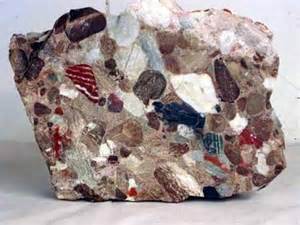
The type of sediment that created this rock.
a)
biogenous
b)
hydrogenous
c)
terrigenous
d)
cosmogenous
32.
Sediments can be from organic and inorganic material.
a)
true
b)
false
33.
Rock salt is what kind of sediment?
a)
hydrogenous
b)
cosmogenous
c)
terrigenous
d)
biogenous
34.
In the deep ocean almost all of the biogenous sediments are composed of single-celled organisms.
a)
true
b)
false
35.
if more than 30% of an area's sediment is made up of biogenous particles, it is called a(n)
a)
ooze
b)
slush
c)
mud
d)
silt
36.
Where would you find volcanic ash as sediment?
a)
continental shelf
b)
rivers and streams
c)
deep ocean
d)
all of the above
Reset

