
 Worksheets
End of the Year Science Benchmark Review
Total questions: 155
Worksheet time: 2hrs 15mins
Name
Class
Date
1.
This type of force is an attraction between two objects
a)
contact
b)
gravity
c)
friction
2.
This type of force resist motion between two surfaces that are pressed together
a)
contact
b)
gravity
c)
friction
3.
If the net force is equal to zero, the forces acting on the object are
a)
balanced
b)
unbalanced
4.
Balanced forces do not change the objects speed or
a)
direction
b)
distance
c)
time
d)
mass
5.
The unit of force is
a)
m/s
b)
m/s^2
c)
newton
d)
kg
6.
What is defined as a push or pull?
a)
force
b)
motion
c)
vector
d)
speed
7.
Jupiter has about 317 times more mass than Earth. What can you infer from this fact?
a)
That Jupiter’s gravitational force is much weaker than on Earth’s gravitational force.
b)
That Jupiter’s gravitational force is much stronger than Earth’s gravitational force.
c)
That Jupiter’s and Earth’s gravitational forces are equal.
d)
Mass has no effect on the gravitational force between two objects
8.

What force holds the planets in motion around the sun?
a)
Magnetic
b)
Electrical
c)
Gravitational
d)
Air Resistance
9.

What force brings the pencil down?
a)
Applied
b)
Magnetic
c)
Normal
d)
Gravitational
10.

What force ultimately slows the roller coaster to a stop?
a)
Applied
b)
Normal
c)
Friction
d)
Magnetic
11.
Simon wanted to know if the height of a ramp affected how fast the car went down it. What part of this experiment is Simon's Dependent (Outcome) Variable?
a)
there isn't one
b)
the height of the ramp
c)
the type of car
d)
the speed of the car
12.
Simon wanted to know if the height of a ramp affected how fast the car went down it. What part of this experiment is Simon's INDEPENDENT (Test) Variable?
a)
height of the ramp
b)
the type of car
c)
the speed of the car
d)
there isn't one
13.
An _______ force must act on an object for it to CHANGE it's motion
a)
balanced
b)
unbalanced
c)
gravitational
d)
electrical
14.
Speed is
a)
the distance covered per unit of time
b)
the time it takes something to move a certain distance
c)
distance x time
d)
time x distance
15.
What two quantities must I know to calculate something's speed?
a)
time and weight
b)
position and distance
c)
distance and time
d)
distance and speed
16.
What does the strength of gravity between two objects depend upon?
a)
Mass & distance
b)
Mass & weight
c)
Gravity & inertia
d)
Inertia & mass
17.
After Simon conducted his experiment he analyzed his data and saw some speeds that were surprising. Why would it be a good idea for Simon to ask his friends to replicate (redo) his experiment?
a)
They can test many more different variables that he did
b)
they can compare their results to Simon's to see if he was accurate
c)
So they can get better results
d)
They wouldn't do that, scientists do repeat other scientists experiments.
18.

When mass increases then gravity
a)
Decreases
b)
Increases
c)
Stays the same
19.
A distance vs. time graph shows an object's
a)
frame of reference
b)
speed
c)
acceleration
d)
favorite food
20.
LT2: I want to find the average speed of a triathlon race. What steps would I take?
a)
add up total distance, add up total time, divide total distance by total time
b)
add up total distance, add up total speed, divide distance by speed
c)
Add up total time and subtract total distance
21.
LT2: Grayson walks 5 meters in 5 seconds. What is his average speed?
a)
25 m/sec
b)
1 m/sec
c)
5 m/sec
d)
.25 m/sec
22.
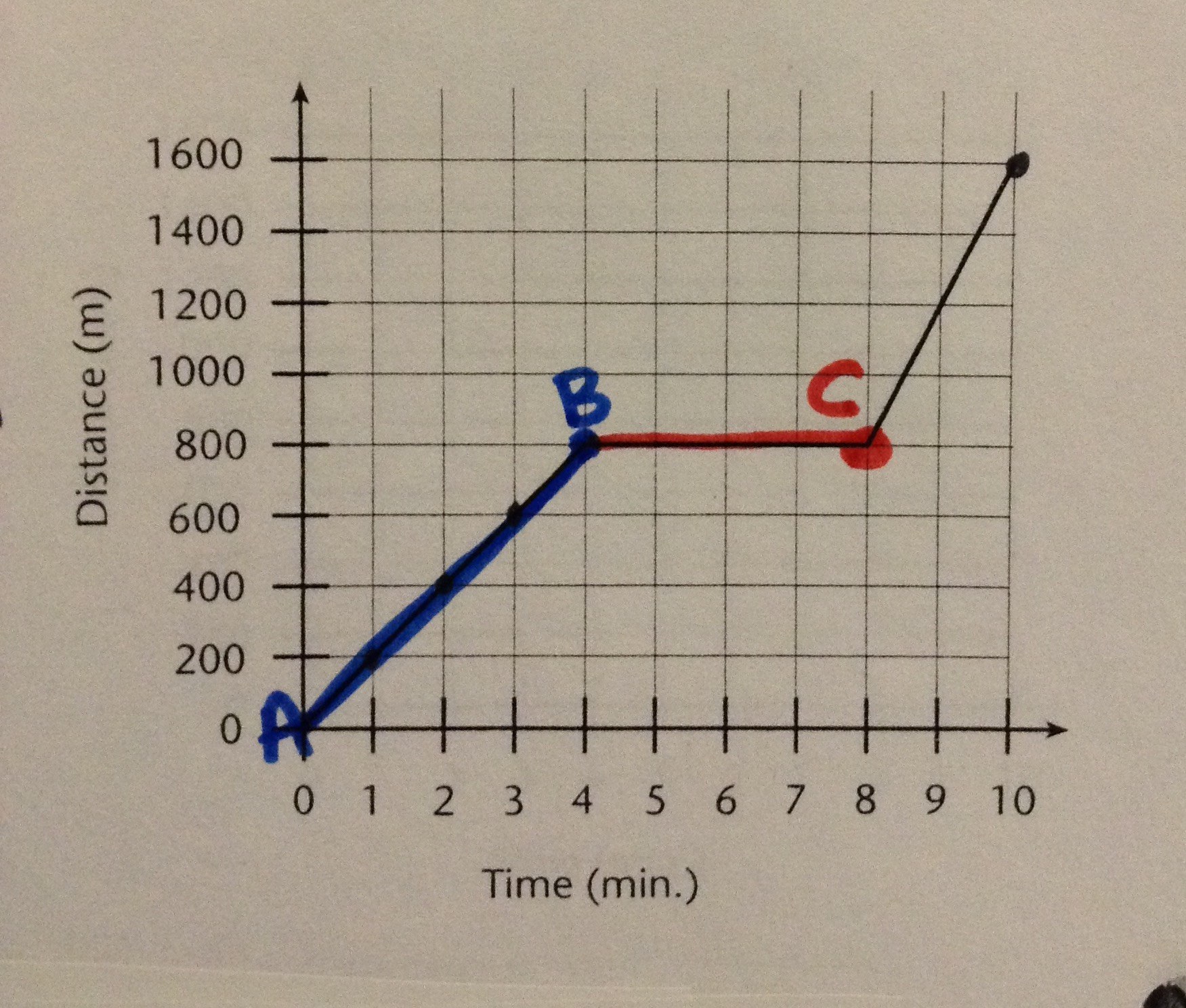
LT4: The graph shows Ashley riding her bike to Maria's house.
What is occurring from point A to point B?
What is occurring from point A to point B?
a)
they are traveling at a constant speed
b)
they are decreasing in speed
c)
they stopped to take a break
23.
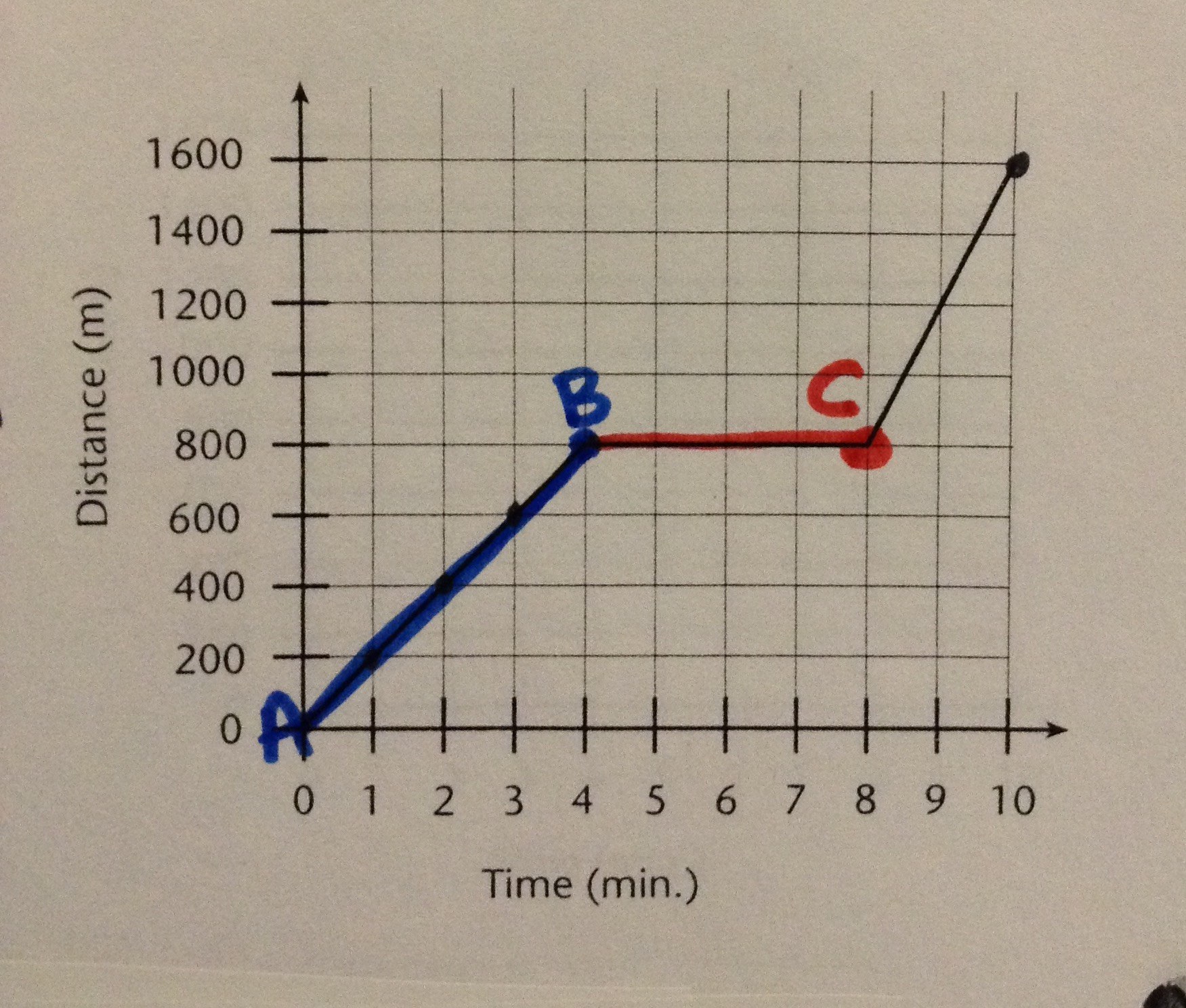
LT4: The graph shows Ashley riding her bike to Maria's house.
What was occurring from point B to point C?
What was occurring from point B to point C?
a)
She was increasing her speed.
b)
She stopped for 4 minutes
c)
She was decreasing in speed
24.
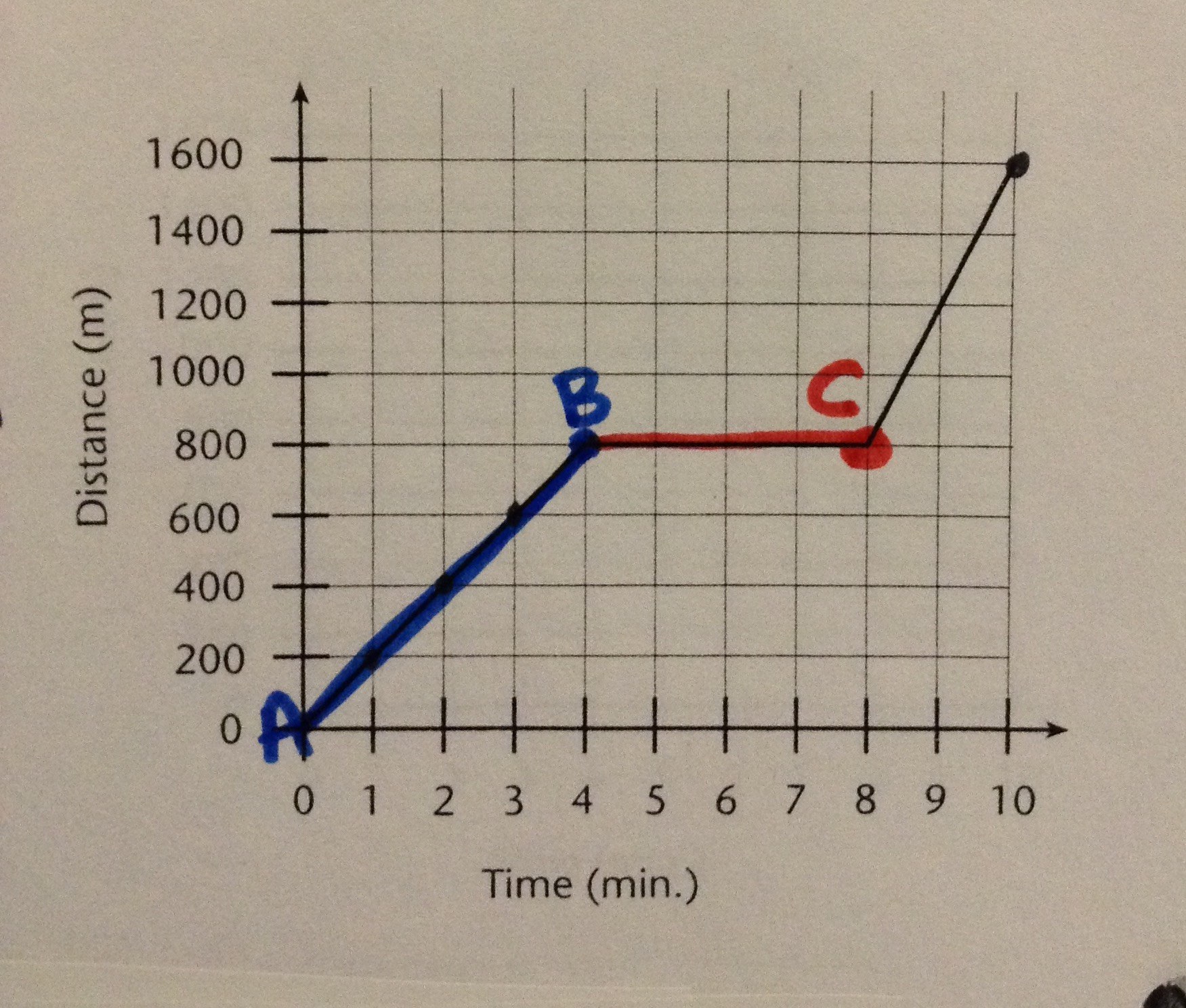
LT4: The graph shows Ashley riding her bike to Maria's house.
What was her average speed for the ENTIRE trip?
What was her average speed for the ENTIRE trip?
a)
1600 m/min
b)
200 m/min
c)
160 m/min
25.

The graph represents
a)
no motion
b)
Constant velocity
c)
Acceleration
d)
negative acceleration
26.

The graph represents
a)
no motion
b)
constant velocity
c)
acceleration
d)
negative acceleration
27.

The graph respresents
a)
No motion
b)
Constant Velocity
c)
Acceleration
d)
Deceleration
28.
An object is _____ if its position changes relative to another object.
a)
in motion
b)
at reset
c)
a frame of refence
d)
magical
29.
A place or object used for comparison to determine if another object is in motion is called a
a)
comparison point
b)
reference point
c)
point of view
d)
motion detector
30.
You walk 10 meters to math class in 20 seconds. Your average speed is
a)
2 m/s
b)
0.5 m/s
c)
200 m/s
d)
5 m/s
31.
On a distance-versus-time graph, a straight line ALWAYS indicates that an object’s speed is _____.
a)
constant
b)
zero
c)
increasing
d)
decreasing
32.
On a distance vs. time graph, the steeper the slope _____
a)
the slower the speed
b)
the faster the speed
c)
less acceleration
d)
greater acceleration
33.
What is the equation to find speed?
a)
s=t/d
b)
s=d x t
c)
s=d/f
d)
s=d/t
34.
What is the SI unit for speed
a)
Km
b)
s
c)
m/s
d)
m/s2
35.
When something has speed in a certain direction it is called ___________.
a)
motion
b)
position
c)
velocity
d)
speed
36.

The remains of living things that died long ago are often found in what type of rock?
a)
igneous rocks
b)
sedimentary rock
c)
metamorphic rock
d)
all rocks
37.

The cooled and hardened magma from volcanoes form what rocks?
a)
igneous
b)
sedimentary
c)
metamorphic
d)
fossils
38.

The thickest layer of Earth is the ___ where it is so hot that the rock there is soft.
a)
inner core
b)
crust
c)
outer core
d)
mantle
39.
Rocks come in many different characteristics like...
a)
color
b)
shape
c)
texture
d)
all of these
40.

Hot, molten rock inside the earth is called ...
a)
lava
b)
magma
c)
igneous rock
d)
minerals
41.

Once magma reaches the earth's surface, it is called __________.
a)
a vent
b)
minerals
c)
igneous rocks
d)
lava
42.

Large rocks can be broken down into smaller rocks by wind and water. These small rocks can break down into very tiny pieces called _______.
a)
minerals
b)
pebbles
c)
sediments
d)
chalk
43.

Rocks that are buried deep in the earth can be changed into an entirely new rock when it goes through what?
a)
weathering and erosion
b)
pressing and cementing
c)
heat and pressure
d)
cooling and hardening
44.

A never ending process by which rocks are changed from one type to another.
a)
weathering and erosion
b)
rock cycle
c)
heat and pressure
d)
pressing and cementing
45.

1. What will happen if an igneous rock is put under an extreme amount of heat and pressure?
a)
it will melt into lava
b)
it will weather and erode
c)
it will become a metamorphic rock
d)
it will become a sedimentary
46.

This rock formed when bits of other rocks became pressed into a solid. What type of rock is it?
a)
Sedimentary Rock
b)
Metamorphic Rock
c)
Igneous Rock
47.
What are the 3 major types of rocks?
a)
Igneous, Metamorphic, Sedimentary
b)
Metamorphic, Igneous, Cementation
c)
Brown, Red, Gray
d)
Streak, Hardness, Breakage
48.
What process is used to form sedimentary rocks?
a)
Lava cools and hardens to form a rock.
b)
Weathering, Erosion, Deposition, Compaction, Cementation
c)
Extreme heat and pressure from inside the Earth turn rocks into new rocks.
d)
Magma trapped under the Earth's surface cools and solidifies.
49.
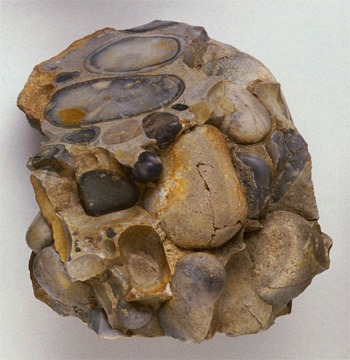
This rock was formed by smaller pieces of rock that settled at the bottom of a lake millions of years ago. What type of rock is this?
a)
Sedimentary
b)
Igneous
c)
Metamorphic
50.
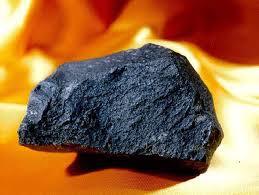
This rock was found near the mouth of a volcano. What type of rock is this?
a)
Sedimentary
b)
Igneous
c)
Metamorphic
51.
What is deposition?
a)
Dropping off sediment
b)
Movement of sediment
c)
Breaking down of sediment
52.

The process when rocks break into smaller pieces due to exposure to natural elements is called
a)
erosion
b)
weathering
c)
sediments
d)
deposition
53.
The movement of weathered material (sediment) is called?
a)
weathering
b)
erosion
c)
deposition
d)
cementation
54.

This rock started as lava that cooled and then was heated and put under pressure over time. What type of rock is this?
a)
Sedimentar
b)
Igneous
c)
Metamorphic
55.
What two processes make sediment?
a)
Weathering
b)
Erosion
c)
Weathering & Erosion
56.

Each rock type can follow only one pathway of the rock cycle.
a)
True
b)
False
57.
A naturally occurring, inorganic solid which has a definite crystalline structure
a)
Mineral
b)
Element
c)
Compound
d)
Rock
58.
The color of a mineral in powder form is called the mineral's
a)
hardness
b)
specific gravity
c)
luster
d)
streak
59.
How light reflects off of a mineral is called the mineral's
a)
luster
b)
streak
c)
cleavage
d)
fracture
60.
Why is coal not a mineral?
a)
It's not a solid
b)
It is man-made
c)
It is not inorganic
d)
It is made of carbon
61.

The following image shows what mineral property?
a)
Hardness
b)
Streak
c)
Cleavage
d)
Density
62.
Diamond has a hardness of ___ on Mohs Hardness Scale.
a)
1
b)
5
c)
8
d)
10
63.
Dull, silky, waxy, pearly, and earthy are terms that best describe which property of minerals?
a)
luster
b)
color
c)
streak
d)
cleavage
64.

By definition, a mineral has which of the following characteristic(s)?
a)
definite chemical composition
b)
crystal structure
c)
naturally occuring
d)
all of the above
65.
How do you test the hardness of a mineral?
a)
Throw it against a wall
b)
Step on it
c)
Scratch Test
d)
Kick it until it breaks
66.
What mineral is the softest mineral on Moh's Hardness Scale and the main ingredient in baby powder?
a)
feldspar
b)
talc
c)
gypsum
d)
kaolinite
67.
A mineral's resistance to being scratched is called?
a)
streak
b)
luster
c)
hardness
d)
heft
68.
The mineral iron is primarily used to make
a)
jewelry
b)
tools
c)
cement
d)
glass
69.
Large crystals are going to form
a)
when lava erupts from a volcano
b)
when a shallow sea evaporates
c)
when magma underground cools off
d)
all of the above
70.
A rock which contains a useful mineral is call a/an
a)
gem
b)
quarry
c)
ore
d)
alloy
71.

What layer can be seen here?
a)
chromosphere
b)
corona
c)
photosphere
d)
core
72.
When we look at the sun, what layer are we viewing?
a)
photosphere
b)
chromosphere
c)
corona
d)
convection zone
73.
Which has the LONGEST wavelength and, therefore, the lowest frequency/energy
a)
Gamma Rays
b)
Radio Waves
c)
Visible Light
d)
Infrared rays
74.
Which has the SHORTEST wavelength and, therefore, the highest frequency/most energy
a)
Radio waves
b)
Ultraviolet Rays
c)
Gamma Rays
d)
X-rays
75.
Put the visible light colors in order from longest wavelength to shortest wavelength
a)
Violet, Indigo, Blue, Green, Orange, Yellow, Red
b)
Red, Yellow, Green, Orange, Violet, Blue, Indigo
c)
Red, Orange, Yellow, Green, Blue, Indigo, Violet
76.
Which of the following electromagnetic waves is given off as heat?
a)
Radio Waves
b)
Infrared Rays
c)
Visible Light
d)
Gamma Rays
77.
Which of the following has the longest wavelength?
a)
microwaves
b)
visible light
c)
x-rays
d)
infrared waves
78.
Which of the following does not cause damage to human cells?
a)
UV
b)
Gamma
c)
X-ray
d)
Radio waves
79.
Which of the following colors has the shortest wavelength?
a)
Yellow
b)
Green
c)
Blue
d)
Red
80.
Which of the following is part of the radiation that is released from the sun?
a)
X-rays
b)
Visible Light
c)
Microwaves
d)
All of these
81.
Which of the following is partially blocked by Earth's atmosphere
a)
UV
b)
Radio
c)
Visible
d)
Gamma
82.

a)
#7 Prominences
b)
#7 Corona
c)
#7 Sunspots
d)
#7 Photosphere
83.

a)
#9 Prominences
b)
#9 Corona
c)
#9 Sunspots
d)
#9 Photosphere
84.

This is the final layer of the sun's atmosphere. It appears as a halo around the moon during a solar eclipse.
a)
Crown
b)
Corona
c)
Photosphere
85.
What is the name of the star that is the center of our solar system?
a)
Betelgeuse
b)
Sun
c)
Mira
d)
Polaris
86.

Describe the sun
a)
A moon
b)
A flaming planet
c)
The largest star
d)
An average-sized yellow star
87.
Which shows these according to size, from biggest to smallest?
a)
Earth, Moon, Sun
b)
Sun, Moon, Earth
c)
Earth, Sun, Moon
d)
Sun, Earth, Moon
88.

Which season is taking place in the Northern Hemisphere in Position 3?
a)
Winter
b)
Spring
c)
Summer
d)
Fall
89.

Which season is taking place in the Northern Hemisphere in Position 3?
a)
Winter
b)
Spring
c)
Summer
d)
Fall
90.

Which season is taking place in the Northern Hemisphere in Position 4?
a)
Winter
b)
Spring
c)
Summer
d)
Fall
91.
The Earth's axis is tilted _____ degrees.
a)
23.5
b)
25.3
c)
30.2
d)
24
92.

At position A, which hemisphere would have summer?
a)
Northern hemisphere
b)
Southern hemisphere
93.

What happens when the area in which you live tilts away from the sun?
a)
It is summer.
b)
It is spring.
c)
It is winter.
d)
It is fall.
94.
What do June 21 and December 21 have in common?
a)
equinox dates
b)
the moon is full
c)
solstice dates
d)
the cold fronts blow in
95.
What is the longest day of the year?
a)
winter solstice
b)
summer solstice
c)
fall equinox
d)
spring equinox
96.
Why do we experience the changing of the season on the earth?
a)
distance from the sun
b)
rotation of the earth
c)
change in solar output
d)
tilt of the earth's axix
97.

Why is the Equator warmest?
a)
Because it is closest to the sun.
b)
Because it receives the most direct sunlight
c)
Because no clouds form here.
d)
Because it is far from the sun
98.

Which season is taking place in the Southern Hemisphere in Position 1?
a)
Winter
b)
Spring
c)
Summer
d)
Fall
99.

Which season is taking place in the Northern Hemisphere in Position 1?
a)
Winter
b)
Spring
c)
Summer
d)
Fall
100.

Which season is taking place in the Northern Hemisphere in Position 2?
a)
Winter
b)
Spring
c)
Summer
d)
Fall
101.
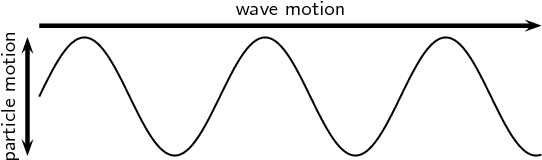
What kind of wave is pictured below?
a)
compressional wave
b)
transverse wave
c)
sound wave
d)
mechanical wave
102.
Waves are a transfer of what?
a)
Heat
b)
Light
c)
Energy
d)
Food
103.
Amplitude reflects the amount of ____________________ in a wave.
a)
energy
b)
compression
c)
rarefaction
d)
speed
104.
The ___________________ of waves can change when the waves move from one medium to another.
a)
altitude
b)
amplitude
c)
speed
d)
compression
105.
Sound is caused by?
a)
force
b)
vibrations
c)
instruments
d)
medium
106.
What is vibration?
a)
how loud a sound is
b)
the back and forth movement of matter
c)
how high or low a sound is
d)
the loudness or softness of a sound
107.
This is what you get when sound waves are reflected, or bounce back, off of a hard surface.
a)
Amplitude
b)
Pitch
c)
Volume
d)
Echo
108.
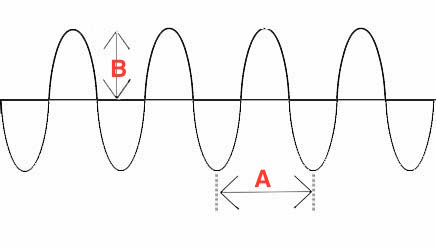
What property of this wave is represented by the letter "A"
a)
amplitude
b)
crest
c)
trough
d)
wavelength
109.
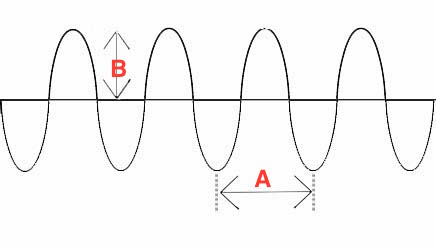
What property of the wave is represented by the letter "B"?
a)
amplitude
b)
crest
c)
trough
d)
wavelength
110.
The highest point on a wave is:
a)
the crest
b)
the trough
c)
the top
d)
the coast
111.
The lowest point on a wave is the:
a)
Amplitude
b)
Crest
c)
Trough
d)
Wavelength
112.
The number of wavelengths that pass a point each per second is:
a)
frequency
b)
period
c)
longitudinal
d)
transverse wave
113.
The type of waves that require medium to pass:
a)
Mechanical Waves
b)
Electromagnetic Waves
114.

Which vocabulary term is used to identify the distance between points C & G?
a)
Amplitude
b)
Crest
c)
Frequency
d)
Wavelength
115.
When the frequency of a wave increases, what happens to the wavelength?
a)
The wavelength is not directly affected by the frequency of a wave.
b)
The wavelength increases.
c)
The wavelength decreases.
d)
More specific information is needed to form a conclusion about the wavelength.
116.
A mechanical wave cannot travel through...
a)
a vacuum(empty space).
b)
water.
c)
air.
d)
glass.
117.
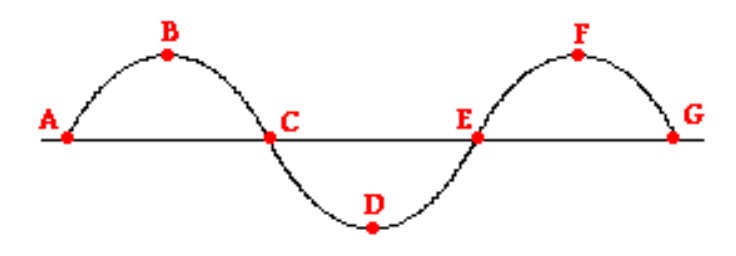
Which letter(s) represent the trough of the wave?
a)
A
b)
B & D
c)
D
d)
C & G
118.
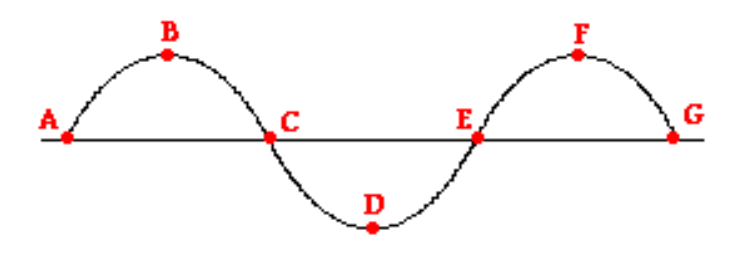
Which letter(s) represent the crest of the wave?
a)
A
b)
B & D
c)
B & F
d)
F
119.
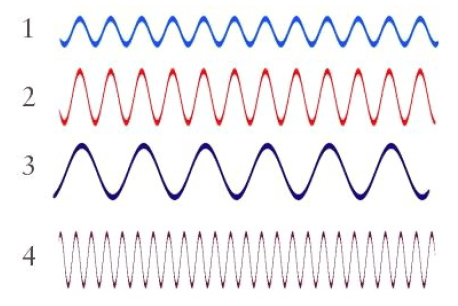
Which wave in the diagram has the greatest frequency?
a)
1
b)
2
c)
3
d)
4
120.
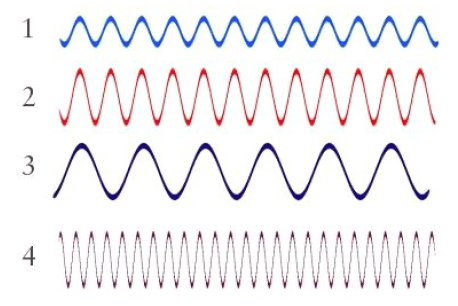
Which wave in the diagram has the greatest wavelength?
a)
1
b)
2
c)
3
d)
4
121.
Which of the following can sound travel through?
a)
solid
b)
liquid
c)
gas
d)
all of the above
122.
crest to crest or trough to trough
a)
crest
b)
trough
c)
amplitude
d)
wavelength
123.
Which of the following tools are used to magnify the appearance of distant objects in the sky?
a)
telescope
b)
periscope
c)
microscope
d)
horoscope
124.
What causes the sun to look like it is rising in the east and setting in the west?
a)
moon's orbit
b)
sun's rotation
c)
Earth's revolution
d)
Earth's rotation
125.

What is the name of the imaginary line running through the North Pole to the South Pole?
a)
orbit
b)
axis
c)
equator
d)
latitude
126.
The changing angle of the sun's rays hitting Earth causes ______________
a)
day and night
b)
weather
c)
shadows
d)
seasons
127.
In order for us to experience day, the side of the Earth we live on must be __________ the Sun.
a)
facing away from the Sun
b)
facing toward
128.
What causes the sun to look like it is rising in the east and setting in the west?
a)
moon's orbit
b)
sun's rotation
c)
Earth's revolution
d)
Earth's rotation
129.

The purpose of a telescope is to make far away objects seem ____________.
a)
larger
b)
more colorful
c)
less fuzzy
d)
brighter and closer
130.

What is indicated by the red line circle around the Sun?
a)
Earth’s rotation
b)
Earth’s revolution
c)
Earth’s orbit
d)
Earth’s seasons
131.

A body that orbits a planet is a...
a)
Meteor
b)
Asteroid
c)
Satellite
d)
Comet
132.

Earth moves in 2 ways.
a)
True
b)
False
133.
Spinning of Earth on its axis.
a)
Rotation
b)
Revolution
134.
Movement of Earth around the sun.
a)
Rotation
b)
Revolution
135.

The time it takes from one full moon to the other.
a)
28 days
b)
29.5 days
c)
29 days
d)
28.747362 days
136.

Measure of force of gravity on an object.
a)
Inertia
b)
Mass
c)
Weight
137.
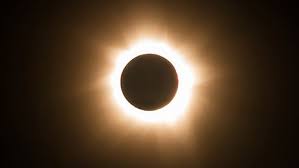
During a solar eclipse...
a)
The sun is blocked by the moon
b)
The Earth is blocked moon
c)
The moon is blocked by the sun
d)
You are blocked
138.

In thinking about a solar eclipse, what does the light source in the diagram represent?
a)
the Earth
b)
the Moon
c)
the Sun
139.

What must occur for an solar eclipse to occur?
a)
Sun-Earth-Moon in line
b)
Sun-Moon-Earth in line
140.

In thinking about a solar eclipse, what does the ball in the diagram represent?
a)
the Earth
b)
the Moon
c)
the Sun
141.
During a lunar eclipse, what color does the moon appear?
a)
Black
b)
Red-orange
c)
Yellow-green
d)
White
142.
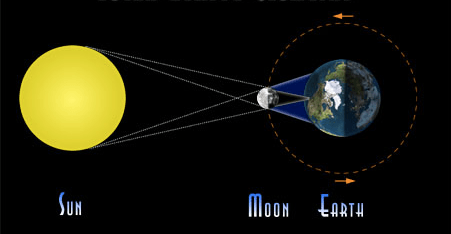
Which type of eclipse is shown in this picture?
a)
Solar Eclipse
b)
Orbit
c)
Lunar Eclipse
d)
Total Eclipse
143.
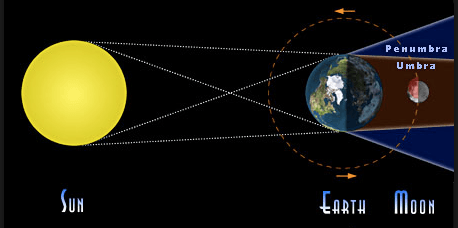
Which type of eclipse is shown in the diagram?
a)
Solar Eclipse
b)
Lunar Eclipse
c)
Total Eclipse
d)
Partial Eclipse
144.
Differences in the moon's and sun's pull on different sides of the Earth cause _________.
a)
gravity
b)
lunar phases
c)
tides
d)
dabbing
145.
The bulge of water on the side of the Earth closest to the moon produces ___________.
a)
high tide
b)
low tide
c)
neap tide
d)
spring tide
146.
Tides are the cycle of rising and falling ocean water that repeats automatically every
a)
24 hours
b)
12.5 hours
c)
25 hours
d)
6.25 hours
147.

What is a difference between spring and neap tides?
a)
Spring tides occur when the earth and sun are IN LINE with the new or full moon.
b)
Spring tides occur when moon in 3rd or 1st quarter phases
c)
Spring tides are LOWER than neap tides
d)
Spring tides occur in Spring and neap tides can occur in any season
148.

Which body has the greater effect on Earth's tides?
a)
Sun
b)
Saturn
c)
Moon
d)
Venus
149.
What do we call tides that have a smaller range that happen when the sun and moon are at right angles to each other?
a)
Neap Tide
b)
Spring Tide
c)
Larger Change
d)
Smaller Change
150.

What type of tide would this arrangement of earth-moon-sun create?
a)
full moon tide
b)
new moon tide
c)
neap tide
d)
spring tide
151.
What causes tides?
a)
gravity
b)
wind
c)
spring
d)
neap
152.
If tides alternate from high to low and there are two of each type of tide a day, about how many hours will generally be between each different tide?
a)
2 hours
b)
6 hours
c)
12 hours
d)
24 hours
153.

The diagram below shows the alignment of the sun, the moon, and Earth. In which locations are neap tides taking place?
a)
1 and 2
b)
1 and 3
c)
2 and 4
d)
3 and 4
154.
How many high tides are there in Myrtle Beach every day?
a)
One
b)
Two
c)
Three
d)
Four
155.

What type of tides would this arrangement of earth-moon-sun create?
a)
neap tide
b)
spring tide
c)
new moon tide
d)
full moon tide
100 %

