
 Worksheets
7.02 - Gravity and Magnetism Review
Total questions: 109
Worksheet time: 1hrs 6mins
Name
Class
Date
1.

Carlos is investigating the gravity on three planets: Earth, Jupiter, and Saturn. Which line graph probably best represents the velocity caused by gravity on Earth
a)
A
b)
B
c)
C
d)
D - They should all be the same
2.

The diagram shows which of the following?
a)
An electric motor
b)
An electric generator
c)
A temporary magnet
d)
An electromagnet
3.

What will happen when these magnets are brought close together?
a)
They will attract each other.
b)
They will repel each other.
c)
Both magnets will turn to the left
d)
Both magnets will turn to the right
4.
Magnets have a north and a south ___________
a)
shape
b)
color
c)
pole
d)
region
5.
Iron, Nickel and cobalt are all __________________ materials
a)
Shiny
b)
poles
c)
magnetic
d)
cold
6.
Where is the strongest attraction force of the magnet?
a)
at the poles
b)
in the middle
c)
above the magnet
d)
below the magnet
7.
A device that uses a free-moving magnetic needle to show direction is a:
a)
Ruler
b)
magnet
c)
compass
d)
magnetic field
8.

Which of the following would not make the electromagnet stronger
a)
Increasing the number of coils
b)
increasing the power output of the batteries
c)
using a plastic core
d)
Adding a magnetic core
9.
As distance between two objects decreases gravitational force between the two objects...
a)
increases
b)
decreases
c)
remains constant
d)
is irrelevant
10.
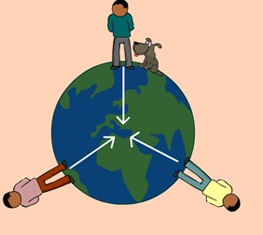
What is gravity?
a)
A force
b)
Energy
c)
A push
d)
All of them
11.
What is the SI unit used to measure force?
a)
pounds
b)
grams
c)
newtons
d)
friction
12.
The amount of matter in an object is
a)
pressure
b)
weight
c)
mass
d)
force
13.
The law of universal gravitation is credited to whom?
a)
Einstein
b)
Galileo
c)
Darwin
d)
Newton
14.
Two factors effecting the magnitude of the force of gravity between 2 objects are...
a)
mass and distance
b)
mass and matter
c)
distance and weight
d)
weight and mass
15.
Gravity attracts all objects towards one another.
a)
False
b)
True
c)
It depends
16.
If Earth's mass was cut in half, what would happen to your mass?
a)
increase because gravitational force increases
b)
decrease because gravitational force decreases
c)
decrease because gravitational force increases
d)
nothing, mass is not affected by gravitational force
17.
Every object in the universe attracts every other object.
a)
True
b)
False
18.

What does this tool measure?
a)
weight
b)
meters
c)
mass
d)
force
19.

Is the force of gravity acting on the bag of potatoes a contact or non-contact force?
a)
contact force
b)
non-contact force
20.

Is the force of gravity on the diver a push or a pull?
a)
push
b)
pull
21.
What is the name of a magnet that stays magnetic only while it touches a permanent magnet, or one that is magnetic for a very short time
a)
Temporary magnet
b)
Permanant magnet
c)
Electromagnet
d)
Magnet
22.

The picture is an example of an:
a)
Electric circuit
b)
Electromagnet
c)
Electric nail
d)
Electric power cell
23.

what do magnets produce?
a)
attraction
b)
area of magnetic force called a magnetic field.
c)
a force against your hand
24.
what can be attracted to magnets?
a)
wood
b)
skin
c)
Metals such as iron, nickel and cobalt
25.

what is the earths magnetic field useful for
a)
deflecting the solar wind, charged particles that come from the Sun.
b)
wind
c)
sun
d)
light
26.
how are electromagnets created?
a)
forces
b)
light
c)
an electric current running through a surrounding coil. They have many uses including the generation of electricity in hydroelectric dams.
27.

What will happen when these magnets are brought close together?
a)
They will attract each other.
b)
They will repel each other.
c)
Both magnets will turn to the left
d)
Both magnets will turn to the right
28.
What characteristics do magnetic substances have?
a)
They can give you a "shock" when you touch them
b)
They can push or pull objects without touching them
c)
They are always black and cold to touch
d)
They fall faster than other objects when you drop them
29.
How is Earth's magnetic field similar to that of a magnet?
a)
It is hundreds of miles long
b)
It has north and south poles
c)
It is made in Earth's core
d)
It is shaped like a horseshoe
30.
What is our best evidence that Earth has a magnetic field?
a)
All things fall toward Earth's center
b)
A compass needle lines up with it
c)
Winds blow from east to west
d)
Earth's oceans all have currents
31.

Earth's magnetic field and a bar magnet attract particles to the same locations. Where are they?
a)
The middle
b)
All around the outside
c)
The north and south poles
d)
First to the middle, then to the ends
32.

Why does a compass needle point north?
a)
The compass is a bar magnet
b)
Because north is up
c)
Because it's magic
d)
It lines up with the Earth's magnetic field
33.
A magnet cannot not move which of the following objects?
a)
a paper clip
b)
a nail
c)
a toothpick
d)
a staple
34.
Earth acts like a giant magnet because its center is made up MOSTLY of
a)
granite
b)
limestone
c)
iron
d)
nickel
35.
Where is the force of attraction the strongest on a magnet?
a)
at the poles
b)
in the middle
c)
above the magnet
d)
below the magnet
36.
Spinning electrons themselves are small magnets.
a)
true
b)
false
37.
What is an electromagnet?
a)
a magnet that creates an electric current
b)
a magnet created by an electric current
c)
a magnet that has an electric charge
d)
an electric charge that is magnetic
38.

This substance is
a)
magnetizecd
b)
unmagnetized
c)
positively charged
d)
negatively charged
39.
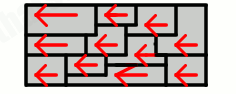
You know this substance is magnetized because
a)
all the domains have right angles
b)
the arrows are drawn in red
c)
the domains are aligned
d)
the domains are random
40.

This is an example of a
a)
temporary magnet
b)
permanent magnet
c)
an ion
d)
an isotope
41.

To make this electromagnet stronger you could
a)
use less wire
b)
have fewer wire coils around the nail
c)
have more wire coils around the nail
d)
use a plastic core
42.

Where are the magnetic force the strongest in this picture?
a)
Location 1
b)
Location 2
c)
Location 3
d)
Location 4
43.
As distance between two objects increase the pull of gravity
a)
Increases
b)
Decreases
c)
Stays the same
44.
The force of gravity acting on an object is the object's ______.
a)
mass
b)
matter
c)
weight
d)
terminal velocity
45.
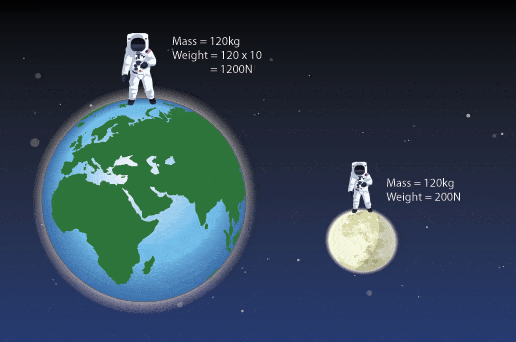
Which of the following will not change in different gravitational fields?
a)
weight
b)
force
c)
mass
d)
pounds
46.
An object is falling but is not accelerating. What do you know?
a)
Gravity is stronger than air resistance
b)
Air resistance is stronger than gravity
c)
Air resistance is equal to gravity
d)
Forces are unbalanced
47.
A person weighs _____ on the Earth than they do on the Moon.
a)
less
b)
more
c)
the same
48.
What is the SI unit used to measure force?
a)
pounds
b)
grams
c)
newtons
d)
kg/ m2
49.
Which is NOT a step in the scientific method?
a)
Make observation
b)
Form a theory
c)
Collect data
d)
Form a hypothesis
50.
In a controlled experiment, how many variables can be worked with at a time?
a)
one
b)
none
c)
two or more
d)
how ever many makes sense.
51.
A force of attraction between objects that is due to their masses.
a)
Force
b)
Gravity
c)
Gravitational Pull
d)
Weight
52.

A measure of the amount of matter in an object
a)
mass
b)
weight
c)
gravity
d)
pounds
53.

A force of attraction between 2 object that is directly related to mass and indirectly related to distance.
a)
mass
b)
weight
c)
gravity
d)
kilogram
54.

As mass increases, what happens to gravitational force?
a)
increases
b)
decreases
c)
stays the same
d)
i don't know
55.

As the distance between 2 objects increases, what happens to gravitational force?
a)
increases
b)
decreases
c)
stays the same
d)
i don't know
56.

Which of the following will change with different gravitational forces?
a)
mass
b)
amount of matter in an object
c)
weight
d)
kilograms
57.

What would happen to your weight if Earth's mass was cut in half?
a)
increase because gravitational force increases
b)
decrease because gravitational force decreases
c)
decrease because gravitational force increases
d)
increase because gravitational force decreases
58.
A series of steps used by scientists to solve a problem or answer a question.
a)
scientific method
b)
recipe
c)
data collection
d)
metric system
59.
The law of universal gravitation is credited to whom?
a)
Einstein
b)
Galileo
c)
Darwin
d)
Newton
60.
Gravity attracts all objects towards one another.
a)
False
b)
True
c)
It depends
61.
Any object with mass has gravity.
a)
True
b)
Sometimes
c)
False
d)
Never
62.
The amount of matter in an object is
a)
pressure
b)
weight
c)
mass
d)
force
63.
Gravity is the force objects put on each other because of their ______.
a)
Mass
b)
Friendliness
c)
Acceleration
d)
Speed
64.
An object at rest remains at rest and an object in motion remains in motion unless it experiences an unbalanced force is what law?
a)
First Law
b)
Second Law
c)
Third Law
d)
Ninth Symphony
65.
The formula we get from the second law is...?
a)
F = m*a
b)
v = d/t
c)
a = v/t
d)
f = 1/T
66.
What is the force necessary to accelerate a 1785 kg car at a rate of 50 m/s/s?
a)
89,250 N
b)
35.7 N
c)
98.8 N
d)
75,620 N
67.
All objects in the universe attract each other through gravitation force is called...
a)
The Law of Universal Gravitation
b)
The Law of Conservation of Momentum
c)
The Law of Thermodynamics
d)
The Law of Monty the Snake
68.
The Free Fall acceleration for Earth is or g equals what...?
a)
9.8 m/s/s
b)
10 m/s/s
c)
98 m/s/s
d)
2 m/s/s
69.
A student stands on a scale, and the scale reads 85 pounds. What is being measured by the scale?
a)
The volume of the student
b)
The mass of the student
c)
The gravity acting on the student
d)
The air pressure on the student
70.
If the mass of an object on Earth is 18 grams, what would the mass of the same object be on the Moon?
a)
18 g
b)
4 g
c)
0 g
d)
32 g
71.
Two factors effecting the magnitude of the force of gravity between 2 objects are...
a)
mass and distance
b)
mass and matter
c)
distance and weight
d)
weight and mass
72.
What does this tool measure?
a)
weight
b)
meters
c)
mass
d)
force
73.
Gravity attracts all objects towards one another.
a)
False
b)
True
c)
It depends
74.
A person would weigh less on on the Moon than on the Earth because . . .
a)
Moon has more mass, and therefore more gravity
b)
Moon has less mass, and therefore more gravity
c)
Moon has more mass, and therefore less gravity
d)
Moon has less mass and therefore less gravity
75.
If Earth's mass was cut in half, what would happen to your mass?
a)
increase because gravitational force increases
b)
decrease because gravitational force decreases
c)
decrease because gravitational force increases
d)
nothing, mass is not affected by gravitational force
76.
Every object in the universe attracts every other object.
a)
True
b)
False
77.
As distance between two objects increase the pull of gravity
a)
Increases
b)
Decreases
c)
Stays the same
78.

What does this tool measure?
a)
weight
b)
meters
c)
mass
d)
force
79.
Any object with mass has gravity.
a)
True
b)
Sometimes
c)
False
d)
Never
80.
The amount of matter in an object is
a)
pressure
b)
weight
c)
mass
d)
force
81.

Which of the following will not change in different gravitational fields?
a)
wieght
b)
force
c)
mass
d)
pounds
82.
As distance between two objects increase the pull of gravity
a)
Increases
b)
Decreases
c)
Stays the same
83.
The force of gravity acting on an object is the object's ______.
a)
mass
b)
matter
c)
weight
d)
terminal velocity
84.
Which of the following will not change in different gravitational fields?
a)
weight
b)
force
c)
mass
d)
pounds
85.
An object is falling but is not accelerating. What do you know?
a)
Gravity is stronger than air resistance
b)
Air resistance is stronger than gravity
c)
Air resistance is equal to gravity
d)
Forces are unbalanced
86.
A person weighs _____ on the Earth than they do on the Moon.
a)
less
b)
more
c)
the same
87.
What is the SI unit used to measure force?
a)
pounds
b)
grams
c)
newtons
d)
kg/ m2
88.
Which is NOT a step in the scientific method?
a)
Make observation
b)
Form a theory
c)
Collect data
d)
Form a hypothesis
89.
In a controlled experiment, how many variables can be worked with at a time?
a)
one
b)
none
c)
two or more
d)
how ever many makes sense.
90.
A force of attraction between objects that is due to their masses.
a)
Force
b)
Gravity
c)
Gravitational Pull
d)
Weight
91.
A measure of the amount of matter in an object
a)
mass
b)
weight
c)
gravity
d)
pounds
92.
A force of attraction between 2 object that is directly related to mass and indirectly related to distance.
a)
mass
b)
weight
c)
gravity
d)
kilogram
93.
As mass increases, what happens to gravitational force?
a)
increases
b)
decreases
c)
stays the same
d)
i don't know
94.
As the distance between 2 objects increases, what happens to gravitational force?
a)
increases
b)
decreases
c)
stays the same
d)
i don't know
95.
Which of the following will change with different gravitational forces?
a)
mass
b)
amount of matter in an object
c)
weight
d)
kilograms
96.
What would happen to your weight if Earth's mass was cut in half?
a)
increase because gravitational force increases
b)
decrease because gravitational force decreases
c)
decrease because gravitational force increases
d)
increase because gravitational force decreases
97.
A series of steps used by scientists to solve a problem or answer a question.
a)
scientific method
b)
recipe
c)
data collection
d)
metric system
98.
The law of universal gravitation is credited to whom?
a)
Einstein
b)
Galileo
c)
Darwin
d)
Newton
99.
Gravity attracts all objects towards one another.
a)
False
b)
True
c)
It depends
100.
Any object with mass has gravity.
a)
True
b)
Sometimes
c)
False
d)
Never
101.
The amount of matter in an object is
a)
pressure
b)
weight
c)
mass
d)
force
102.
Gravity is the force objects put on each other because of their ______.
a)
Mass
b)
Friendliness
c)
Acceleration
d)
Speed
103.
An object at rest remains at rest and an object in motion remains in motion unless it experiences an unbalanced force is what law?
a)
First Law
b)
Second Law
c)
Third Law
d)
Ninth Symphony
104.
The formula we get from the second law is...?
a)
F = m*a
b)
v = d/t
c)
a = v/t
d)
f = 1/T
105.
What is the force necessary to accelerate a 1785 kg car at a rate of 50 m/s/s?
a)
89,250 N
b)
35.7 N
c)
98.8 N
d)
75,620 N
106.
All objects in the universe attract each other through gravitation force is called...
a)
The Law of Universal Gravitation
b)
The Law of Conservation of Momentum
c)
The Law of Thermodynamics
d)
The Law of Monty the Snake
107.
The Free Fall acceleration for Earth is or g equals what...?
a)
9.8 m/s/s
b)
10 m/s/s
c)
98 m/s/s
d)
2 m/s/s
108.
A student stands on a scale, and the scale reads 85 pounds. What is being measured by the scale?
a)
The volume of the student
b)
The mass of the student
c)
The gravity acting on the student
d)
The air pressure on the student
109.
If the mass of an object on Earth is 18 grams, what would the mass of the same object be on the Moon?
a)
18 g
b)
4 g
c)
0 g
d)
32 g
100 %

