wayground logo

Free Printable Worksheets

NEW

Font size

S
M
L
XL
Worksheets

Cardiovascular System

Total questions: 72

Worksheet time: 36mins

Name
Class
Date
1.
Blood is...
a)
A connective tissue
b)
always deoxygenated
c)
only made up of cells
d)
only made up of extracellular matrix
2.
True or False: Blood is composed mainly of cells with a small amount of extracellular matrix
a)
Ture
b)
False
3.
Blood Plasma is composed of:
a)
Mostly water and proteins
b)
Mostly water and oxygen
c)
Mostly water and cholesterol
d)
Mostly water and erythrocytes
4.
An individual with an A+ blood type:
a)
Produces anti-A and anti-rH antibodies
b)
Produces anti-B and anti-rH antibodies
c)
Produces anti-b antibodies
d)
Produces only the A surface antigen
5.
Which of the following blood types could an individual with AB+ blood NOT receive?
a)
AB-
b)
B+
c)
O-
d)
They could receive all of these
6.
The bottom layer which is produced when a blood sample is spun in a centrifuge...
a)
Hematocrit
b)
Plasma
c)
Buffy Coat
7.
What is the buffy coat composed of?
a)
Erythrocytes
b)
White Blood Cells and Platelets 
c)
Water and Proteins
d)
Slain vampires
8.
Your hematocrit is made up of:
a)
Erythrocytes
b)
Leukocytes
c)
Mast Cells
d)
Polycytes
9.
White Blood Cells are also called:
a)
Erythrocytes
b)
Leukocytes
c)
Mast Cells
d)
Polycytes
10.
Erythrocytes have:
a)

Very large surface area compared to their volume

b)

A lot of mitochondria

c)

Multiple nuclei

d)

A lot of ribosomes

11.
Which of the following best describes the shape of an erythrocyte?
a)
Biconcave
b)
Bilateral
c)
Biarchal
d)
Bitetral
12.
Pigmented protein found in Erythrocytes which contains binding sites for oxygen and carbon dioxide
a)
Hemoglobin
b)
Insulin
c)
Tryptophan
d)
Aspartic Acid
13.
Red Blood Cell formation
a)
Erythropoiesis 
b)
Hemogenic Forging 
c)
Hemoglobular Genesis 
d)
Hematoxygenic Reactant 
14.
Hormone which triggers the bone marrow to produce more red blood cells
a)
Erythropoietin 
b)
Hematotin
c)
Insulin
d)
Glucagon
15.
The heart is located within the:
a)
Thoracic Cavity
b)
Abdominal Cavity
c)
Spinal Cavity
d)
Cranial Cavity
16.
The heart is located within the:
a)
Mediastium
b)
Pleural  Cavity
c)
Medastatic Cavity
d)
Diaphragmal Cavity
17.
Movement of blood from the heart to the lungs and then back to the heart
a)
Pulmonary Circuit
b)
Systemic Circuit
c)
Venous System
d)
Arterial System
18.
Movement of blood from the heart to all of the body's living cells and then back to the heart
a)
Pulmonary Circuit
b)
Systemic Circuit
c)
Venous System
d)
Arterial System
19.
Responsible for the movement of blood away from the heart 
a)
Pulmonary Circuit
b)
Systemic Circuit
c)
Venous System
d)
Arterial System
20.
Responsible for the movement of blood towards the heart 
a)
Pulmonary Circuit
b)
Systemic Circuit
c)
Venous System
d)
Arterial System
21.
The right side of the heart will always carry ________ blood. (Barring any septal defects)
a)
Oxygenated
b)
Deoxygenated
c)
Blue
22.
Protective, double layered sac, which surrounds the heart 
a)
Pericardium
b)
Endocardium
c)
Myocardium
23.
Smooth, inner lining of the chambers
a)
Pericardium
b)
Endocardium
c)
Myocardium
24.
The actual muscle tissue of the heart
a)
Pericardium
b)
Endocardium
c)
Myocardium
25.
Systole refers to the _____ of a chamber of the heart while diastole means _________
a)
Contraction / Relaxation
b)
Relaxation / Contraction
26.
Upon leaving the left ventricle, blood will be in the:
a)
Pulmonary Arterial System
b)
Systemic Arterial System
c)
Systemic Venous System
d)
Pulmonary Venous System
27.
Upon leaving the right ventricle, blood will be in the:
a)
Pulmonary Arterial System
b)
Systemic Arterial System
c)
Systemic Venous System
d)
Pulmonary Venous System
28.
Blood in the vena cava is in the:
a)
Pulmonary Arterial System
b)
Systemic Arterial System
c)
Systemic Venous System
d)
Pulmonary Venous System
29.
Blood leaves the lungs through the:
a)
Pulmonary Arterial System
b)
Systemic Arterial System
c)
Systemic Venous System
d)
Pulmonary Venous System
30.
Gas exchange in the pulmonary circuit:
a)
Oxygen enters the blood and carbon dioxide leaves the blood
b)
Oxygen leaves the blood and carbon dioxide enters the blood
31.
Gas exchange in the systemic circuit:
a)
Oxygen enters the blood and carbon dioxide leaves the blood
b)
Oxygen leaves the blood and carbon dioxide enters the blood
32.
Which of the following best describes the correct order of the blood vessel types branching from the aorta
a)
Artery > Arteriole > Capillary > Venule > Vein
b)
Artery > Arteriole > Venule > Vein > Capillary
c)
Artery > Arteriole > Capillary > Vein > Venule
33.
Veins contain ______ to prevent the back flow of blood due to gravity and low pressure
a)
One way valves
b)
Smooth Muscle
c)
Lumen
d)
Endothelium
34.
Arterioles contain a high amount of ________ which can be used to help regulate blood pressure
a)
One way valves
b)
Smooth Muscle
c)
Lumen
d)
Endothelium
35.

Valve between right atrium and right ventricle

a)

Tricuspid Valve

b)

Pulmonary Valve

c)

Aortic Valve

d)

Mitral Valve

e)

There is no valve here

36.
Which side of the heart undergoes systole first in a normal cardiac cycle?
a)
Right
b)
Left
c)
They both contract at the same time
37.
What is blood pressure?
a)
The force of blood felt by the endothelium 
b)
The force of blood felt by the outer edges of the vessel
c)
The force of blood felt only during contraction
d)
The force of blood felt only during relaxation
38.
Systolic Blood Pressure:
a)
Pressure recorded during the contraction of the ventricles
b)
Pressure recorded during the relaxation of the ventricles
39.
Diastolic Blood Pressure:
a)
Pressure recorded during the contraction of the ventricles
b)
Pressure recorded during the relaxation of the ventricles
40.
Which of the following will lower your blood pressure?
a)
Vasodilation
b)
Vasocontriction
c)
Increasing your blood volume
d)
Increasing your bloods viscosity
41.
Which of the following will raise your blood pressure?
a)
Vasodilation
b)
Vasocontriction
c)
Decreasing your blood volume
d)
Decreasing your bloods viscosity
42.
Hypertension
a)
Transient High Blood Pressure
b)
Chronicly High Blood Pressure
c)
Transient Low Blood Pressure
d)
Chronicly Low Blood Pressure
43.
Hypertension can cause:
a)
Tears in the endothelium of your blood vessels
b)
The development of plaques within the arteries (atherosclerosis)
c)
An increased risk of heart attack and stroke
d)
All of these
44.
____ blood pressure is always higher than ____ blood pressure
a)

Arterial / Venous

b)

Venous / Arterial

45.

The movement of an action potential through a segement of muscle

a)

Depolarization

b)

Repolarization

46.
The "recharging" of a chamber of the heart
a)
Depolarization
b)
Repolarization
47.
Depolarization causes:
a)
Systole
b)
Diastole
48.
The QRS complex in an ECG indicates:
a)
Ventricular Depolarization
b)
Atrial Depolarization
c)
Ventricular Repolarization
49.
The P-Wave in an ECG indicates:
a)
Ventricular Depolarization
b)
Atrial Depolarization
c)
Ventricular Repolarization
50.
The T-Wave in an ECG indicates:
a)
Ventricular Depolarization
b)
Atrial Depolarization
c)
Ventricular Repolarization
51.
When within an ECG are the atria repolarizing?
a)
T-Wave
b)
P-Wave
c)
QRS Complex
52.

What causes the Korotkoff Sounds?

a)

Fully opened artery

b)

Fully closed artery

c)

Partially opened artery

53.

How do you observe the Korotkoff Sounds?

a)

Squeezing with a Sphygmomanometer

b)

Looking with a microscope

c)

Listening through a stethoscope

d)

Tasting with your tongue

54.

The last Korotkoff sound tells you the:

a)

Hypertension

b)

Hypotension

c)

Diastolic Blood Pressure

d)

Systolic Blood Pressure

55.

Valve between right atrium and left atrium

a)

Tricuspid Valve

b)

Pulmonary Valve

c)

Aortic Valve

d)

Mitral Valve

e)

There is no valve here

56.

Valve between right ventricle and pulmonary artery

a)

Tricuspid Valve

b)

Pulmonary Valve

c)

Aortic Valve

d)

Mitral Valve

e)

There is no valve here

57.

Valve between left ventricle and aorta

a)

Tricuspid Valve

b)

Pulmonary Valve

c)

Aortic Valve

d)

Mitral Valve

e)

There is no valve here

58.

Valve between left atrium and left ventricle

a)

Tricuspid Valve

b)

Pulmonary Valve

c)

Aortic Valve

d)

Mitral Valve

e)

There is no valve here

59.

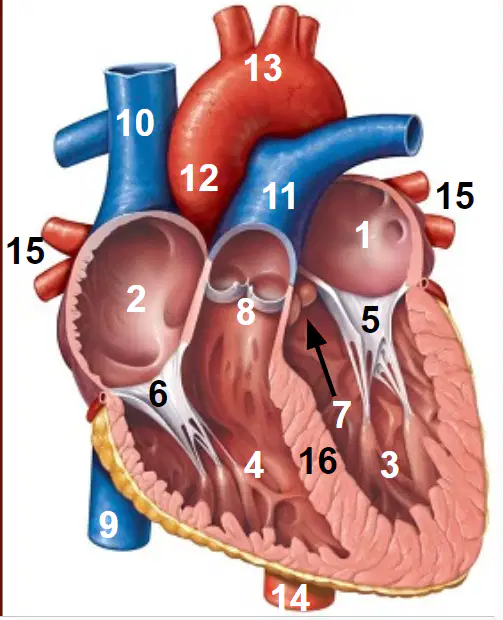
#3

a)

Left Ventricle

b)

Right Ventricle

c)

Left Atrium

d)

Right Atrium

60.

#1

a)

Left Ventricle

b)

Right Ventricle

c)

Left Atrium

d)

Right Atrium

61.

#2

a)

Left Ventricle

b)

Right Ventricle

c)

Left Atrium

d)

Right Atrium

62.

#4

a)

Left Ventricle

b)

Right Ventricle

c)

Left Atrium

d)

Right Atrium

63.

#5

a)

Mitral Valve

b)

Tricuspid Valve

c)

Pulmonary Valve

d)

Aortic Valve

64.

#6

a)

Mitral Valve

b)

Tricuspid Valve

c)

Pulmonary Valve

d)

Aortic Valve

65.

#7

a)

Mitral Valve

b)

Tricuspid Valve

c)

Pulmonary Valve

d)

Aortic Valve

66.

#8

a)

Mitral Valve

b)

Tricuspid Valve

c)

Pulmonary Valve

d)

Aortic Valve

67.

#16

a)

Epicardium

b)

Endocardium

c)

Interventricular Septum

d)

Left Auricle

e)

Right Auricle

68.

#10

a)

Inferior Vena Cava

b)

Superior Vena Cava

c)

Pulmonary Arteries

d)

Pulmonary Veins

e)

Aorta

69.

#9

a)

Inferior Vena Cava

b)

Superior Vena Cava

c)

Pulmonary Arteries

d)

Pulmonary Veins

e)

Aorta

70.

#15

a)

Inferior Vena Cava

b)

Superior Vena Cava

c)

Pulmonary Arteries

d)

Pulmonary Veins

e)

Aorta

71.

#11

a)

Inferior Vena Cava

b)

Superior Vena Cava

c)

Pulmonary Arteries

d)

Pulmonary Veins

e)

Aorta

72.

#13

a)

Aortic Arch

b)

Ascending Aorta

c)

Descending Aorta