wayground logo

Free Printable Worksheets

Font size

S
M
L
XL
Worksheets

Ecology Part 1 Review

Total questions: 70

Worksheet time: 2hrs 30mins

Name
Class
Date
1.

Water temperature would be an example of ...

a)

a biotic factor

b)

an abiotic factor

c)

an antibiotic factor

d)

a bacterial factor

2.

A collection of living organisms that belong to different populations but all live in the same area and interact with one another is a...

a)

Population

b)

Ecosystem

c)

Community

d)

Ecosphere

3.

What are the biotic factors in this image?

a)

sunlight, elephants, grasses

b)

sunlight, water, air

c)

elephants, plants, trees

d)

elephants, clouds, grasses

4.

Which of the following is a population?

a)

hawks, barred owls, and eagles on NC coast

b)

mountain stream

c)

all the frogs in a pond and the water they live in

d)

blue-tailed skinks (lizards) around a barn

5.

Which of the following best describes a community?

a)

sharks, groupers, anemones and shrimp on a coral reef

b)

decorator crabs on the seafloor

c)

loggerhead sea turtles in Atlantic

d)

prairie grassland in Wyoming

6.

What level of organization can be seen here?

a)

Species

b)

Population

c)

Community

d)

Ecosystem

7.
What level of organization can be observed in the image?
a)
Species
b)
Population
c)
Community
d)
Ecosystem
8.
A collection of organisms that make up a community as well as all of the nonliving aspects of the environment.
a)
Population
b)
Community
c)
Habitat
d)
Ecosystem
9.
Two organisms that are so similar they can interbreed in nature and produce fertile offspring
a)
biotic factor
b)
herbivore
c)
ecosystem
d)
species
10.
What are the ecological levels of organization from smallest to the largest?
a)
organism, population, community, ecosystem, biome, biosphere
b)
organism, community, population, ecosystem, biome, biosphere
c)
organism, population, community, biome, ecosystem, ecosphere.
d)
organism, community, population, biome, ecosystem, ecosphere
11.
Antonio and Javier are astronauts in space looking back at Earth and discussing how all the life on Earth interacts with each other as well as the nonliving things. What level of organization are they discussing?
a)
A community
b)
A biome
c)
An ecosystem
d)
A biosphere
12.
Which of the following is NOT a criteria for life?
a)
response to environment
b)
Growth
c)
Reproduce
d)
Breathes
13.
The 8 levels of classification, broadest to most specific.
a)
Domain, Genus, Family, Order, Class, Phylum, Kingdom, Species
b)
Domain, Species, Kingdom, Genus, Phylum, Family, Class, Order
c)
Domain, Kingdom, Phylum, Class, Order, Family, Genus, Species
d)
Order, Kingdom, Species, Domain, Phylum, Family, Class, Genus
14.
What part of the water cycle does this picture show?
a)
condensation
b)
precipitation
c)
evaporation
15.
Which of these is an example of precipitation?
a)
snow
b)
air
c)
clouds
d)
vapor
16.
What is it called when plants give off water vapor as a waste product?
a)
condensation
b)
evaporation
c)
sublimation
d)
transpiration
17.
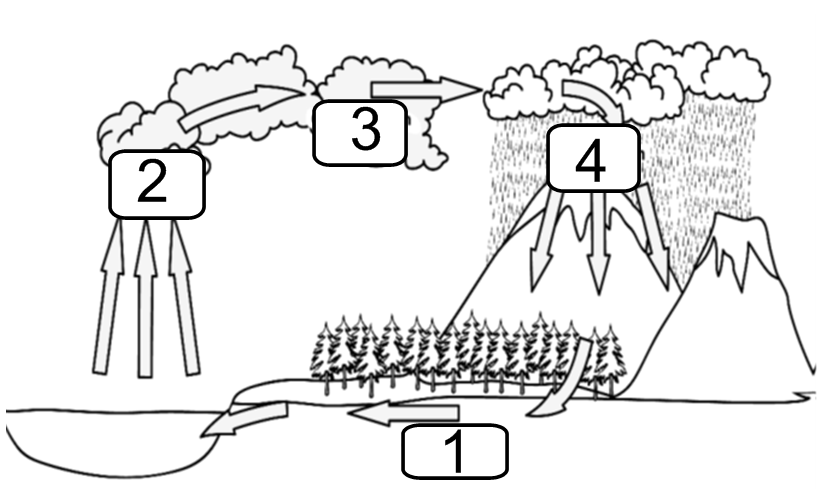
Which stage does the #2 show in the diagram?
a)
condensation
b)
evaporation
c)
precipitation
d)
run off
18.
How nitrogen is "fixed" into useable form for plants...
a)
through action of bacteria only
b)
through lightning only
c)
through action of bacteria & lightning
d)
through photosynthesis
19.
How much of the atmosphere is composed of nitrogen gas?
a)
87%
b)
38%
c)
78%
d)
21%
20.
What can excess amounts of nitrogen cause in ecosystems? 
a)
Disrupts the equilibrium of ecosystem, causing number of species to decline
b)
Leads to improvement of an ecosystem due to healthy plant growth
c)
Leads to high oxygen content in aquatic ecosystems
d)
Increases the speed of decomposition of plants and animals 
21.
Nitrogen-rich fertilizers and manure can cause water pollution.
a)
True
b)
False
22.
How do plants get the nitrogen they need?
a)
from the air
b)
from the soil or water in which they live
c)
from the Sun
d)
from broken-down rocks
23.
Organisms that break down dead plants & animals and release nitrogen back into atmosphere...
a)
bacteria
b)
plants
c)
animals
d)
producers
24.
What does not produce carbon dioxide?
a)
Photosynthesis
b)
Burning Fossil Fuels
c)
Animal respiration
d)
Plants decaying
25.

Producers capture Carbon dioxide from the atmosphere and use it to make sugar

a)

Photosynthesis

b)

Cellular Respiration

c)

Consumption

d)

Combustion

26.

Carbon dioxide released into the atmosphere as waste from metabolism

a)

Photosynthesis

b)

Cellular Respiration

c)

Consumption

d)

Combustion

27.

One organism eats another for carbon

a)

Photosynthesis

b)

Cellular Respiration

c)

Consumption

d)

Combustion

28.

Carbon dioxide released into the atmosphere from burning

a)

Photosynthesis

b)

Cellular Respiration

c)

Consumption

d)

Combustion

29.

Decomposers break down carbon/nitrogen from dead organisms

a)

Decomposition

b)

Fossilization

c)

Nitrogen Fixation

d)

Ammonification

30.

Converts carbon from once living organisms into a fuel source through intense heat and compression

a)

Decomposition

b)

Fossilization

c)

Nitrogen Fixation

d)

Ammonification

31.

Bacteria convert nitrogen from waste into ammonia

a)

Decomposition

b)

Fossilization

c)

Nitrogen Fixation

d)

Ammonification

32.

Bacteria convert nitrogen in ammonia into nitrates and nitrites for plants to absorb in their roots

a)

Nitrogen Fixation

b)

Ammonification

c)

Nitrification

d)

Denitrification

33.

Bacteria convert nitrogen in ammonia to atmospheric nitrogen

a)

Nitrogen Fixation

b)

Ammonification

c)

Nitrification

d)

Denitrification

34.

Bacteria in soil or water convert nitrogen gas into forms that plants can use

a)

Decomposition

b)

Fossilization

c)

Nitrogen Fixation

d)

Ammonification

35.

Water cycle: water falling to Earth from clouds

a)

Transpiration

b)

Evaporation

c)

Precipitation

d)

Infiltration

36.

Water cycle: water that doesn't soak in runs along the surface and collects in bodies of water.

a)

Infiltration

b)

Run-off

c)

Precipitation

d)

Ground water

37.

Water cycle: water soaks in to Earth's surface

a)

Run-off

b)

Infiltration

c)

Soaking in

d)

Seeping

38.

Water cycle: the sun heats liquid water to vapor and it rises into the atmosphere.

a)

Evaporation

b)

Transpiration

c)

Condensation

d)

Run-off

39.

Water cycle: water rising into the atmosphere from plants

a)

Evaporation

b)

Transpiration

c)

Condensation

d)

Precipitation

40.

Water cycle: water vapor forms clouds.

a)

Transpiration

b)

Evaporation

c)

Run-off

d)

Condensation

41.

This is NOT a part of the phosphorus cycle.

a)

Phosphate is incorporated into sedimentary rocks

b)

Phosphate bound to soil

c)

Atmospheric phosphate

d)

Phosphate is absorbed from the soil by plants

42.

_____ brings phosphorous into our waterways. .

a)

Precipitation

b)

Runoff

c)

Transpiration

d)

Condensation

43.
What role do decomposers play in the phosphorous cycle?
a)
absorb phosphorous 
b)
release phosphorous into atmosphere
c)
return phosphorous into the soil
d)
combustion
44.

This is released by the weathering of rocks.

a)

Carbonate

b)

Phosphate

c)

Phosphorus

d)

Nitrogen

45.
If the number of births in a population is the same as the number of deaths in a population, what will happen to the growth of the population?
a)
It will increase.
b)
It will decrease.
c)
It will stay the same.
d)
It will fluctuate.
46.
Largest number of individuals of a population that the environment can support...  
a)
carrying capacity
b)
population crash
c)
lag phase
d)
mutualism
47.
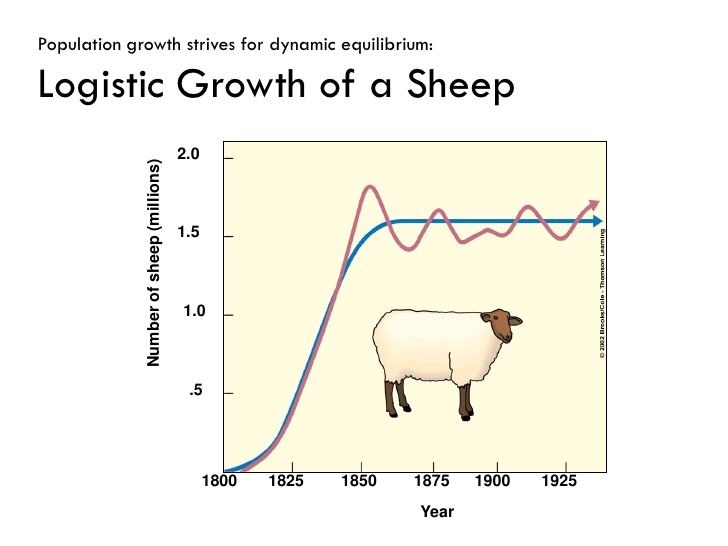
What is the carrying capacity for this sheep population?
a)
1.8 million
b)
1.25 million
c)
1.6 million
d)
1.o million
48.
When a population grows past the ecosystem's carrying capacity, what happens to the population?
a)
Continues to grow
b)
The population starts to die off to return to carrying capcity
c)
The population will go extinct due to lack of resources
d)
The population grows then finds a new carrying capacity
49.
Food, water, sunlight, shelter, and space are resources that are often __________.
a)
limiting factors
b)
wet
c)
messy
d)
found in rocks
50.
When organisms move out of the population, this is known as
a)
emigration
b)
abandonment
c)
immigration
d)
succession
51.
which statement sounds accurate based on the graph data. 
a)
The zebra and lions do not affect each other
b)
when lions population increases, so does the zebra population
c)
When the zebra population increases, it causes the lion population to also increase
d)
when zebra populations go down, the zebra population goes up. 
52.
Which kind of growth does the human population follow? It is described as a J-shaped curve.
a)
Exponential Growth
b)
Logistic Growth
c)
Outstanding Growth
d)
Minimal Growth
53.
A population is...
a)
A group of one species in one area
b)
Multiple species that live in one area
c)
All of the living and nonliving things in an area
d)
None of these
54.
What type of growth is represented behind?
a)
exponential
b)
logistics
c)
a good kind
d)
representative
55.
What point on the graph represents the carrying capacity?
a)
A
b)
B
c)
C
d)
D
56.

Which of the following are density dependent factors?

a)

competition for resources

b)

predation

c)

disease

d)

natural disasters

57.

Which of the following are examples of a density independent factors?

a)

forest fire

b)

seasonal cycles

c)

storms

d)

disease

58.
What factor describes when populations increase because animals are moving into a population?
a)
Emigration
b)
Limiting Factors
c)
Immigration
d)
Exponential Growth
59.
Which limiting factor would increase due to the number of individuals in a population?
a)
Unusual weather
b)
Natural disaster
c)
Births
d)
Disease
60.
Which limiting factor is independent of the number of individuals in a population?
a)
competition
b)
parasitism/disease
c)
stress
d)
natural disasters
61.
What is the carrying capacity of the following graph?
a)
1000
b)
8000
c)
800
d)
600
62.

What is happening at the B on the graph?

a)

the population overshoots above the carrying capacity

b)

the population stops growing

c)

growth begins to slow down due to limited resources

d)

growth is speeding up due to an abundance of resources

63.

What point on the graph does the population slow down tremendously due to limiting resources as it approaches the carrying capacity?

a)

A

b)

B

c)

C

d)

D

64.
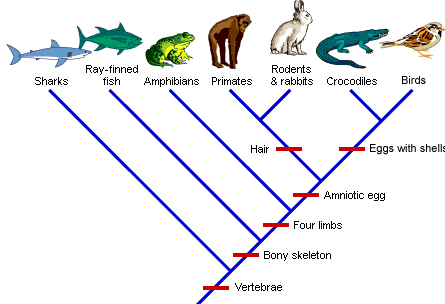
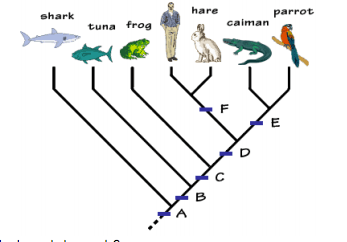
According to this cladogram, primates are most closely related to -
a)
Amphibians
b)
Rodents and rabbits
c)
Crocodiles
d)
Birds
65.
According to this cladogram, birds are LEAST related to -
a)
Amphibians
b)
Sharks
c)
Ray Finned Fish
d)
Crocodiles
66.
On the cladogram, which organism is the closest relative of the human?
a)
Frog
b)
Hare
c)
Caiman
d)
Parrot
67.
Individuals that are well adapted to their environment will survive and produce:
a)
Fewer mutations
b)
Stronger genes
c)
More offspring
d)
Better traits
68.
What genus does Bird Z belong to?
a)
Certhidea
b)
Geospiza
c)
Camarhynchus
d)
Platyspiza
69.
What genus does Bird X belong to?
a)
Certhidea
b)
Geospiza
c)
Camarhynchus
d)
Platyspiza
70.
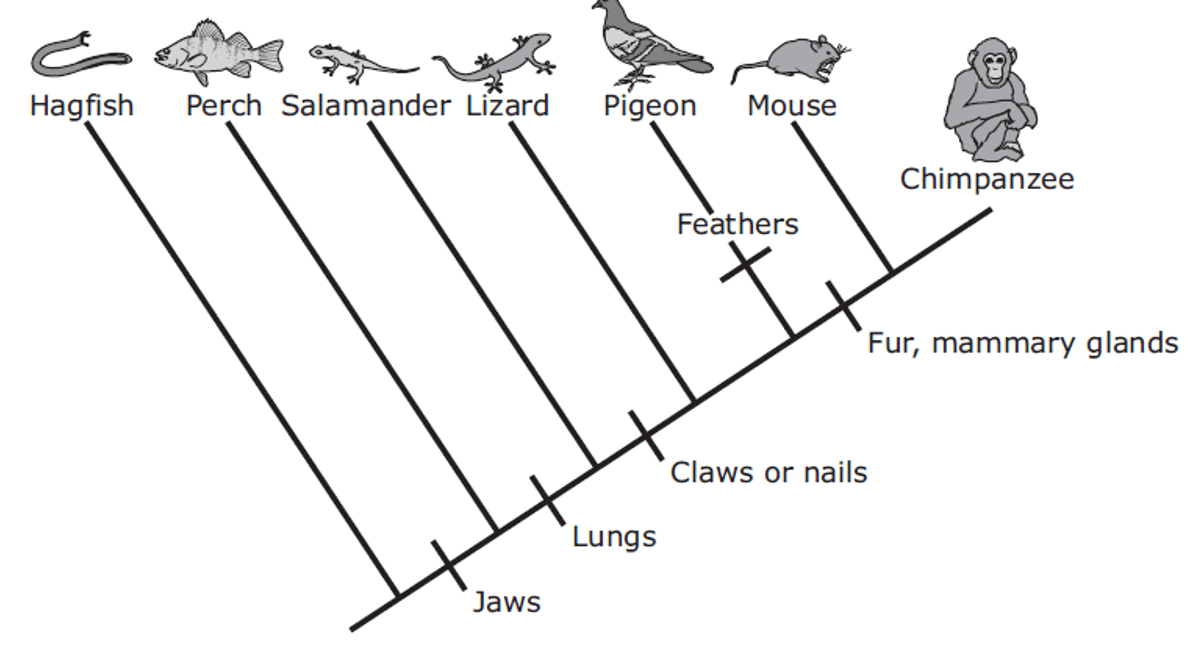
All the animals to the right of the hagfish would have the common characteristic of -
a)
Fur
b)
Claws or nails
c)
Lungs
d)
Jaws