
 Worksheets
Taxonomy Practice Test
Total questions: 70
Worksheet time: 1hrs 10mins




Reorder the following taxonomic Categories from least related to most related
Class
Order
Family
Genus
Species
Which two taxonomic groups give you the scientific name of an organism?
Class & Family
Domain & Kingdom
The common Name
Genus & Species
Mammals belonging to which taxonomic group would be the most closely related?
mammals in the same Order
mammals in the same Genus
mammals in the Class
Mammals in the same Family
The bullfrog, Rana catesbeiana, is most closely related to the
spotted chorus frog, Pseudacris clarki
asian flying frog, Polypedates leucomystax
northern leopard frog, Rana pipiens
african bullfrog, Pyxicephalus adspersus
Which of the following taxonomic groups would contain plants with the greatest amount of variety and differences?
Kingdom
Phylum
Order
Family

Which of the two organisms are the most related?
Tiger and Polar Bear
Polar Bear and Mountain Lion
Mountain Lion and Tiger
Zebra and Tiger

Which of the following organisms are the LEAST related?
Zebra and Tiger
Polar Bear and Mountain Lion
Polar Bear and tiger
Mountain Lion and Tiger

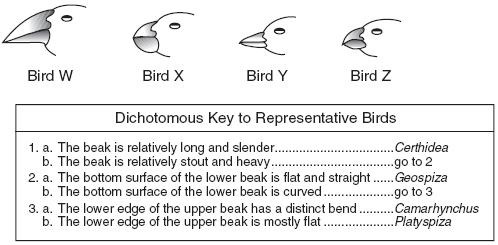
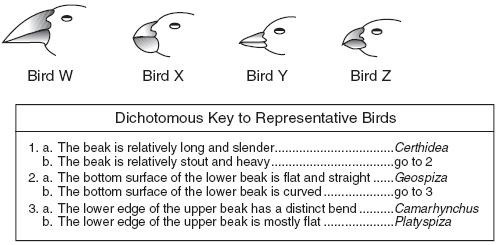
Use the dichotomous key to identify Bird X?
Certhidea
Geospiza
Camarhynchus
Platyspiza
Who created the most commonly used system of taxonomy?
Niels Bohr
Watson and Crick
Charles Darwin
Carl Linnaeus
Which is the correct order?
Kingdom Phylum Order Class
Class Order Family Genus
Domain Phylum Kingdom Species
Order Family Species Genus
Identify the one that is NOT an archaea.
Methanogen
Thermophile
Halophile
Virus
You find a species that seems to be unicellular and is eating smaller cells around it. It has organelles and a nucleus. Which kingdom is it MOST likely a part of?
Fungi
Bacteria
Protists
Plants
Which of the following is NOT a unicellular kingdom?
Prokaryotes
Protists
Archaea
Fungi
You identify a small living organism that is eating something at your feet. It's visible but pretty tiny, you take it to a lab and find that it has cell walls made of chitin. Which is its domain and kingdom?
Prokaryote, Fungi
Eukaryote, Fungi
Prokaryote, Plant
Eukaryote, Plant
Which is NOT a eukaryote?
Plants
Animals
Archaea
Protists
Which best explains why a sponge is an animal?

All animals breath and sponges breath
Animals live underwater and so do sponges
Animals are multicellular heterotrophs and so are sponges

Which organisms have eggs with shells?
sharks
amphibians
crocodiles
birds

Which organism is most closely related to the rodents & rabbits?
primates
amphibians
crocodiles
sharks
Which of the following is a grizzly bear's correct scientific name?
Ursus Arctos
ursus arctos
Ursus arctos
Ursus arctos
Clostridium tetani is a type of bacteria that causes tetanus. Which of the following organisms is most closely related to this bacteria?
Tetanus tocani
Clostridium botulinum
Streptobacillus clostridium
None of the choices

According to this chart, which two organisms are most closely related?
Snail and triceratops
Human and snail
Human and triceratops
None are related to each other

According to the dichotomous key below, what is the name of the pink creature?
1a. mouth open………….go to 2
1b. mouth not open……..go to 4
2a. Arms…………………….go to 3
2b. No arms….Alienus quadlegicus
3a. Hairy……………..Alienus haircus
3b. Not hairy…..Alienus tritoothicus
4a. No horns………………..go to 5
4b. Horns…………...Alienus stripicus
5a. No legs…….…..Alienus biobicus
5b. Legs………………Alienus fuzzicus
Alienus quadalegicus
Alienus tritoothicus
Alienus stripicus
Alienus fuzzicis

Which of the following is the most recent common ancestor of a Hippo and Whale?
A
B
C
D
E

Which of the following organisms is most closely related to the Annelids?
Sponges
Mollusks
Arthropods
Echinoderms

Which of the following organisms is least related to the crocodile?
Sharks
Amphibians
Rodents
Birds

According to this chart, which two organisms are most closely related?
Cat and Wolf
Cat and Fly
Wolf and Fly
Which of the following is the correct scientific name for a tiger?
PANTHERA tigris
Panthera tigris
Panthera Tigris
Panthera Tigris

The following are common names for Heliscuc tropicus. Why should scientist use the scientific name vs the common names for an organism?
Communication with other scientist will be reduced
All scientist will be using one name
Standardized names are less descriptive of the animal that has been observed

Which organism is more similar to a chimpanzee, an orangutan or a dog?
orangutan--they share the same FAMILY
Dog --they share the same CLASS
orangutan--they share the same ORDER

A
B
C
D

Identify the fish
Sebastes serriceps
Sebastes nebulosus
Naucrates ductor
Seriola lalandi


Leaf S (3RD LEAF)
Eastern white pine
balsam poplar
sweet gum
ginko

Which characteristics are used to identify the American Robin?
Head color, Beak shape, and Beak Color
Head color and Beak Color
Beak Shape and Beak Color
Beak Color

Use the image for help. Which kingdom is prokaryotic and lives in neutral environments?
archaebacteria
eubacteria
fungi
protista
Use the image for help. Which kingdom is prokaryotic and lives in extreme environments?
archaebacteria
eubacteria
fungi
protista
Use the image for help. Which kingdom is eukaryotic and has no cell wall?
animalia
eubacteria
fungi
protista
Use the image for help. Which kingdom is eukaryotic and unicellular?
animalia
plantae
fungi
protista
Use the image for help. Which kingdom is eukaryotic, multicellular, and are autotrophs?
animalia
plantae
fungi
protista
Use the image for help. Which kingdom is eukaryotic, multicellular, and are heterotrophs as decomposers?
animalia
plantae
fungi
protista
Use the image for help. Which kingdoms are eukaryotic and have cell walls? Check all that apply.
animalia
plantae
fungi
protista
Use the image for help. One of the kingdoms is eukaryotic and gets its nutrients by acting as a decomposer. Which kingdom must this be?
animalia
plantae
fungi
protista


Rod-shaped prokaryotes swabbed from a kitchen faucet.
Microscopic unicellular organism found in a mud puddle. Organism's DNA is contained in a nucleus and it moves by beating tiny hairs in the water.
In the English language, dogs have many different names to describe them. For example, canine, puppy, dog, hound, etc. In science around the world we use a naming system called what to make it uniform across the world?
binomial nomenclature
polynomial nomenclature
taxonomy
none of the above
There are many different species of big cats around the world. Why is having a scientific name for each species of an organism important?
to prevent existing named organisms from having their name changed as they become extinct
to keep the classification system from being altered as new organisms are discovered
to allow organisms to be placed in many classification levels at the same time
to standardize the naming and organization of organism to avoid confusion between scientist across the world

