wayground logo

Free Printable Worksheets

Font size

S
M
L
XL
Worksheets

Honors Biology Genetics Review

Total questions: 73

Worksheet time: 1hrs 5mins

Name
Class
Date
1.
Which sequence of DNA bases would pair with this partial strand
ATG TGA CAG
a)
ATG TGA CAG
b)
TAC ACT GTC
c)
GTA AGT GAC
d)
CAT TCA CTG
2.
Which of the following best describes a DNA molecule?
a)
double helix
b)
contains ribose
c)
made of amino acids
d)
contains Uracil
3.
Which of the following units are repeatedly joined together to form a strand of DNA?
a)
amino acids
b)
nucleotides
c)
fatty acids
d)
polysaccharides
4.
Guanine bonds with ______________.
a)
Adenine
b)
Guanine
c)
Cytosine
d)
Thymine
5.
In a molecule of double-stranded DNA, the amount of Adenine present is always equal to the amount of
a)
cytosine
b)
guanine
c)
thymine
d)
uracil
6.
Why is DNA important?
a)
it is very small and very complicated
b)
it's in everything
c)
it serves as the blueprint for traits of all living things
d)
because we eat it every day for energy
7.
What determines the code, or information, of a DNA molecule?
a)
the shape (structure) of the nitrogen bases
b)
the order (sequence) of the nitrogen bases
c)
the color of the nitrogen bases
d)
the frequency (number) of nitrogen bases
8.
Which 2 molecules form the sides (backbone) of the DNA ladder?
a)
deoxyribose sugar and adenine
b)
deoxyribose sugar and a hydrogen bond
c)
deoxyribose sugar and the nucleus
d)
deoxyribose sugar and phosphate
9.
What are the three components of a nucleotide?
a)
sugar, hydrogen, nitrogen base
b)
sugar, oxygen, nitrogen base
c)
sugar, phosphate, nitrogen base
d)
sugar, phosphate, protein
10.
A process in which DNA has the unique ability to make an exact copy of itself.
a)
Replication
b)
Translation
c)
Transcription
11.
Nitrogenous bases are joined by which type of bond?
a)
polar bonds
b)
ionic bonds
c)
covalent bonds
d)
hydrogen bonds
12.
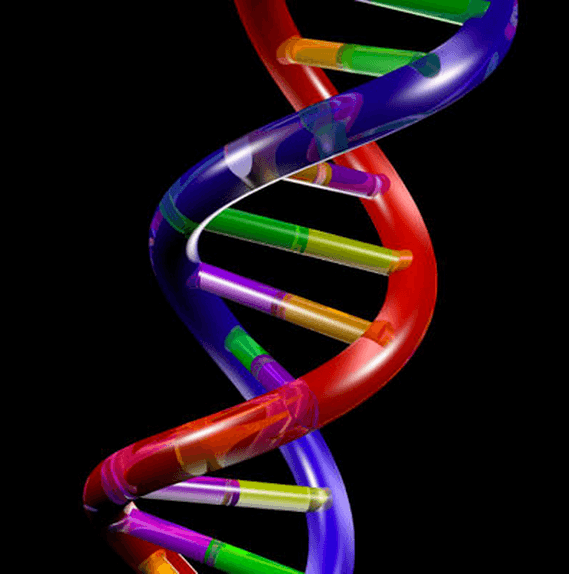
The following picture must be
a)
DNA because it's double stranded
b)
RNA because it's single stranded
c)
DNA because it's single stranded
d)
RNA because it's double stranded
13.
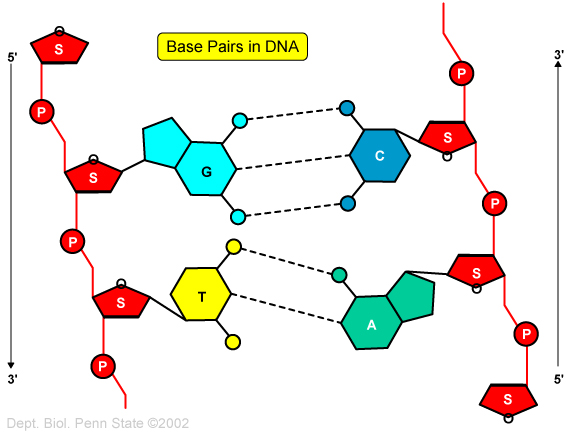
What does this picture represent?
a)
amino acid
b)
base pairing
c)
nucleotide
d)
the DNA molecule
14.
The enzyme that unzips the DNA to prepare for replication
a)
helicase
b)
replicase
c)
polymerase
d)
synthase
15.
RNA contains the sugar
a)
ribose
b)
deoxyribose
c)
glucose
d)
lactose
16.
What is the difference between DNA and RNA in terms of bases?
a)
RNA contains uracil in place of thymine
b)
RNA contains uracil in place of adenine
c)
RNA contains uracil in place of guanine
d)
RNA contains uracil in place of  cytosine
17.
Which type of RNA takes the instructions from the nucleus to the cytoplasm?
a)
mRNA
b)
tRNA
c)
rRNA
d)
RNA polymerase
18.
What is the template for mRNA?
a)
DNA
b)
tRNA
c)
rRNA
d)
proteins
19.
What is the product of translation?
a)
DNA
b)
mRNA
c)
tRNA
d)
proteins
20.
What is the product of transcription?
a)
DNA
b)
mRNA
c)
tRNA
d)
proteins
21.
How many nucleotides make a codon?
a)
1
b)
2
c)
3
d)
6
22.

What is the central dogma of molecular biology?

a)

RNA-protein-DNA

b)

RNA-DNA-protein

c)

DNA-protein-RNA

d)

DNA-RNA-protein

23.

The picture below shows the steps of DNA replication beginning with step one and ending with step three.


​Because you are reusing the old, or parent, DNA strand DNA replication is said to be

a)

Semi- Conservative

b)

Semi-discontinuous

c)

Continuous

d)

Fully-Conserveative

24.

Which enzyme is responsible for adding the free nucleotides to the replicating DNA? ​

a)

DNA Helicase

b)

DNA Ligase

c)

DNA polyermase

d)

RNA Polymerase

25.

Which is the first step in DNA replication?

a)

DNA Helicase unwinds original DNA strand

b)

RNA Primase lays down RNA primer for new nucleotide bases.

c)

DNA polymerase builds new strands by bring in new nucleotide bases.

d)

Ligase knits together fragments on lagging strand

26.

Which is the second step in DNA replication?

a)

DNA Helicase unwinds original DNA strand

b)

RNA Primase lays down RNA primer for new nucleotide bases.

c)

DNA polymerase builds new strands by bring in new nucleotide bases.

d)

Ligase knits together fragments on lagging strand

27.

Which is the third step in DNA replication?

a)

DNA Helicase unwinds original DNA strand

b)

RNA Primase lays down RNA primer for new nucleotide bases.

c)

DNA polymerase builds new strands by bring in new nucleotide bases.

d)

Ligase knits together fragments on lagging strand

28.

Which is the fourth step in DNA replication?

a)

DNA Helicase unwinds original DNA strand

b)

RNA Primase lays down RNA primer for new nucleotide bases.

c)

DNA polymerase builds new strands by bring in new nucleotide bases.

d)

Ligase seals the gaps in the DNA strands

29.

If a person suffered from a disorder where their DNA fragments were unable to fill in the missing slots in between the fragments of the lagging strand, they would most likely have a disorder that affected which enzyme?

a)

DNA Helicase

b)

DNA Ligase

c)

DNA polyermase

d)

RNA Polymerase

30.

DNA replication runs from ______' to _____' and is said to be ______________________

a)

5, 3, antiparallel

b)

3, 5, antiparallel

c)

5, 3, parallel

d)

3, 5, parallel

31.

Okazaki fragments appear on which strand of DNA during DNA replication?

a)

lagging

b)

leading

32.
The process to go from DNA to mRNA is _______
a)
translation
b)
transcription
c)
replication
33.
The process to go from mRNA to a protein is called ____
a)
transcription
b)
rRNA
c)
replication
d)
translation
34.
What is the location in the cell for translation?
a)
nucleus
b)
mitochondria
c)
ribosome
d)
chloroplast
35.
How many amino acids are coded for by this sequence of nucleotides:
ATG GGA ACT CCA
a)
4
b)
2
c)
6
d)
12
36.
What is the three base sequence of mRNA that codes for a single amino acid?
a)
Anticodon
b)
Codon
c)
Protein
37.
The mRNA leaves the ________ to find the ribosome to make proteins.
a)
cell
b)
nucleotide
c)
nucleus
38.

Transcribe the following DNA strand: CTG AAT

a)

GAC TTA

b)

CTG AAT

c)

GAC UUA

d)

CUG AAU

39.

The RNA codon AUG means

a)

add amino acid methionine

b)

start the protein here

c)

add the amino acid tyrosine

d)

end the polypeptide chain here

40.

When RNA is being made, the RNA base ____ always pairs with the base ___ in DNA.

a)

U-T

b)

T-G

c)

U-A

d)

A-U

41.

tRNA plays a role in which of the following ?

a)

picking up the amino acid specified by the anticodon

b)

recognizing the appropriate codons in mRNA

c)

translating codons into amino acids

d)

all of these are correct

42.

Any change in the nucleotide sequence of a gene is called

a)

a mutation

b)

a codon

c)

a translation

d)

an anticodon

43.
What is it called when a sperm and egg meet?
a)
meiosis
b)
fertilization
c)
cell division
d)
mitosis
44.
Which process and type of resulting cells are represented?
a)
mitosis, gametes
b)
mitosis, body cells
c)
meiosis, gametes
d)
meiosis, body cells
45.
The chromosomes that pair up during meiosis, are called __________ chromosomes.  
a)
homozygous 
b)
asexual
c)
homologous
d)
genes
46.
A male shark has 40 chromosomes in each of its sex cells. How many would be present in its body cells?
a)
20
b)
40
c)
80
d)
160
47.
Compared to the number of chromosomes contained in a body cell, how many chromosomes would normally be contained in a gamete?
a)
The same number
b)
One-fourth as many
c)
Twice as many
d)
Half as many
48.
What causes genetic variation in meiosis?
a)
chromosomes lining up
b)
crossing over of chromosomes
c)
separation of chromosomes
d)
chromosomes pulling apart
49.
What is one of the advantages, why is it better to reproduce sexually versus asexually?
a)
survival of the fittest
b)
overproduction
c)
genetic variation
d)
cloning
50.
Females have ____ and males have _____ chromosomes.
a)
XX, XY
b)
XY, XX
c)
XX, XX
d)
XY, XY
51.
Diploid Cells are represented by
a)
2n
b)
n
c)
4n
d)
1/2 n
52.
What phase is  shown in the picture?
a)
anaphase 1
b)
anaphase 2
c)
metaphase 1
d)
telophase 1
53.
The process of crossing over occurs in what phase of meiosis?
a)
anaphase 1
b)
prophase 1
c)
prophase 2
d)
telophase 1
54.

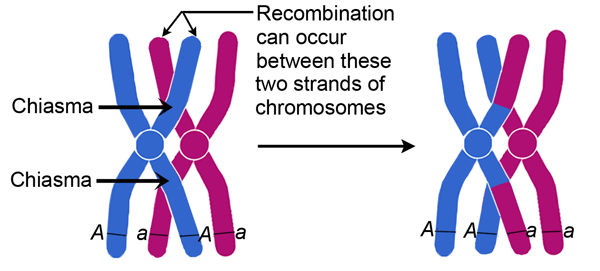
This image shows chromosomes during Prophase 1. Which of the following correctly describes the process shown?

a)

segregation of sister chromatids

b)

condensation and segregation of alleles

c)

mutationin which the DNA content of the gene is altered

d)

crossing over in which genes are exchanged

55.

In what phase is the DNA of the cell replicated or copied?

a)

Interphase

b)

Prophase I

c)

Telophase I

d)

Metaphase I

56.

What part of the cell disappears during Prophase and reappears in Telophase?

a)

nuclear membrane

b)

cell membrane

c)

chromosomes

57.

Homologous pairs line up in the middle of the cell in what phase of Meiosis?

a)

Metaphase I

b)

Metaphase II

c)

Mitosis

d)

Prophase II

58.

What phase of Meiosis is the picture showing?

a)

Metaphase I

b)

Telophase I

c)

Anaphase II

d)

Telophase II

59.

What phase is in the picture?

a)

Telophase I

b)

Telophase II

c)

Prophase I

d)

Metaphase II

60.

What phase is shown in the picture?

a)

Prophase I

b)

Prophase II

c)

Telophase II

d)

Anaphase I

61.

What phase is in the picture?

a)

Anaphase I

b)

Anaphase II

c)

Telophase I

d)

Metaphase II

62.

What phase is in the picture?

a)

Metaphase 1

b)

Metaphase 2

c)

Prophase 1

d)

Prophase 2

63.

What phase is in the picture?

a)

Prophase 1

b)

Prophase 2

c)

Telophase 2

64.
How many chromosomes are in the new cells of mitosis?
a)
46
b)
23
65.
How many daughter cells are produced at the end of meiosis?
a)
1
b)
2
c)
3
d)
4
66.

Involves two parents and produces offspring different from parents

a)

external fertilization

b)

sexual reproduction

c)

internal fertilization

d)

asexual reproduction

67.

A reproductive process that involves two parents that combine genetic material to produce a new organism, which differs from both parents.

a)

external fertilization

b)

asexual reproduction

c)

sexual reproduction

d)

internal development

68.

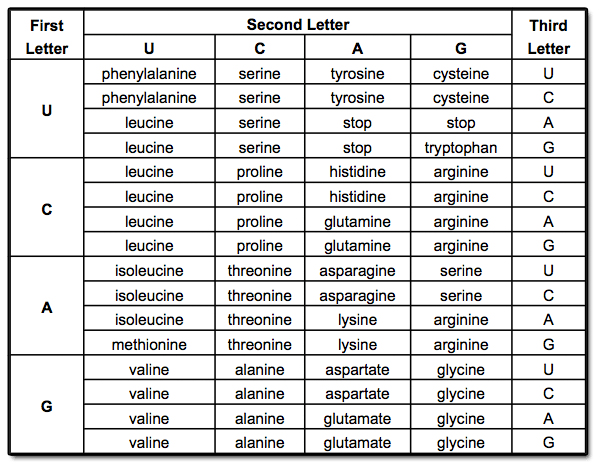
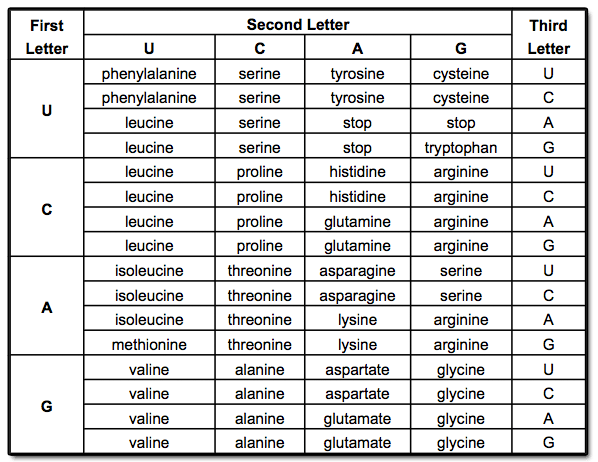
When using your codon chart, what sequence can you use to find the correct amino acid?

a)

DNA

b)

mRNA

c)

tRNA

d)

Any of these will do

69.
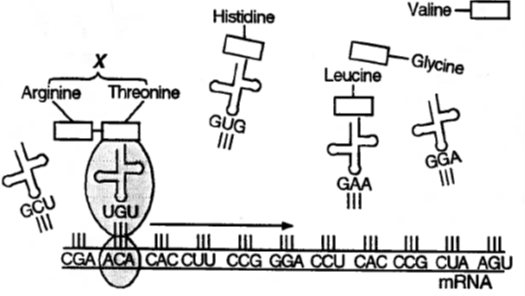
What process is going on in this photo? 
a)
Transcription 
b)
Translation 
c)
Replication 
d)
All the above 
70.
What amino acid is represented by the codon UUA?
a)
Phenylalanine
b)
Tyrosine
c)
Leucine
d)
Stop codon
71.
What is the correct amino acid sequence for the mRNA code AUGCCAGUAUGA
a)
Met-Pro-Ala-Val
b)
Met-Pro-Val
c)
Tyr-Gly-His
d)
Tyr-Gly-Arg-His
72.
The codon CCU codes for what amino acid?
a)
Isoleucine
b)
Stop
c)
Methionine
d)
Proline
73.
Which amino acid pairs with the codon AGA
a)
Thr
b)
Arg
c)
Ala
d)
Glu