wayground logo

Free Printable Worksheets

Font size

S
M
L
XL
Worksheets

Unit 2 Review

Total questions: 68

Worksheet time: 1hrs 14mins

Name
Class
Date
1.
What are the nucleotides made of?
a)
Sugar, Phosphate, nitrogen base
b)
Phosphate, Adenine, nitrogen base
c)
Thymine, Adenine, Cytomine
d)
Phosphate, Nitrogen, Adenine
2.
Adenine bonds with ______________.
a)
Guanine
b)
Thymine
c)
Cytosine
d)
Adenine
3.
Guanine bonds with ______________.
a)
Adenine
b)
Guanine
c)
Cytosine
d)
Thymine
4.
Which sequence of DNA bases would pair with this partial strand
ATG TGA CAG
a)
ATG TGA CAG
b)
TAC ACT GTC
c)
GTA AGT GAC
d)
CAT TCA CTG
5.

In eukaryotes, which organelle is DNA usually found in?

a)

cell membrane

b)

vacuole

c)

chloroplast

d)

nucleus

6.
The building block of nucleic acids are nucleotides.  Nucleotides are composed of a sugar, a phosphate group, and a _________________ base.
a)
oxygen
b)
hydrogen
c)
nitrogen
d)
carbon
7.
Which of the following monomers are repeatedly joined together to form a strand of DNA?
a)
amino acids
b)
nucleotides
c)
fatty acids
d)
polysaccharides
8.
What determines the code, or information, of a DNA molecule?
a)
the shape (structure) of the nitrogen bases
b)
the order (sequence) of the nitrogen bases
c)
the color of the nitrogen bases
d)
the frequency (number) of nitrogen bases
9.
Which 2 molecules form the sides (backbone) of the DNA ladder?
a)
deoxyribose sugar and adenine
b)
deoxyribose sugar and a hydrogen bond
c)
deoxyribose sugar and the nucleus
d)
deoxyribose sugar and phosphate
10.
How would the DNA sequence GCTATA be transcribed to mRNA?
a)
GCUAUA
b)
CGATAT
c)
CGAUAU
d)
GCUTUT
11.
The process by which the genetic code of DNA is copied into a strand of RNA is called
a)
translation
b)
transcription
c)
transformation
d)
replication
12.
Which of the following describes RNA?
a)
RNA is usually double-stranded and contains the base thymine
b)
RNA is usually single-stranded and contains the base uracil
c)
RNA is longer than DNA and uses five bases to encode information
d)
RNA is made in the nucleus of eukaryotic cells and stays there to carry out its functions
13.
In messenger RNA, each codon specifies a particular
a)
nucleotide
b)
enzyme
c)
amino acid
d)
promoter
14.
Changes is DNA sequences that affect genetic information are known as
a)
replications
b)
mutations
c)
transformations
d)
translations
15.
A substance that can cause a change in the DNA code of an organism is called a 
a)
toxin
b)
mutagen
c)
nitrogenous base
d)
nucleotide
16.
An expressed gene
a)
functions as a promoter
b)
is transcribed into RNA
c)
codes for just one amino acid
d)
is made of mRNA
17.

Which organelle is the location where protein is made?

a)

Ribosome

b)

Nucleus

c)

Cytoplasm

d)

Nucleotide

18.

During transcription, this type of ribonucleic acid is responsible for copying the DNA and brining it out of the nucleus.

a)

tRNA

b)

mRNA

c)

rRNA

d)

dRNA

19.

When these bond together, they form a protein

a)

Amino Acids

b)

Peptide Bonds

c)

Ribose

d)

Nucleotides

20.

A string of nucleotides that contain the information to make a specific protein

a)

Ribose

b)

Amino Acids

c)

tRNA

d)

Gene

21.

Which of the following is the complementary mRNA sequence to this DNA strand: AACTGAA

a)

UUGACUU

b)

TTGACTT

c)

AACTGAA

d)

AACUGAA

22.
What is the term for a three-nucleotide sequence that codes for an amino acid?
a)
base
b)
codon
c)
amine
d)
serine
23.
Which of the following is the site of translation?
a)
vacuole
b)
lysosome
c)
nucleus
d)
ribosome
24.
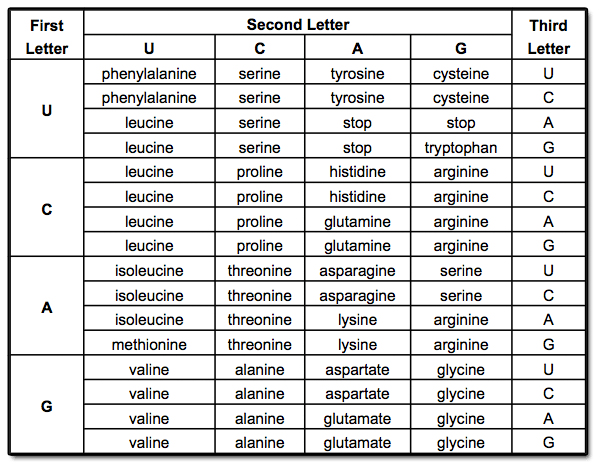
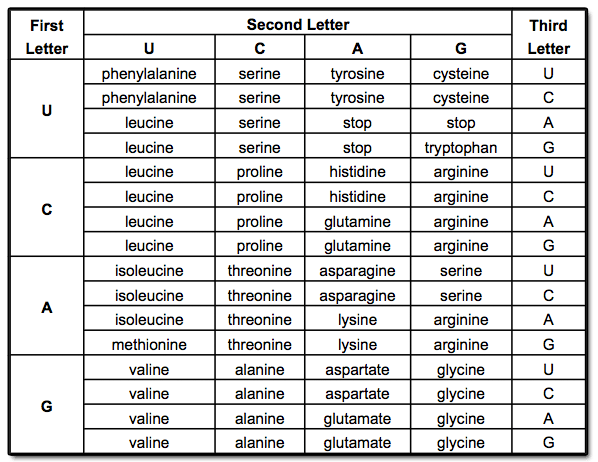
What amino acid is represented by the codon UUA?
a)
Phenylalanine
b)
Tyrosine
c)
Leucine
d)
Stop codon
25.
What is the correct amino acid sequence for the mRNA code AUGCCAGUAUGA
a)
Met-Pro-Ala-Val
b)
Met-Pro-Val
c)
Tyr-Gly-His
d)
Tyr-Gly-Arg-His
26.
The physical traits of an organism
a)
Teletype
b)
Genotype
c)
Mesotype
d)
Phenotype
27.
The genes of an organism
a)
Mesotype
b)
Phenotype
c)
Teletype
d)
Genotype
28.
This means Same Gene
a)
Dominant
b)
Recessive
c)
Heterozygous
d)
Homozygous
29.
Genes always appear in pairs. Your parents donate ________ allele for every trait.
a)
1
b)
2
c)
23
d)
46
30.
This means Different Gene
a)
Dominant
b)
Recessive
c)
Homozygous
d)
Heterozygous
31.
What is Bb?
a)
Homozygous
b)
Heterozygous
c)
Recessive
d)
Alleles
32.
What are the two genotypes that show the DOMINANT Phenotype
a)
GG, gg
b)
GG, Gg
c)
Gg, gg
33.
What is the only Genotype that shows the RECESSIVE Phenotype?
a)
GG
b)
Gg
c)
gg
34.
Which of the following pairs is homozygous dominant?
a)
Hh
b)
pp
c)
HH
d)
aa
35.

Chromosomes are

a)

Found in the mitochondria

b)

Made of 20 pairs

c)

Long strands of DNA that contain many genes

d)

Bundles of DNA that contain only one gene each

36.

In science, mutations are

a)

The reason the X-Men exist

b)

Genetically engineered creatures that you fight in the Hunger Games

c)

A change in the DNA of an organism that produces new traits

d)

Always helpful for survival

37.

If a gene is always expressed or always shown with a capital letter it is

a)

Bossy

b)

Recessive

c)

Yelling

d)

Dominant

38.

Different versions of the same gene are called

a)

Jeans

b)

Editions

c)

Varieties

d)

Alleles

39.
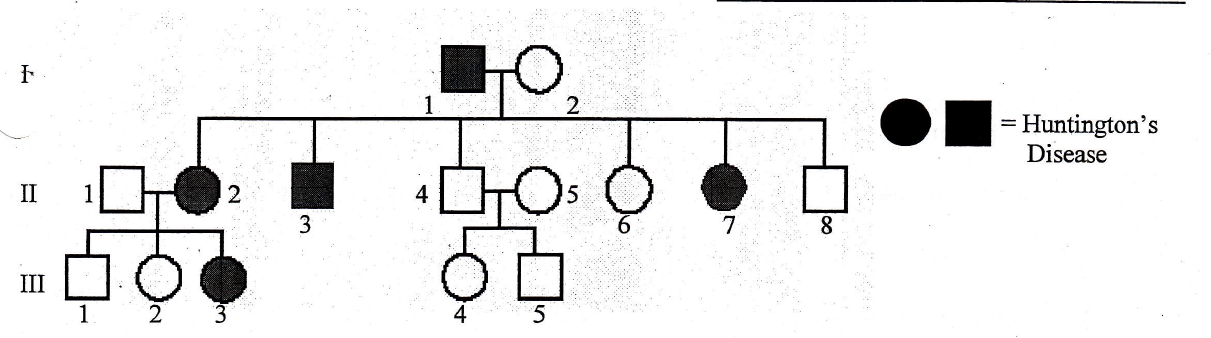
If this pedigree shows an autosomal recessive disorder, what MUST the genotype of individual II-3 be?
a)
HH
b)
Hh
c)
hh
d)
None of the above
40.
There are no carriers for Huntington's Disease- you either have it or you don't. Is Huntington's disease caused by a dominant or recessive trait?
a)
Dominant
b)
Recessive
41.
Does this pedigree show a dominant or recessive trait?
a)
Dominant
b)
Recessive
42.
Hemophilia is a recessive sex-linked trait. If H = normal & h = has hemophilia, which genotype represents a male with hemophilia. 
a)
XHY
b)
XHXh
c)
XhXh
d)
Xh
43.
What is the genotype of the mother?
a)
BB
b)
bb
c)
Bb
d)
BB or Bb
44.
Which of the following is a phenotype?
a)
Aa
b)
red hair
c)
heterozygous
d)
DNA
45.
T - tall and t = short
In the punnett square below, what belongs in the missing square
a)
tt
b)
Tt
c)
Bb
d)
TT
46.
G = green, g = yellow
The genotype for a yellow plant is...
a)
GG
b)
Gg
c)
gg
d)
all of the choices result in yellow
47.
In a certain species of rabbits, black coat color is dominant over brown coat color. What is the probability of producing a rabbit with brown coat color from two rabbits that are both heterozygous for black coat color?
a)
0%
b)
25%
c)
75%
d)
100%
48.
Phenylketonuria (PKU) is inherited as a recessive condition. A man with PKU marries a woman without any alleles for PKU. What is the probability that their child will inherit PKU?
a)
0%
b)
25%
c)
50%
d)
75%
49.

What is the dominant trait here?

a)

Bb

b)

Recessive eyes

c)

Blue eyes

d)

Brown eyes

50.

Which of the following is the correct order?

a)

Fascicle, muscle fiber, myofibril, sarcomere, myofilament

b)

Sarcomere, muscle fiber, fascicle, myofibril, myofilament

c)

Muscle fiber, fascicle, sarcomere, myofibril, myofilament

d)

Fascicle, muscle fiber, myofilament, myofibril, sarcomere

51.

the functional contractile unit within a muscle fiber is called the

a)

sarcomere

b)

fascia

c)

sarcoplasm

d)

tendon

52.

Structure B is known as the thin filaments of the sarcomere, what is another name for the thin filaments?

a)

myosin

b)

actin

c)

fascia

d)

myofibril

53.

Identify the red structures? A fibrous protein that forms (together with actin) the contractile filaments of muscle cells.

a)

actin

b)

myosin

c)

tropomyosin

d)

troponin

e)

cross bridge

54.
Two organisms that are closely related would have
a)
very similar DNA sequence
b)
exactly the same DNA sequences
c)
no proteins in common
d)
completely different DNA sequence
55.
How do fossils provide evidence that evolution has happened on Earth?
a)
Fossils show how the sizes of certain animals has changed drastically over millions of years
b)
Fossils show that some species have gone extinct
c)
Fossils show how life forms present today are different than those from the past
d)
Different sedimentary rock layers provide evidence for how the environment has changed over time
56.
Scientists compare organisms' DNA to support the theory that all species share a common _________________
a)
separation
b)
ancestor
c)
population
d)
environment
57.
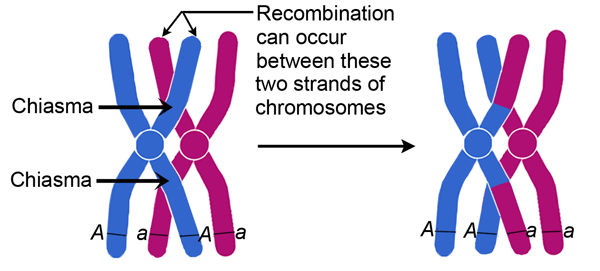
The process of crossing over occurs in what phase of meiosis?
a)
anaphase 1
b)
prophase 1
c)
prophase 2
d)
telophase 1
58.
This image shows chromosomes during Prophase 1. Which of the following correctly describes the process shown?
a)
segregation of sister chromatids
b)
condensation and segregation of alleles
c)
mutationin which the DNA content of the gene is altered
d)
crossing - over in which alleles are exchanged
59.
Meiosis results in the production of
a)
2 diploid cells
b)
2 haploid cells
c)
4 haploid cells
d)
4 diploid cells
60.
The end of meiosis results in  ____ to each other.
a)
2 cells that are identical
b)
4 cells that are identical
c)
2 cells that are not identical
d)
4 cells that are not identical
61.
Why would it be important to replicate DNA before a cell divides in mitosis or meiosis?
a)
In order for genetic information to be transferred into daughter cells.
b)
In order for the cell to be able to increase in size.
c)
In order for the DNA to be contained in the nucleus.
d)
In order for the cell to re-order the DNA sequencing in the new cells.
62.

This law describes how each homologous pair separates independently of any other pairs during Anaphase I of meiosis

a)

Law of Segregation

b)

Law of Independent Assortment

c)

Law of Gravity

d)

Law of Mathematical Order

63.

Any change in the sequence of DNA is a

a)

recombination

b)

mutation

c)

chromatin

d)

independent assortment

64.

Squirrels have 40 chromosomes in its diploid cells. How many chromosomes will you find in their egg cells

a)

40

b)

23

c)

20

d)

Not enough information to answer the question

65.

A haploid cell from a male camel has 35 chromosomes. What type of cell is this? Choose all that apply

a)

Sperm

b)

Egg

c)

Heart Cell

d)

Muscle Cell

66.
A dog has 78 chromosomes in its body cells.  What is the diploid number?
a)
78
b)
39
c)
1
d)
100
67.
A Goat has 60 chromosomes in its body cells.  What is the haploid number?
a)
60
b)
30
c)
100
d)
120
68.
A human has 46 chromosomes in their body cells.  What is the haploid number?
a)
46
b)
92
c)
23
d)
12