Wayground logo

Free Printable Worksheets

Font size

S
M
L
XL
Worksheets

Periodic Table

Total questions: 46

Worksheet time: 33mins

Name
Class
Date
1.
Each column in the periodic table is called a 
a)
period
b)
group
c)
cluster
d)
unit
2.
The atomic number tells you what?
a)
number of electrons
b)
number of protons
c)
number of neutrons
d)
both electrons and protons in an atom.
3.
Elements which are shiny, conduct electricity and heat are called
a)
metal
b)
nonmetal
c)
metalloid
d)
nonexistent
4.
Which element is not a metal?
a)
H
b)
Re
c)
Al
d)
B
5.
The atoms along the staircase are called 
a)
metals
b)
nonmetals
c)
metalloids
d)
noble gases
6.
Which is an alkali metal?
a)
Magnesium
b)
Iron
c)
Sodium
d)
Europium
7.
A horizontal row of elements in the periodic table.
a)
column
b)
group
c)
period
8.
A proton is....
a)
A negatively charged subatomic particle
b)
A positively charged subatomic particle
c)
A neutrally charged subatomic particle
d)
The only subatomic particle located in the nucleus
9.
A neutron has a charge of
a)
+2
b)
No charge
c)
-1
d)
+1
10.
In what section would Transition Metals be found?
a)
orange
b)
light blue
c)
blue
d)
white
11.
Elements on the left side of the periodic table are 
a)
metals
b)
nonmetals
c)
metalloids
d)
noble gases
12.
Which elements have the most similar chemical properties?
a)
K and Na
b)
K and Ca
c)
K and Cl
d)
K and S
13.
What are the first two elements on the periodic table?
a)
hydrogen and helium
b)
hydrogen and lithium
c)
hydrogen and carbon
d)
nitrogen and helium
14.
Nonmetals are located in what section of this periodic table?
a)
Blue
b)
Yellow
c)
Pink
15.
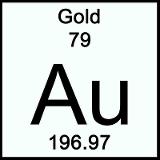
Which number is the atomic mass?
a)
79
b)
196.97
16.
Which is a halogen?
a)
Helium
b)
Chlorine
c)
Oxygen
d)
Neptune
17.
Which is an alkali metal?
a)
Magnesium
b)
Iron
c)
Sodium
d)
Europium
18.
The atomic number of this pictured element is
a)
28
b)
58.6934
c)
Ni
d)
Nickel
19.
A negatively charged particle that moves around the nucleus is a(n)
a)
proton
b)
neutron
c)
electron
d)
quark
20.
Which of the 4 major groups is the largest? (4.4)
a)
Metals
b)
Semimetals
c)
Nonmetals
d)
Inert/Noble Gases 
21.
Valence electrons are: 
a)
Electrons farthest away from the nucleus
b)
Electrons closest to the nucleus
c)
Electrons that just come and go - they don't stay with the atom
22.
True or False - Protons and Neutrons have about the same mass.
a)
True - They have about the same mass
b)
False - They do not have about the same mass
23.
Which subatomic particle has a positive (+) charge?
a)
Neutron
b)
Proton
c)
Electron
24.
Which subatomic particle has a negative (-) charge?
a)
Proton
b)
Electron
c)
Neutron
25.
Which subatomic particle has a neutral or no charge?
a)
Proton
b)
Electron
c)
Neutron
26.
Where is the nucleus located in an atom?
a)
Near the electron shells/levels
b)
Near the center of an atom
27.
Which two subatomic particles make up the nucleus of an atom?
a)
Protons and Electrons
b)
Neutrons and Electrons
c)
Electrons and Protons
d)
Protons and Neutrons
28.
Where are the Electrons found in the structure of an atom?
a)
In the nucleus
b)
In spaces around the nucleus
29.
The subatomic particles in green are...
a)
Protons
b)
Neutrons
c)
Electrons
30.
How many electron shells/levels does this atom have?
a)
1
b)
2
c)
3
d)
4
31.
How many electrons does this picture show?
a)
4
b)
5
c)
6
d)
3
32.

Which element is in Group 2, Period 4?

a)

Calcium

b)

Magnesium

c)

Silicon

d)

Carbon

33.

Which element is in Group 8, Period 6?

a)

Radon

b)

Radium

c)

Polonium

d)

Chromium

34.

Where is Cesium (Ce) found?

a)

Group 1, Period 6

b)

Group 6, Period 1

c)

Group 4, Period 2

d)

Group 3, Period 3

35.

Where is Boron (B) found?

a)

Group 3, Period 3

b)

Group 4, Period 3

c)

Group 3, Period 4

d)

Group 6, Period 1

36.

What is the atomic mass of Nitrogen (N)?

a)

14

b)

7

37.

How many protons does Zinc (Zn) have?

a)

30

b)

65

c)

35

38.

How many electrons does Scandium (Sc) have?

a)

21

b)

45

c)

24

39.

How many neutrons does Fluorine (F) have?

a)

10

b)

9

c)

19

40.

How many valence electrons does Magnesium (Mg) have?

a)

1

b)

2

c)

3

d)

4

41.

How many valence electrons does Oxygen (O) have?

a)

6

b)

3

c)

4

d)

2

42.

What word best describes something that can be flattened into sheets?

a)

malleability

b)

ductility

c)

conductivity

d)

reactivity

43.

What word best describes something that can cause chemical reactions with other substances?

a)

malleability

b)

ductility

c)

conductivity

d)

reactivity

44.

What word best describes something that can be rolled into thin wires?

a)

malleability

b)

ductility

c)

conductivity

d)

reactivity

45.

What word best describes something that can transfer heat and electricity?

a)

malleability

b)

ductility

c)

conductivity

d)

reactivity

46.

What word best describes the process of forming rust?

a)

malleability

b)

corrosion

c)

conductivity

d)

reactivity