Wayground logo

Free Printable Worksheets

Font size

S
M
L
XL
Worksheets

March Madness (Science)

Total questions: 80

Worksheet time: 58mins

Name
Class
Date
1.

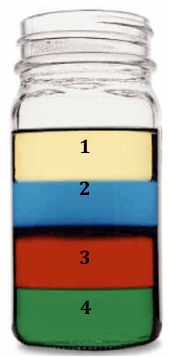
What part of the illustration shows Evaporation?

a)

1

b)

2

c)

3

d)

4

2.

Which number illustrates Condensation?

a)

1

b)

2

c)

3

d)

4

3.

What does this symbol on a weather map indicate?

a)

High pressure system

b)

Low pressure system

c)

Cold front

d)

Warm front

4.

What does this symbol indicate on a weather map?

a)

High pressure system

b)

Low pressure system

c)

Cold front

d)

Warm front

5.

What kind of weather is usually associated with a high pressure system?

a)

Sunny weather

b)

Precipitation (rain, snow, etc.)

6.

Which weather tool measures air pressure?

a)

thermometer

b)

barometer

c)

anemometer

d)

psychrometer

7.
This weather tool measures wind speed and direction
a)
thermometer
b)
barometer
c)
anemometer
d)
psychrometer
8.
Which weather tool measures temperature?
a)
thermometer
b)
barometer
c)
psychrometer
d)
anememeter
9.
The boundary  between two air masses is known as:
a)
front
b)
storm
c)
climate
d)
flood
10.
Mark looks at the clouds in the sky and decides that he does not need to
take his umbrella with him today. Which clouds did Mark most likely see
in the sky?
a)
cirrus
b)
nimbostratus
c)
cumulonimbus
11.
Which type of cloud is most often observed during a thunderstorm?
a)
cirrus
b)
stratus
c)
cumulus
d)
cumulonimbus
12.
Which condition usually means cloudy, stormy weather?
a)
high pressure
b)
low pressure
13.
a)
nimbostratus cloud
b)
cumulonimbus cloud
c)
cirrocumulus cloud
d)
altostratus cloud
14.
name this front
a)
warm front
b)
cold front
c)
stationary front
d)
occluded front
15.
What does this symbol on a weather map indicate? 
a)
High pressure system
b)
Low pressure system
c)
Cold front
d)
Warm front
16.
A _____ is a large, swirling, low-pressure system that forms over the Atlantic Ocean.
a)
blizzard
b)
cold front
c)
tornado 
d)
hurricane
17.
Rain, snow, sleet, and hail are all forms of _____.
a)
precipitation
b)
condensation
c)
evaporation
d)
climate
18.
What units do we use to measure length?
a)
meters (m)
b)
milliliters (mL)
c)
grams (g)
d)
cubic centimeters (cm3)
19.
What units do we use to measure mass?
a)
milliliters (mL)
b)
liters (L)
c)
centimeters (cm)
d)
grams (g)
20.

The unit of measurement for volume is:

a)

Meter

b)

Gram

c)

Liter

d)

Pounds

21.
What is this piece of equipment?
a)
A. spring scale
b)
B. Triple Beam Balance
c)
C. Balance Scale
d)
D. Balance
22.
How many millimeters are there in a centimeter?
a)
1
b)
10
c)
100
d)
1000
23.
What do we call these instruments?
a)
buret
b)
erlenmeyer flask
c)
graduated cylinder
d)
beaker
24.
What is the name of this piece of lab equipment?
a)
beaker
b)
flask
c)
graduated cylinder
d)
test tube
25.
"Will ice melt faster in salt water?", is an example of a
a)
Hypothesis
b)
Question
c)
Dependent variable
d)
Control
26.
"Ice will melt faster in salt water.", would make a good
a)
Hypothesis
b)
Question
c)
Analysis
d)
Conclusion
27.
Which of these is NOT a scientific observation?
a)
All birds have feathers.
b)
Some birds have colorful feathers.
c)
There are many different types of birds.
d)
Birds are a great pet.
28.

What are the steps in the Scientific Method?

a)

Ask a Question, Make a Hypothesis, Do Background research, Conduct an Experiment, Analyze your data, Report your results.

b)

Ask a Question, Make a Hypothesis, Analyze your data, Do Background research, Conduct an Experiment, Report your results.

c)

Ask a Question, Do Background research, Make a Hypothesis, Conduct an Experiment, Analyze your data, Report your results.

d)

Ask a Question, Do Background research, Conduct an Experiment, Make a Hypothesis, Analyze your data, Report your results.
29.
If a student spills something when they are conducting an experiment they should
a)
clean it up quickly.
b)
tell their teacher.
c)
ask another student to help them clean it up.
d)
tell another student to clean it up.
30.
An object with which of the following densities will float on water?
a)
0.7 g/cm3
b)
1.2 g/cm3
c)
3.5 g/cm3
d)
11.4 g/cm3
31.
Why do ice cubes float in a  glass of water?
a)
the ice cubes are more dense than the water
b)
the water is more dense than the ice cubes
c)
the water is more dense than the glass
d)
the ice is more dense than the glass
32.
The following liquids are poured together in a beaker: alcohol (density=0.79), corn syrup (density=1.38), water (density=1.0), and cooking oil (density=0.93).  Which of these liquids will sink to the bottom of the beaker?
a)
alcohol
b)
corn syrup
c)
water
d)
cooking oil
33.
A scientist has four different liquids and pours them all into a bottle.  The silver liquid sinks to the bottom, the red liquid settles on top of the silver one, and the pink liquid stays at the surface. Which liquid has the smallest density?
a)
the pink liquid
b)
the silver liquid
c)
the red liquid
d)
the water
34.
What is the density of water?
a)
0 g/ml
b)
1 g/ml
c)
10 g/ml
d)
100 g/ml
35.
What is the density of a substance that has a mass of 30g and a volume of 6 liters?
a)
24 g/l
b)
5 g/l
c)
36 g/l
d)
180 g/l
36.
Helium balloons rise on earth because
a)
helium is less dense than air
b)
helium is more dense than air
c)
helium is cooler than air
d)
helium is warmer than air
37.
Put the liquids in order from most dense to least dense?
a)
4, 3, 2, 1
b)
1, 2, 3, 4
c)
3, 4, 2, 1, 
d)
4, 3, 1, 2
38.
all matter is made of what 
a)
energy 
b)
atoms 
c)
electrons 
d)
compounds 
39.
The positive particles of an atom are 
a)
electrons 
b)
positrons 
c)
neutrons 
d)
protons 
40.
the central region of an atom where its neutrons and protons are is its 
a)
nucleus 
b)
electron cloud
c)
core 
d)
center 
41.
an atom with atomic number 6 would have how many protons 
a)
6
b)
12
c)
3
d)
cannot be determined 
42.
Particles in an atom that are neutral and have no charge are 
a)
negatrons 
b)
electrons 
c)
neutrons 
d)
protons 
43.

What is the atomic number for an element with three protons?

a)

2

b)

1

c)

3

d)

6

44.

A particle that moves around the nucleus is a(n)...

a)

Proton

b)

Neutron

c)

Electron

d)

Quark

45.
What does the 1.00794 stand for?
a)
Hydrogen
b)
atomic number
c)
atomic mass
d)
atomic explosion
46.

What is the atomic mass of "F"

a)

9

b)

18

c)

17

d)

19

47.

The first energy level can hold up to how many electrons?

a)

8

b)

4

c)

2

d)

5

48.
The particles that are found in the nucleus of an atom are
a)
neutrons and electrons
b)
electrons only
c)
protons and neutrons
d)
protons and electrons
49.
What is the atomic symbol for sodium?
a)
Na
b)
So
c)
NaCl
d)
S
50.

How many neutron are in the atom "K"?

a)

7

b)

2

c)

39

d)

20

51.
Which one of these is NOT located in the element square on the Periodic Table?
a)
Atomic Number
b)
Atomic Mass
c)
Room Temperature
d)
Chemical Symbol
52.
If an atom has 10 protons, 10 neutrons, and 10 electrons, what is the mass of the atom?
a)
10
b)
20
c)
30
53.

Atoms are mostly filled with?

a)

electrons

b)

empty space

c)

protons

54.
A pure substance that cannot be separated into simpler substances by chemical or physical means.  
a)
Element
b)
Compound
c)
Mixture
d)
Chemical
55.
These contain only one kind of atom. 
a)
element 
b)
compound 
c)
mixture 
d)
water 
56.
Carbon Dioxide is a ______ 
a)
compound 
b)
element 
c)
mixtures 
d)
Battle of Bunker Hill 
57.
Salt is a _________. 
a)
compound 
b)
element 
c)
mixture 
58.

Which of the following is not a compound?

a)

HCl

b)

Cl

c)

NaCl

d)

CO2

59.
A combination of substances that are not chemically combined is called a(n)____________. 
a)
mixture
b)
compound
c)
physical
60.

This picture represents which of the following?

a)

element

b)

compound

c)

mixture of elements

d)

mixture of compounds

61.
This picture represents which of the following?
a)
element
b)
compound
c)
mixture
62.
Is salt (NaCI) a compound or a element
a)
Compound
b)
element
63.

How many elements are represented in the compound?

Na2CO3

a)

1

b)

2

c)

3

d)

4

64.

Which form of matter has a definite shape and takes up space (has definite volume)?

a)

liquid

b)

solid

c)

gas

d)

clay

65.
Which form of matter take the shape of a container like this juice?
a)
liquid
b)
solid
c)
glass
d)
gas
66.
Which form of matter fills the space like it has in the balloon?
a)
liquid
b)
string
c)
solid
d)
gas
67.
The milk in the glass has volume and takes the shape of its container. Therefore, it is assumed that milk is a ______________.
a)
solid
b)
liquid
c)
gas
d)
plasma
68.
Which of the following is a base?
a)
orange juice
b)
water
c)
vinegar
d)
dishwashing detergent
69.
 Which of the following is an acid?
a)
shampoo
b)
baking soda
c)
orange juice
d)
water
70.
The pH of a solution is tested, and it is found to be a basic solution. Of the following choices, what could the pH have been?
a)
3
b)
9
c)
7
d)
5
71.
Human blood has a pH between 7.35 and 7.45. Which of the following best describes human blood?
a)
strongly acidic
b)
slightly acidic
c)
strongly basic
d)
slightly basic
72.
What would be considered the weakest base? 
a)
8
b)
14
c)
7.8
d)
11.6
73.
Many cleaning solutions are bases. Which of the following is a property of most bases?
a)
feels slippery
b)
white color
c)
can only be liquid
d)
tastes sour
74.
Pure water has a pH of 7. Pure water _______.
a)
is a base
b)
is a neutral substance
c)
could be either an acid or a base
d)
is an acid
75.
Soap is a weak base.  What is true about the taste of bases?
a)
they taste sour
b)
they taste sweet
c)
they taste bitter
d)
they taste salty
76.
Which of these solutions is an acid?
a)
Dish Soap: pH of 12
b)
Tomato Soup: pH of 4
c)
Baking Soda: pH of 9
d)
Drain Cleaner: pH of 14
77.
Which of the following is true about acids and bases?
a)
The lower the pH, the stronger the acid
b)
the higher the pH, the stronger the acid
c)
The lower the pH, the more neutral the acid
d)
The higher the pH, the weaker the base
78.
What is the pH of water?
a)
0
b)
4
c)
7
d)
14
79.
Ranging from 0 to 14, a pH value indicates how acidic or basic a solution is.  Which of these pH values would be a strong acid?
a)
2
b)
6
c)
9
d)
13
80.
Williams collected a rain sample and measured its pH to be 5.6.  What does this mean?
a)
the rain water is a weak base
b)
the rain water is neutral
c)
the rain water is a strong acid
d)
the rain water is a weak acid