
 Worksheets
602 electrical science
Total questions: 100
Worksheet time: 3hrs 35mins
Name
Class
Date
1.

In the triangle shown, what is the length of side 'a'?
a)
2 cm
b)
4 cm
c)
6 cm
d)
9 cm
2.
What is the volume of a room that measures 3m in width, 8m in length, and the ceiling is 2.4m high?
a)
13.4 m²
b)
13.4 m³
c)
57.6 m³
d)
57.6 m²
3.
Evaluate u + xy, for u = 18 , x = 10 , and y = 8.
a)
188
b)
36
c)
98
d)
224
4.
Which of these fractions has the LEAST value (is the smallest)?
a)
1/4
b)
1/9
c)
1/12
d)
1/3
5.
8/12 + 3/12
a)
12/12
b)
11/12
c)
12/11
d)
10/12
6.
-10z = 40
a)
z = 50
b)
z = 30
c)
z = -4
d)
z = 4
7.
How would you write 4.3756 x 10⁴ in standard form?
a)
437,560,000
b)
0.00043756
c)
43,756
d)
4,3756
8.
How would you write 0.0005 in scientific notation?
a)
50 x 105
b)
5 x 10⁴
c)
5 x 10³
d)
.5 x 103
9.
The sub-multiple milli matches which of the following?
a)
1/10000
b)
1/100
c)
1/1000
d)
1/100000
10.
The SI unit which represents meter squared is?
a)
volume
b)
area
c)
height
d)
density
11.
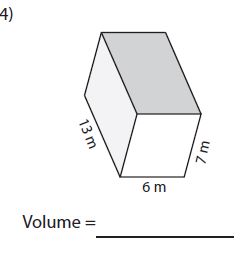
Solve for the volume.
a)
546 m3
b)
456 m3
c)
654 m3
d)
54 m3
12.
What prefix is represented by the following symbol: k
a)
hecto
b)
kilo
c)
deci
d)
deka
13.
Convert 12 km to m
a)
120 m
b)
1,200 m
c)
12,000 m
d)
120,000 m
14.
What is the base unit for measuring temperature?
a)
Fahrenheit
b)
Celsius
c)
Kelvin
d)
degrees
15.
The amount of space an object takes up or the amount of space something contains
a)
volume
b)
weight
c)
mass
d)
force
16.
What is density?
a)
The measurement of how tightly compact the mass is in an object
b)
The measurement of a surface
17.
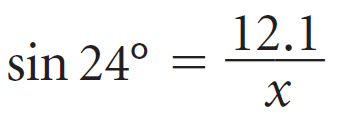
Solve for x.
a)
24.20
b)
4.92
c)
290.4
d)
29.75
18.
Hertz is the SI unit of measurement for
a)
Resistivity
b)
Frequency
c)
Reactance
d)
Capacitance
19.

Approximately what force is needed to raise the 100kg mass shown in the diagram?
a)
981 N
b)
981 W
c)
327 N
d)
327 W
20.
How much work is done if I use 3 Newtons of force to move an object 5 meters?
Formula: Work= force x distance
Joules= Newtons x meters
Formula: Work= force x distance
Joules= Newtons x meters
a)
15 Joules
b)
15 Newtons
c)
8 Joules
21.
A wheelbarrow is which of the following?
a)
First order lever
b)
Second order lever
c)
Third order lever
d)
Fourth order lever
22.
Name the three effects of electrical current.
a)
Chemical, Thermionic, Thermal
b)
Magnetic, Chemical, Resistive
c)
Chemical, Magnetic, Thermal
d)
Thermal, Thermionic, Resistive
23.
Identify one source of electricity.
a)
A wattmeter
b)
An ammeter
c)
A diode
d)
A battery
24.

What is the mechanical advantage of this pulley system?
a)
2
b)
3
c)
4
d)
5
25.
A long distance runner travels 59.7m using 35,000J of work. How much force did the runner use?
a)
586 N
b)
593 N
c)
59 N
d)
60 N
26.
To complete a project, 200,000J of work are needed. The time taken to complete the project is 20 seconds. How much power is needed?
a)
10,000 W
b)
0.0001 W
c)
200,020 W
d)
1,000,000 W
27.
The number of times a machine multiplies your effort/input force is called ___.
a)
mechanical advantage
b)
mechanical efficiency
c)
power
d)
work
28.
A machine's ability to convert input work to output work
a)
efficiency
b)
power
c)
input force
d)
mechanical advantage
29.
What is the efficiency of the machine if the input is 263 J and the output is 142 J?
a)
6.26%
b)
54%
c)
100%
d)
260%
30.
Materials that have a high electrical resistance
a)
less length
b)
less tempareture
c)
more thickness
d)
less cross sectional area
31.

The conductor with higher temperature
a)
high resistance
b)
low resistance
c)
same resistance
d)
it does not affect the resistance
32.
The length of a certain conductor of resistance 100 is doubled and its cross-sectional area is halved. Its new resistance is
a)
100
b)
50
c)
200
d)
400
33.
Resistivity of a wire depends on:
a)
length
b)
material
c)
cross sectional area
d)
none of the above
34.
What size resistor would produce a 3 Amp current flow with a 12 Volt battery
a)
1 Ohm
b)
3 Ohms
c)
4 Ohms
d)
12 Ohms
35.
What is electric current?
a)
The number of charged particles that pass a point each second
b)
The difference in potential
c)
The resistance
d)
Light Emitting Diode
36.
What is voltage?
a)
The difference in potential energy of the charged particles
b)
The number of charged particles that pass a point each second
c)
The flow of protons
d)
A type of dog from Central Asia
37.
Electricity is the flow of _________.
a)
Protons
b)
Neutrons
c)
Electrons
38.

What is this symbol for?
a)
light bulb
b)
switch
c)
battery
d)
resistor
39.
What are the color codes for a 210 ohm resistor?
a)
brown, grey, red
b)
brown, black, yellow
c)
red, brown, brown
d)
brown, black, brown
40.
What is the tolerance for a Green, Red, Black, Gold resistor?
a)
1%
b)
20%
c)
5%
d)
10%
41.

Bits of paper are attracted to the surface of this balloon. What attracts the paper pieces to the balloon?
a)
Friction
b)
Static Electricity
c)
Magnetism
d)
Potential Energy
42.

If the voltage across the battery was 10V in this diagram. What would the voltage across each bulb be?
a)
10V
b)
5V
c)
20V
d)
0V
43.
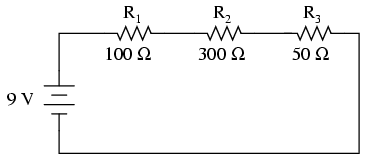
The total resistance in this circuit is
a)
100 ohms
b)
450 ohms
c)
400 ohms
d)
30 ohms
44.

The voltage dropped across the 300 ohm resistor is
a)
6 V
b)
9 V
c)
2 V
d)
30 V
45.
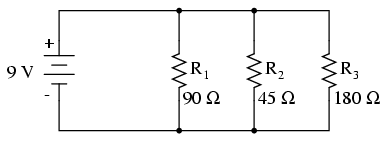
The current going through the 45 ohm resistor is
a)
0.05 amps
b)
0.2 amps
c)
0.1 amps
d)
5 amps
46.
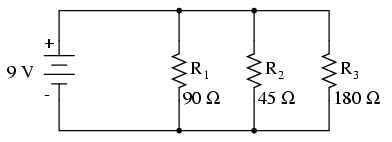
The total resistance of this circuit is
a)
25.7 ohms
b)
315 ohms
c)
324 ohms
d)
90 ohms
47.

Does this diagram represent a series or parallel circuit?
a)
series circuit
b)
parallel circuit
48.

The total current going through the battery of this circuit is
a)
0.35 amps
b)
0.0286 amps
c)
0 amps
d)
9 amps
49.

Calculate the power dissipated in the circuit shown.
a)
50 W
b)
52 W
c)
55 W
d)
60 W
50.

Calculate the power dissipated in the circuit shown.
a)
300 W
b)
60 W
c)
720 W
d)
1000 W
51.
This transforms mechanical energy into electrical energy
a)
Generator
b)
Motor
c)
Electromagnet
52.
This is formed when a wire in an electric circuit is wrapped around an iron core producing a magnetic field.
a)
Generator
b)
Motor
c)
Electromagnet
53.
Two parallel copper wires are each carrying the same electrical current in the same direction. Which statement explains how they respond to each other?
a)
They repel each other, because they have similar magnetic fields.
b)
They repel each other, because they have opposite magnetic fields.
c)
They strengthen each other, because they have similar magnetic fields.
d)
They strengthen each other, because they have opposite magnetic fields.
54.
What happens when a wire is wound into a coil around an iron core in an electromagnet?
a)
the wire exolodes
b)
you get electricuted
c)
the magnetic field becomes stronger
d)
the magnetic field becomes weaker
55.
Magnetic Field lines....
a)
Go out of the North side and into the South side
b)
Go out of the South side and into the North side
c)
Go out of the North side AND out of the South side
d)
Go into the North side AND go into the South side
56.
Fleming’s left hand rule is used to find
a)
direction of magnetic field due to current carrying conductor
b)
direction of flux in a solenoid
c)
direction of force on a current carrying conductor in a magnetic field
d)
polarity of a magnetic pole
57.
The left hand rule correlates to
a)
current, induced e.m.f. and direction of force on a conductor
b)
magnetic field, electric field and direction of force on a conductor
c)
self induction, mutual induction and direction of force on a conductor
d)
current, magnetic field and direction of force on a conductor
58.
Indicate which of the following material does not retain magnetism permanently.
a)
Soft iron
b)
Stainless steel
c)
Hardened steel
d)
None of the above
59.
When there is a change in the magnetic field in a closed loop of wire
a)
(a) a voltage is induced in the wire
b)
(b) current is made to flow in the loop of wire
c)
(c) electromagnetic induction occurs
d)
(d) all of these
60.
As electrons move, they make
a)
A. electromagnetism.
b)
B. auroras.
c)
C. ferromagnetism.
d)
D. magnetic
fields.
61.
A device that converts electrical energy into mechanical energy
a)
A. electromagnet
b)
B. electromagnetic induction
c)
C. electric motor
d)
D. electromagnetism
62.
A device that converts mechanical energy into electrical energy
a)
A. electric generator
b)
B. electric motor
c)
C. electromagnetic induction
d)
D. mechanical generator
63.

What kind of magnet can be turned on and off?
a)
refrigerator magnet
b)
electromagnet
c)
magnetite
d)
iron
64.
What can you do to increase the strength of an electromagnet?
a)
Add more coils of wire
b)
Remove some coils of wire
c)
Stick a wooden pencil inside of the coils
d)
Increase to resistance in the circuit
65.
1. What is electromagnetic Induction? (694-695)
a)
The process of inducing a current in a circuit by changing the magnetic field.
b)
Potential difference of electrons and circuits
c)
Gravitational force and magnetic force.
d)
Electromagnetic waves and magnetic waves.
66.
How can you induce a current in a closed loop of wire (circuit)
a)
By rubbing it vigorously
b)
By moving it towards or away from the magnet.
c)
By using a voltmeter to measure the current.
d)
The gravitational force that accelerates it downward.
67.
The unit of magnetic flux is the
a)
Henry
b)
Tesla
c)
Faraday
d)
Weber
68.
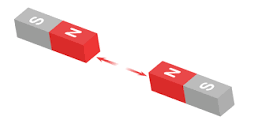
What will happen when these magnets are brought close together?
a)
They will attract each other.
b)
They will repel each other.
c)
Both magnets will turn to the left
d)
Both magnets will turn to the right
69.
what is magnetic flux
a)
number of magnetic field lines passing through a surface perpendicular to the lines
b)
wire connected to a circuit and coiled into many spiral loops
c)
magnet whose magnetic field is produced by electric current
d)
characteristic of magnets that they have two opposite ends called poles
70.
What areas of a magnet have the strongest magnetic effect?
a)
the middle
b)
the poles
c)
the sides
d)
the magnetic field lines
71.

Are the magnetic field lines in the picture correct?
a)
Yes, because they point from north to south.
b)
No, because they point from north to south (they're supposed to go the other way).
c)
Yes, because the North pole is on the left in all pictures.
d)
No, because the North pole is on the left in all pictures (it's supposed to be on the right).
72.

This is the symbol for ...
a)
resistor
b)
NPN Transistor
c)
light dependent resistor
d)
variable capacitor
73.

Name this electrical component
a)
Jump Wire
b)
Fixed Resistor
c)
Capacitor
d)
Diode
74.

a)
Light dependent resistor
b)
Resistor
c)
Transistor
d)
Light emitting diode
75.

a)
Light dependent resistor
b)
Light emitting diode
c)
Resistor
d)
Transistor
76.
What unit is used for power factor?
a)
Amps
b)
Apparent power
c)
None as it is a ratio
d)
%
77.
Which electronic component provides an opposition to current flow in a fire alarm circuit?
a)
A Zener Diode
b)
A Thermistor
c)
A Resistor
d)
A Capacitor
78.
1,000 waves go past in 1 second = _________Hz
a)
1,000 Hz
b)
1 Hz
c)
10 Hz
d)
1 million Hz
79.
________________: How many waves go past a point in one second; unit of measurement is hertz (Hz).
a)
Frequency
b)
Crest
c)
Trough
d)
Ocean
80.
ג is the symbol for _______________
a)
Wavelength
b)
Hertz
c)
Hz
d)
Frequency
81.

The maximum height of a wave.
a)
crest
b)
trough
c)
amplitude
d)
wavelength
82.

In alternating current:
a)
current flow alternates back and forth
b)
reactance changes between high and low
c)
resistance changes between high and low
83.

A periodic waveform is:
a)
one which continuously repeats
b)
one which has no distortion
c)
one that only happens monthly
d)
one that appears in a magazine
84.

The RMS voltage of a sine wave is the same as the average voltage:
a)
True
b)
False
85.

The number of times a cycle happens per second is called:
a)
Frequency
b)
Period
c)
Wavelength
d)
Amplitude
86.

The amount of time for one complete cycle is called?
a)
Frequency
b)
Period
87.

To find the peak voltage of a waveform you:
a)
Divide Peak to peak by two
b)
Multiply Peak to Peak by 2
c)
Divide peak by .707
88.
Peak and peak-to-peak woltage values for an Ac waveform can only be measured with a(n) _____.
a)
oscilloscope
b)
RMS meter
c)
AC voltmeter
d)
True RMS meter
89.
A waveform is a graph of the relationship between _____ and _____.
a)
time, frequency
b)
Time, magnitude
c)
Magnitude, frequency
d)
Period, frequency
90.

Four lamps are labelled ‘60 W 240 V’.
In which circuit are the lamps connected so that they all work at normal brightness?
In which circuit are the lamps connected so that they all work at normal brightness?
a)
A
b)
B
c)
C
d)
D
91.

Which graph shows the output of a simple a.c. generator?
a)
A
b)
B
c)
C
d)
D
92.
_________ is a term used to describe voltage
a)
electronmotive
b)
reluctance
c)
conductance
d)
siemens
93.
The principles of heating are..
a)
Convection, induction and consumption.
b)
Convection, conduction and radiation.
c)
Radiation, conduction and production.
d)
location, location, location.
94.
Which electronic component is used to amplify low level signals from PIR detectors, to higer levels that can trigger the alarm circuit?
a)
Thyristor
b)
Transistor
c)
Capacitor
d)
Resistor
95.

a)
Buzzer
b)
Switch (Open)
c)
Diode
d)
Horn
96.
What are the color codes for a 470k ohm resistor?
a)
Yellow, Violet, Yellow
b)
Orange, Grey, Orange
c)
Yellow, Violet, Orange
d)
Orange, Grey, Yellow
97.
What is the tolerance for a Red, Brown, Brown, Silver resistor?
a)
1%
b)
20%
c)
5%
d)
10%
98.
What is the color code for a Orange, Black, Red resistor?
a)
3k Ohms
b)
200 Ohms
c)
300 Ohms
d)
2K Ohms
99.
What are the color codes for a 210 ohm resistor?
a)
brown, grey, red
b)
brown, black, yellow
c)
red, brown, brown
d)
brown, black, brown
100.

This is the symbol for ...
a)
electrolytic capacitor
b)
switch
c)
battery
d)
resistor
100 %

