
Font size
 Worksheets
CUA 2 Review Scientific Investigation-Waves
Total questions: 58
Worksheet time: 41mins
Nuclear reaction in which two or more atomic nuclei collide to join and form a new nucleus.
fission
fusion
Nuclear Fission
is a process of splitting a heavy nucleus into two lighter nuclei
is a process of combination of two lighter nuclei to form a heavier nuclei
This type of mirror converges light.
plane
convex
concave
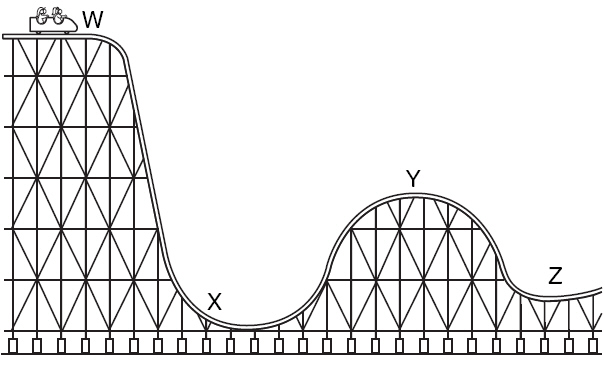
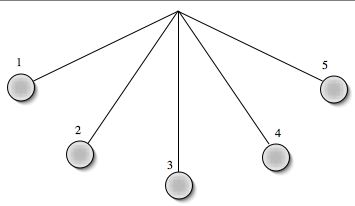
Kinetic energy depends on the ________ and ________ of the object.
Height and mass
Friction and movement
Mass and Velocity (speed)
Velocity and Muscles
What kind of energy powers the sun?
mechanical
nuclear
chemical
electrical
A student conducts an experiment to see which temperature of water will make Kool-aid dissolve the fastest. What things should be kept constant? SELECT ALL THAT APPLY
time it takes the Kool-aid to dissolve
amount of Kool-aid
temperature of the water
amount of water
brand and flavor of Kool-aid

What form of energy is stored in the bonds between molecules of matter?
chemical energy
mechanical energy
nuclear energy
radiant energy
electrical energy

What type of energy is seen here (the energy of movement/motion)?
chemical energy
mechanical energy
nuclear energy
radiant energy
electrical energy
What type of energy is produced when electrically charged particles vibrate (such as light, radio, gamma rays, and other electromagnetic waves)?
chemical energy
mechanical energy
nuclear energy
radiant energy
electrical energy
Turning on a lightbulb is an example of energy transforming from electrical to ______________ energy.
SELECT ALL THAT APPLY
nuclear
radiant
light
chemical
heat

At which temperature would all molecules stop moving (in theory)?
100 degrees Celsius
-273 degrees Celsius
32 degrees Fahrenheit
273 Kelvin
Melting is an example of _____. (Ask yourself, does heat have to be added, or taken away, to make it happen?)
an exothermic process
an endothermic process
Water turns to steam when it is heated. Then it hits the cold mirror and turns back into cold droplets of water. What has happened to the water?
It vaporized and then froze.
It vaporized and then condensed.
It condensed and then vaporized.
It froze and then vaporized.
Changing from a liquid to a gas is called ________.
condensation
vaporization
deposition
sublimation
Changing from a gas to a liqud is called ________.
condensation
vaporization
deposition
sublimation
Changing from a solid to a gas (like what happens when dry ice is put into the room) is called ________.
condensation
vaporization
deposition
sublimation
Changing from a gas to a solid (like what happens when fog in the air turns into frost) is called ________.
condensation
vaporization
deposition
sublimation


If I have a beaker, a hot plate, and a thermometer, I can find this property, which will help me figure out what an unknown substance is.
density
chemical change
mass
boiling point
This technology transfers thermal energy between the earth (underground) and the surface below a building using pipes with water.
heat engine
solar power
geothermal power
heat pump
A wave with a short wavelength will have a ______ frequency.
high
low
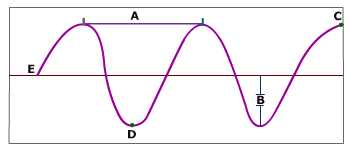
The darkest/densest place in a compression is the _____ of the wave.
crest
trough
Which of the following is NOT a way to measure the wavelength in a compression/longitudinal wave?
compression to next compression
rarefaction to next rarefaction
rarefaction to next compression
The place in a compression/longitudinal wave that has less pressure (it looks lighter).
compression
rarefaction
Which of the following is NOT an application of sound (compression) waves?
microwaving food to warm it up
getting an ultrasound at the doctor
sonar being used to find a crashed plane in the ocean
bats locating food using echolocation
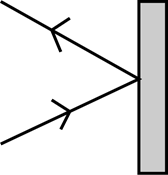
The illustration shows a light ray striking an object.
In the illustration, the light ray striking the object is-
absorbed
transmitted
reflected
refracted

Which interaction is occurring in the picture?
Reflection
Refraction
Diffraction
Interference
The bending of a wave around the edge of a barrier or as it passes through a tiny opening is called
reflection
diffraction
interference
refraction
Light that passes through an object or medium is _________.
absorbed
transmitted
reflected
refracted
A concave mirror will make an object (held far away) look ______.
larger/right side up
smaller/right side up
larger/upside down
smaller/upside down
A concave mirror will make an object (held close up) look ______.
larger/right side up
smaller/right side up
larger/upside down
smaller/upside down

Which shows a convex lens?
Top left
Top right
Bottom left
Bottom right
Which of the following is true about electromagnetic wave speeds?
Gama rays travel the fastest.
Radio waves travel the fastest.
All electromagnetic waves travel the same speed (through a vacuum).
None of the above.
Which of the following shows the correct order of the electromagnetic spectrum?
Infrared, Radio, Microwaves, Visible, X-ray, Ultraviolet, Gamma
Visible, X-Ray, Ultraviolet, Gamma, Infrared, Radio, Microwaves
Gamma, Radio, Ultraviolet, Visible, Microwaves, X-Ray, Infrared
Radio, Microwaves, Infrared, Visible, Ultraviolet, X-Ray, Gamma
Heaters, police scanners (heat imaging), heat lamps, and TV remotes all utilize waves from which part of the electromagnetic spectrum?
ultraviolet rays
radio waves
visible light
infrared rays
Which of the following uses light to send information for cable, internet, and telephone?
LED lights
fiber optics
holograms
lasers
Which of the following parts of the electromagnetic spectrum is used send all kinds of communications (audio and video), both on earth and in space?
infrared rays
x-rays
ultraviolet rays
radio waves
microwaves
Which of the following parts of the electromagnetic spectrum is used in tanning beds and can cause sunburn?
infrared rays
x-rays
ultraviolet rays
radio waves
microwaves
Which of the following parts of the electromagnetic spectrum is used in appliances to cook food?
infrared rays
x-rays
ultraviolet rays
radio waves
microwaves
Which of the following parts of the electromagnetic spectrum is used medically to "see" inside the body?
infrared rays
x-rays
ultraviolet rays
radio waves
microwaves
Which of the following is NOT a part of the particle theory of matter?
Particles are in constant motion.
Particles attract each other.
Particles of different elements are different.
Particles are always closely packed together.
Particles of the same element are basically the same.

