Wayground logo

Free Printable Worksheets

Font size

S
M
L
XL
Worksheets

The ULTIMATE EASTER QUIZ

Total questions: 31

Worksheet time: 18mins

Name
Class
Date
1.

A computer system is?

a)

Components

b)

Hardware and Software

c)

A big box of metal

d)

Non tangible components

2.

A computer is a machine that processes data

a)

no

b)

yes

3.

A microwave is an embedded system

a)

yes

b)

no

4.

A mobile phone is an embedded system

a)

yes

b)

no

5.

CPU stands for....

a)

Control Paw Unit

b)

Central Processing Unit

c)

Candy Pepsi Unicon

6.

What is hardware?

a)

Application Software

b)

Physical items

c)

Operating Systems

d)

Keyboard

7.

Tick an Output device

a)

Monitor

b)

Speaker

c)

Microphone

d)

Camera

8.

What is the difference between OS and Application software

a)

OS is the platform that the system runs, applications perform a specific task

b)

OS is the BIOS and the applications are apps

c)

OS is for a specific thing and applications run the computer

d)

Applications allow us to work on tasks, the OS is APPLE

9.

Select a component of the CPU

a)

Fingers

b)

ALU

c)

Ben and Jerrys Brain

d)

Brain

10.

A computers purpose is....

a)

take data, process it, then output it

b)

data, process, input

c)

output, think, data

d)

data, processing, save

11.
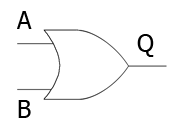
What logic gate is this?
a)
AND
b)
OR 
c)
NOT
d)
TO
12.
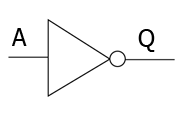
What logic gate is this?
a)
AND 
b)
OR 
c)
NOT 
d)
THE
13.
What logic gate is this?
a)
OR
b)
NOT
c)
AND 
d)
THE
14.
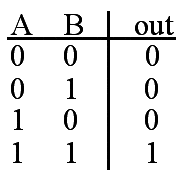
What gate is this table for?
a)
AND
b)
OR
c)
NOT
d)
NOR
15.
What gate is this table for?
a)
AND
b)
XOR
c)
OR 
d)
NOT
16.
Logic gates are digital ...
a)
.. Switches
b)
.. Footprints
c)
.. Binary
d)
.. RAM
17.
What is the purpose of the CPU?
a)
To process all the data and instructions.
b)
To turn the computer on.
c)
To create PowerPoint presentations.
d)
To provide power to the computer.
18.
What is the main function of the CPU?
a)
To carry out processing of the data.
b)
To help with playing games.
c)
To fetch instructions from memory, decode them and execute the instructions.
d)
To heat up the computer.
19.
What are registers used for?
a)
To check that students are in school.
b)
To temporarily hold bits of data needed by the CPU.
c)
To make sure that the CPU runs properly.
d)
To make the CPU faster.
20.
This is volatile storage
a)
ROM
b)
RAM
c)
Secondary Storage
d)
Hard Disk
21.
BIOS (Boot-up program)
a)
ROM
b)
RAM
c)
Cache
d)
Hard Disk
22.
You can write data more than once to this device
a)
CD ROM
b)
RAM
c)
ROM
d)
DVD+R
23.
How does data/ instructions move between the CPU and RAM?
a)
ROM
b)
Address and data bus
c)
Address bus
d)
Data bus
24.
You can purchase a USB flash drive which can store 2PB of data.
a)
False
b)
True
25.
USB flash drives use solid state memory.
a)
True
b)
False
26.
Solid state hard drives are more suitable than magnetic hard drives for portable devices.
a)
True
b)
False
27.
A CD-ROM is re-writable.
a)
False
b)
True
28.
Solid state hard drives have moving parts.
a)
False
b)
True
29.
The term durability refers to
a)
how easily you can damage the device
b)
the speed of the device
c)
the amount of data you can store on the device
d)
how shiny the device is
30.
The term portability refers to
a)
how easy it is to carry around/transport the device
b)
the speed of the device
c)
the amount of data you can store on the device
d)
how shiny the device is
31.
Which one of these is commonly used to measure storage capacity
a)
bytes
b)
the number of text documents you can store on it
c)
hertz
d)
Mb/s