wayground logo

Free Printable Worksheets

NEW

Font size

S
M
L
XL
Worksheets

Plate Tectonics

Total questions: 57

Worksheet time: 48mins

Name
Class
Date
1.
What is the correct order (starting from the surface) of Earth's layers?
a)
crust, outer core, inner core, mantle
b)
mantle, outer core, inner core, crust
c)
crust, mantle, outer core, inner core
d)
outer core, inner core, crust, mantle
2.
Earth's inner core is...
a)
a dense ball of solid iron and nickel.
b)
a layer of molten iron and nickel.
c)
a layer of hot rock.
d)
a layer of rock that forms Earth's outer skin.
3.
Which layer of Earth has the GREATEST density?
a)
crust
b)
mantle
c)
outer core
d)
inner core
4.
Heat transfer within a fluid takes place by...
a)
convection currents
b)
radiation
c)
conduction
d)
density
5.
Earth's mantle is
a)
a layer of molten metal.
b)
a layer of hot rock.
c)
a dense ball of solid metal.
d)
a layer of rock that forms Earth's outer skin.
6.
Earth's magnetic field results from movements in the
a)
mantle
b)
outer core
c)
inner core
d)
crust
7.
Scientists think that convection currents flow in Earth's
a)
continents
b)
mantle
c)
lithosphere
d)
inner core.
8.
Which layer of Earth is the hottest?
a)
lithosphere
b)
asthenosphere
c)
outer core
d)
inner core
9.
If we compare the temperature and pressure of Earth's mantle to the core, what differences can we expect as we move downward into Earth?
a)
Both temperature and pressure increase.
b)
Both temperature and pressure decrease.
c)
Temperature decreases and pressure increases.
d)
Temperature increases and pressure decreases.
10.
Which layer of Earth is LIQUID?
a)
upper mantle
b)
lower mantle
c)
outer core
d)
inner core
11.
What are the two kinds of crust?
a)
lithospheric and asthenospheric
b)
silicon based and iron based
c)
continental and oceanic
d)
outer and inner
12.
Which layer of Earth is the thinnest?
a)
crust
b)
mantle
c)
outer core
d)
inner core
13.
In Earth's crust, what type of rock is found under the oceans?
a)
only granite
b)
only basalt
c)
granite on top; basalt underneath
d)
basalt on top; granite underneath
14.
Which layer of Earth is made up partly of crust and partly of mantle material?
a)
asthenosphere
b)
crust
c)
lithosphere
d)
mantle
15.
Geologists' main evidence about the structure of Earth's interior comes from
a)
temperature measurements in deep mines
b)
observations of other planets
c)
exploration of caves
d)
rock samples and seismic waves
16.
The soft layer of the mantle on which pieces of lithosphere move is called
a)
mesosphere
b)
lithosphere
c)
asthenosphere
d)
outer core
17.
Which layer of Earth is made up of tectonic plates?
a)
outer core
b)
inner core
c)
asthenosphere
d)
lithosphere
18.
Continental crust is made of 
a)
granite
b)
basalt
c)
water
d)
sandstone
19.
Name the three types of heat transfer.
a)
conduction, convection, radiation
b)
lithosphere, conduction, x-rays
c)
ROY G BIV
d)
waves, sunlight, heat
20.
What makes the inner core solid?
a)
Metals in the core are very light.
b)
Pressure at the core is very high.
c)
Chemicals in the core are very reactive.
d)
Temperatures in the core are very low.
21.
Identify C
a)
Crust
b)
Mantle
c)
Outer Core
d)
Inner Core
22.
Identify A
a)
Crust
b)
Mantle
c)
Outer Core
d)
Inner Core
23.
Identify D
a)
Crust
b)
Mantle
c)
Outer Core
d)
Inner Core
24.
Identify B
a)
Crust
b)
Mantle
c)
Outer Core
d)
Inner Core
25.
Temperature and pressure increase toward the center of the Earth.
a)
True
b)
Flase
26.
The type of plate boundary where two plates come together is a .....
a)
Convergent Boundary
b)
Divergent Boundary
c)
Transform Boundary
d)
Plate Boundary
27.
Which of the following causes Earth's tectonic plates to move?
a)
Energy from the Sun
b)
Magnetic Pole Reversal
c)
Convection currents in the mantle
d)
Faults in Mountain Ranges
28.
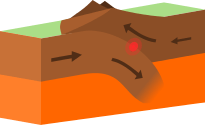
What type of plate boundary is this?
a)
Plate
b)
Divergent
c)
Convergent
d)
Transform
29.
A divergent boundary occurs when plates ....
a)
Pull apart
b)
Come together
c)
Slide past each other
d)
subducting
30.
Which of the following is the name of the ancient supercontinent formed 28 Million Years ago.
a)
Pangea
b)
Gondwanda
c)
Laurasia
d)
Neverland
31.
Which of the following is NOT evidence to support the theory of plate tectonics?
a)
Fossils
b)
Mountains
c)
Glaciers
d)
Sand Erosion
32.
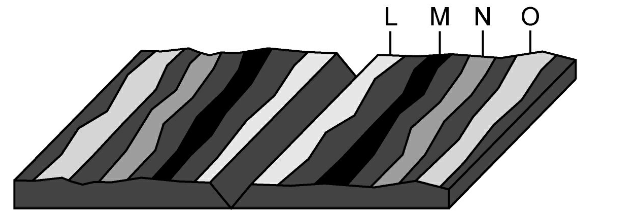
Where would the oldest rock be found?
a)
L
b)
M
c)
N
d)
O
33.
Mountains are created when....
a)
Two continental plates collide
b)
Two oceanic plates pull apart
c)
An Oceanic plate subducts under a Continental Plate
d)
Two continental plates pull apart
34.
Which of the following is NOT a tectonic boundary?
a)
Convergent
b)
Divergent
c)
Sedergent
d)
Transform
35.
This landform can occur at a divergent plate boundary.
a)
ocean trench
b)
mid-ocean ridge
c)
tall mountains
d)
transform fault
36.
What is the name of the plate boundary that slides past each other?
a)
Divergent
b)
Convergent
c)
Transform
d)
Mr. C the Slide Man
37.
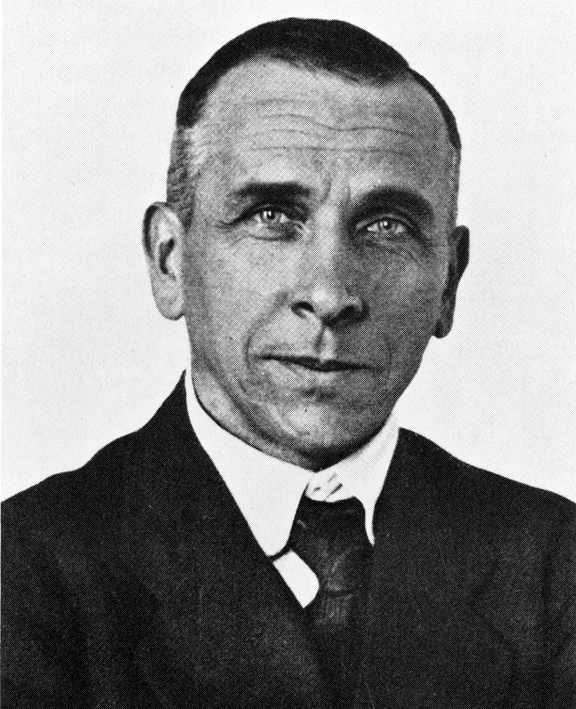
Who is the person credited with developing the theory of continental drift?
a)
Harry Hess
b)
Galileo
c)
Alfred Wegener
d)
Newton
38.
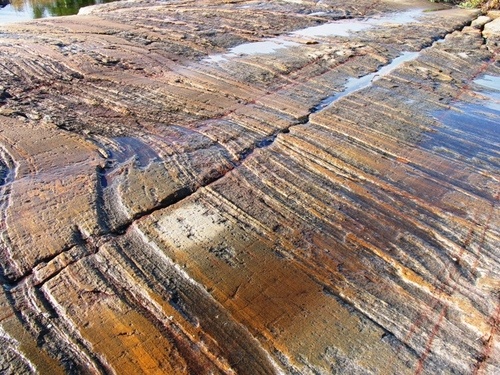
This is a picture of glacier scars found in Africa.  What are these evidence for?
a)
Africa has always been near the equator
b)
Africa was once in an area of the Earth that had a very cold climate
c)
The continents have not moved
d)
sea floor spreading
39.
What evidence did Wegener use in his theory?
a)
Continents and fossils fitting together/matching-up like puzzle pieces 
b)
glacier scars and evidence from temperature
c)
mountain ranges and coal deposits line up across continents
d)
all of the above
40.
Why did no one believe Wegener's thoery?
a)
He could not explain HOW the continents moved
b)
He didn't have evidence
c)
His data was wrong
d)
He didn't use the right technology to gather data
41.
What drives tectonic plate movement? 
a)
gravity
b)
coriolis effect
c)
convection currents
d)
the earth's magnetic core
42.
Glossopteris fossils are found between where?
a)
India
b)
I really don't know 😭😂
c)
Antarctica
d)
All of them
43.

What process takes place at a Deep-Ocean Trench?

a)

Sea-Floor Spreading

b)

Deep-Ocean Trench

c)

Mid-Ocean Ridge

d)

Subduction

44.

What happens to older oceanic crust as new molten material rises from the mantle?

a)

Older crust is pushed out/away

b)

Older crust does not move

c)

Newer crust immediately returns to the mantle

45.

The process by which molten material adds new oceanic crust to the ocean floor.

a)

Sea-Floor Spreading

b)

Deep-Ocean Trench

c)

Mid-Ocean Ridge

d)

Subduction

46.

A deep valley along the ocean floor beneath which oceanic crust slowly sinks toward the mantle.

a)

Sea-Floor Spreading

b)

Deep-Ocean Trench

c)

Mid-Ocean Ridge

d)

Subduction

47.

An undersea mountain chain where new ocean floor is produced.

a)

Sea-Floor Spreading

b)

Deep-Ocean Trench

c)

Mid-Ocean Ridge

d)

Subduction

48.

True or False: Scientists are not able to tell the age of oceanic crust.

a)

True

b)

False

49.

True or False: Pillow/Poop shaped rocks are clear evidence for sea-floor spreading.

a)

True

b)

False

50.
What did scientists use to map the oceans floor?
a)
Echo-location
b)
Sonar
c)
Space Shuttles
d)
Animals
51.
What was Wegener's hypothesis called?
a)
The Pangea 
b)
Moving Continents 
c)
The Continental Drift
d)
Techtonic Plates
52.
What is an ancient organism that is preserved in rock?
a)
A rock
b)
A fossil
53.
What evidence helped Wegener support his theory?
a)
Climate
b)
 Fossils
c)
Land Features
d)
All of the Above
54.
What evidence helps scientists show how sea floor spreading occurs?
a)
Ocean Floor Material
b)
Magnetic Stripes
c)
Drilling Samples
d)
All of the Above
55.
The OLDEST seafloor is located? 
a)
Closest to the mid-ocean ridge
b)
Farthest from the mid-ocean ridge
56.

How are Alfred Wegner and Harry Hess connected?

a)

They are cousins

b)

Harry Hess was in Greenland helping Alfred Wegner explore.

c)

Harry Hess was one of the scientists who made fun of Alfred Wegner.

d)

Harry Hess accidentally discovered an explanation of how the continents might have moved.

57.
Who created the Theory of Continental Drift?
a)
Harry Hess
b)
James Hutton
c)
Dan McKenzie
d)
Alfred Wegener