Wayground logo

Free Printable Worksheets

Font size

S
M
L
XL
Worksheets

7H Solutions

Total questions: 46

Worksheet time: 39mins

Name
Class
Date
1.
What is a solvent?
a)
The substance that does the dissolving in a solution.
b)
The substance that is being dissolved in a solution.
c)
The mixing of different substances.
d)
The process in which neutral molecules lose or gain electrons
2.
This is the part of a solution that dissolves
a)
Solute
b)
Solvent
c)
Solution
d)
Mixture 
3.
The concentration of a mixture can be increased in which of the following ways?
a)
Heating the mixture
b)
Adding more water “solvent”
c)
Adding more powder “solute”
d)
Stirring the mixture
4.
In the above picture, a powder is about to be poured into the liquid. Which of the following should be done to make this powder dissolve faster?

a)
stir the powder in the liquid
b)
freeze the mixture
c)
add more powder to the liquid
d)
store the mixture in a dark place
5.
A solution that is considered dilute would be....
a)
Dark in color
b)
Have a strong scent
c)
Have a large amount of solute
d)
Have a small amount of solute
6.
salt water is a 
a)
compound
b)
element
c)
heterogeneous mixture
d)
solution
7.
When a certain amount of solvent cannot hold any more solute it is called a ________ solution.
a)
Diluted
b)
Saturated
8.
Which of the following is not a way to increase the rate of dissolving
a)
evaporation
b)
stirring 
c)
increasing temperature
d)
using a smaller particle size
9.

How does temperature affect the rate of dissolving?

a)

by increasing the movement of the particles

b)

by decreasing the particle size

c)

by decreasing collisions between particles

10.
Which solute does not increase in solubility as temperature rises?
a)
NH3
b)
NaNO3
c)
KNO3
d)
NaCl
11.
You and your friend have a contest to see who can make iced tea the fastest. Which of the following would NOT help you win?
a)
Cooling the water
b)
Using smaller crystals
c)
Heating the water
d)
Stirring quickly
12.
Which solute is the least soluble at 90 ⁰C?
a)
SO2
b)
KClO3
c)
KI
d)
HCl
13.
What will allow more solute to be dissolved in a solvent.
a)
adding more solute
b)
stiring
c)
cooling solution
d)
heat
14.
At approximately what temperature does the solubility of sodium chloride, NaCl, match the solubility of potassium dichromate, K2Cr2O7?
a)
60 ºC
b)
30 ºC
c)
50 ºC
d)
83 ºC
15.
When solute dissolves into a solvent it is called a _____________.
a)
mixture
b)
solution
c)
element
16.
What is the minimum temperature needed to dissolve at least 10 g of KClO3?
a)
25 ⁰C
b)
10 ⁰C
c)
5 ⁰C
d)
100 ⁰C
17.
The substance being dissolved is the solvent, and the substance doing the dissolving is the solute.
a)
True
b)
False
18.
If a solute is said the have a high solubility it means it will not dissolve in a solvent.
a)
True
b)
False
19.

Separating a mixture using a fine mesh or paper

a)

Evaporation

b)

Filtration

c)

Distillation

d)

Chromatography

20.

Separating a mixture using solvent and filter paper

a)

Evaporation

b)

Filtration

c)

Distillation

d)

Chromatography

21.

Separating a mixture by boiling and condensing

a)

Evaporation

b)

Filtration

c)

Distillation

d)

Chromatography

22.

Two different compounds or chemicals in a single container

a)

Mixture

b)

Dilution

c)

Concentration

d)

Solubility

23.

A solid that readily dissolves in a solution

a)

Soluble

b)

Solvent

c)

Insoluble

d)

Solute

24.

A solid that does not dissolve in a solution

a)

Soluble

b)

Solvent

c)

Insoluble

d)

Solute

25.
How can I get water from salty water?
a)
a) Evaporation
b)
b) Distillation
c)
c) Chromatography
d)
d) Filtration
26.
What two processes are involved in distillation?
A - Evaporation
B - Condensation
C - Boiling
D - Filtration
a)
A+C
b)
B+C
c)
D+A
d)
C+D
27.
Which label identifies where on the diagram of the simple distillation of salt and water where there will be just liquid Water particles?
a)
A
b)
C
c)
F
d)
H
28.
Which label identifies where on the diagram of the simple distillation of salt and water where there will be a gradually increasing concentration of salt particles?
a)
C
b)
F
c)
G
d)
H
29.
Which label identifies where on the diagram the thermometer can be found?
a)
B
b)
D
c)
E
d)
F
30.
Which label identifies where on the diagram the collection flask can be found?
a)
A
b)
F
c)
G
d)
H
31.
Which label identifies where on the diagram the 'Liebig condenser' can be found?
a)
A
b)
F
c)
G
d)
H
32.
17. Normal salt solution is colourless (transparent) so is difficult to tell if the separated water is pure. What colour is Copper Sulphate salt solution that can be separated in this way?
a)
a) GREEN
b)
b) RED
c)
c) BLUE
d)
d) YELLOW
33.
Which one of the following is the name for separation technique in the picture below
a)
distillation
b)
seiving
c)
evaporation
d)
decanting
34.
Solid substances that stay on the filter paper are called the ___________?
a)
Residue
b)
Filtrate
35.
The solution that passes through the filter paper is called the ____________
a)
Residue
b)
Filtrate
36.
Filter paper is like a sieve with __________ holes
a)
Large
b)
Tiny
37.
Which one of the following solids is insoluble in water?
a)
sugar
b)
sand
c)
copper sulfate
d)
salt
38.
Of these mixtures, which one is a solution?
a)
A
b)
B
c)
C
d)
D
39.
A leibeg condenser is used in
a)
Filtration
b)
Chromatography
c)
Evaporation
d)
Distillation
40.
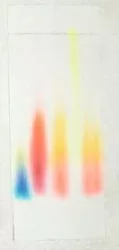
Dyes in water soluble markers may be separated by means of..
a)
crystallization
b)
sublimation
c)
chromatography
d)
sedimentation
41.
Water and alcohol are easily separated by distillation because of their
a)
 different melting points
b)
different colours
c)
different densities
d)
different boiling points
42.
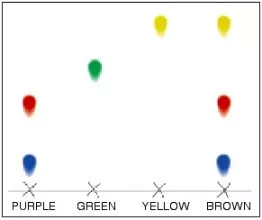
The diagram shows the chromatogram for three colouring dyes and that for a brown marker. What dye(s) are contained in the marker's ink?
a)
purple and green
b)
purple and yellow
c)
purple only
d)
green and yellow
43.
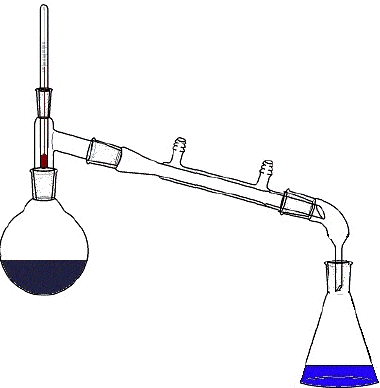
Look at the apparatus setup. It cannot be used to separate which of the following mixtures? 
a)
Marble chips from oil 
b)
Alcohol and water
c)
Chalk from sugar solution
d)
Sand and sea water
44.
Sodium chloride can be separated from rock salt by first adding water to the mixture to dissolve the sodium chloride. The separation then takes place in two stages:
a)
evaporation followed by filtration
b)
 distillation followed by decanting
c)
filtration followed by evaporation
d)
filtration followed by decanting
45.
The diagram shows the apparatus for separating soil and water. What are the labelled parts?
a)
A = residue, B = distillate
b)
 A = residue, B = filtrate
c)
A = filtrate, B = residue
d)
A = distillate, B = filtrate
46.

What is the chemical name for white table salt

a)

sodium chloride

b)

sodium bicarbonate

c)

calcium chloride

d)

sodium iodide