
 Worksheets
HW 1 theories, plate boundaries/tectonics (sr)
Total questions: 65
Worksheet time: 1hrs 4mins
Name
Class
Date
1.
What is the name of the theory that states that the continents are constantly in motion?
a)
Pangaea
b)
Tectonic plates
c)
Continental Drift
d)
Divergent boundary
2.
What is the name of the supercontinent made up of all 7 continents?
a)
All land
b)
Gondwandoland
c)
Pangaea
d)
America
3.
What is the name of the theory that Earth's crust is broken up into pieces?
a)
Plate tectonics
b)
Pangaea
c)
Continental drift
d)
Transform boundary
4.
Which of the following choices correctly states the 2 types of crust?
a)
Oceanic and Magma crust
b)
Continental and Oceanic crust
c)
American and Pacific crust
d)
Continental and Atlantic crust
5.
Tectonic plates are made up of continental crust and ________ crust.
a)
continental
b)
oceanic
c)
plates
d)
mantle
6.
Who created the Continental Drift Theory?
a)
Shakespeare
b)
Wegener
c)
Pangaea
d)
Einstein
7.

The layer with the greatest temperature is...
a)
the lithosphere
b)
the inner core
c)
the crust
d)
the mantle
8.
Scientists know about the layers because
a)
waves move through the Earth at different speeds
b)
they have been able to drill through them
c)
we can observe them from the crust
d)
they researched it on Wikipedia
9.
Waves travel faster through layers that
a)
are solid
b)
are liquid
c)
are more dense
d)
are less dense
10.
What is the name of the layer that contains the uppermost mantle and crust
a)
Asthenosphere
b)
Mesosphere
c)
Lithosphere
d)
Transosphere
11.
Which layer of the earth is under the highest pressure?
a)
Crust
b)
Mantle
c)
Outer Core
d)
Inner Core
12.
Scientists determine what Earth’s interior looks like by using:
a)
Volcanoes
b)
Seismic Waves
c)
Continental Drift
d)
Convection Currents
13.
If you traveled from the center of Earth to the surface, the pressure would...
a)
increase
b)
decrease
c)
stay the same
d)
unsure
14.

What layer of the Earth if made of liquid metal?
a)
Inner Core
b)
Outer Core
c)
Crust
d)
Mantle
15.

Around the core is the mantle. What is it made of?
a)
Cold Rock
b)
Liquid Water
c)
Hot dense metal
d)
Hot dense rock
16.
The theory on how the continents were formed and why they move is called
a)
Plate Theory
b)
Plate Tectonics
c)
Continent
Movement
Movement
d)
Earth Physics
17.
Supporting Evidence: discovery of Mid-Atlantic Ridge, core rock samples showing older rocks the farther that you get from the mid ocean ridge
a)
Continental Drift
b)
Seafloor Spreading
c)
Plate Tectonics
18.
The tectonic plates float on the
a)
lithosphere
b)
lower mantle
c)
outer core
d)
asthenosphere
19.
The lithosphere is divided into segments called _________.
a)
mountains
b)
countries
c)
partials
d)
plates
20.

An area where magma melts through the crust in the middle of a plate is called a ________.
a)
island arc
b)
hot spot
c)
geyser
d)
pipe
21.

Once magma reaches the earth's surface it is called.....
a)
Silica
b)
Rock
c)
lava
22.
What are mid-ocean ridges?
a)
A chain of underwater waterfalls
b)
A chain of underwater volcanos
c)
A chain of underwater mountains
d)
A chain of underwater rocks
23.

Which was NOT evidence of Wegener?
a)
Seafloor spreading
b)
fossils
c)
puzzle piece
d)
glacier evidence
24.
What are the two types of crust
a)
continental and oceanic
b)
ocean and upper
c)
lower and upper
d)
pizza and subway
25.
When one plate sides under neath another, it _________ and the magma _________.
a)
hardens, sinks
b)
melts, sinks
c)
hardens, rises
d)
melts, rises
26.
Mountains are created when....
a)
Two continental plates collide
b)
Two oceanic plates pull apart
c)
An Oceanic plate subducts under a Continental Plate
d)
Two continental plates pull apart
27.

What type of event will occur at this boundary?
a)
Earthquake
b)
Volcano Eruption
c)
Tornado
d)
Mountain Building
28.
What does the theory of continental drift state?
a)
The continents were once joined in a super-continent and have moved over time
b)
Continents are stationary and do not move
c)
The Earth is broken into lithospheric plates that move due to convection currents
d)
none of the above
29.
What evidence did Wegener use in his theory?
a)
Continents and fossils fitting together/matching-up like puzzle pieces
b)
glacier scars and evidence from temperature
c)
mountain ranges and coal deposits line up across continents
d)
all of the above
30.
What specific technology did Wegener use in his study?
a)
GPS
b)
Sonar
c)
Radar
d)
Maps
31.
Why did no one believe Wegener's thoery?
a)
He could not explain HOW the continents moved
b)
He didn't have evidence
c)
His data was wrong
d)
He didn't use the right technology to gather data
32.
What causes the movement of tectonic plates?
a)
Gravitational pull between Earth and the moon
b)
Convection occurring beneath the Earth's crust
c)
Energy produced by earthquakes within the Earth
d)
Rotation of liquid rock found within the core
33.
What happens when Subduction occurs?
a)
Parts of the crust fall into the mantle
b)
Parts of the crust fall into the core
c)
Parts of the crust fall into space
d)
None of the Above
34.

What type of plate boundary causes this physical feature?
a)
Divergent
b)
Convergent
c)
Transformative
35.

What type of plate boundary causes this physical feature?
a)
Divergent
b)
Convergent
c)
Transformative
36.

What type of plate boundary causes this natural disaster (an earthquake)?
a)
Divergent
b)
Convergent
c)
Transformative
37.
What would you be most likely to find at a divergent boundary between two pieces of continental crust?
a)
Mid-Ocean Ridge
b)
Mountain
c)
Rift valley
d)
Island Arc (chain of islands)
38.
What would you be most likely to find at a divergent boundary between two pieces of oceanic crust?
a)
Rift
b)
Mid-Ocean Ridge
c)
Island Arc
d)
Flat land
39.
What would you be most likely to find at a convergent boundary between a continental and oceanic plate?
a)
Mountains
b)
Volcanoes
c)
Mid-Ocean Ridge
d)
Rift valley
40.
What would you be most likely to find at a convergent boundary between two pieces of oceanic crust?
a)
Mountains
b)
Rift
c)
Mid-Ocean Ridge
d)
Island Arc (trail of islands)
41.
What would you be most likely to find at a transform boundary?
a)
(shallow) Earthquakes
b)
Volcanoes
c)
Mountains
d)
Rift valley
42.
What is an example of volcanic arc of islands formed at an ocean/ocean convergent zone?
a)
Japan
b)
Haiti
c)
Hawaii
d)
Puerto Rico
43.
Which of the following statements is false?
a)
Oceanic crust is younger than continental crust
b)
Oceanic crust is thinner than continental crust
c)
Oceanic crust is less dense than continental crust
44.
Earthquakes typically occur _________________.
a)
In the middle of tectonic plates
b)
only in California
c)
only in the middle of the ocean
d)
along plate boundaries
45.
An ocean trench occurs when...
a)
plates divide and magma rises up
b)
oceanic crust subducts below continental crust
c)
we dig a hole in the ocean
d)
when plates slide past each other
46.
Which type of boundary has plate moving together?
a)
Divergent
b)
Convergent
c)
Transform
47.
Which type of boundary has plate moving apart?
a)
Divergent
b)
Convergent
c)
Transform
48.
When convergent plates collide, if both plates are pushed upward, this forms.
a)
Fissures
b)
Mountain Ranges
c)
Volcanoes
d)
Rock Cycle
49.
When divergent plates pull the crust apart, cracks form in the crust called...
a)
Fissures
b)
Mountain Ranges
c)
Volcanoes
d)
Rock Cycle
50.
A place where two plates meet; a break in Earth's crust
a)
plate
b)
fault
c)
fold
d)
crack
51.

Name the boundary
a)
convergent boundary
b)
divergent boundary
c)
transform boundary
d)
sergent boundary
52.

Name the boundary
a)
convergent boundary
b)
divergent boundary
c)
transform boundary
d)
sergent boundary
53.
The denser and thinner of the two plate types.
a)
continental crust
b)
oceanic crust
54.
Deep underwater canyons.
a)
trench
b)
mid-ocean ridge
c)
rift valley
d)
subduction zone
55.
The Great Rift Valley in Africa and the Mid-Ocean Ridge were all created by this boundary
a)
Divergent
b)
Convergent
c)
Reform
d)
Transform
56.

This image is of...
a)
Convergent boundary
b)
Transform Boundary
c)
Divergent Boundary
57.
A subduction zone is formed...
a)
when one tectonic plate sinks below another
b)
at every type of convergent plate boundary
c)
at every type of divergent plate boundary
d)
at transform boundaries
58.
The youngest rocks on the seafloor are most likely found...
a)
closest to a mid-ocean ridge
b)
farthest from a mid-ocean ridge
c)
near the coastlines
d)
closest to a deep sea trench
59.
Which of the following statements is false?
a)
Oceanic crust is made of basalt
b)
Oceanic crust is thinner than continental crust
c)
Oceanic crust is less dense than continental crust
d)
Oceanic crust is younger than continental crust
60.
What would you be most likely to find at a convergent boundary between two pieces of oceanic crust?
a)
Mountains
b)
Rift
c)
Mid-Ocean Ridge
d)
Island Arc
61.
Mountains form from ...
a)
plates sliding past one another
b)
collision of plates
c)
plates moving away from each other
62.
Select which answer is false....The theory of plate tectonics is
a)
A theory that states the earth's crust is broken into plates that float on the asthenosphere
b)
A combination of the seafloor spreading theory and the continental drift theory
c)
Is the idea that the continents are slowly drifting further away each other.
63.
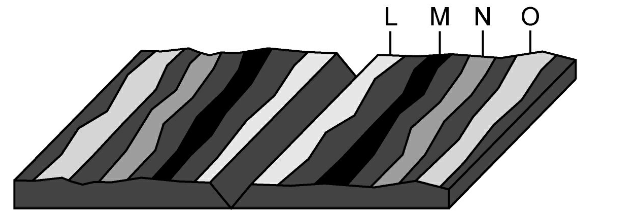
Where would the oldest rock be found?
a)
L
b)
M
c)
N
d)
O
64.
How is it possible for new crust to be formed without increasing the surface area of the Earth?
a)
Crust is destroyed at the same time it is created
b)
New crust is underwater where it sinks
c)
New crust breaks more easily than old crust
65.

The presence of the same ________ on several continents supports the idea of continental drift.
a)
rocks
b)
fossils
c)
both fossils and rocks
d)
neither fossils nor rocks
100 %

