wayground logo

Free Printable Worksheets

Font size

S
M
L
XL
Worksheets

Cell signaling and endocrine system

Total questions: 57

Worksheet time: 59mins

Name
Class
Date
1.
When levels go above or below a set point a hormone is released to return the body to set point. When the body is restored to set point no more hormone is released. This is an example of...
a)
a positive feedback loop
b)
a negative feedback loop
c)
a neutral feedback loop
2.
The 3 steps of signal transduction in order are
a)
reception, transduction, response
b)
response, transduction, reception
c)
reception, response, transduction
d)
transduction, reception, response
3.
Protein kinases activate other relay proteins by adding a(n) ____ to them.
a)
phosphate
b)
ATP molecule
c)
cAMP
d)
GTP
4.
Which of the following is an example of a second messenger?
a)
cAMP
b)
GTP
c)
insulin
d)
epinephrine
5.

Signal amplification is most often achieved by

a)

an enzyme phosphorylation cascade

b)

binding of multiple signals

c)

branching pathways

d)

action of adenylyl cyclase

6.
What do second messengers do?
a)
transport a signal through the lipid bilayer
b)
relay a signal from the outside to the inside of the cell
c)
relay message from the inside of the mebrane throughout the cytoplasm
d)
dampen the message
7.
When epinephrine binds to cardiac (heart) muscle cells, it speeds their contraction. When it binds to muscle cells of the small intestine, it inhibits their contraction. Which of the following best accounts for the fact that the same hormone can have different effects on muscle cells?
a)
Cardiac cells have more receptors for epinephrine than do intestinal cells
b)
Epinephrine circulates to the heart first and thus is in higher concentration around cardiac cells
c)
The two types of muscle cells have different signal transduction pathways for epinephrine and thus have different cellular responses
d)
Cardiac muscle is stronger than intestinal muscle and thus has a stronger response to epinephrine
8.
Each of the following numbered processes are involved in signal transduction pathways:  
 I.  Response
 
II.  Amplification
 
 III.  Reception
 
IV.  Transduction
Which represents the sequence of events in a typical signal transduction pathway?
a)
I, II, III, IV
b)
III, I, IV, II
c)
II, IV, I, III
d)
III, IV, II, I
9.
A signal molecule that binds to a plasma-membrane protein is a
a)
ligand
b)
second messenger
c)
protein kinase
d)
receptor protein
10.
What determines whether a cell is a target cell for a particular signal molecule?
a)
phosphorylation cascade
b)
cAMP
c)
signal receptors
d)
phosphatase
11.
Consider this pathway: epinephrine --> receptor --> cAMP --> protein kinase --> transcription factors. 

Identify the secondary messenger.
a)
epinephrine
b)
G protein-coupled receptor
c)
adenylyl cyclase
d)
cAMP
12.
What is a G protein?
a)
specific type of membrane-receptor protein
b)
protein on the cytoplasmic side of a membrane
c)
membrane-bound enzyme
d)
relay protein
13.
What is a phosphorylation cascade?
a)
travelling of hormones through the air
b)
travelling of hormones through the blood
c)
the removal of a phosphate
d)
a series of molecules that get phosphorylated
14.

Epinephrine (also known as adrenaline or adrenalin) is a hormone and a neurotransmitter. The model for the action of Epinephrine is shown below.

Which of the following would likely NOT be observed in a person injected with epinephrine?

a)

Decreased production of cAMP in liver cells

b)

Inactivation of glycogen synthase

c)

Increased glucose mobilization

d)

Activation of G proteins

15.
G proteins are a family of proteins involved in transmitting chemical signals originating from outside a cell into the inside of the cell. G proteins function as molecular switches.
Which of the following best describes the role in which the G protein is most intimately involved in the process shown above?
a)
Production of the ligand molecule.
b)
Reception of the signal.
c)
Transduction of the signal.
d)
Production of response to signal.
16.
What activates adenylyl cyclase?
a)
epinephrine binding to it
b)
an activated G protein
c)
cAMP
d)
a protein kinase
17.
A G protein is active when (Chapter 11)
a)
GTP is bound to it
b)
GDP replaces GTP
c)
It is phosphorylated by a protein kinase
d)
It is bound by its ligand and transported to the nucleus
18.
G proteins are a family of proteins involved in transmitting chemical signals originating from outside a cell into the inside of the cell. G proteins function as molecular switches.
Investigations into the causes behind symptoms in Alzheimer’s patients have led to the hypothesis that the disease may be caused by excessive activity of IP3 second messengers in brain cells. When comparing cell samples of Alzheimer’s patients to those taken from the control group, which of the following pieces of evidence would support this hypothesis?
a)
A lower number of receptor proteins in the Alzheimer cell samples.
b)
A greater volume of endoplasmic reticulum membrane in the control group cell samples.
c)
A higher concentration of calcium ions in the cytosol of the Alzheimer cell samples.
d)
A lower number of activated proteins in the cytosol of the Alzheimer cell samples
19.
Which areas in the diagram depict the process of transduction in the signal transduction pathway of cell communication?
a)
Q and R
b)
Q and U
c)
S and T
d)
T and U
20.
The data shown was collected in an experiment designed to test the hypothesis that a second messenger mediates between receptor activation at the plasma membrane and enzyme activation in the cytoplasm. Liver tissue was homogenated and used to make three test solutions; a whole homogenate, a fraction containing plasma membrane and a fraction containing cytoplasm but no plasma membrane. Which of the following would be a reasonable conclusion based on the data collected?
a)
All cells in an organism respond to the presence of epinephrine via second messengers present in the homogenate
b)
A soluble second messenger, produced by hormone-actived membranes is present in the solution and activates enzymes in the cytoplasm
c)
Epinephrine is a hormone found bound in the membrane of cells and requires a ligand to stimulate its transduction
d)
An epineprine signal transduction pathway works more efficiently at warmer temperatures
21.

According to the diagram, if the levels of thyroxine increases, then

a)

the level of TSH (thyroid stimulating hormone) will also increase

b)

the Temperature will continue to increase

c)

the level of TSH will decrease

d)

the amount of thyroxine will increase

22.

What is the molecule that directly causes the GLUT transporters to move to the membrane?

a)

PIP

b)

AKT

c)

IRS-1

d)

PI-3 kinase

23.

What is being depicted in the image?

a)

Amplification of the signal molecule

b)

Enzymatic proteins inhibiting process of the signal transduction pathway

c)

Kinase groups adding dimer groups to other enzymes

d)

Diffusion of molecules within the cell due to the signaling molecule

24.
What type of transmembrane receptor is being shown?
a)
G-protein receptor
b)
tyrosine kinase receptor
c)
gated ion channel
25.

Some signaling molecules can enter the cell by passing through the membrane. What determines whether a signal molecule binds on the surface or enters the cell?

a)

the polar nature of the steroid means it can pass through

b)

the non-polar nature of the steroid means that it can pass through the membrane

c)

the large size means it can move through the membrane

d)

when a cell fails to make a receptor, the ligand can then pass through the membrane

26.
Which of the following correctly describes the reception stage of this signal transduction pathway?
a)
epinephrine binds to a g-protein coupled receptor protein present in the cell membrane
b)
the g protein changes shape, is activated, activates adenyl cyclase, which activates cAMP, which activates protein kinases
c)
protein kinases phosphoylate molecules
d)
glycogen synthesis is inhibited and glycogen breakdown is promoted
27.
Which of the following correctly describes the response stage of this signal transduction pathway?
a)
epinephrine binds to a g-protein coupled receptor protein present in the cell membrane
b)
the g protein changes shape, is activated, activates adenyl cyclase, which activates cAMP, which activates protein kinases
c)
cAMP binds to the g-protein coupled receptor protein
d)
glycogen synthesis is inhibited and glycogen breakdown is promoted
28.
Where are receptors located for steroid hormones?
a)
in the cell membrane
b)
in the cytoplasm
c)
in the extracellular environment
d)
at the ribosomes
29.
Which signaling molecules can cross the cell membrane on their own and do not need to bind to receptor proteins?
a)
steroid hormones (nonpolar lipids)
b)
ions (small, very polar)
c)
glucose (large and polar)
d)
protein hormones (large and polar)
30.
What type of transmembrane receptor is being shown?
a)
 tyrosine kinase receptor
b)
G-protein receptor
c)
gated ion channel
31.
Is GTP or GDP part of an ACTIVE G protein? 
a)
ATP
b)
GDP
c)
ADP
d)
GTP
32.
Which of the following can activate a protein by transferring a phosphate group to it?
a)
cAMP
b)
G Protein
c)
protein kinase
d)
protein phosphatase
33.
A signal molecule that binds to a plasma-membrane protein is a
a)
ligand
b)
second messenger
c)
protein kinase
d)
receptor protein
34.

A tyrosine kinase receptor is being activated. What would be an accurate description of the process

a)

each phosphorylated tyrosine can activate a separate signaling pathway

b)

all 6 tyrosines need to be phosphorylated in order to signal one pathway

c)

the entire complex shown on the right would then move into the cell

d)

the activated complex changes the ligand so that it can diffuse through the membrane

35.

Which of the following antigens would bind to this B cell receptor?

a)
b)
c)
d)
36.

Which of the following is NOT representing a cell to cell direct signaling interaction?

a)
b)
c)
d)
37.

Many new treatments for diseases are being created using antibodies, such as cancer, lupus, Crohns, and rheumatoid arthritis. Many of them work by attaching to a molecule causing inflammation and blocking its action. Which of the following characteristics of antibodies allows researchers to use antibodies so successfully?

a)

antibodies are proteins

b)

Millions of antibodies are made

c)

Antibodies are specific to their target

d)

Antibodies last for a long time.

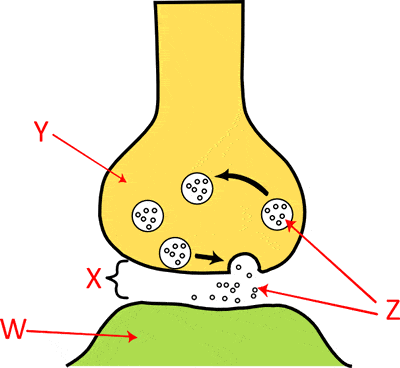
38.
W
a)
Axon Terminal Button
b)
Neurotransmitters
c)
Dendrite
d)
Synapse
39.
X
a)
Axon Terminal Button
b)
Neurotransmitters
c)
Dendrite
d)
Synapse
40.
Y
a)
Axon Terminal Button
b)
Neurotransmitters
c)
Dendrite
d)
Synapse
41.
Z
a)
Dendrite
b)
Axon Terminal
c)
Neurotransmitters
d)
Synapse
42.

What's in the picture?

a)

synaptic vesicles

b)

neurotransmitters

c)

presynaptic neuron

d)

postsynaptic neuron

e)

synaptic cleft

43.

What's in the picture?

a)

synaptic vesicles

b)

neurotransmitters

c)

presynaptic neuron

d)

postsynaptic neuron

e)

synaptic cleft

44.

A researcher is studying a toxin produced by an animals and notices that the toxin blocks the calcium channels in the synapse of the prey animal. What would be the effect of blocking the Calcium channel?

a)

blocking the calcium channel blocks the synaptic vesicles from fusing with the membrane

b)

blocking the calcium channel means that the toxin competitively inhibits the neurotransmitter binding to the recepter on the pos-synaptic membrane

c)

blocking the calcium channel means the toxin attaches to the neurotransmitter

d)

the action potential is blocked in the presynaptic neuron

45.

Cancer cells do not pass cell cycle checkpoints, and so they undergo apoptosis and die.

a)

True

b)

False

46.
What is a term for programmed cell death?
a)
apoptosis
b)
necrosis
c)
cell death
d)
doom
47.

________________is a critical point where stop and go signals can regulate the cycle

a)

Metastasis

b)

Checkpoint

c)

Malignant

d)

Benign

48.
Which phrase best describes a common characteristic of all cancers?
a)
absence of cyclins
b)
damaged DNA
c)
uncontrolled cell growth
d)
inherited from parents
49.

What is the role of protein kinases?

a)

remove phosphate groups to deactivate enzymes

b)

trigger apoptosis

c)

add phosphate groups and energy to activate enzymes

d)

stop the cell cycle

50.

Which of these may be assessed by various proteins during a "checkpoint"? CHECK ALL THAT APPLY

a)

Ensure that all chromosomes have lined up in the center of the cell before sister chromatids separate

b)

Ensure that spindle fibers have attached to all centromeres before cell division

c)

Ensure that DNA has been replicated properly

51.

The graph represents the amount of DNA in the nucleus of each cell during the cell cycle.

Which region represents the G2 phase? (remember G2 is after S, where DNA is replicated)

a)

I

b)

II

c)

III

d)

IV

52.
The normal function of a tumor suppressor gene is 
a)
to produce growth signals
b)
to code for proteins that inhibit, or slow, cell division
c)
to cause the cell to move faster through the cell cycle
d)
to attack cancer cells in the body
53.

In the ripening of fruit, one fruit starts to release the plant hormone ethylene, a gas. Once other fruit detect ethylene, it causes them to release more and more ethylene, signaling to more fruit to release ethylene. This is an example of

a)

a negative feedback system

b)

a positive feedback system

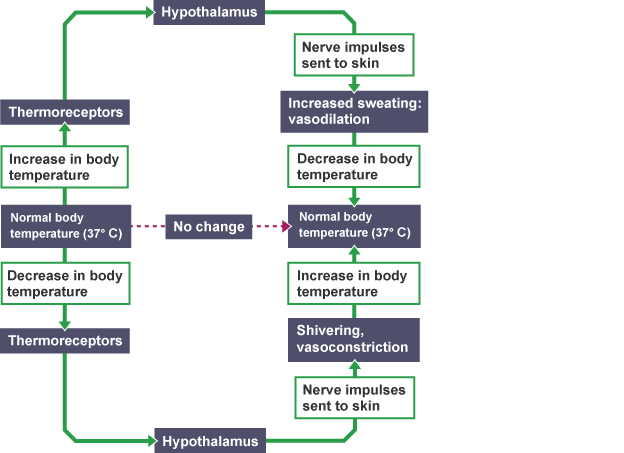
54.
If the environment gets cold, we will often shiver in order to:
a)
keep body temperature the same as the external temperature
b)
decrease body temperature
c)
increase body temperature
d)
regulate blood pressure
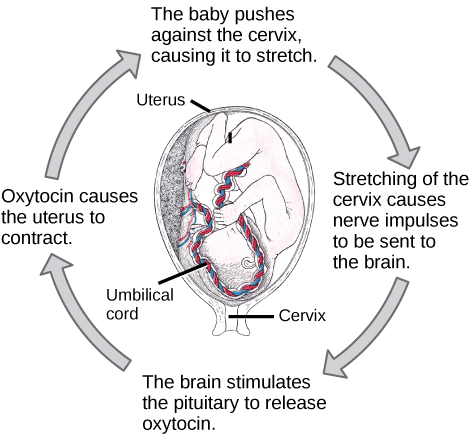
55.
What type of feedback loop is shown?
a)
Positive
b)
Neutral
c)
Negative
56.
What type of feedback loop is shown?
a)
negative
b)
neutral 
c)
positive
57.
When glucose levels in the blood rise, your brain sends a signal to your pancreas. The pancreas releases insulin, which opens channels in cell membranes to allow glucose to enter the cell, lowering blood sugar levels. 
a)
Positive Feedback Response
b)
Negative Feedback Loop