Wayground logo

Free Printable Worksheets

Font size

S
M
L
XL
Worksheets

AP BIO Molecular Genetics

Total questions: 80

Worksheet time: 2hrs 43mins

Name
Class
Date
1.
In trying to determine whether DNA or protein is the genetic material, Hershey and Chase made use of which of the following facts? 
a)
 DNA contains sulfur, whereas protein does not. 
b)
DNA contains phosphorus, whereas protein does not. 
c)
 DNA contains nitrogen, whereas protein does not.
d)
DNA contains purines, whereas protein includes pyrimidines. 
2.

In an analysis of the nucleotide composition of DNA, which of the following will be found?

a)

A = C

b)

A = G and C = T

c)

A + C = G + T

d)

G + C = T + A

3.

Replication in prokaryotes differs from replication in eukaryotes for which of the following reasons?

a)

Prokaryotic chromosomes have histones, whereas eukaryotic chromosomes do not.

b)

Prokaryotic chromosomes have a single origin of replication, whereas eukaryotic chromosomes have many.

c)

The rate of elongation during DNA replication is slower in prokaryotes than in eukaryotes.

d)

Prokaryotes produce Okazaki fragments during DNA replication, but eukaryotes do not

4.
What is meant by the description "antiparallel" regarding the strands that make up DNA? 
a)
The twisting nature of DNA creates nonparallel strands. 
b)
The 5' to 3' direction of one strand runs counter to the 5' to 3' direction of the other strand. 
c)
Base pairings create unequal spacing between the two DNA strands.
d)
One strand is positively charged and the other is negatively charged. 
5.

A nitrogenous base that has a double-ring structure; one of the two general categories of nitrogenous bases found in DNA and RNA; either adenine or guanine

a)

purine

b)

pyrimidine

6.
 A frameshift mutation could result from 
a)
a base insertion only.
b)
a base deletion only. 
c)
a base substitution only. 
d)
either an insertion or a deletion of a base.
7.
What is the flow of genetic information in cells from DNA to protein? (Central Dogma)
a)
RNA to DNA to protein
b)
DNA to RNA to protein
c)
protein to DNA to RNA
d)
RNA to protein to DNA
8.
A protein that binds to the operator and blocks the RNA polymerase
a)
regulator
b)
repressor
c)
activator
d)
corepressor
9.

An enzyme that connects the RNA nucleotides as they base-pair along the DNA template strand

a)

DNA polymerase

b)

RNA polymerase

c)

helicase

d)

topoisomerase

10.
Which RNA bases would pair with TACGAA in transcription? 
a)
AUGCUU
b)
ATGCTT
c)
GCATCC
d)
GCAUCC
11.
What is occurring in this picture?
a)
Translation
b)
Replication
c)
Translocation
d)
Transcription
12.
Which process is happening in this picture?
a)
Transcription
b)
Translation
c)
Replication
13.
Which of the following polypeptides is coded for by the mRNA sequence 5' AUGGUUAAA 3'?
a)
Val, Lys, Phe, Gly
b)
Met, Asp, Phe
c)
Met, Val, Lys
d)
Ile, Gln, Leu, Ser
14.

Spliceosomes are formations created by proteins and snRNPs. What is the function of a spliceosome?

a)

cuts apart RNA

b)

cuts out exons & reconnects introns

c)

cuts out introns & reconnects exons

d)

cuts apart DNA at particular base sequences

15.

What type of mutation occurs when the mRNA codes for a stop codon prematurely?

a)

Extensive Missense

b)

Immediate Nonsense

c)

Limited Effect

d)

Silent

16.
In the lac operon, the genes within the operon will be expressed if:
a)
lactose is absent in the cell
b)
galactose is present in the cell
c)
lactose is present in the cell
d)
glucose is absent in the cell
17.
DNA molecule segment is : TTACGCAAG
The mutated DNA segment is TTATCGCAAG. This is an example of ___ mutation.
a)
Deletion
b)
Substitution
c)
Insertion
d)
Inversion
18.
A mutation that does NOT alter the protein production is called a 
a)
deletion mutation
b)
inversion mutation
c)
silent mutation
d)
transverse mutation
19.
_______ is to transcription as ________ is to translation.
a)
mRNA / Amino Acid Chain
b)
Amino Acid Chain / mRNA
c)
Ribosome / Nucleus
d)
mRNA / tRNA
20.
Transcription begins at sequences called
a)
Start Codons
b)
Promoters
c)
Origins
d)
Introns
21.
Why are insertion and deletion (frameshift) mutations so harmful?
a)
They change all of the codons from the mutation on down the line, which changes the amino acid sequence
b)
They insert things that an organism doesn't need.
c)
They often delete things that organisms need.
d)
Insertion and deletions are not any more harmful than substitution mutations.
22.

Put the steps of translation in the correct order.

a)

1) Elongation 2) Initiation 3)Termination

b)

1) Initiation 2) Termination 3) Elongation

c)

1) Initiation 2) Elongation 3) Termination

d)

1) Elongation 2) Termination 3) Initiation

23.
Antibiotics kill viruses
a)
True
b)
False
24.
A(n) _____ is a virus that enters a bacterial cell.
a)
endospore
b)
decomposer
c)
plasmid
d)
bacteriophage
25.
Which viral life cycle allows viral genetic material to lay dormant while the host cell reproduces?
a)
lytic
b)
mitosis
c)
lysogenic
d)
S phase
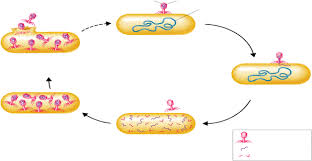
26.
What is shown here?
a)
Lysogenic Cycle
b)
Lytic Cycle
c)
Binary Fission
d)
Conjugation
27.

This laboratory procedure is known as

a)

CLONING

b)

gel electrophoresis

c)

chromatography

d)

use of a dichotomous key

28.

In preparation for an electrophoresis procedure, restriction enzymes are added to DNA in order to

a)

convert the DNA into gel

b)

cut the DNA into fragments

c)

change the color of the DNA

d)

produce longer sections of DNA

29.

The parents of a new baby believe they brought the wrong child home from the hospital. Gel electrophoresis was performed using DNA samples from the parents and the child. A section of the gel

electrophoresis results is shown below. Which conclusion is valid based on the gel electrophoresis results?

a)

They have the correct child, because her genetic information is identical to that of the father.


b)

They have the wrong child, because her genetic information does not match that of either parent.

c)

They have the correct child, because her genetic information came from both parents.


d)

They have the wrong child, because her genetic information matches only that of the mother.

30.

A student performed a gel electrophoresis experiment. The results are represented in the diagram

below. Compared to the fragments at the top of the gel, the fragments at the lower end are

a)

larger, and move slower

b)

larger, and move faster

c)

smaller, and move faster

d)

smaller, and move slower

31.

A product of genetic engineering technology is represented below . Which substance was needed to join the insulin gene to the bacterial DNA as shown?

a)

DNA polymerase

b)

Ligase

c)

RNA polymerase

d)

Helicase

32.

What is the result of step 3?

a)

a new type of molecular base is formed

b)

different types of minerals are joined together

c)

DNA from the bacterial cell is cloned

d)

Recombinant DNA

33.

Which of the following processes brings about an exchange of genetic information between bacterial cells through a pillus?

a)

binary fission

b)

mutulaism

c)

conjugation

d)

replication

34.
Process by which bacteria reproduce asexually
a)
binary fission
b)
transduction
c)
transformation
d)
conjugation
35.

This is the process by which DNA is transferred from one bacterium to another by a virus.

a)

translation

b)

transduction

c)

conjugation

d)

transpiration

36.

In humans, if a non-disjunction event leads to an individual that is XXY, they would

a)

be female because they have 2 X chromosomes

b)

be male because they have a Y chromosome

c)

die

d)

have both male and female characteristics

37.
What type of chromosomal mutation is this?
a)
Inversion
b)
Translocation
c)
Deletion
d)
Duplication
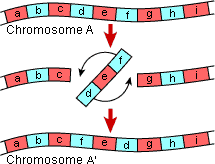
38.
Which type of chromosome mutation is this (use image) and why?
a)
Inversion, because the genes are switching places with those of another chromosome
b)
Translocation, because the genes are switching places with those of another chromosome
c)
Inversion, because the genes of the same chromosome are switched to opposite orders
d)
Translocation, because the genes of the same chromosome are switched to opposite orders
39.

Which of the following figures correctly depicts the interactions at the lac operon when lactose is NOT being utilized? (The legend above defines the shapes of the molecules illustrated in the options.)

a)
b)
c)
d)
40.

ABCDEF. . . -> ABDCEF. . .


A rearrangement in the linear sequence of genes as shown in the diagram above is known as

a)

duplication

b)

deletion

c)

inversion

d)

translocation

41.

A single substitution in the third position would have the greatest probability of mutational effect on the

codon


a. GUU

b. AUU

c. CGU

d. AUG

e. CCC

a)

GUU

b)

AUU

c)

CGU

d)

AUG

42.
What is recombinant DNA?
a)
DNA containing genes foreign to that organism
b)
DNA which has been impacted by epigenetics
c)
DNA that has restriction enzymes
d)
DNA that has been sequenced
43.

Which virus replication cycle results in the immediate death of the host cell?

a)

Carbon Cycle

b)

Lysogenic Cycle

c)

Nitrogen Cycle

d)

Lytic Cycle

44.
tRNA is involved in
a)
carrying amino acids 
b)
carrying ribosomes
c)
carrying glucose
d)
carrying lipids
45.
Carries the genetic code to the ribosome
a)
mRNA
b)
tRNA
c)
rRNA
d)
DNA
46.
A mutation that does NOT alter the protein production is called a 
a)
deletion mutation
b)
inversion mutation
c)
silent mutation
d)
transverse mutation
47.
The "on/off" switch for an operon is called the
a)
promoter
b)
repressor
c)
operator
d)
gene
48.
Transcription begins at sequences called
a)
Start Codons
b)
Promoters
c)
Origins
d)
Introns
49.
Translation is a process in eurkaryotic cells takes place in the:
a)
Cytoplasm
b)
Nucleus
c)
Nucleolus
d)
Golgi Bodies
50.
When the Ribosome reaches ________________ the process of translation stops
a)
Stop Codon
b)
Okazaki Fragment
c)
Terminator
d)
taq Polymerase
51.
Why are insertion and deletion (frameshift) mutations so harmful?
a)
They change all of the codons from the mutation on down the line, which changes the amino acid sequence
b)
They insert things that an organism doesn't need.
c)
They often delete things that organisms need.
d)
Insertion and deletions are not any more harmful than substitution mutations.
52.

Which of the following polypeptides is coded for by the mRNA sequence 5' AUGGUUAAA 3'?

a)

Val, Lys, Phe, Gly

b)

Met, Asp, Phe

c)

Met, Val, Phe

d)

Ile, Gln, Leu, Ser

53.
How did Rosalind Franklin's photo 51 affect the work of Watson and Crick? (picture is shown)
a)
It was used to determine the physical structure of DNA
b)
It was used to identify the four bases that make up DNA
c)
It was used to determine the theory of independent assortment
d)
It was used to show DNA was the molecule of inheritance
54.

DNA consists of two strands of nucleotides held together by ____ bonds between complimentary bases.

a)

Covalent

b)

Hydrogen

c)

Ionic

d)

Hydrophobic

55.
Cytosine makes up 42% of the nucleotides in a sample of DNA from an organism. Approximately what percentage of the nucleotides in this sample will be thymine?
a)
8%
b)
16%
c)
42%
d)
58%
56.
What amino acid is represented by the codon UUA?
a)
Phenylalanine
b)
Tyrosine
c)
Leucine
d)
Stop codon
57.
If a cell has an abnormal number of chromosomes, usually from meiosis, what is this considered? Choose the best answer.
a)
Chromosome mutation
b)
Nondisjunction
c)
Sex-linked mutation
d)
Inversion
58.

Identify the tool in the image:

a)

Karyotype

b)

Gel Electrophoresis

c)

DNA Fingerprint

d)

Gene Analysis

59.

Monosomy:

a)

Missing 1 chromosome

b)

3 chromosomes (instead of a pair)

c)

Chromosomes are normal

60.

Trisomy:

a)

Missing 1 chromosome

b)

3 chromosomes (instead of a pair)

c)

Chromosomes are normal

61.

SELECT ALL THAT APPLY:

a)

Male

b)

Female

c)

No chromosomal abnormalities

d)

Trisomy 21

62.

Observe the results above. What gene is present in the engineered plasmid?

a)

kanamycin resistant gene

b)

ampicillin resistant gene

c)

tetracycline resistant gene

d)

No plasmid is necessary to grow on plate 3.

63.

The exogenous DNA used in bacterial transformation can be,

a)

mRNA molecule

b)

rDNA

c)

natural DNA

d)

2 and 3

64.

Which of the following statements regarding the trp operon is true?

a)

The operator region produces the mRNA that codes for the repressor.

b)

The regulatory gene is not transcribed in the presence of the repressor.

c)

Repressor proteins are inactivated by the presence of the repressor. .

d)

The trp operon is always activated unless deactivated by a repressor

65.
Replicate the following strand of DNA: 
AATCATGGA
a)
AATCATGGA
b)
TTAGTACCT
c)
UUAGUACCU
d)
GGATAUCUA
66.
The enzyme that unzips the DNA to prepare for replication
a)
helicase
b)
replicase
c)
polymerase
d)
synthase
67.
After analyzing a sample of DNA, a scientist recorded the data shown in the table. What percentage of the DNA sample is cytosine?
a)
22%
b)
25%
c)
28%
d)
56%
68.
Which enzyme fixes the Okazaki fragments in the lagging strand?
a)
Helicase
b)
Polymerase
c)
Ligase
d)
Primerase
69.
If a strand reads:
3' A A A T T T C 5'
The matching strand would read...
a)
5' T T T A A A G 3'
b)
3' T T T A A A G 5'
c)
5' A A A T T T C 3'
d)
3' U U U A A A G 5'
70.
The enzyme that splits open the DNA creates what's called a fork - where the DNA separates into the lagging strand and the ______ strand.
a)
leading
b)
leveraging
c)
Okazaki
d)
ligase
71.
Polymerase is able to replicate the new DNA ______ along the leading strand.
a)
continuously
b)
only in short fragments
c)
very slowly
d)
prokaryotically
72.
order of replication
a)
3, 4, 2, 1
b)
3, 1, 4, 2
c)
2, 1, 4, 3
d)
3, 4, 1, 2
73.
In what phase of the cell cycle does DNA replication take place?
a)
G1
b)
S
c)
G2
d)
M
74.
Based on the diagram, how many origins of replication are represented?
a)
1
b)
2
c)
3
d)
4
75.
Based on the diagram, the enzyme (represented in gray) is most likely...
a)
DNA polymerase
b)
DNA Ligase
c)
Nuclease
d)
Helicase
76.

Direction that DNA is READ?

a)

3' to 5'

b)

5' to 3'

77.

This structure is an Okazaki fragment.

a)

A

b)

D

c)

F

d)

G

78.
What is a Codon?
a)
4 base pairs that transfer to amino acids
b)
3 base pairs that transfer to amino acids
c)
3 base pairs that transfer to DNA
d)
3 base pairs that transfer to mRNA
79.
When transferring tRNA to amino acids, the process cannot begin until it reaches a...
a)
Beginning codon
b)
Start codon 
c)
Initiator codon
d)
Anticodon
80.
Which of the following will NOT generally cause mutations?
a)
radiation
b)
DNA replication
c)
chemicals
d)
viruses