
NEW
Font size
S
M
L
XL
 Worksheets
Year 11 Tuesday
Total questions: 41
Worksheet time: 26mins
Name
Class
Date
1.
Calculate the SA for a cube-shaped cell with sides equal to .8mm.
a)
3.84 mm2
b)
.5 mm3
c)
.5 mm2
d)
3.84 mm3
2.
Which cells are more efficient at obtaining nutrients?
a)
Small Cells
b)
Medium Size Cells
c)
Large Cells
d)
X-Large Cells
3.
How is the relationship between the cell size and the cell nutrient absorption rate determined?
W=width, L=length, H=height, SA= surface area, and V=volume
W=width, L=length, H=height, SA= surface area, and V=volume
a)
(6xWxL)
b)
(WxLxH)
c)
SA ➗V
d)
V➗SA
4.
Calculate the SA:V ratio for a cube-shaped cell with sides equal to .1 mm.
a)
6:1
b)
60:1
c)
600:1
d)
.6:1
5.
Calculate the volume for a cube-shaped cell with sides equal to .4mm.
a)
.06 mm2
b)
.06 mm3
c)
.96 mm3
d)
.96 mm2
6.
Which of the following is NOT a reason why cells need to remain small?
a)
to efficiently obtain nutrients
b)
to efficiently obtain waste products
c)
to efficiently remove waste produces
d)
to efficiently send signals to the center of the cell
7.
How does the SA:V ratio change as the size of the cell increases?
a)
It increases
b)
it decreases
c)
it remains the same
d)
it is not affected by cell size
8.
How does the SA:V ratio change as the size of the cell decreases?
a)
it increases
b)
it decreases
c)
it remains the same
d)
it is not affected by cell size
9.
Which cube-shaped cell would be the most efficient?
A: .01 mm
B: 1.4 mm
A: .01 mm
B: 1.4 mm
a)
A
b)
B
c)
They are equally efficient
10.
Which cube-shaped cell would have a higher SA:V ratio?
A: .01 mm
B: 1.4 mm
A: .01 mm
B: 1.4 mm
a)
A
b)
B
c)
They are equally efficient
11.
Which cube-shaped cell would have a lower SA:V ratio?
A: 1.1 mm
B: 0.8 mm
A: 1.1 mm
B: 0.8 mm
a)
A
b)
B
c)
They are equally efficient
12.
How would the rate of diffusion in a cell change as a cell got larger?
a)
It does not affect the rate of diffusion
b)
increases
c)
decreases
13.
How would the time it takes for nutrients to reach the center of the cell change as a cell gets smaller?
a)
It does not affect the rate of diffusion
b)
increases
c)
decreases
14.
Which increases at a faster rate as cell size gets larger?
a)
SA
b)
V
c)
The SA and V increase at the same rate
15.
What means of particle transport requires energy?
a)
passive
b)
active
c)
facilitated
d)
osmosis
16.
Diffusion is the movement of particles
a)
from low to high concentration
b)
from high to low concentration
c)
from equilibrium to areas of high concentration
d)
all of the above
17.
The current model of the plasma membrane is called the
a)
hydrophobic layer
b)
transport bilayer
c)
phosphoproteins
d)
fluid mosaic model
18.
What characteristic of the cell membrane allows only certain material to pass through?
a)
selective gating
b)
selective permeability
c)
hydrophilia
d)
selective service
19.
What is the function of cholesterol materials in the cell membrane?
a)
make the membrane thicker
b)
make the membrane more porous
c)
connect the proteins together
d)
make the membrane more stable
20.
Facilitated diffusion requires
a)
no energy
b)
energy
21.
Placing a cell in an isotonic solution causes the cell to
a)
shrink
b)
swell
c)
stay the same
22.
Placing a cell containing 10% salt into a solution containing 7% salt will cause the cell to
a)
shrink
b)
swell
c)
stay the same
23.
Placing a cell containing 10% salt into a solution containing 15% salt will cause the cell to
a)
shrink
b)
swell
c)
stay the same
24.
What is the diffusion of water through a selectively permeable membrane?
a)
active transport
b)
osmotic pressure
c)
facilitated diffusion
d)
osmosis
25.

Movement of particles through the cell membrane from high to low concentrations
a)
diffusion
b)
photosynthesis
c)
mitochondria
d)
active transport
26.

Against the concentration gradient
low to high uses energy/ATP
low to high uses energy/ATP
a)
facilitated diffusion
b)
osmosis
c)
active transport
d)
diffusion
27.

Allows certain molecules or ions to pass through it by diffusion and doesn't allow others.
a)
protein
b)
semi-permeable membrane
c)
isotonic
d)
homeostasis
28.

Equal percentage of solutes inside and out.
Concentration of substances is the same.
Concentration of substances is the same.
a)
hypotonic
b)
isotonic
c)
nucleus
d)
hypertonic
29.
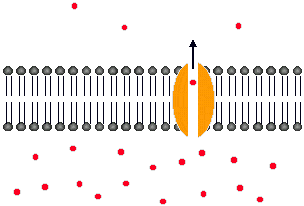
Particles are too large to enter the membrane.
Need help from channel proteins. No energy required.
Need help from channel proteins. No energy required.
a)
active transport
b)
passive transport
c)
facilitated diffusion
d)
osmosis
30.

Diffusion of water across a cell membrane
from high to low.
from high to low.
a)
osmosis
b)
active transport
c)
protein channel
d)
pinocytosis
31.

Engulfs large molecules and moves them inside the membrane.
Uses energy.
Uses energy.
a)
exocytosis
b)
endocytosis
c)
protein channel
d)
diffusion
32.

Engulfing a large substance from the inside of the cell to move it outside of the cell.
Uses energy.
Uses energy.
a)
exocytosis
b)
endocytosis
c)
photosynthesis
d)
diffusion
33.

Particles move from high concentrations to low concentrations.
Doesn't need energy
Doesn't need energy
a)
passive transport
b)
facilitated transport
c)
active transport
d)
exocytosis
34.
Cell is placed into a concentration of water that has the same makeup as the cell. The cell will
a)
Explode
b)
Shrink
c)
Stay the same
d)
None of the above
35.
The substance that is dissolved in a solution.
a)
solute
b)
solution
c)
solvent
d)
solidify
36.
A cell in a hypotonic solution will
a)
swell
b)
shrink
c)
stay the same size
d)
impossible to tell
37.
When a cell is placed in a hypertonic solution water
a)
moves from the inside of the cell to the solution
b)
moves from the solution to the inside of the cell
c)
moves equally in and out of the cell
d)
none of these
38.
The cell membrane is solid and rigid
a)
true
b)
false
39.
A state of biological balance
a)
homeostasis
b)
hypertonic
c)
hypotonic
d)
hippocampus
40.
Permeable means
a)
things can pass through
b)
the concentration levels are different
c)
permanent
d)
things are stuck
41.

The picture is an example of...
a)
active tranport
b)
passive transport
c)
diffusion
d)
osmosis
Reset

