
 Worksheets
SO-- Anatomy & Phys
Total questions: 159
Worksheet time: 2hrs 53mins
Name
Class
Date
1.

When you breathe, your lungs take in ___ and remove ___.
a)
air/oxygen
b)
oxygen/carbon dioxide
c)
carbon dioxide/waste
d)
waste/air
2.

The air sacs that are covered with capillaries that separate gases we need from gases we don't need.
a)
bronchi
b)
lungs
c)
oxygen
d)
alveoli
3.

A disorder of the lungs called ____ causes the bronchi to become restricted (get smaller) so air can't get to the lungs.
a)
asthma
b)
cold
c)
influenza
d)
bronchitis
4.

What is tube that is also known as your wind pipe?
a)
esophogus
b)
bronchi
c)
trachea
d)
alveoli
5.
How is carbon dioxide released from the body?
a)
When we exhale
b)
When we urinate
c)
When we sweat
d)
When we inhale
6.

spasm of the diaphragm
a)
cough
b)
sneeze
c)
hiccup
d)
yawn
7.
The exchange of gases between your blood and tissue cells is known as:
a)
Pulmonary ventilation
b)
external respiration
c)
internal respiration
d)
systemic ventiation
8.
The final and smallest component of the conducting zone of the respiratory tract is the:
a)
tertiary bronchi
b)
Terminal bronchioles
c)
Respiratory bronchioles
d)
Alveolar sacs
9.
Which factor shifts an oxygen dissociation curve to the right?
a)
Increase in body temperature
b)
Decrease in partial pressure of carbon dioxide
c)
Increase in hemoglobin’s affinity for oxygen
d)
Decrease in 2,3-BPG levels
10.
Which of the following is not an effect of high altitudes on the respiratory system?
a)
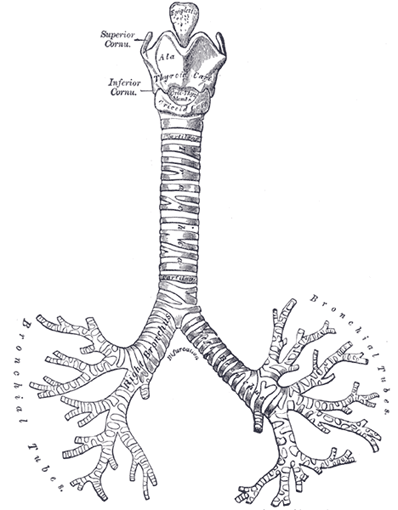
Pulmonary artery pressure decreases
b)
The saturation of oxyhemoglobin begins to decrease rapidly
c)
Hyperpnea
d)
Hypoxia
11.
Which nerve in the body controls the diaphragm muscle?
a)
Phrenic nerve
b)
Thoracodorsal nerve
c)
Intercostal nerves
d)
Vagus nerve
12.
Which gas law states that the volume of a given quantity of gas is directly proportional to its absolute temperature?
a)
Boyle’s law
b)
Charles’ law
c)
Henry’s law
d)
Dalton’s law
13.
When a person receives a vaccine, his or her body:
a)
receives antibodies against a specific pathogen
b)
immediately begins to fight the infection caused by the pathogens
c)
creates plasma cells that can produce antibodies against the specific pathogen
d)
creates antigens to fight the specific pathogen.
14.
Hemolytic disease of the newborn (HDN) can occur when:
a)
the mother is Rh negative and baby is Rh positive
b)
the mother is Rh positive and baby is Rh negative
c)
the mother is Rh negative and baby is Rh negative
d)
the mother is Rh positive and baby is Rh positive
15.
what are the common terms for mastication and deglutition?
a)
Swallowing; chewing
b)
Chewing; spitting
c)
Chewing; swallowing
d)
Swallowing; spitting
16.
In the tongue, which are the most abundant forms of papillae?
a)
Fungiform
b)
Filiform
c)
Vallate
d)
Foliate
17.
Where does the majority of chemical digestion in the stomach occur?
a)
Fundus and body
b)
Cardia and fundus
c)
Body and pylorus
d)
Body
18.
Where is chime converted to feces?
a)
Rectum
b)
Colon
c)
Anus
d)
Ileum
19.
How many waves of peristalsis occur in the esophagus?
a)
1
b)
2
c)
3
d)
4
20.
Which of the following is not a layer of the mucosa?
a)
Epithelium
b)
Lamina propria
c)
Muscularis externa
d)
Muscularis mucosae
21.
Like all other body systems, the immune system helps the body maintain homeostasis. Which statement best describes how the immune system does this?
a)
it protects other organs and tissues from infection and disease
b)
it breaks down food to provide cells with nutrients
c)
it gathers information through the senses and controls all other body systems
d)
it transports oxygen and carbon dioxide
22.

The picture below illustrates one internal part of the body’s immune system. What process is illustrated in the picture?
a)
a skin cell destroying germs.
b)
inflammation near an opened wound
c)
a white blood cell destroying pathogens
d)
mucus in the lungs destroying pathogens
23.
What do scientists call bacteria and viruses that can make people sick?
a)
diseases
b)
vaccines
c)
antibodies
d)
pathogens
24.
Jorge has a cold but feels well enough to study with his friends Lisa and Jin. Lisa and Jin become sick. Which term describes Jorge’s condition when he was studying with his friends?
a)
noninfectious
b)
contagious
c)
immune
d)
deadly
25.
Liz notices that shortly after cutting her arm accidentally the area around the cut is turning red and feeling hot. Which immune system defense is Liz experiencing?
a)
inflammation
b)
white blood cell clotting
c)
skin
d)
fever
26.
Diseases are passed from human to human by these four types of germs:
a)
Viruses, influenza, HIV, and vaccines
b)
Viruses, bacteria, fungi, and parasites
c)
Viruses, cancers, mutagens, and DNA
d)
Viruses, blood, pollutants, and symptoms
27.
Which answer best describes how infectious diseases get transmitted (passed on)?
a)
people can sneeze or cough and pass disease on through the air
b)
drinking water can be contaminated with diseases
c)
objects such as doorknobs and towels can be contaminated by disease
d)
all of the above answers are ways that diseases are transmitted
28.
The human body has both internal and external defense against disease. Which of these includes only internal defenses?
a)
hair and inflammation
b)
white blood cells and sweat
c)
inflammation and white blood cells
d)
skin and mucus
29.
Erick wants to avoid exposure to infectious disease as much as possible. Which strategy can best help him do this?
a)
eat a balanced diet
b)
wash his hands regularly
c)
wear sunscreen outside
d)
exercise several days a week
30.
Scientists are testing the effectiveness of 3 different viral medicines (or vaccines) in protecting against the common cold. They sign up 1,200 human volunteers and split them into three groups. So each group of 400 people is given one of the vaccines. The groups are studied for five years and the scientists record how many colds they get each year. What is the dependent variable in this investigation?
a)
different viral medications
b)
the type of common cold virus
c)
the number of years
d)
the number of colds each year
31.

Which of the following illness is caused by pathogens?
a)
Bruise
b)
Blood Clot
c)
Diabetes
d)
Influenza
32.

Vaccinations are used for
a)
Curing the illness
b)
Preventing the Illness
c)
Getting the illness
33.

What are the 4 types of pathogens that could cause illness?
a)
animals, bacteria, fungi and plants
b)
bacteria, fungi, nucleus, protist
c)
bacteria, fungi, viruses, protist
d)
bacteria, plants, fungi, protist
34.

What is the main purpose of the immune system?
a)
support the body through bones and muscles
b)
get rid of waste from the body
c)
protect the body from pathogens
d)
move blood through the body
35.

What type of microbe is used in a vaccine?
a)
it doesn't really matter
b)
a damaged one
c)
a weakened or inactivated one
d)
a normal one
36.

What do antibodies attach to on the pathogen?
a)
Anti inflammatory
b)
Antigens
c)
Antiseptic
d)
Antibodies
37.

Vaccines stimulate the body to produce...
a)
autoimmune diseases
b)
helper t-cells
c)
fever
d)
antibodies
38.

Which would most likely prevent a cold virus from spreading in a classroom?
a)
tissue at a teacher's desk
b)
students wash hands regularly with soap
c)
students shake hands regularly with each other
d)
students wipe desks with dry paper towels
39.

Which disease is caused by a bacteria?
a)
Malaria
b)
The flu
c)
Strep Throat
d)
Athlete's foot
40.

Ringworm is caused by which pathogen?
a)
Bacteria
b)
Virus
c)
Protist
d)
Fungi
41.

Which one is a way the body defends against a pathogen?
a)
Fever
b)
Stomach Acid digesting
c)
White Blood Cells fighing
d)
All of these are correct
42.
What is the Immune system?
a)
The body's defense system
b)
A system that gives support and structure
c)
A system that helps you breathe
d)
None of the above
43.
What are Lymphocytes?
a)
A type of red blood cell
b)
A nucleus
c)
A type of white blood cell
d)
Bone Marrow
44.
Which one of these options makes lymphocytes?
a)
Blood Cells
b)
Bone Marrow
c)
Bacteria
d)
The Heart
45.
Which one of these options makes lymphocytes?
a)
Blood Cells
b)
Bone Marrow
c)
Bacteria
d)
The Heart
46.
Which one of these options makes lymphocytes?
a)
Blood Cells
b)
Bone Marrow
c)
Bacteria
d)
The Heart
47.
There are more than one type of blood cell.
True Or False
True Or False
a)
True
b)
False
48.
What do T cells do?
a)
Create antibodies
b)
Fight of viruses
c)
Track down viruses
d)
T cells aren't real
49.
What is involved in innate immunity?
a)
Barriers that keep harmful materials from your body
b)
Skin cells that fight viruses and harmful bacteria from your body
c)
Bone Marrow that creates white blood cells to help heal your body
d)
Red Blood Cells
50.
What is the Lymphatic System?
a)
A system that traps and destroys harmful viruses and bacteria
b)
Another name for the immune system
c)
Red blood cells that trap and destroy harmful viruses and bacteria
d)
None Of The Above
51.
Anything that triggers an immune response is a/n
a)
lymph cell
b)
antigen
c)
antibody
d)
neutrop
52.
__________ immunity is when the bodies makes its own antibodies.
a)
passive
b)
active
c)
cell mediated
d)
false
53.
The type of disorder where body reacts against antigens that are not pathogenic is known as a/n
a)
allergy
b)
autoimmune disorder
c)
immunodeficiency
d)
pneumonia
54.
Which of the following describes when the body's immune system attacks its own tissues?
a)
allergies
b)
anaphylactic shock
c)
autoimmune
55.
The type of disorder where body reacts against antigens that are not pathogenic is known as a/n
a)
allergy
b)
autoimmune disorder
c)
immunodeficiency
d)
pneumonia
56.
Matures in the thymus gland
a)
Macraphage
b)
T Cells
c)
B Cells
57.
Inspect antigen, attacks & kills antigen, if it is recognized
a)
Macraphage
b)
T Cells
c)
B Cells
58.
First recognizes foreign body and eats it and displays it to the other cells
a)
Macraphage
b)
T Cells
c)
B Cells
59.
Watery fluid mainly consisting of leukocytes:
a)
Antigens
b)
Lymph
c)
Cell-Mediated Immunity
d)
Antibodies
60.
Two organs of the lymph system:
a)
Thymus & Pancreas
b)
Pancreas & Thyroid
c)
Spleen & Thymus
d)
Tonsils & Thymus
61.
Newborns can acquire ____ immunity through breast milk.
a)
specific
b)
passive
c)
active
d)
innate
62.

A primary immune response is ____; and a secondary immune response is___.
a)
very important; less important
b)
very rapid; very slow
c)
slower; faster
d)
none of these is correct
63.
How does the body acquire active immunity to a disease without getting the disease?
a)
by means of the inflammatory response
b)
through an allergic reaction
c)
by means of passive immunity
d)
through vaccination
64.
What is one of the ways that antibiotics work?
a)
They can stop bacteria from reproducing
b)
They can stop viruses from reproducing
c)
They stop toxins from poisoning the tissues of hosts
65.
What is the main reason we should be careful not to over-use anitbiotics?
a)
They are very expensive and the money could be used for other things.
b)
We will kill all of the "friendly" bacteria in our guts so we will have to consume lots of yougurt.
c)
Dangerous strains of bacteria may develop by natural selection.
66.
What is one of the functions of white blood cells?
a)
To carry oxygen in the blood stream
b)
To produce antigens that destroy pathogens
c)
To ingest and destroy pathogens
67.
Body temperature that has risen above the normal set point (~37 C or 98.6 F); can indicate an illness. Causes more WBC to be made.
a)
B cell
b)
fever
c)
virus
d)
T cell
68.
These cells are responsible for making antibodies
a)
B Cells
b)
Killer T Cells
c)
Helper T Cells
d)
Macrophages
69.
Which is NOT considered FIRST line of defense?
a)
White Blood Cells
b)
Skin
c)
Hair
d)
Mucous Membranes
70.

Which disease is caused by a bacteria?
a)
Malaria
b)
The flu
c)
Strep Throat
d)
Athlete's foot
71.

Which would most likely prevent a cold virus from spreading in a classroom?
a)
tissue at a teacher's desk
b)
students wash hands regularly with soap
c)
students shake hands regularly with each other
d)
students wipe desks with dry paper towels
72.

Which disease is a non-infectious disease?
a)
Diabetes
b)
Influenza
c)
AIDS
d)
Chickenpox
73.

Which of the following is a route by which an allergen may enter the body?
a)
Ulnar
b)
Excretion
c)
Contact
d)
Vagus
74.

In an anaphylactoid recation
a)
the second time an antigen is introduced into the body, chemical mediators are released.
b)
bronchoconstriction, decreased capillary membrane permeability, and vasoconstriction occur.
c)
the treatment is significantly different from anaphylaxis
d)
the patient will not have experienced a previous exposure to an antigen.
75.
A severe form of allergic reaction is called...?
a)
an allergen
b)
epinephrine
c)
anaphylaxis
d)
an immune reaction
76.

The most common cause of anaphylaxis is
a)
glue and adhesives
b)
pollen from ragweed
c)
medicaitons
d)
mosquito bites
77.
All of these are part of the innate immune response except:
a)
B cells
b)
mast cells
c)
natural killer cells
d)
macrophages
78.
Where are B and T lymphocytes produced?
a)
thymus
b)
pancreas
c)
bone marrow
d)
thryoid
79.
This protein increases the blood vessels permeability to WBCs and other substances involved in the immune response.
a)
histamine
b)
complement
c)
lysozyme
d)
defensin
80.
These molecules are responsible for inducing a fever during the innate immune response.
a)
interferons
b)
cytokines
c)
complement
d)
antibodies
81.

Disease of the pancreas where no insulin is produced causing patients to have high blood sugars
a)
diabetes mellitus type 1
b)
graves disease
c)
addisons disease
d)
diabetes insipidus
82.

Hypothyroidism that results in bulging eyes
a)
insomnia
b)
cushing syndrome
c)
addisons disease
d)
graves disease
83.

Disease caused by the malfunction of the thyroid gland causing large growths in the neck area
a)
grave disease
b)
goiters
c)
addisons disease
d)
ovarian cysts
84.
What "happens" in the lymph nodes?
a)
Excess glucose in the lymph is stored in the liver
b)
Carbon dioxide is removed from the lymph and passed to the lungs for exhalation
c)
Lymph is oxgenated and pumped through the body
d)
Lymph is cleaned of foreign antigens and debris
85.
Where is the SPLEEN?
a)
Surrounding the voice box
b)
Above the heart
c)
Adjacent to the stomach
d)
In the arm pit
86.
Which cells engulf & destroy bacteria in the lymph nodes?
a)
lymphocytes
b)
macrophages
c)
Peyers patches
d)
Spleen cells
87.
What is edema?
a)
Another name for plasma
b)
Fluid that accumulates in the tissues
c)
Antigens found on the surface of RBCs
d)
Fluid that accumulates in your lymph nodes
88.
Internal gas exchange occurs between
a)
alveoli and pulmonary capillary
b)
alveoli and body tissue
c)
body tissue and pulmonary capillary
d)
body tissue and systemic capillary
89.
Exchange of oxygen and carbon dioxide through respiratory membranes is caused by
a)
osmosis
b)
simple diffusion
c)
active transport
d)
facilitated diffusion
90.
Oxygen binds to hemoglobin in the blood to form
a)
bicarbonate ion
b)
carbonic acid
c)
carbon dioxide
d)
oxyhemoglobin
91.
70% of carbon dioxide is transferred as
a)
oxyhemoglobin
b)
carbaminohemoglobin
c)
bicarbonate ion
d)
dissolved in plasma
92.
Most of carbon dioxide is transported within blood in
a)
red blood cells
b)
plasma
c)
white blood cells
d)
in alveoli
93.
During vigorous exercise, which muscle causes forced inhalation?
a)
trapezius
b)
pectoralis major
c)
pectoralis minor
d)
latissimus dorsi
94.
science word for "breathing"
a)
cellular respiration
b)
apnea
c)
eupnea
d)
pulmonary ventilation
95.
Which of the following is true?
a)
CO2 concentration is higher in the capillaries than the alveoli
b)
CO2 concentration is higher in the alveoli than the capillaries
c)
O2 concentration is higher in the capillaries than the alveoli
d)
O2 concentration is lower in the alveoli than the capillaries
96.
Which of the following is true?
a)
Oxygen diffuses along the concentration gradient from the alveoli into the capillaries
b)
Oxygen diffuses against the concentration gradient from the alveoli into the capillaries
c)
Oxygen diffuses along a concentration gradient from the capillaries to the alveoli
d)
Oxygen diffuses against the concentration gradient from the capillaries to the alveoli
97.
Which is the correct order of structures that air passes through?
a)
Trachea --> bronchi --> bronchioles --> alveoli
b)
Bronchi ---> trachea--> bronchioles --> alveoli
c)
Bronchioles --> bronchi --> trachea --> alveoli
d)
Trachea --> bronchioles --? bronchi --> alveoli
98.
What happens to the volume and pressure inside the thorax when the external intercostal muscles contract?
a)
Volume increases, pressure decreases
b)
Volume increases, pressure increases
c)
Volume decreases, pressure decreases
d)
Volume decreases, pressure increases
99.
What occurs first during inspiration?
a)
air flows into lungs
b)
thoracic cavity volume increases
c)
intercostal muscles contract
d)
intrapulmonary pressure increases
100.
The two main branches from the trachea (one to each lung)
a)
bronchi
b)
alveoli
c)
capillaries
d)
bronchioles
101.

The air sacs that are covered with capillaries where gas exchange takes place
a)
bronchi
b)
lungs
c)
oxygen
d)
alveoli
102.
Location of gas exchange
a)
alveoli
b)
myocardium
c)
raveoli
d)
pulmonary vent
103.

2?
a)
thyroid cartilage
b)
epiglottis
c)
vocal cords
d)
trachea
104.

What is the function of the bronchi?
a)
Transport air from nose to lungs
b)
Transport air from trachea to lungs
c)
Transport air from lungs to alveoli
d)
Transport air from alveoli to blood
105.

4?
a)
Sinusis
b)
Nasal cavity
c)
Pharynx
d)
Larynx
106.

B?
a)
larynx
b)
lung lobe
c)
pharynx
d)
trachea
107.

C?
a)
left lung
b)
right lung
c)
diaphragm
d)
treachea
108.

A?
a)
alveoli
b)
alveolar duct
c)
alveolar sac
d)
capilaries
109.
Given the following structures:
1. larynx
2. nasal cavity
3. pharynx
4. trachea
Which of the following is the correct order that air would flow during inhalation.
1. larynx
2. nasal cavity
3. pharynx
4. trachea
Which of the following is the correct order that air would flow during inhalation.
a)
1,2,3,4
b)
2,3,1,4
c)
2,1,3,4
d)
4,2,3,1
110.
Given the following structures:
1. alveoli
2. bronchi
3. bronchioles
Which of the following is the correct order in which air would flow after inhalation?
1. alveoli
2. bronchi
3. bronchioles
Which of the following is the correct order in which air would flow after inhalation?
a)
1,2,3
b)
2,1,3
c)
2,3,1
d)
3,2,1
111.
The actual gas exchange with the blood occurs in the
a)
bronchi
b)
bronchioles
c)
alveoli
d)
ventricles
112.
Which of the following is not a characteristic of human lungs?
a)
Both right and left lungs are composed of three lobes.
b)
Bronchi divide to form bronchioles.
c)
Capillary supply is abundant to facilitate gas exchange with the blood.
d)
The alveoli are tiny air sacs arranged in clusters.
113.

What is tube that is also known as your wind pipe?
a)
esophogus
b)
bronchi
c)
trachea
d)
alveoli
114.
Inhalation brings in fresh ________ and exhalation removes ________.
a)
cabon dioxide, oxygen
b)
oxygen, nitrogen
c)
oxygen, carbon dioxide
d)
nitrogen, carbon dioxide
115.
The upper section of the pharynx is called:
a)
oropharynx
b)
nasopharynx
c)
laryngopharynx
d)
hypopharynx
116.
This structure protects the superior opening of larynx.
a)
thyroid cartilage
b)
epiglottis
c)
vocal cords
d)
glottis
117.
The structure just inferior to the oropharyx .
a)
oropharynx
b)
nasopharynx
c)
laryngopharyx
d)
larynx
118.
Two membranes that cover each lung
a)
epiglottis
b)
apex
c)
base
d)
pleurae
119.
Complex of lipids and proteins that prevent collapse and resist expansion of the alveoli.
a)
surfactant
b)
oxygen
c)
carbon dioxide
d)
water
120.
COPD is mostly caused by
a)
heredity
b)
pollutants
c)
smoking
d)
plaque
121.
Mucus production and inflammation of lower respiratory passageways.
a)
Chronic Bronchitis
b)
Emphysema
c)
Cilia destruction
122.
Enlargement of alveoli and destruction of alveolar walls.
a)
Chronic Bronchitis
b)
Emphysema
c)
Cilia Destruction
123.

What is "A"
a)
Mouth
b)
Pharynx
c)
Tongue
d)
Esophagus
124.

What is "B"?
a)
Pharynx
b)
Mouth
c)
Esophagus
d)
Epiglottis
125.

What is "C"?
a)
Mouth
b)
Tongue
c)
Epiglottis
d)
Pharynx
126.

What is "D"?
a)
Epiglottis
b)
Esophagus
c)
Salivary glands
d)
Pharynx
127.

What is "E"?
a)
Esophagus
b)
Mouth
c)
Tongue
d)
Epiglottis
128.

What is "F"?
a)
Gall Bladder
b)
Small Intestines
c)
Liver
d)
Stomach
129.

What is G?
a)
Pancreas
b)
Liver
c)
Stomach
d)
Large intestines
130.

What is "H"?
a)
Gall Bladder
b)
Stomach
c)
Liver
d)
Pancreas
131.

What is "I"?
a)
Pancreas
b)
Small Intestines
c)
Rectum
d)
Gall Bladder
132.

What is "J"?
a)
Appendix
b)
Small intestines
c)
Large intestines
d)
Liver
133.

What is "K"?
a)
Stomach
b)
Small intestines
c)
Liver
d)
Large intestines
134.

What is "L"?
a)
Liver
b)
Pancreas
c)
Gall Bladder
d)
Appendix
135.

What is "M"?
a)
Rectum
b)
Large Intestines
c)
Small Intestines
d)
Pancreas
136.
The throat, food passes through here when swallowing.
a)
esophagus
b)
pharynx
c)
stomach
d)
salivary glands
137.
Where digestion begins, teeth and tongue help break food into smaller pieces.
a)
mouth
b)
pharynx
c)
esophagus
d)
salivary glands
138.
Releases salivary amylase into mouth which helps break down carbs.
a)
esophagus
b)
stomach
c)
epiglottis
d)
salivary glands
139.
Squeezes food down from mouth to the stomach.
a)
esophagus
b)
pharynx
c)
epiglottis
d)
liver
140.
Small flap that covers the trachea when swallowing to prevent food from entering lungs.
a)
epiglottis
b)
stomach
c)
esophagus
d)
salivary glands
141.
Churns and mixes food, produces acid to kill pathogens & pepsin to digest proteins.
a)
stomach
b)
liver
c)
gall bladder
d)
pancreas
142.
Makes bile, detoxified blood that carries nutrients from the small intestines.
a)
liver
b)
gall bladder
c)
pancreas
d)
large intestines
143.
helps neutralize stomach acid & digest food and regulates blood sugar levels.
a)
pancreas
b)
stomach
c)
gall bladder
d)
appendix
144.
stores excess bile made by the liver.
a)
large intestines
b)
small intestines
c)
pancreas
d)
gall bladder
145.
digest food in the first part and then absorbs nutrients in the second and third part.
a)
large intestines
b)
small intestines
c)
liver
d)
appendix
146.
a small sac found near the large intestines, it doesn't help with digestion.
a)
appendix
b)
pancreas
c)
gall bladder
d)
small intestines
147.
absorbs water from waste, good bacteria live here and help maintain good health. (dryer of digestive system).
a)
liver
b)
epiglottis
c)
large intestines
d)
rectum
148.
Where waste is stored before it is eliminated from the body.
a)
rectum
b)
epiglottis
c)
esophagus
d)
pancreas
149.
Smooth muscle contractions used to break down food in the gut is called...
a)
Peristalsis
b)
Segmentation
c)
Hydrolysis
d)
Dehydration synthesis
150.
GIP is released in response to
a)
Fat presence
b)
carbohydrate presence
c)
fat absence
d)
protein absence
151.
Carbohydrates are absorbed immediately following chemical digestion
a)
Contact digestion
b)
Peristalsis
c)
Hydrolysis
d)
Brush boarder retention
152.
Contact digestion occurs in the...
a)
mouth
b)
stomach
c)
deuodenum
d)
brush boarder
153.
GIP causes the pyloric sphincter to...
a)
Open
b)
Close
154.

Digestion is when food is absorbed into the blood stream by?
a)
villi
b)
stomach
c)
esophagus
d)
liver
155.

What type of acid is in the stomach?
a)
HCl (Hydrochloric acid)
b)
NaCl (Table salt)
c)
NaOH (Sodium Hydroxide)
156.

The Pancreas is responsible for?
a)
Creating enzymes for digestion
b)
Regulating the sugar levels in your body
c)
Both A & B
d)
Neither A & B
157.

Chemical digestions is?
a)
Enzymes from glands
b)
Chewing food
c)
Both A & B
d)
Neither A & B
158.

Carbohydrates are broken down into?
a)
sugar
b)
protein
c)
amino acids
d)
lipids
159.

Find the correct order.
a)
Tissue / Organ / Organ System
b)
Cell / Organ System / Organism
c)
Organ / Cell / Organ System
100 %

