
 Worksheets
life science 7th
Total questions: 62
Worksheet time: 1hrs 26mins
Name
Class
Date
1.

What is the process of making a sound with the voice?
a)
bioluminescence
b)
gift giving
c)
pheromones
d)
vocalization
2.

What is it called when a bird puffs up or shows off its feathers?
a)
bioluminescence
b)
gift giving
c)
plumage displays
d)
vocalization
3.

What is the primary way that birds protect their young?
a)
herding
b)
nest building
c)
vocalization
d)
fighting
4.

How do elephants, whales, and caribou protect their young?
a)
nest building
b)
vocalization
c)
herding
d)
fighting
5.

Who is an organism that gives pollen from one plant to another plant of the same kind so that seeds will be produced?
a)
germinator
b)
pollinator
c)
predator
d)
fertilizer
6.

Which is not a way that flowers attract pollinators?
a)
colorful petals
b)
strong odors
c)
herding
d)
nest building
7.

What is the process of getting a baby plant away from the parent so it can grow more successfully?
a)
predation
b)
dispersal
c)
germination
d)
reproduction
8.
Colorful leaf like structure that attracts pollinators
a)
Petals
b)
Sepal
c)
Leave
d)
Stamen
9.
The transfer of pollen from the anther of one plant to the stigma of another plant.
a)
Pollination
b)
Self-pollination
c)
Cross-pollination
d)
Pollen tube
10.
What type of reproduction has occurred when an organism produces genetically identical offspring?
a)
sexual reproduction
b)
asexual reproduction
c)
seedling
d)
pollination
11.
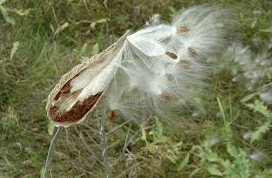
All of the following are examples of seed disbursement except:
a)
wind
b)
volcanic eruptions
c)
physical movement (rolling)
d)
animals feces
12.
____________ reproduction is where the offspring is a clone of the parent
a)
sexual
b)
asexual
13.
Which of the following is a disadvantage of asexual reproduction?
a)
Environment is stable
b)
Minimal energy required
c)
Changing environment
14.
_______________ reproduction requires the union of gametes (egg and sperm) from two parents- male and female. There is an exchange of genetic material
a)
Sexual
b)
Asexual
15.
Which of the following is not a disadvantage of sexual reproduction?
a)
greater genetic variation
b)
requires a male
c)
not all genetic combinations are viable
16.

What is the main energy source for this food chain?
a)
Berries
b)
Squirrel
c)
Bobcat
d)
Sun
17.

The arrows represent -
a)
The consumers in the food chain
b)
Which animal eats another
c)
How energy flows
d)
The direction in which organisms move
18.

Which of the following is NOT a consumer?
a)
Plants
b)
Polar Bear
c)
Oxen
d)
Insects
19.

Which of these organisms is most likely an herbivore?
a)
Arctic Fox
b)
Lemmings
c)
Snowy Owl
d)
Plants
20.

If the bass were removed from this food web, which of the following would most likely NOT be an effect?
a)
The crayfish population would increase
b)
The pickerel population would decrease
c)
The amphipod population would increase
d)
The snail population would increase
21.
Which of these is an example of an organism interacting with another organism in its environment?
a)
A fire ant digging a tunnel in sandy soil
b)
A blue jay drinking water from a puddle
c)
A bee collecting pollen from a tree
d)
A hawk circling in the air over a tree
22.
An organism that is killed and eaten by another organism
a)
Predator
b)
Prey
c)
Competition
d)
Adaptation
23.
What does symbiosis mean?
a)
A.living separately, no relationship between 2 species
b)
A.living together, close relationship between 2 species
c)
A.Living separately, long distance relationship between 2 species
d)
When one species kills and eats another
24.
The organism that does the killing in a predation interaction
a)
Predator
b)
Prey
c)
Competition
d)
Adaptation
25.
What type of symbiosis?
* Hummingbirds feed on nectar from flowers.
* Flowers are pollinated by hummingbirds as they move from flower to flower.
* Hummingbirds feed on nectar from flowers.
* Flowers are pollinated by hummingbirds as they move from flower to flower.
a)
commensalism
b)
mutualism
c)
parasitism
d)
predation
26.
What type of symbiosis?
*The tick lives on dog and feeds on its blood and tissue.
* The dog gets skin irritation and can pick up diseases carried by tick.
*The tick lives on dog and feeds on its blood and tissue.
* The dog gets skin irritation and can pick up diseases carried by tick.
a)
commensalism
b)
mutualism
c)
parasitism
d)
predfation
27.
On a safari at night, a lion hunts and feeds on an antelope. In this relationship, the lion is the ____________________ and the antelope is the _________________.
a)
Parasite/host
b)
Predator/prey
c)
Prey/Predator
28.
The struggle between organisms to survive as they attempt to use the same resource
a)
Predator
b)
Prey
c)
Competition
d)
Adaptation
29.
Camouflage is an example of an ______________________ that a prey might have to survive.
a)
Niche
b)
Prey
c)
Competition
d)
Adaptation
30.
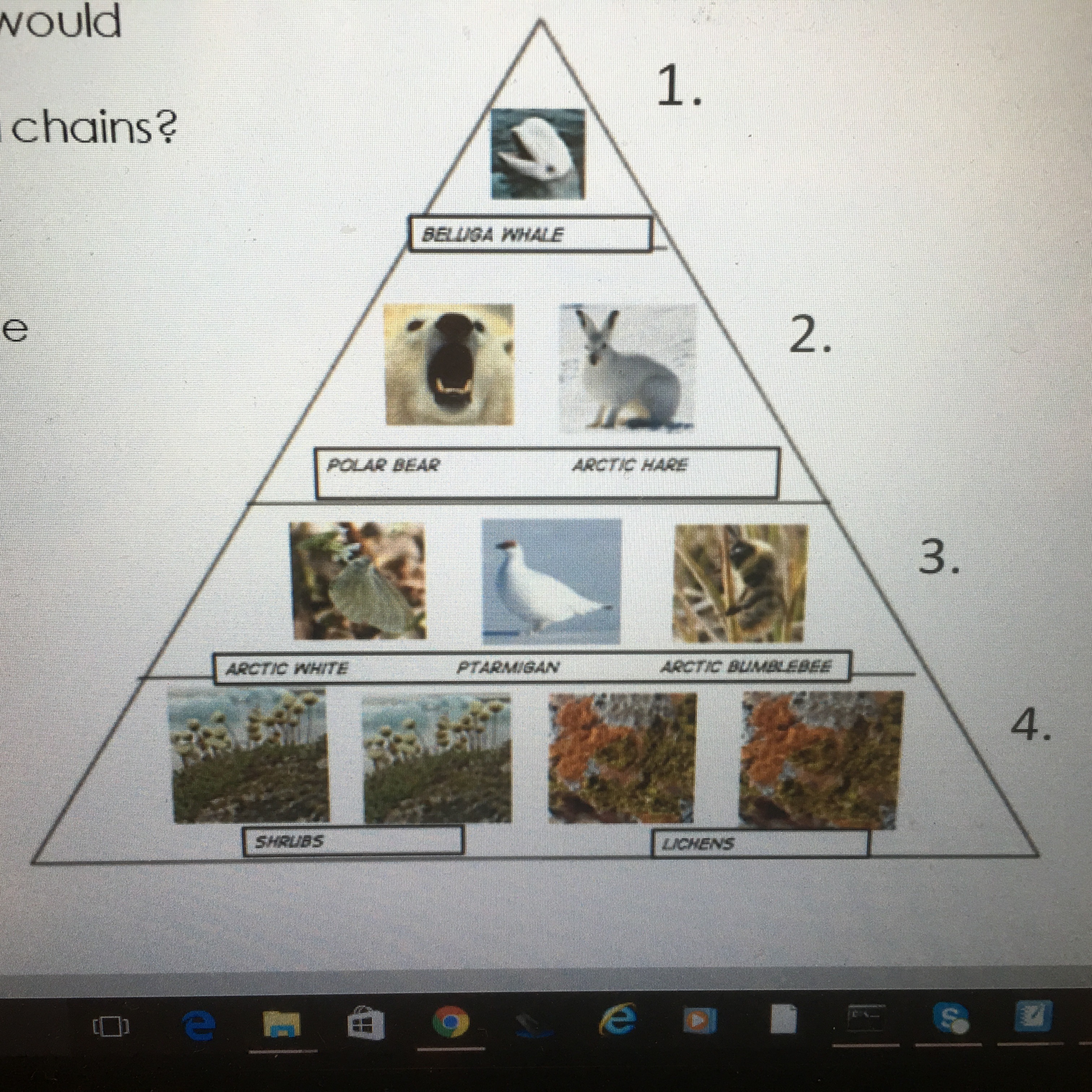
Which is the apex predator?
a)
Ptarmigan
b)
Polar Bear
c)
Lichens
d)
Beluga Whale
31.
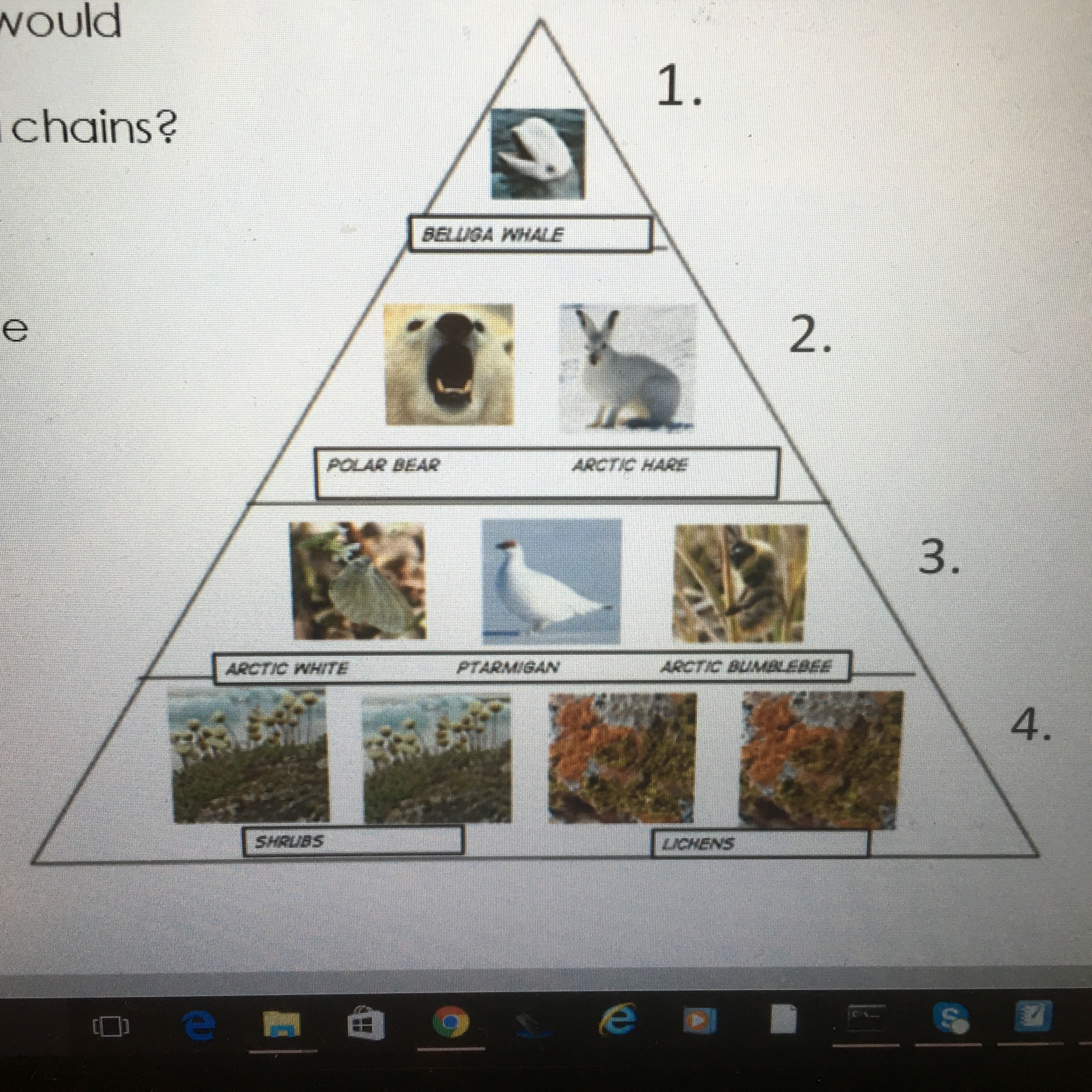
Which group are the producers?
a)
1 and 2
b)
3 and 4
c)
4
d)
3
32.
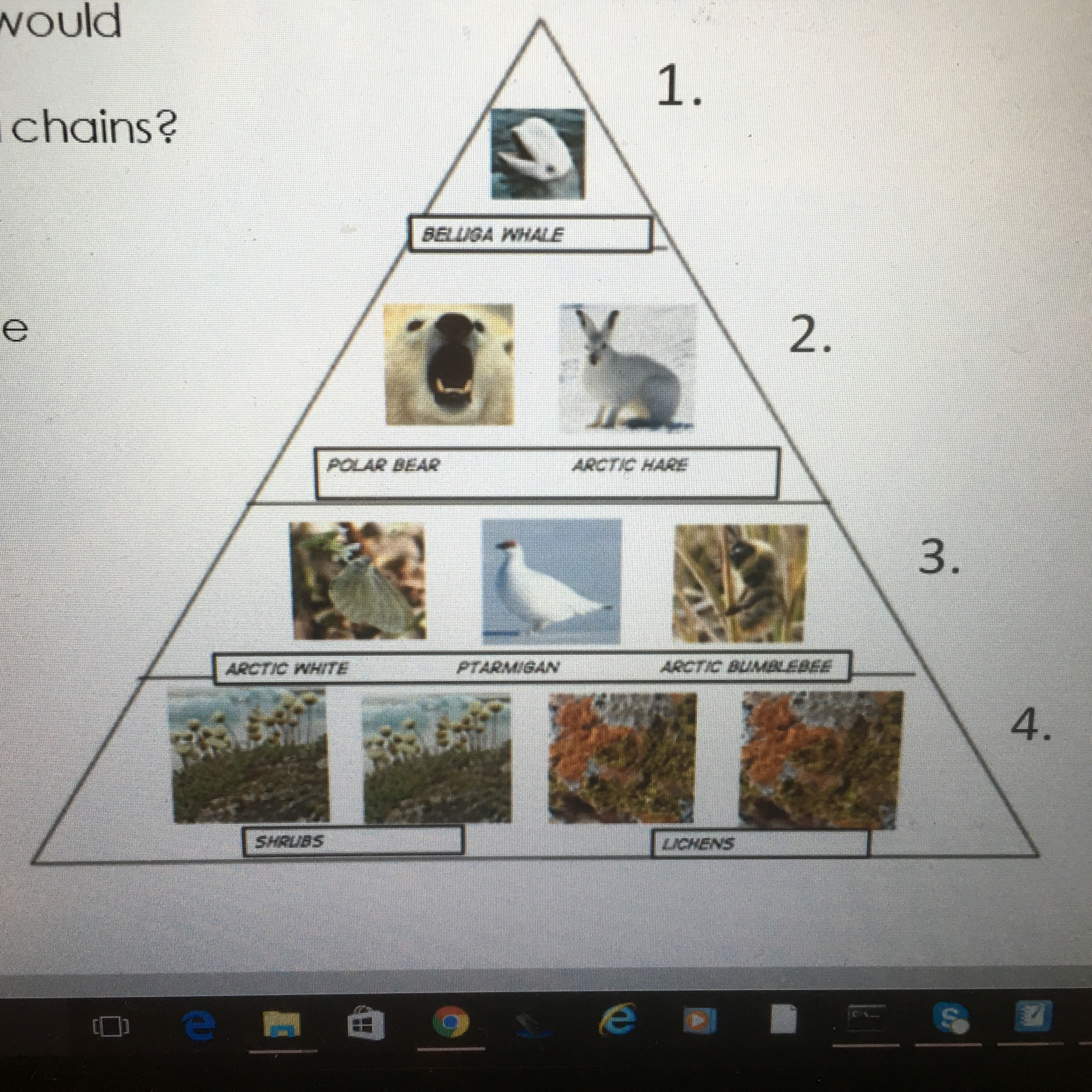
Which trophic level is the Primary consumer?
a)
1
b)
2
c)
3
d)
4
33.
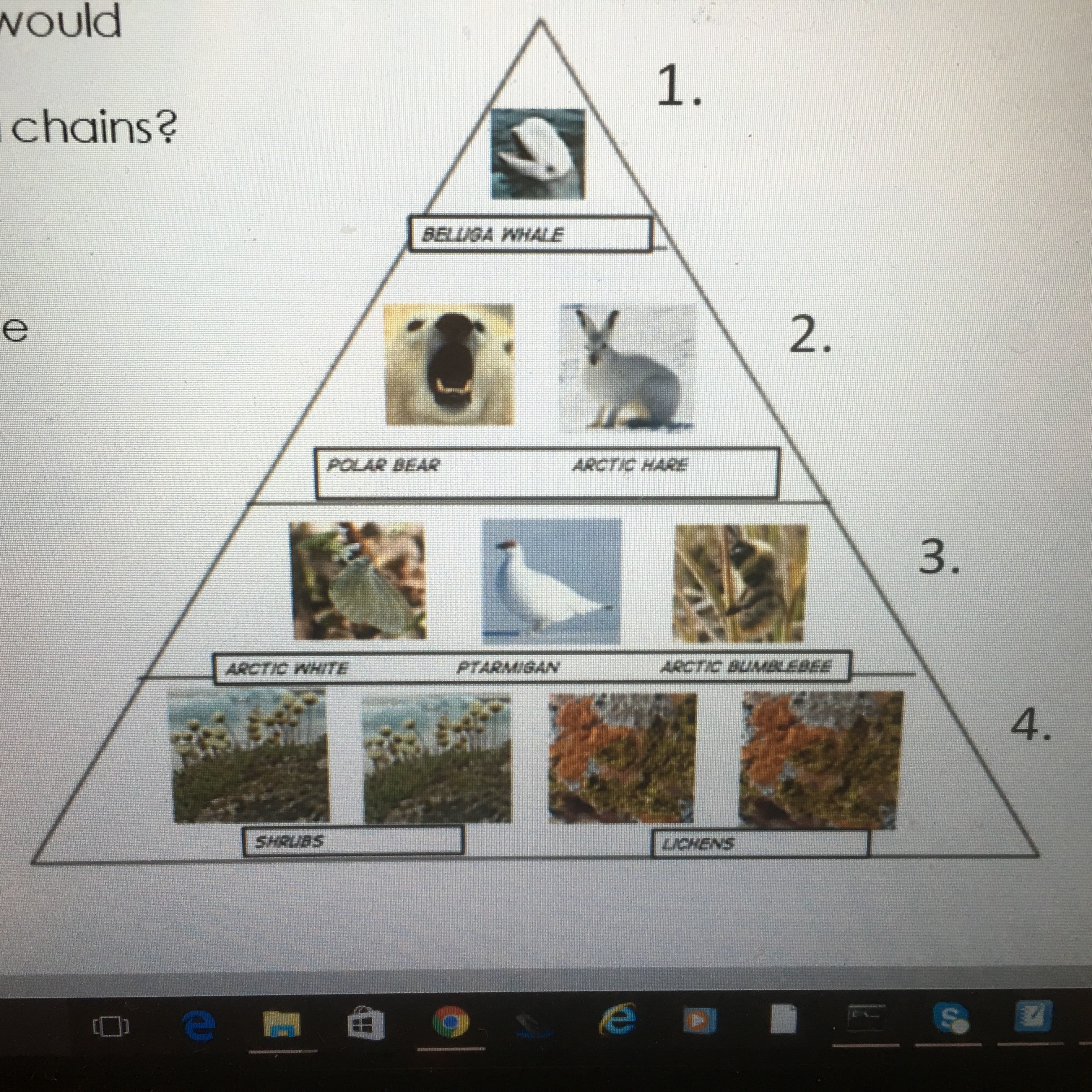
Level 1 is called the _____________ trophic level.
a)
Tertiary consumer
b)
Tertiary producer
c)
Primary consumer
d)
Primary producer
34.
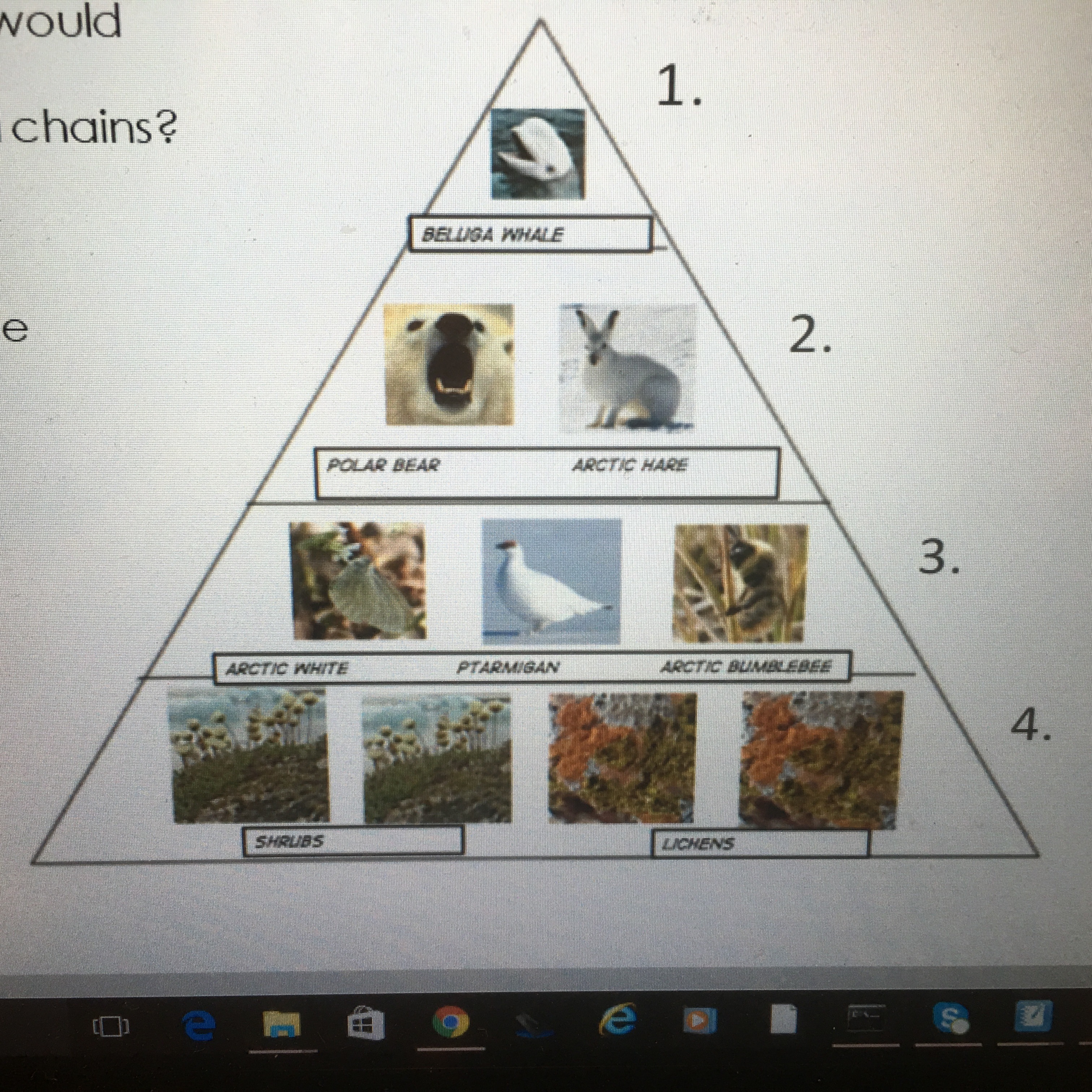
Which trophic level has the greatest amount of energy to use?
a)
Producers
b)
Primary consumers
c)
Secondary consumers
d)
Tertiary consumers
35.
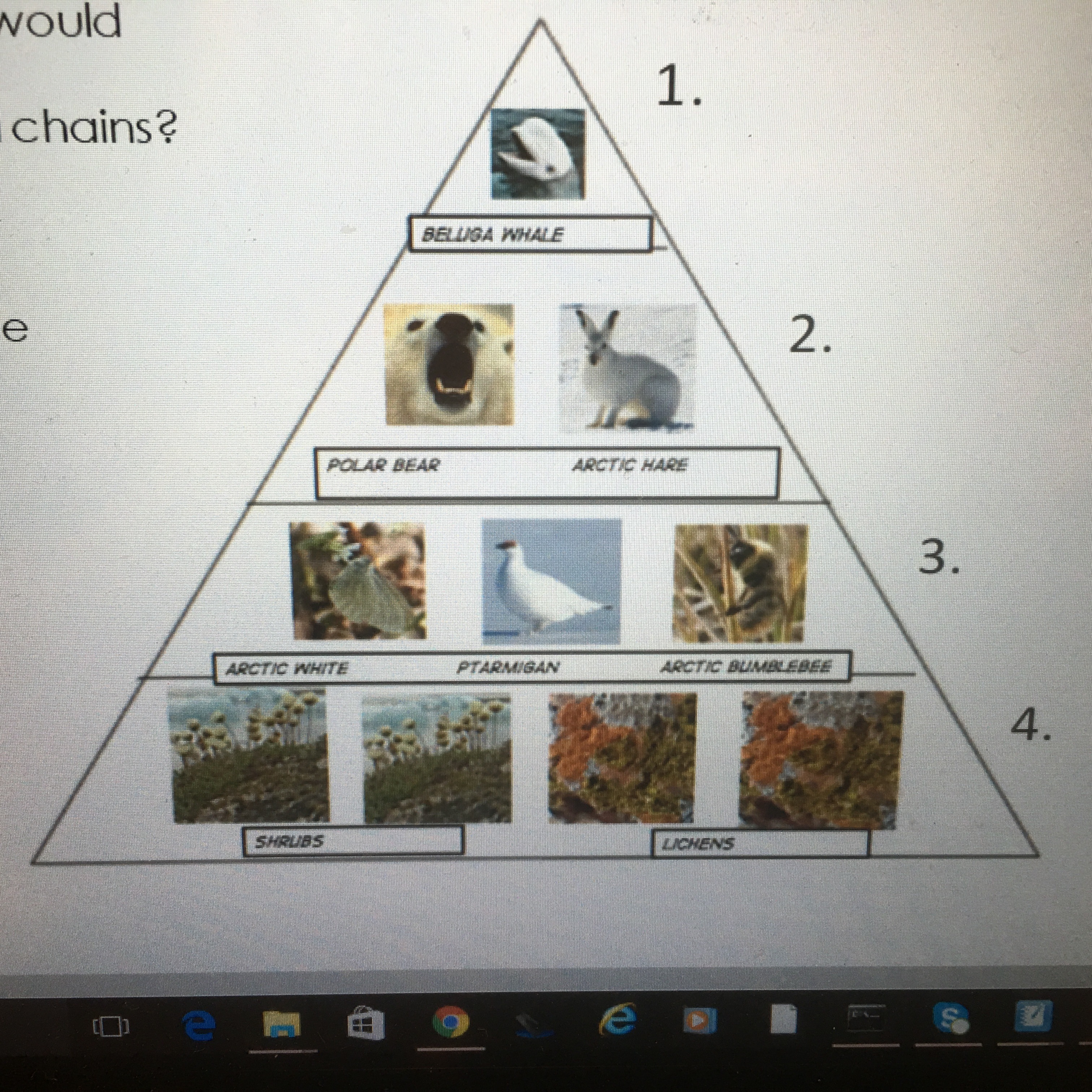
If the original amount of energy in an energy pyramid is 10,000 J what amount is left for the apex predators?
a)
10 J
b)
1 J
c)
100 J
d)
1000 J
36.

How much energy is lost when organisms consume another organism from a different level?
a)
90%
b)
20%
c)
50%
d)
10%
37.

Makes its own food
a)
autotroph
b)
heterotroph
c)
herbivore
d)
biomass
38.

Process through which plants make their own food
a)
autotroph
b)
producer
c)
photosynthesis
d)
biomass
39.
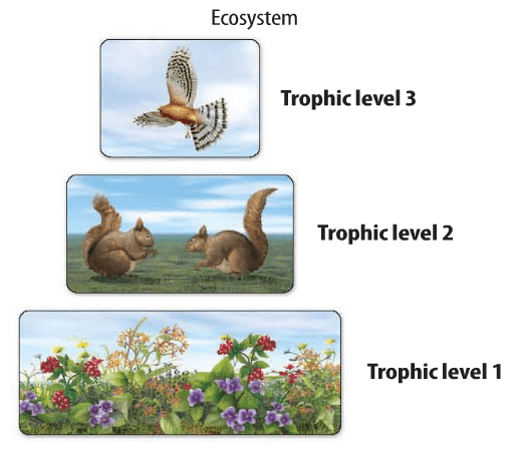
Position that an organism occupies based on what it eats
a)
biomass
b)
autotroph
c)
trophic level
d)
carnivore
40.

Eats dead organisms and returns nutrients to soil
a)
decomposer
b)
carnivore
c)
autotroph
d)
heterotroph
41.

Cannot make its own food
a)
heterotroph
b)
autotroph
c)
producer
d)
decomposer
42.

Get their energy from the sun and make their own food.
a)
Producer
b)
consumer
c)
decomposer
d)
photosyntheis
43.

Only eats meat
a)
omnivore
b)
herbivore
c)
carnivore
d)
primary consumer
44.

Only eats plants
a)
omnivore
b)
carnivore
c)
herbivore
d)
tertiary consumer
45.
What might happen if you remove a primary consumer from the ecosystem?
a)
There would be more food for secondary consumers.
b)
The number of primary consumers would increase.
c)
The number of plants would increase.
d)
The number of secondary consumers would increase.
46.

How many primary consumers are there in this food web?
a)
1
b)
2
c)
3
d)
4
47.

What is the difference between biotic and abiotic?
a)
Biotic are non-living things
b)
Abiotic are living organisms
c)
Biotic is life,
Abiotic is non-living
Abiotic is non-living
d)
Biotic is non-living, Abiotic is living
48.

What does biodiversity mean?
a)
Only one species in an area.
b)
The different amount of species in an area
c)
All abiotic life
d)
Nitrogen fixation
49.
Which option is abiotic?
a)
Plants
b)
Rocks
c)
Animals
d)
Fungi
50.
Which option is abiotic?
a)
Plants
b)
Bacteria
c)
Water
d)
Fungi
51.

What do biologist call an ecosystem that has reached its maximum potential?
a)
Rainforest
b)
Environment
c)
Climax Community
d)
Biome
52.

Which biome is more likely to survive a change in the environment?
a)
High (rich) biodiversity
b)
Low (poor) biodiversity
53.
Which of the following situations contributes to stability in an ecosystem?
a)
increase in biodiversity
b)
decrease in biodiversity
c)
extinction of a population from the ecosystem
d)
removal of many populations of organisms
54.
What are three things that create biodiversity?
a)
species, genetic variation, and ecosystem
b)
mutation, disorder, regression
c)
genes, cells, traits
d)
water, land, mountains
55.

What type of succession is shown going from figure A to figure B?
a)
primary succession
b)
eutrophication
c)
secondary succession
d)
intermediate
56.
Starts with BARE ROCK followed by lichen
a)
primary succession
b)
secondary succession
c)
both types of succession
57.
Invasive species alter the ecosystem by a___________in number quickly,this leads to _____ food for the native species.
a)
increasing less
b)
decline decreasing
58.
Invasive species grow quickly due to the lack of predators, this leads to a decline or extinction of the native population. True or false?
a)
false
b)
true
59.
1. What makes a species invasive?
a)
Moving to a new ecosystem and taking resources from natives
b)
Not having papers
c)
Species that can't adapt
d)
Plants that take up too much space
60.
What is the main cause for species invading?
a)
Air Pollution
b)
Wanting to be adventerous
c)
Human Means
d)
Themselves
61.
Invasive species help the food web by adding extra carnivores?
a)
True
b)
False
62.
Exotic or invasive species leads to all of these problems except
a)
increased biodiversity
b)
loss of biodiversity
c)
disease
d)
loss of native species
100 %

