wayground logo

Free Printable Worksheets

Font size

S
M
L
XL
Worksheets

Simple Organisms

Total questions: 57

Worksheet time: 5hrs 45mins

Name
Class
Date
1.

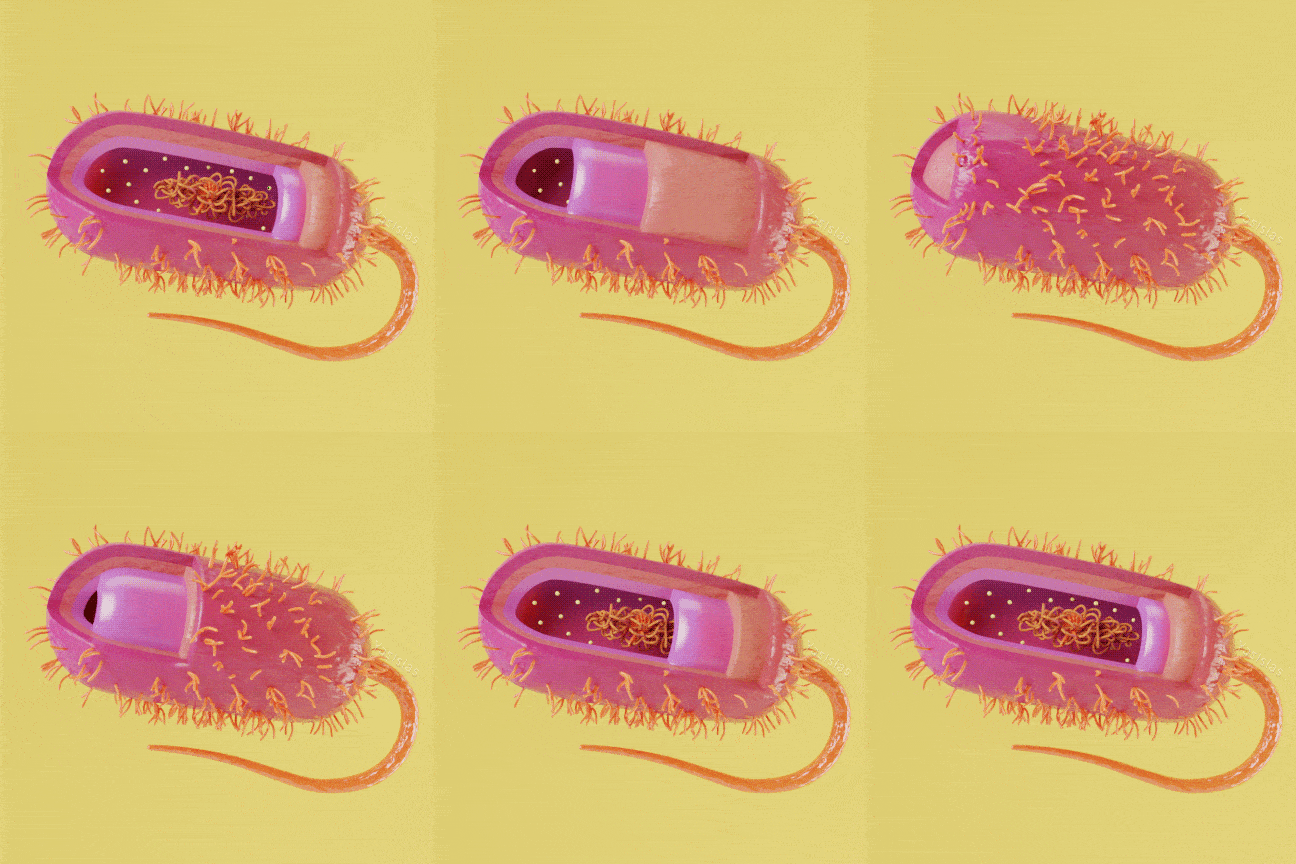
Which organisms is a prokaryote?

a)
b)
c)
d)
2.

Plasmodium is a protist that causes...

a)

Hiker's Disease

b)

Typhoid Fever

c)

Bubonic Plague

d)

Malaria

3.

This protist is using pseudopods

a)
b)
c)
4.

Some organisms can create my own light. It is called...

a)

Euglenoid

b)

Plasmodium

c)

Bioluminescence

d)

Photoluminescence

5.

Animal-like protists are called

a)

Jerks

b)

Protozoans

c)

Autotrophs

d)

Mildew

6.

True or False: Fungi are heterotrophic

a)

True

b)

False

7.

This fungi helps make bread rise by releasing carbon dioxide.

a)

Helicobacter Pylori

b)

Yeast

c)

Club Fungi

d)

Mold

8.

True or False: The shape of this bacteria is coccus.

a)

True

b)

False

9.

Fungi help make all of the following except...

a)

Bread

b)

Yogurt

c)

Mushroom Souffles

d)

Penicillin

10.

When conditions become bad, some bacteria are able to form...

a)

Pods

b)

Flagella

c)

Endospores

d)

Gangs

11.

Fungi can be beneficial to humans in all of the following ways except...

a)

Decomposing dead material

b)

Helping plant crops grow

c)

Fighting Disease

d)

Using in Food

12.

Hairlike extensions of the cell are called

a)

cilia

b)

pseudopods

c)

flagella

d)

tiny legs

13.
What part of a fungus is described as long, thread-like structures that absorb nutrients?
a)
roots
b)
fruit body
c)
hyphae
d)
spores
14.
What part of a fungus is used for reproduction?
a)
spores
b)
flagellum
c)
cilia
d)
hyphae
15.

Any method of reproducing that creates offspring identical to the single parent.

a)

asexual

b)

budding

c)

sexual

d)

sporogenesis

16.
Name this protist?
a)
Euglena 
b)
Amoeba 
c)
Paramecium 
d)
Volvox
17.

How does this protist move?

a)

Pseudopods

b)

Cilia

c)

Flagellum

d)

Tiny Feet

18.
The whiplike tail on some bacteria that help them move
a)
Nucleoid
b)
Pili
c)
Flagella
d)
Cilia
19.
Which statement about bacteria is true?
a)
All bacteria are prokaryotes
b)
All bacteria are eukaryotes
c)
All bacteria are autotrophs
d)
All bacteria are heterotrophs
20.
Bacteria come in all of the following shapes EXCEPT which?
a)
spiral
b)
rod-like
c)
rectangular
d)
spherical
21.

Which statement about bacteria is true?

a)

Bacteria help you breath

b)

Bacteria are needed to help you digest your food

c)

Bacteria help add carbon dioxide to the atmosphere

d)

All bacteria need sunlight to make food

22.

How does pasteurization make food safe to eat?

a)

It changes dangerous chemicals in the food into safer chemicals

b)

It encourages the growth of important gut-bacteria

c)

It heats the food enough to kill bacteria

d)

It causes milk to sour and turn into butter

23.
Bacteria have a cell membrane
a)
True
b)
False
c)
Some do, some don't
d)
Only in certain temperature conditions
24.

Bacteria that help break down dead material in the environment are called

a)

vaccines

b)

decomposers

c)

oats

d)

autotrophs

25.

All bacteria are

a)

unicellular

b)

multicellular

c)

eukaryotic

d)

dangerous

26.

Antibiotics only work against what organisms ?

a)

viruses

b)

bacteria

c)

prions

27.

Influenza (the flu) is caused by a ___________________.

a)

virus

b)

bacteria

c)

prion

28.

Viruses are considered non-living because they...?

a)

are a complete cell

b)

use energy to grow

c)

are smaller than bacteria

d)

do not show all the characteristics of life

29.

When learning about viruses, a host is described as...?

a)

Organism that lives on the cell and causes it harm

b)

Something that causes harm to the cell

c)

The virus' best friend

d)

Cell that the virus invades and takes over

30.
What is the first step of the virus reproduction cycle?
a)
The viruses genetic material (DNA) starts to take over the functions of the cell
b)
The host cell bursts open, releasing the new viruses
c)
The virus injects its genetic material into the cell
d)
A virus attaches to the surface of a host cell
31.
What is the last step in the viral reproduction cycle?
a)
A virus attaches to the surface of a host cell
b)
The proteins and genetic material start to assemble in the cell
c)
The host cell bursts open, releasing the new viruses
d)
The virus injects its genetic material into the cell
32.
Most bacteria are surrounded by a strong structure that acts like a shield for the virus called the…?
a)
Cell Wall
b)
Cell Membrane
c)
Protein Coat
33.

What is the main function of the projections on the surface of a virus?

a)

They aid in respiration

b)

They help the virus grow

c)

They help the virus invade its host by attaching to specific protein sites on the host

d)

They help the virus digest food molecules

34.
What are pathogens?
a)
FDA
b)
MRSA
c)
Ebola
d)
Disease causing agents (germs)
35.
Which of the following is NOT a possible part of a virus?
a)
 Capsid
b)
   DNA
c)
 Nucleus
d)
RNA
36.
What do viruses have in common with living cells? They both...
a)
store genetic information
b)
have chloroplasts
c)
use glucose for cellular respiration
d)
have endoplasmic reticulum
37.
A(n) _____ is a virus that enters a bacterial cell.
a)
endospore
b)
decomposer
c)
plasmid
d)
bacteriophage
38.
Why do doctors suggest people get a flu vaccine every year?
a)
Flu viruses replicate more rapidly over time
b)
Flu viruses can mutate from year to year
c)
Vaccines are absorbed by the body after a year
d)
Vaccines get stronger over time
39.
Which type of protist is shown in the picture?
a)
euglena
b)
paramecium
c)
amoeba
d)
prokaryotic
40.

Which of the following is true about ALL organisms in the protist kingdom?

a)

They are multicellular

b)

They live in moist environments

c)

They move using cilia

d)

They move using flagella

41.
Which protist has an eyespot?
a)
Amoeba
b)
Volvox
c)
Euglena 
d)
Paramecium 
42.
Fine hairs that allow protist to move is called what? 
a)
Pseudopods 
b)
Euglena 
c)
Flagella 
d)
Cilia 
43.
Which protists are autotrophic? 
a)
Euglena and Volvox
b)
Amoeba and Euglena 
c)
Volvox and Amoeba 
d)
Paramecium Only 
44.
Many protists, particularly flagellates, use a _________ to regulate how much water they have in their cell.
a)
contractile vacuole
b)
food vacuole
c)
gullet
d)
mitochondria
45.
What organism uses the pseudopod for both movement and capturing its food?
a)
amoeba
b)
paramecium
c)
volvox
d)
pretzel mold
46.

Like animals, animal-like protists are

a)

autotrophs

b)

unicellular

c)

heterotrophs

47.

How are fungus-like protists similar to fungi?

a)

They do not have cell walls.

b)

They are unable to move.

c)

Most use spores to reproduce.

48.

Slime molds are one type of?

a)

Animal-like protist

b)

Fungus-like protist

c)

Plant-like protist

49.
Which is an example of a disease caused by fungi
a)
Diphtheria
b)
The Common Cold
c)
Strep Throat
d)
Athlete's Foot
50.
What do fungi use to reproduce?
a)
Hyphae
b)
Branches
c)
Spores
d)
They split apart
51.

Which of the following are examples of fungi? (Choose ALL correct answers)

a)

bread mold

b)

pollen

c)

yeast

d)

mushrooms

52.
Fungi were originally classified as plants but later they were classified separately.  Which of the following characteristics of fungi separates them from plants?
a)
They reproduce asexually.
b)
They are able to grow in dry conditions.
c)
They are unable to make their own food.
d)
They can move from one place to another.
53.

Fungi break down dead organisms, or waste products of living organisms, returning nutrients to the soil. We call this kind of organism a(n).....?

a)

consumer

b)

producer

c)

autotroph

d)

decomposer

54.
An antibiotic made from a species of thread-like fungus.
a)
lichen
b)
mold
c)
penicillin
d)
asprin
55.

What characteristic do all algae share?

a)

They are autotrophs.

b)

They are unicellular.

c)

They are multicellular.

d)

They live in colonies.

56.

Which virus is named for the organism it infects?

a)

influenza virus

b)

smallpox virus

c)

bacteriophage

d)

West Nile virus

57.

What characteristic of viruses makes them useful in gene therapy?

a)

their ability to enter cells

b)

their ability to remain inactive for a long time

c)

their inability to multiply in cells

d)

their inability to take over the functions of host cells