wayground logo

Free Printable Worksheets

Font size

S
M
L
XL
Worksheets

Year 10 Genetics revision

Total questions: 140

Worksheet time: 3hrs 14mins
Name
Class
Date
1.
Which of the following best describes a DNA molecule?
a)
double helix
b)
contains ribose
c)
made of amino acids
d)
contains Uracil
2.
Which of the following units are repeatedly joined together to form a strand of DNA?
a)
amino acids
b)
nucleotides
c)
fatty acids
d)
polysaccharides
3.
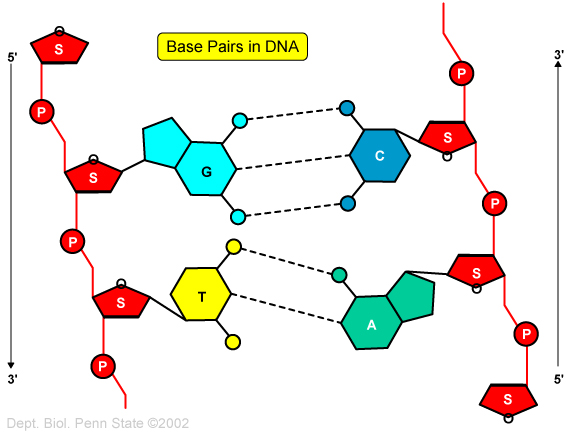
In a molecule of double-stranded DNA, the amount of Adenine present is always equal to the amount of
a)
cytosine
b)
guanine
c)
thymine
d)
uracil
4.
Guanine bonds with ______________.
a)
Adenine
b)
Guanine
c)
Cytosine
d)
Thymine
5.
Why is DNA important?
a)
it is very small and very complicated
b)
it's in everything
c)
it serves as the blueprint for traits of all living things
d)
because we eat it every day for energy
6.
What determines the code, or information, of a DNA molecule?
a)
the shape (structure) of the nitrogen bases
b)
the order (sequence) of the nitrogen bases
c)
the color of the nitrogen bases
d)
the frequency (number) of nitrogen bases
7.
Which 2 molecules form the sides (backbone) of the DNA ladder?
a)
deoxyribose sugar and adenine
b)
deoxyribose sugar and a hydrogen bond
c)
deoxyribose sugar and the nucleus
d)
deoxyribose sugar and phosphate
8.
Which organelle is DNA usually found in?
a)
cell membrane
b)
vacuole
c)
chloroplast
d)
nucleus
9.
Nitrogenous bases are joined by which type of bond?
a)
polar bonds
b)
ionic bonds
c)
covalent bonds
d)
hydrogen bonds
10.
Replicate the following strand of DNA: 
AATCATGGA
a)
AATCATGGA
b)
TTAGTACCT
c)
UUAGUACCU
d)
GGATAUCUA
11.
What are the three components of a nucleotide?
a)
sugar, hydrogen, nitrogen base
b)
sugar, oxygen, nitrogen base
c)
sugar, phosphate, nitrogen base
d)
sugar, phosphate, protein
12.
The yellow part of this picture is DNA. What do you think the turquoise part around it is?
a)
chromosome
b)
gene
c)
DNA
d)
ACTG
13.
Which sentence is FALSE?
a)
Humans have 23 pairs of DNA.
b)
Humans have 46 total chromosomes.
c)
Genes are made of chromosomes.
d)
Every human's DNA is at least 99% similar.
14.
Which of the following does NOT describe this picture?
a)
humans' 46 chromosomes
b)
one gene
c)
the human genome
d)
humans' 23 pairs of chromosomes
15.
The part of a chromosome that carries information for a certain trait is called a 
a)
protein
b)
gene 
c)
nucleus
d)
gametes
16.
How many pairs of chromosomes do humans have?
a)
10
b)
23
c)
11
d)
15
17.
An organism's appearance or other detectable characteristic
a)
genotype
b)
phenotype
c)
allele
d)
genetic variation
18.
Process that produces cells with half the usual number of chromosomes
a)
mitosis
b)
meiosis
c)
mitochondria
d)
heredity
19.
How many chromosomes does offspring receive from a human father?
a)
46
b)
23
c)
12
d)
none of the above
20.
One of the alternative forms of a gene that governs a characteristic.
a)
Allele
b)
genetic variation
c)
genotype
d)
characteristic
21.
P=purple flower color
p=white flower color, if a flower has a genotype Pp its phenotype would be
a)
white
b)
purple
c)
violet
d)
pink
22.
A normal human has ___ pairs of autosomes and ___ pair(s) of sex chromosomes.
a)
23,1
b)
22,1
c)
1, 22
d)
1, 23
23.
In humans, chromosome # ___ is the largest.
a)
1
b)
10
c)
22
d)
23
24.
____ are chromosomes that contain genes for characteristics unrelated to sex.
a)
autosomes
b)
microsomes
c)
cosmos
d)
inheritance 
25.
Genes that are critical to life are found on the Y chromosome.
a)
True
b)
False
26.
Females have ____ and males have _____ chromosomes.
a)
XX, XY
b)
XY, XX
c)
XX, XX
d)
XY, XY
27.
A person with extra 21st chromosome exhibits what genetic disorder?
a)
hemophilia
b)
heterogeneity 
c)
down syndrome
d)
dwarfism
28.
Which of the following is heterozygous
a)
FF
b)
tt
c)
Gg
d)
RR
29.
Which of the following is homozygous recessive?
a)
rr
b)
AA
c)
TT
d)
Ff
30.
What does the prefix homo- in homozygous mean?
a)
same
b)
different
c)
dating
d)
humans
31.
What does the prefix hetero- in heterozygous mean?
a)
same
b)
different
c)
dating
d)
human
32.
Which of the following is heterozygous
a)
Ww
b)
ii
c)
DD
d)
kk
33.
Which of the following is homozygous dominant?
a)
Jj
b)
Rr
c)
MM
d)
ee
34.
The physical appearance of a trait is known as the-
a)
genotype
b)
phenotype
c)
characteristics
d)
intelligence
35.
How many letters does a genotype contain?
a)
1
b)
2
c)
3
d)
4
36.
Mark is heterozygous. If B is for brown hair, and b is for blonde hair, what is Mark's phenotype?
a)
Brown Hair
b)
Blonde Hair
c)
Brown and Blonde Hair
d)
Black Hair
37.
Mark is heterozygous. If B is for brown hair, and b is for blonde hair, what is Mark's genotype?
a)
BB
b)
bb
c)
Bb
d)
bB
38.
Mary is heterozygous. If F for freckles, and f is for no freckles, what is Mary's phenotype?
a)
Freckles
b)
No Freckles
c)
A few Freckles
d)
One Freckle
39.
Mary is heterozygous. If F for freckles, and f is for no freckles, what is Mary's genotype?
a)
FF
b)
Ff
c)
ff
d)
fF
40.
Chris is homozygous dominant. If W for widow's peak, and w is for no widow's peak, what is Chris' phenotype?
a)
Widow's Peak
b)
No Widow's Peak
c)
A small Widow's Peak
d)
Not enough information
41.
Chris is homozygous dominant. If W for widow's peak, and w is for no widow's peak, what is Chris' genotype?
a)
WW
b)
ww
c)
Ww
d)
wW
42.
Hh
a)
Homozygous Dominant
b)
Homozygous Recessive
c)
Heterozygous
d)
Heterozygous Dominant
43.
TT
a)
Homozygous Dominant
b)
Homozygous Recessive
c)
Heterozygous
d)
Heterozygous Dominant
44.
rr
a)
Homozygous Dominant
b)
Homozygous Recessive
c)
Heterozygous
d)
Heterozygous Recessive
45.
Which of the following is heterozygous
a)
Dd
b)
dD
c)
DD
d)
dd
46.
Which of the following is homozygous dominant?
a)
Rr
b)
Hh
c)
ii
d)
DD
47.
Fruit fly body cells have 8 chromosomes. After mitosis, you would expect a resulting fruit fly daughter cell to have ...
a)
16 chromosomes.
b)
46 chromosomes.
c)
8 chromosomes.
d)
4 chromosomes.
48.
Structure (b) is a ____.
a)
chromosome
b)
chromatid
c)
centromere
49.
Structure (a) is a ____.
a)
chromosome
b)
chromatid
c)
centromere
50.
Structure (c) is a ____.
a)
chromosome
b)
chromatid
c)
centromere
51.
Name the phase:
a)
Anaphase
b)
Telophase
c)
Metaphase
d)
Prophase
52.
What is the next phase of mitosis?
a)
Prophase
b)
Metaphase
c)
Anaphase
d)
Telophase
53.
What is the next phase of mitosis?
a)
Prophase
b)
Metaphase
c)
Anaphase
d)
Telophase
54.
Name the previous phase.
a)
Prophase
b)
Metaphase
c)
Anaphase
d)
Telophase
55.
Name the previous phase.
a)
Prophase
b)
Metaphase
c)
Anaphase
d)
Telophase
56.
Name the previous phase.
a)
Prophase
b)
Metaphase
c)
Anaphase
d)
Telophase
57.
Name the phase:
a)
Prophase
b)
Metaphase
c)
Anaphase
d)
Telophase
58.
Name the phase:
a)
Prophase
b)
Metaphase
c)
Anaphase
d)
Telophase
59.
Name the phase:
a)
Prophase
b)
Metaphase
c)
Anaphase
d)
Telophase
60.
The stages of mitosis in order
a)
Metaphase, Anaphase, Prophase, Telophase
b)
Prophase, Anaphase, Metaphase, Telophase
c)
Prophase, Metaphase, Anaphase, Telophase
d)
Anaphase, Prophase, Telophase, Metaphase
61.
The cells produced via meiosis are called:
a)
sex cells
b)
somatic cells
c)
body cells
d)
skin cells
62.
A human usually has xx amount of chromosomes.
a)
6
b)
22
c)
4
d)
46
63.
What is it called when a sperm and egg meet?
a)
meiosis
b)
fertilization
c)
cell division
d)
mitosis
64.
Meiosis makes sperm and egg cells. In humans, sperm and egg cells each have _____ chromosomes. Therefore a fertilized human egg cell (sperm and egg cell combined) would create a cell with _____ chromosomes.
a)
23, 46
b)
46, 23
c)
2, 4
d)
50, 100
65.
Unlike mitosis, meiosis in male mammals results in the formation of
a)
one haploid gamete
b)
three diploid gametes
c)
four diploid gametes
d)
four haploid gametes
66.
When an area of a chromatid is exchanged with the matching area on a chromatid of its homologous chromosome, _________________ occurs
a)
crossing over
b)
mutagenesis
c)
hybridization
d)
fertilization
67.
If the Diploid number of Carrots is 18, the haploid number is
a)
18
b)
9
c)
27
d)
36
68.
Goes through P.M.A.T two rounds 
a)
Mitosis
b)
Meiosis
c)
Osmosis
d)
Transcription
69.
Which process and type of resulting cells are represented?
a)
mitosis, gametes
b)
mitosis, body cells
c)
meiosis, gametes
d)
meiosis, body cells
70.
If a somatic cell in a butterfly contains 24 chromosomes, a butterfly egg would contain
a)
3
b)
6
c)
12
d)
24
71.
The process of crossing over occurs in what phase of meiosis?
a)
anaphase 1
b)
prophase 1
c)
prophase 2
d)
telophase 1
72.
Which of these cells would be produced through meiosis?
a)
skin cells
b)
liver cells
c)
brain cells
d)
sperm cells
73.
The chromosomes that pair up during meiosis, are called __________ chromosomes.  
a)
homozygous 
b)
asexual
c)
homologous
d)
genes
74.
Crossing over helps promote 
a)
male genotype
b)
genetic variation
c)
DNA replication
d)
mitosis
75.
What is another reason we need meiosis?
a)
So the offspring has genes from both parents
b)
So the offspring has genes from one parent
c)
So the offspring has genes from neither parents
d)
So the offspring makes its own genes
76.

Describe how the chromosomes in sex cells differ from those in body cells?

a)

Body cells have half the number of chromosomes the parent has. Sex cells have the same number of chromosomes the parent cell has.

b)

Sex cells have the same number of chromosomes the parent has. Body cells have half the number of chromosomes the parent cell has.

c)

Body cells have the same number of chromosomes the parent has. Sex cells have half the number of chromosomes the parent cell has.

d)

Body cells and sex cells both have the exact same number of chromosomes.

77.

Which of the following is a difference between mitosis and meiosis?

a)

in mitosis 4 daughter cells are produced, whereas in meiosis two daughter cells are produced

b)

in mitosis 2 daughter cells are produced, whereas in meiosis 4 daughter cells are produced

c)

cells produced by mitosis are diploid, cells produced by meiosis are haploid

78.

Which of the following is the most significant difference between mitosis and meiosis?

a)

chromosomes are duplicated before mitosis

b)

Meiosis is not followed by cytokinesis

c)

homologous pairs of chromosomes are split up in meiosis

d)

crossing over occurs in mitosis

79.
What makes this individual's karyotype not normal?
a)
An extra sex chromosome
b)
An extra autosome
c)
A missing sex chromosome
d)
A missing autosome
80.
Determine the sex of the individual whose karyotype is displayed in the image.
a)
female
b)
male
81.
Is this Karyotype human?
a)
Yes
b)
No
c)
Impossible to Determine
82.
What mutation has occurred here? 
T-G-A-C-C-A
T-G-A-G-C-A
a)
Substitution
b)
Deletion
c)
Insertion
d)
Frameshift 
83.
Are all mutations bad?
a)
Yes
b)
No
84.
Any change in the sequence of DNA is...
a)
transgenic shift
b)
Single Genotype
c)
Monohybrid Trait
d)
Mutation
85.
DNA molecule segment is : TTACGCAAG
The mutated DNA segment is TTACGCAAC. This is an example of ___ mutation.
a)
Substitution
b)
Insertion
c)
Inversion
d)
Translocation
86.
What is a codon?
a)
It is a three letter section of bases that are read by ribosomes to stamp amino acids into a protein
b)
They are the codes on the DNA (hence "code-on"
c)
It is a type of mutation that occurs when there has been a substitution, deletion or insertion.
d)
It is a made up word for this quiz. Nice try, Wampler.
87.
What are the building blocks of proteins called?
a)
DNA
b)
RNA
c)
Ribosomes
d)
Amino Acids
88.
Why are insertion and deletion (frameshift) mutations so harmful?
a)
They change all of the codons from the mutation on down the line, which changes the amino acid sequence
b)
They insert things that an organism doesn't need.
c)
They often delete things that organisms need.
d)
Insertion and deletions are not any more harmful than substitution mutations.
89.
ATTTGAGCC- Original
ATTGAGCC - Mutated
The example above is an example of a 
a)
Insertion- Frameshift
b)
Deletion- Substitution
c)
Deletion -Frameshift
d)
All of the above
90.
DNA molecule segment is : TTACGCAAG
The mutated DNA segment is TTCGCAAG. This is an example of ___ mutation.
a)
Substitution
b)
Deletion
c)
Insertion
d)
Inversion
91.
Would a mutation in the DNA of a skin cell be passed on to an organism's offspring?
a)
Yes, because any change to the DNA is passed on to the offspring
b)
Maybe. Sex cells only use half of the body's genetic code. It might get the copy of a gene that wasn't mutated.
c)
No. Only mutations that occur in the gametes (sex cells) are passed on to the offspring
d)
Without knowing the animal, it would be hard to tell whether or not the mutation would be passed on.
92.
Which of these bases does not exist in RNA?
a)
C
b)
T
c)
U
d)
A
93.
Which RNA bases would pair with TACGAA in transcription
a)
AUGCUU
b)
ATGCTT
c)
GCATCC
d)
GCAUCC
94.
Using the codon chart here or at your table to identify the amino acid sequence:
AUG-CCA-GUA-GGG-UAA
a)
MET-HIS-ALA-GLY-STOP
b)
MET-PRO-GLY-VAL-STOP
c)
MET-PRO-VAL-GLY-STOP
d)
MET-THR-SER-ASP-STOP
95.
Which amino acid is made from the RNA codon ACC?
a)
Tyrosine
b)
Isoleucine
c)
Threonine
d)
Valine
96.

In what process is mRNA synthesized?

a)

Transcription

b)

Translation

c)

DNA Replication

d)

Mitosis

97.

Where does TRANSCRIPTION occur?

a)

Nucleus

b)

Ribosome

c)

Cytoplasm

d)

Mitochondria

98.

Why must transcription occur where DNA can be found?

a)

because DNA can't leave

b)

because ribosomes are in the nucleus

c)

because DNA polymerase is found there

d)

because helicase unzips the DNA

99.

How many codons equals 1 amino acid?

a)

1

b)

2

c)

3

d)

4

100.

On which molecule can an anticodon be found?

a)

mRNA

b)

DNA

c)

tRNA

d)

rRNA

101.

Which of the following is a codon?

a)
b)

ATG

c)

AUG

d)

AUT

102.

Where is the anticodon located?

a)

at the top of the molecule it's found on

b)

at the bottom of the molecule it's found on

c)

on the right of the molecule it's found on

d)

on the left of the molecule it's found on

103.

What is the purpose for anti-codons?

a)

to ensure the correct amino acid is dropped off

b)

to match the strand of DNA

c)

to decode a sequence of 4 nucleotides into an amino acid

d)

to make me hate biology

104.

Which two thing are found on a molecule of tRNA?

a)

amino acids; anticodons

b)

amino acids; codons

c)

ribose sugar; proteins

d)

deoxyribose sugar; codons

105.

TRANSCRIBE this DNA sequence: TACGTTACT

a)

AUGCAAUGA

b)

ATGCAATGA

c)

AUGGATUGA

d)

TACGTTACT

106.

TRANSLATE this RNA sequence: AUGCAAUGA

a)

Met-Glu-Stop

b)

Met-His-Stop

c)

Thr-Glu-Stop

d)

Thr-Pro-Stop

107.
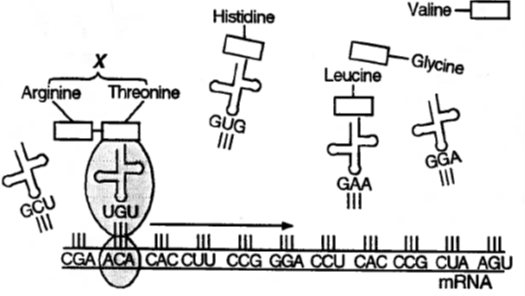
What process is going on in this photo? 
a)
Transcription 
b)
Translation 
c)
Replication 
d)
All the above 
108.
Does the order of amino acids in a protein matter?
a)
YES!
b)
NO!
109.
Which organelle belongs in plant cells only?
a)
Cell Membrane
b)
Mitochondrion
c)
Chloroplast
d)
Nucleus
110.
Which organelle belongs in plant cells only?
a)
Cytoplasm
b)
Mitochondrion
c)
Cell Wall
d)
Nucleus
111.
Which organelle belongs in both plant and animal cells?
a)
Chloroplast
b)
Cell Wall
c)
Large Central Vacuole
d)
Cell Membrane
112.
What organelle is called the "powerhouse" of a cell?

a)
Endoplasmic Reticulum
b)
Nucleus
c)
Mitochondria
d)
Nucleolus
113.
A rigid layer that lies outside the cell's  membrane is...
a)
Cytoskeleton
b)
Cilia
c)
Cell Wall
d)
Flagella
114.
What is the difference between a plant and animal cell?
a)
Animal cells are eukaryotic and plant cell are not
b)
Plant cells are eukaryotic and animal cells are not
c)
plant cells have a larger vacuole, chloroplast, and a cell wall
d)
animal cells have a larger vacuole, chloroplast, and a cell wall
115.
Under a microscope, a student observes a specimen containing a cell wall, nucleus, and chloroplasts. Which of the following could the specimen being observed belong to?
a)
oak tree leaf
b)
human
c)
bacteria
d)
cat hair
116.
An animal cell has the following except a/an...
a)
Golgi Body
b)
Nucleus
c)
Cell Wall
d)
Endoplasmic reticulum 
117.
Plant cell lack the following organelle...
a)
Cell Wall
b)
Mitochondria
c)
Chloroplast 
d)
None of the above
118.
Which cell can change it's shape?
a)
Animal
b)
Plant
119.
Four students examined the cells and made the following observations: 
Student 1: Cell 1 is a plant cell because it has a cell wall
Student 2: Cell 2 is an animal cell because it has a nucleus
Student 3: Cell 1 is a plant cell because it has chloroplasts
Student 4: Cell 2 is an animal cell because it has a cell membrane
Who is correct?
a)
Student 1 and Student 2
b)
Student 2 and Student 3
c)
Student 1 and Student 3
d)
Student 2 and Student 4
120.
Testing the membrane encasing the baby for birth defects.
a)
Ultrasound 
b)
Umbilical Cord 
c)
Amniocentesis
d)
Chorionic Villi Sampling 
121.
Testing the amniotic fluid for birth defects.
a)
Chorionic Villi Sampling 
b)
Ultrasound
c)
Amniocentesis
d)
Embryo Test
122.
A test that uses sound waves to create a sonogram.
a)
Amniocentesis 
b)
Ultrasound
c)
Germinal Sampling
d)
Chorionic Villi Sampling 
123.
environmental causes for birth defects include
a)
drugs
b)
nutrition
c)
disease
d)
all of the above
124.
Genetic tests reveal the presence, absence, or malformation of genes or chromosomes
a)
True
b)
False
125.
The parent to be already has children with a genetic disorder. Should parent see a genetic counselor before becoming pregnant again?
a)
Yes
b)
No
126.
Newborns are screened for PKU which is a disorder that requires a special diet in which high protein is cut out. 
a)
True
b)
False
127.
One of the pros of genetic counseling is details for relatives. Testing may give details about the cancer risk for kids, siblings & other family members. 
a)
True
b)
False
128.
One of the cons of genetic counseling may be discrimination. Some people are worried testing may lead them to discrimination by life, health or disability insurers.  
a)
True
b)
False
129.
Which individual in the first generation is a carrier?
a)
The male
b)
The female
c)
individual 1
d)
None of the above
130.
How many generations are shown in this pedigree?
a)
1
b)
2
c)
3
d)
4
131.
How many kids did the mother and father from the first generation have?
a)
2
b)
4
c)
5
d)
6
132.
In a pedigree, what shape represents a male?
a)
circle
b)
square
c)
triangle
d)
diamond
133.
How many children did I-3 and I-4 have?
a)
2
b)
3
c)
4
d)
5
134.
Imagine the shaded individuals are those WITH a "hitchhikers thumb." What must be the genotype of individual II-1?
a)
TT
b)
tt
c)
Tt
d)
Impossible to tell
135.
Is this trait (the shaded individuals) dominant or recessive?
a)
dominant
b)
recessive
136.
What do we use pedigrees for?
a)
To look at families
b)
To make determinations about the offspring
c)
To track traits in families
d)
Nothing
137.
What does a horizontal line between a square and a circle mean?
a)
They are siblings
b)
They are cousins
c)
They are married ("together")
d)
They are the children
138.
What does a vertical line coming down from a square and circle that are connected by horizontal line indicate?
a)
They are cousins
b)
The children
c)
Aunts and Uncles
139.
How many alleles (letters) do each person carry for a trait?
a)
1
b)
2
c)
3
d)
4
140.
How are individuals III-2 and II-4 related?
a)
Cousins
b)
Dad and Daughter
c)
Uncle and Niece
d)
Grandpa and Granddaughter