wayground logo

Free Printable Worksheets

Font size

S
M
L
XL
Worksheets

PreAP Bio Practice Final

Total questions: 143

Worksheet time: 3hrs 12mins

Name
Class
Date
1.

SELECT ALL THAT APPLY: Which of the following is true for evolution?

a)

Evolution is a change in a group of organisms over time

b)

Evolution states that all life on Earth is related.

c)

Evolution states that all life comes from a common ancestor.

d)

Evolution states that organisms must mutate themselves in order to survive.

2.

SELECT ALL THAT APPLY: Which of the following are examples of fossils?

a)

Bones encased in rock materials

b)

Cemented footprints from ancient organisms

c)

Insects encased in amber

d)

Animal droppings that are several days old

3.

Which of the following is a tool used to perform absolute dating on a fossil?

a)

Radiometric dating

b)

Law of superposition

c)

Homologous structures

d)

Embryology

4.

Which of the following is true, based on the image.

a)

The fossils found in layer B are older than those found in layer G.

b)

The fossils found in layer F are older than those found in layer D.

c)

The oldest fossils are those found in layer G.

d)

Layer C is missing fossils because of an earthquake that occurred during its time period.

5.

Identify the image. How does this image provide evidence for evolution?

a)

Homologous structures show that even animals from different species have the same basic structure, suggesting they may share one common ancestor.

b)

Homologous structures show that animals for different species have a variety of different structures, suggesting that each has a different ancestor.

c)

Analogous structures show that bones length plays a vital role in the evolution of various species.

d)

Analogous structures show that the same basic bone structure may be used in a variety of different functions.

6.

The diagram shows the amino acid sequences for a protein--cytocrome c--that is found in several species. Which species is / are most closely related to the human?

a)

Pig

b)

Chicken

c)

Fruit fly

7.

A scientist is studying the evolutionary relationship between two species. He gets DNA and amino acid samples from various organisms of each species and analyzes them. Which type of evolutionary evidence is the scientist using?

a)

Fossil

b)

Anatomical

c)

Biochemical

8.

Jyquez is curious about the evolutionary relationship between a bear and a cow. He examines various stages of their embryological development and tracks their similarities. Which type of evolutionary evidence is he examining?

a)

Fossil

b)

Anatomical

c)

Biochemical

9.

Some people can wiggle their ears, even though it no longer serves a purpose. This is a:

a)

Homologous structure

b)

Vestigial structure

c)

Analogous structure

d)

Weird thing to do on a first date

10.

The legs in the picture are:

a)

Homologous structures

b)

Vestigial structures

c)

Analogous structures

d)

Funny looking

11.

Structures that have the same function but did NOT come from a common ancestor:

a)

homologous structures

b)

analogous structures

c)

vestigial structures

d)

embryos

12.

Structures that come from a common ancestor but may not have the same purpose:

a)

homologous structures

b)

Homo sapiens

c)

analogous structures

d)

vestigial structures

13.

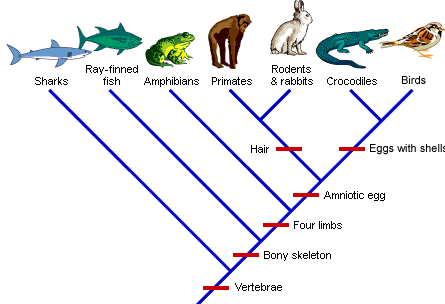
What is this a picture of?

a)

Pedigree

b)

Cladogram

c)

Family Tree

d)

Oak Tree

14.

According to this cladogram, primates are most closely related to....

a)

Amphibians

b)

Rodents & rabbits

c)

Crocodiles

d)

Birds

15.
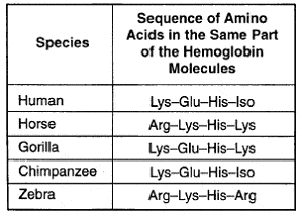
You look at two species and see very similar amino acid sequences. What does this likely tell you?
a)
These are the same animal.
b)
These animals have a common ancestor.
c)
These animals are not likely related.
d)
These animals are likely becoming one species.
16.

What fossil is this?

a)

Archaeopteryx

b)

Coelophysis

c)

Titanis

d)

Velociraptor

17.
Who started the theory of evolution?
a)
Allen Wallace
b)
Charles Darwin
c)
Albert Einstein
18.
Where did Darwin go to study about finches?
a)
Islands of Africa
b)
Coast of South America
c)
Galapagos Islands
19.
Darwin's theory of evolution is supported by his idea on...
a)
natural selection and adaptation
b)
natural living animals like fossils
c)
chickens have the same amount of genes
20.
Genetic variation can arise from a random change in the DNA of a gene.  The change is called a(n)
a)
mutation
b)
gene flow
c)
gene pool
d)
allele
21.
What is the process in which humans breed organisms for certain traits?
a)
natural selection
b)
inheritance
c)
artificial selection
d)
descent without modification
22.
The disappearance of a species.
a)
Evolution
b)
Extinction
c)
Migration
d)
Mutation
23.
A characteristic or feature that increases an organism's ability to survive within a changing environment.
a)
adaptation
b)
hibernation
c)
migration
d)
Natural Selection
24.
Blending in with surroundings
a)
hibernation
b)
Natural Selection
c)
camouflage
d)
variation
25.
A group of similar organisms that can mate with each other and produce fertile offspring.
a)
species
b)
adaptation
c)
hibernation
d)
variation
26.
A biochemical function that makes an organism better suited to its environment.
a)
Physiological adaptation
b)
Behavioral adaptation
c)
Structural adaptation
d)
Natural selection
27.
A physical characteristic that allows an organism to survive in its environment.
a)
species
b)
Physiological adaptation
c)
Behavioral adaptation
d)
Structural adaptation
28.
The process of change over time.
a)
evolution
b)
variation
c)
migration
d)
adaptation
29.
Bahavior that helps an organism to survive and reproduce.
a)
behavorial adaptation
b)
structural adaptation
c)
physiological adaptation
d)
selective breeding
30.
any difference between organisms of the same species
a)
adaptation
b)
camouflage
c)
selective breeding
d)
variation
31.

male elk use their antlers and size to compete with each other for the ability to mate with female elk

a)

directional selection

b)

stabilizing selection

c)

disruptive selection

d)

artificial selection

e)

sexual selection

32.

A population is a group of individuals of the same species. Can the percent of individuals with certain traits in a population change because the environment changes?

a)

Yes, when the environment changes, individuals in a population can change their inherited traits to better fit the environment, and this changes the percent of individuals with certain traits in that population.

b)

Yes, when the environment changes, individuals with certain inherited traits survive and reproduce and other individuals with different inherited traits die, and this changes the percent of individuals with certain traits in a population.

c)

No, the percent of individuals with certain inherited traits in a population changes randomly from one generation to the next, never as a result of changes to the environment.

d)

No, the proportion of individuals with certain inherited traits in a population cannot change because a population is all one species and so will always have the same inherited traits.

33.

According to the theory of natural selection, what would happen to a species of lizards when a new predator is introduced into the environment where the lizards live?


a)

The lizards that already have the physical traits needed to avoid the new predator would be more likely to survive and reproduce, and the ones that do not would be less likely to survive and reproduce.

b)

All of the lizards would try to develop new physical traits to avoid the new predator.

c)

Some of the lizards would try to develop new physical traits to avoid the new predator, and the other lizards would die.

d)

Because all lizards of the same species have the same physical traits, one lizard would not have an advantage over another lizard. They would either all survive or all die.

34.
In recent years "SuperBugs" (bacteria that aren't effected by antibiotics) are becoming more and more common. How could natural selection explain this?
a)
Superbugs survive antibiotics and reproduce
b)
Antibiotics cause bacteria to become superbugs
c)
We have always had the same amount of superbugs; modern media just discusses them more.
d)
There is no reliable data on the origin of super bugs.
35.

The fact that species tend to produce more offspring than the environment can support creates

a)

selection

b)

competition

c)

variation

d)

adaptation

36.
What is fitness?
a)
Exercise
b)
Relative ability to survive and produce offspring
c)
Chuck Norris
d)
Being a Couch Potato
37.
Selective pressures are
a)
adaptations
b)
environmental changes
c)
variations
d)
One direction
38.
What is the basis for all variation among organisms?
a)
Mutation
b)
Genetic Drift
c)
Migration
d)
Inbreeding
39.
A flash flood carried a raft of Amazon ants away from their original population. There is enough distance between the two groups, that they will never meet in nature again. What type of reproductive barrier is this?
a)
behavioral isolation
b)
temporal isolation 
c)
gametic isolation
d)
geographic isolation 
40.
Some female peacocks prefer males with large, colorful tales while other female peacocks prefer males with no tail at all. Females are beginning to only mate with the type of males with the tail they prefer. What type of reproductive barrier is this?
a)
behavioral isolation
b)
hybrid sterility 
c)
temporal isolation
d)
mechanical isolation 
41.
The term for the formation of new and distinct species over the course of evolution is...
a)
speciation
b)
biological species concept
c)
reproductive barrier
d)
natural selection
42.
What is a species? 
a)
A group of organisms that can mate with each other and produce fertile offspring. 
b)
A group of organisms that can mate and produce offspring even if those offspring are infertile.
c)
A group of organisms that genetically are very different from each other. 
d)
Indivual organisms that live in the same environment. 
43.

A new river forms and splits two populations, causing ______________ speciation

a)

Sympatric

b)

Allopatric

c)

Extreme

d)

Convergent

44.

Orcas occur in the same habitat but some are avoiding each other and do not interbreed. They have different diets, vocal behavior, and social structures. What type of speciation is this?

a)

Allopatric

b)

Sympatric

c)

Complex

d)

Covergent

45.
What are the four biological molecules?
a)
proteins, carbohydrates, lipids, nucleic acids
b)
A, T, C, G
c)
water, air, earth, and fire
d)
Joe, Nick, and Kevin Jonas
46.

Which biomolecule do enzymes belong to?

a)

Carbohydrate

b)

Lipid

c)

Nucleic Acid

d)

Protein

47.
Which biomolecule are in starches and fibers?
a)
Lipid
b)
Protein
c)
Nucleic Acid
d)
Carbohydrate
48.
Which biomolecule is made of nucleotides and contain you DNA?
a)
Carbohydrate
b)
Lipids
c)
Protein
d)
Nucleic Acid
49.
Which biomolecule is responsible for insulation and energy storage?
a)
Protein
b)
Nucleic Acid
c)
Lipid
d)
Carbohydrate
50.
Which biomolecule is made of amino acids?
a)
Nucleic Acid
b)
Carbohydrate
c)
Protein
d)
Lipid
51.
Which biomolecule contains fats and oils?
a)
Proteins
b)
Nucleic Acid
c)
Lipids
d)
Carbohydrate
52.
Which biomolecule contain your genetics?
a)
Carbohydrate
b)
Lipid
c)
Nucleic Acid
d)
Protein
53.
The conditions for an enzyme to work need to be ____________
a)
specific
b)
normal
c)
variable
d)
don't matter
54.
Enzymes produce a specific reaction.
a)
True
b)
False
55.
If you want a reaction to speed up you need an _________.
a)
nucleic acid
b)
enzyme
c)
nerve cell
d)
carbohydrate
56.
Once an enzyme does it's work, the enzyme is ___________.
a)
destroyed
b)
unchanged
c)
duplicated
d)
changed
57.
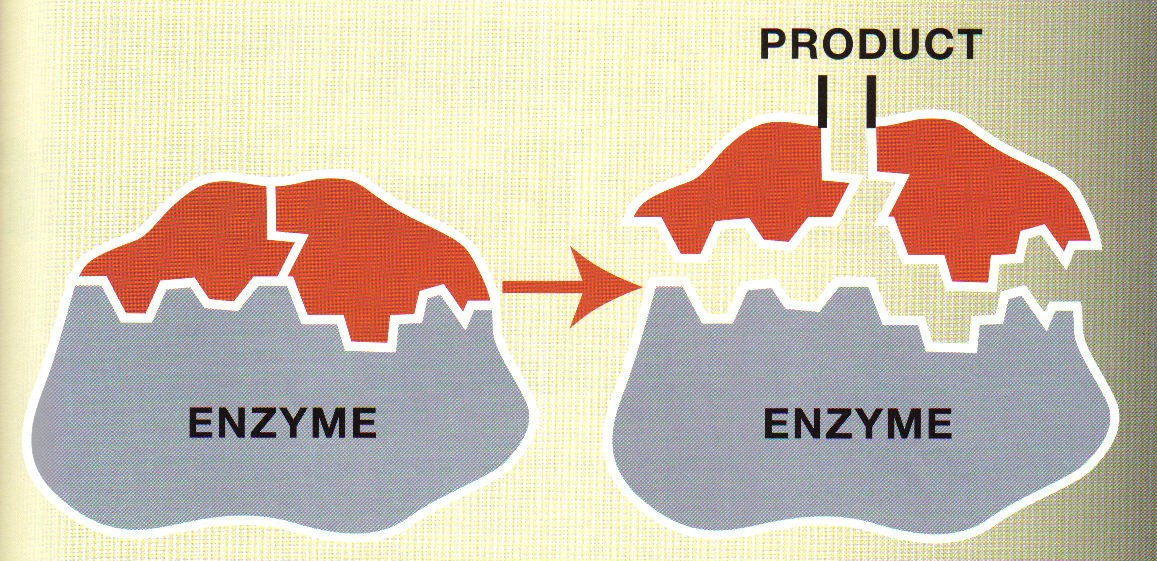
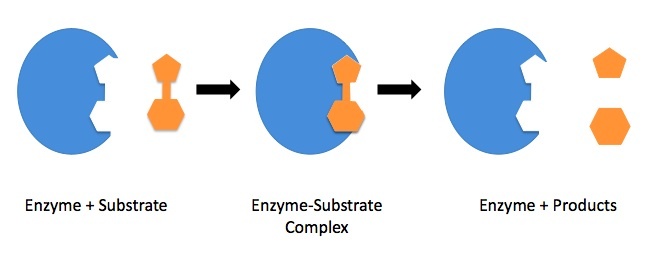
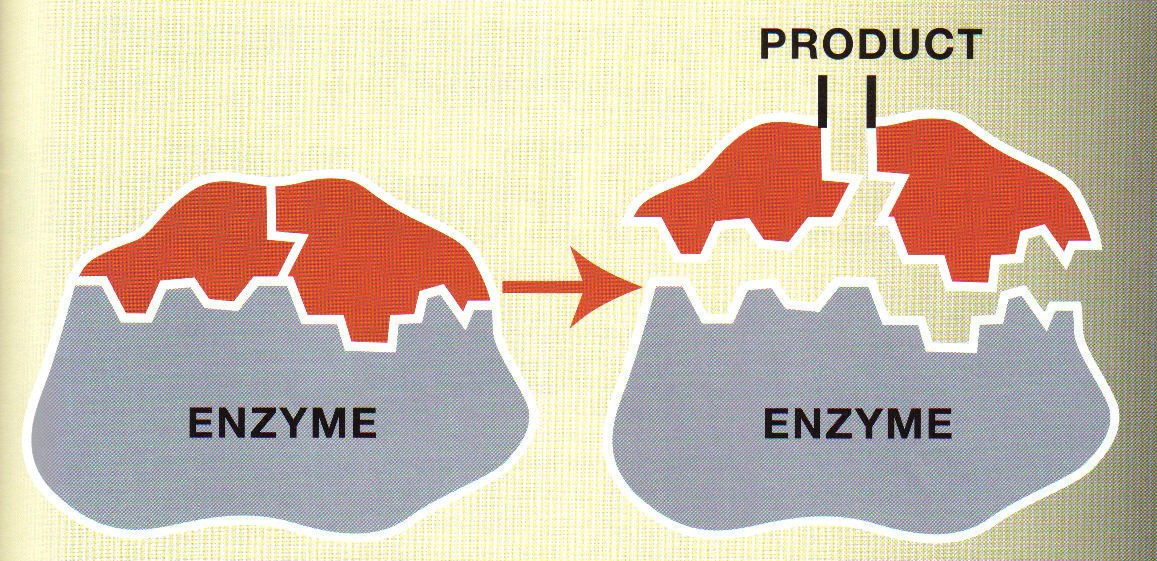
This reaction shows a(n) ____________ reaction
a)
Catabolic
b)
Anabolic
c)
Dehydration Synthesis
d)
Halogenation
58.
The area that the substrate fits into on the enzyme is called the:
a)
Active Site
b)
Allosteric Site
c)
DiSulphide Bridge
d)
β-Pleated Sheet
59.
Enzymes catalyze reactions by ___________ Activation Energy.
a)
Increasing
b)
Decreasing
60.
Most enzymes have the ending:
a)
-ase
b)
-ose
c)
-ic acid
d)
-ate
61.
The molecule an enzyme is working on is called the:
a)
Substrate
b)
Solvent
c)
Allosteric Inhibitor
d)
CoEnzyme
62.
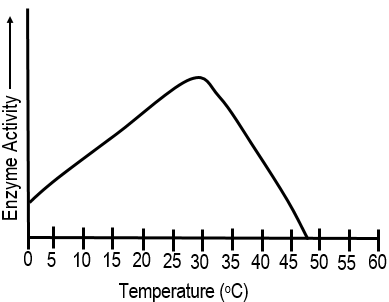
Some bacteria live in hot springs. Their cells contain enzymes that function best at temperatures of 70 °C or higher. At the temperature of 50 °C, how will the enzymes in these bacterial cells most likely be affected?
a)
The enzymes will be destroyed by lysosomes
b)
The enzymes will lose their bond structure and fall apart.
c)
The enzymes will require less energy to function than at 70 °C.
d)
The enzymes will not increase the rate of reactions as much as they would at 70 °C. 
63.
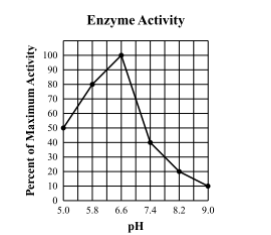
The graph below shows how the activity of an enzyme changes over a range of pH values. Which of the following conclusions can be drawn from this graph?
a)
The optimum pH of the enzyme is 6.6.
b)
The optimum pH of the enzyme is 5.8
c)
The enzyme’s activity continually increases as pH increases from 5.0 to 9.0
d)
The enzyme’s activity is greater around pH of 8.0 than around pH of 5.0.
64.
Which of the following best explains why enzymes are necessary for many cellular reactions?
a)
Enzymes supply the oxygen necessary for the reactions
b)
 Enzymes change reactants from solid to liquids during the reactions.
c)
The reactions take up too much space in the cell if the enzymes are missing.
d)
The reactions are too slow to meet the needs of the cell if enzymes are missing. 
65.
The activity of which enzyme decreases in both acidic and basic environments?
a)
chymotrypsin
b)
pepsin
c)
 cholinesterase
d)
papain
66.
Based on the graph, what is the optimal temperature for this enzyme? 
a)
15oC
b)
40oC
c)
30oC
d)
35oC
67.
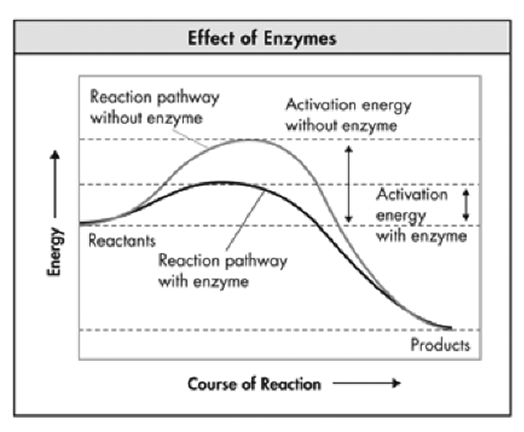
The graph shows how enzymes affect reactions in cells. Which statement best summarizes the information shown in the graph?
a)
Enzymes increase the energy of the reactants.
b)
Enzymes decrease the energy level of the products.
c)
Enzyme decrease the activation energy of the reaction.
d)
Enzymes reverse the direction of the reaction.
68.
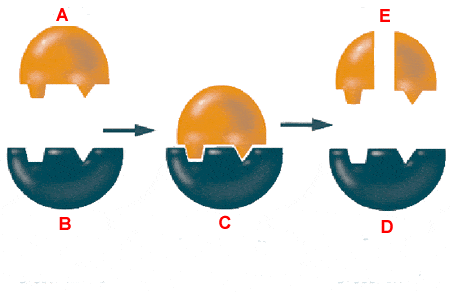
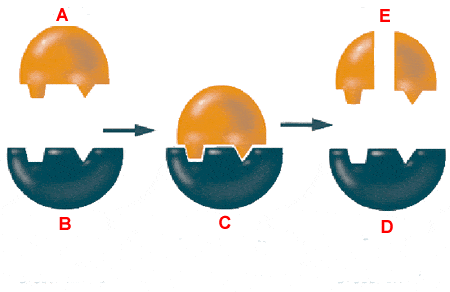
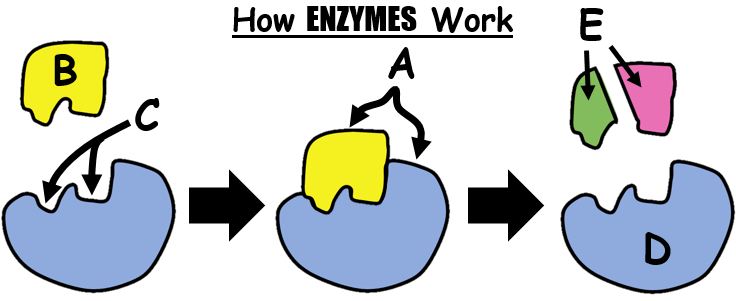
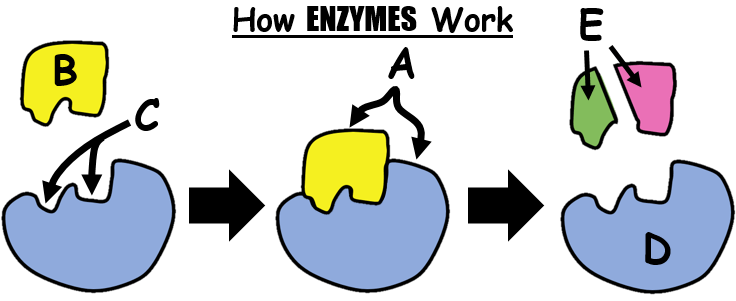
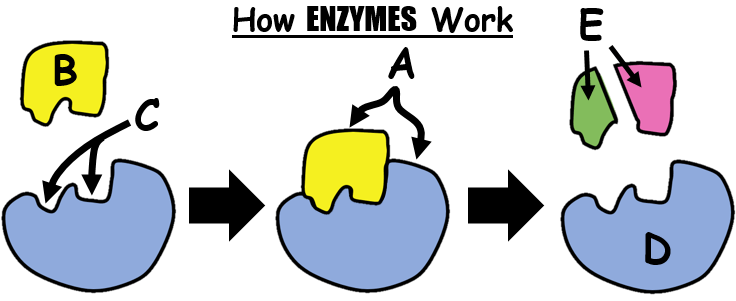
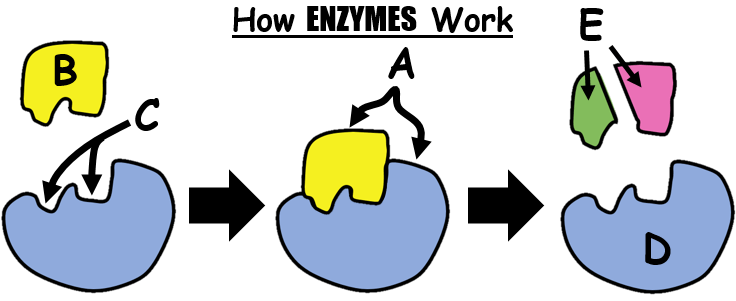
In the diagram, what is letter A? 
a)
product
b)
substrate
c)
enzyme-substrate complex
d)
active site
69.
What happens when enzymes are heated to a high temperature?
a)
The enzymes die.
b)
The shapes of the enzyme are altered denature
c)
The enzymes' amino acid sequence changes.
d)
The enzymes remain the same
70.
Letter B...
a)
active site
b)
enzyme
c)
substrate
d)
products
71.
Letter C...
a)
active site
b)
enzymes
c)
substrate
d)
products
72.
Letter E...
a)
active site
b)
enzyme
c)
substrate
d)
products
73.
What organelle surrounds and supports plant cells?

a)
Cell Membrane
b)
Cell Wall
c)
Nucleus
d)
Golgi Complex
74.
In what organelle does the food making process in plants take place?

a)
Endoplasmic Reticulum
b)
Vacuole
c)
Chloroplasts
d)
Mitochondria
75.
In what organelle is the genetic material found inside?
 
a)
Endoplasmic Reticulum
b)
Golgi Complex
c)
Nucleolus
d)
Nucleus
76.
Where does photosynthesis occur?
a)
mitochondria
b)
stomata
c)
xylem
d)
chloroplast
77.
I make proteins for the cell. What am I?
a)
ribosome
b)
mitochondria
c)
chloroplast
d)
lysosome
78.
The two kinds of cells are Prokaryotes and Eukaryotes. How are they different?
a)
Prokaryotes have a nucleus.
b)
Eukaryotes have a nucleus.
c)
Prokaryotes are plant cells.
d)
There is no difference.
79.
Semi-permeable layer around the cell that encloses the contents of the cell
a)
nucleus
b)
cell membrane
c)
cell wall
d)
chloroplast
80.
What is the name of the genetic material that is inside the nucleus?
a)
ER
b)
ATP
c)
YOLO
d)
DNA
81.
What does "bilayer" mean?
a)
one layer
b)
two layers
c)
laminated
d)
bilateral
82.
What forms the channels and pumps in the phospholipid bilayer?
a)
carbohydrates
b)
proteins
c)
hydrophilic heads 
d)
lipids
83.
This is a balance that organisms maintain through self-regulating adjustments
a)
bilayer
b)
homeostasis
c)
secretions
84.
True or false:  Regulating what enters and leaves the cell helps the cell maintain homeostasis. 
a)
True
b)
False
85.
Lipid tails are...
a)
Hydrophobic
b)
Hydrophilic
86.
What does hydrophobic mean?
a)
Likes water as a friend
b)
Dissolves in water
c)
Loves water
d)
Hates water
87.
What does hydrophilic mean?
a)
Fills water up
b)
Hates water
c)
Loves water
d)
Only associates with water if it has to
88.
When looking at the cell membrane, where are the phosphate heads located?
a)
Floating between bilayer levels
b)
Outer part of the bilayer
c)
Inner part of the bilayer
d)
Located at different parts throughout the bilayer
89.
When looking at the cell membrane, where are the lipid tails located?
a)
Inner part of the bilayer
b)
Outer part of the bilayer
c)
At the end of the bilayer
d)
Goes through each end of the bilayer
90.
This picture show the molecules getting help across the membrane.  The vocabulary word that best describes this is
a)
diffusion
b)
osmosis
c)
facilitated diffusion
d)
active transport
91.
When particles move out of a cell through facilitated diffusion, the cell ____________.
a)
Gains energy
b)
Uses energy
c)
Releases energy
d)
Does not use energy
92.
Osmosis is the diffusion of __________.
a)
water
b)
glucose
c)
air
d)
passive transport
93.

Describe the movement of molecules going through the proteins in the illustration.

a)

Molecules are moving from a higher concentration to a lower concentration.

b)

Molecules are moving from a lower concentration to a higher concentration.

c)

Molecules are moving from a higher concentration to a lower concentration and then from a lower to higher concentration.

d)

Molecules are moving from a lower concentration to a higher concentration and then from a higher concentration to a lower concentration.

94.
The cellular process in which materials are moved across a membrane from an area of low concentration to an area of high concentration is called
a)
Osmosis
b)
Simple Diffusion
c)
Active Transport
d)
Passive Transport 
95.
What is one major difference between passive and active transport?
a)
Passive transport uses energy; active transport does not.
b)
Both types of transport use energy.
c)
Active transport uses energy; passive transport does not.
d)
No difference. They are both the same.
96.
What type of solution is this cell in?
a)
Isotonic
b)
Hypertonic
c)
Hypotonic
d)
diffused
97.
What type of solution is this cell in?
a)
Isotonic
b)
Hypertonic
c)
Hypotonic
d)
diffused
98.
What type of solution is this cell in?
a)
Isotonic
b)
Hypertonic
c)
Hypotonic
d)
diffused
99.
This picture represents which type of cellular transport?
a)
passive transport
b)
endocytosis
c)
exocytosis
d)
osmosis
100.

Solid food is moved into the cell by ________________________.

a)

endocytosis

b)

pinocytosis

c)

exocytosis

d)

osmosis

101.

Liquid unable to get into the cell by osmosis is moved into the cell by ________________________.

a)

endocytosis

b)

pinocytosis

c)

exocytosis

d)

osmosis

102.
Osmosis is the movement of _____ across a membrane.
a)
food
b)
energy
c)
oxygen
d)
water
103.
A cell in an isotonic solution will
a)
swell
b)
shrink
c)
stay the same size
d)
impossible to tell
104.
A cell in a hypotonic solution will
a)
swell
b)
shrink 
c)
stay the same size
d)
impossible to tell
105.
A saltwater fish is accidentally placed in a freshwater aquarium in a few short hours it sadly died. Which explains why this occurred?
a)
The cells of the fish body were dehydrated by the quick loss of water. 
b)
The cells of the fish quickly absorbed massive amounts of water and it ended up killing the fish.  
c)
The fish hated the new decor in the freshwater tank. 
d)
It was just its time. 
106.
This type of endocytosis is used by the cell to take in large molecules or food. 
a)
Pinocytosis 
b)
Protein pumps
c)
Phagocytosis
d)
Exocytosis
107.
Which way is the water moving in this cell?
a)
Water will move out of the cell
b)
Water will move into the cell
108.
What is the ultimate ORIGINAL source of energy for living things
a)
Sugar
b)
Sun
c)
Moon
d)
Carbon Dioxide
109.
What are the products of photosynthesis?
a)
water and carbon dioxide
b)
oxygen and glucose
c)
oxygen and carbon dioxide
d)
oxygen and water
110.
What is the pigment in chloroplasts that performs photosynthesis?
a)
Chlorosynthesis
b)
Chlorophyll
c)
ADP
d)
Electron Transport
111.
What gas goes into the plant before photosynthesis?
a)
Carbon Dioxide
b)
Carbon Monoxide
c)
Oxygen
d)
Nitrogen
112.
What is the main chemical compound that stores and releases energy?
a)
ATP
b)
Cytoplasm
c)
PTP
d)
Oxygen
113.
What do plants need for the photosynthesis process?
a)
a camera and tripod
b)
light, carbon dioxide, and water
c)
roots, flowers, and bees
d)
soil, air, and oxygen
114.
What is the function of ATP in living things?
a)
provides energy for cells
b)
stores genetic information
c)
provides structure in the nucleus
115.
What does the "TP" in ATP stand for?
a)
2 phosphates
b)
tri (3) phosphates
c)
Two proteins
d)
tri (3) proteins
116.
What are the parts of the ATP molecule?
a)
adenine, thylakoids, stroma
b)
stroma, grana, chlorophyll
c)
adenine, ribose, phosphate groups
d)
NADH, NAHPH, FADH
117.
Which of the following is the correct equation for PHOTOSYNTHESIS?
a)
carbon dioxide + water --> oxygen + glucose
b)
carbon dioxide + glucose + water --> oxygen 
c)
oxygen + water --> carbon dioxide + glucose
d)
glucose+ oxygen ---> water + carbon dioxide 
118.
Where does aerobic respiration take place?
a)
Cytoplasm
b)
Mitochondria
c)
Stroma
d)
Thylakoid
119.
Which type of respiration occurs without the presence of oxygen?
a)
Aerobic 
b)
Anaerobic 
120.
What are the two reactants of cellular respiration?
a)
C6H12O6 & 6CO2
b)
6 CO2 & 6H2O
c)
C6H12O& 6O2
d)
6CO2 & 6O2
121.
What are the two produces of aerobic respiration?
a)
Glucose & oxygen
b)
Carbon dioxide & water
c)
Lactic acid
d)
Carbon monoxide 
122.
The overall goal of cellular respiration is to make:
a)
Glucose
b)
ATP
c)
Oxygen
d)
Water
123.
What is the total net gain of ATP at the end of aerobic respiration?
a)
2 ATP
b)
34 ATP 
c)
36 ATP
d)
38 ATP
124.
What is the name of the process that helps make beer and wine?
a)
Fermentation
b)
Alcoholic fermentation
c)
Lactic acid fermentation
d)
Glycolysis
125.
Which type of fermentation occurs in muscles?
a)
Alcoholic 
b)
Lactic acid
126.
How does the amount of energy resulting from fermentation compare with that of aerobic respiration? 
a)
Aerobic respiration results in less energy.
b)
Each process results in equal amounts of energy.
c)
Aerobic respiration results in more energy.
d)
Each process results in variable amounts of energy. 
127.
Respiration is the process by which animals take in _____ and release _____. 
a)
photosynthesis, air
b)
carbon, oxygen
c)
oxygen
d)
oxygen, carbon dioxide
128.
Which of the following removes carbon from the atmosphere?
a)
Combustion
b)
Respiration
c)
Photosynthesis
d)
Death
129.

Which is a true statement?

a)

Humans depend on oxygen, plants depend on carbon dioxide

b)

Plants produce carbon dioxide

c)

Humans depend on carbon dioxide, plants depend on oxygen

d)

Humans don't depend on plants for the air they need

130.
The uncontrolled division of cells...
a)
meiosis
b)
cancer
c)
nondisjunction
d)
crossing over
131.
This process produces cells with only 1/2 of the chromosomes as body cells.
a)
mitosis
b)
meiosis
132.
This produces cells for growth and repair.
a)
mitosis
b)
meiosis
133.
Which of the following is a phenotype?
a)
Aa
b)
red hair
c)
heterozygous genes
d)
mutated DNA
134.
Which of the following cell types is formed by meiosis?
a)
muscle cells
b)
skin cells
c)
sperm cells
d)
blood cells
135.
What is one advantage of sexual reproduction?
a)
offspring are identical to parents
b)
offspring are resistant to viruses
c)
offspring are born live, rather thna from eggs
d)
offspring inherit a wider variety of genetic information
136.
What is a phenotype?
a)
The expression of a trait; what you see.
b)
refers to the genetic makeup of an individual
c)
An organism that has the same genes for a trait (ex. TT or tt)
d)
the passing of traits from parent to offspring
137.
The inherited combination of alleles is known as the offspring's
a)
heredity
b)
phenotype
c)
genotype
d)
redigree
138.
An organism's appearance is known as its
a)
heredity
b)
phenotype
c)
genotype
d)
pedigree
139.
Sex cells are produced through the process of
a)
mitosis
b)
cytokinesis
c)
binary fission
d)
meiosis
140.
What does heterozygous mean?
a)
An organism that has the same genes for a trait (TT or tt)
b)
An organism that has different genes for a trait (Tt)
c)
When neither gene is fully dominant; offspring is a mixture of both
d)
the different forms of a trait (hair color--> brown, blonde, red
141.
A heterozygous yellow pea plant's genotype would be:
a)
YY
b)
yy
c)
Yy
d)
Yg
142.

A gene is

a)

a section of DNA

b)

a chemical found in the nucleus of cells

c)

contains instructions for building a protein

d)

all of the above

143.

Human gametes contain how many chromosomes?

a)

46

b)

23

c)

12

d)

28