
 Worksheets
Geologic Time and the Theory of Evolution
Total questions: 144
Worksheet time: 6hrs 12mins
DNA
common bone structures
developmental similarities
DNA
common bone structures
saliva
common bone structures
plants
developmental similarities
DNA
common bone structures
developmental similarities
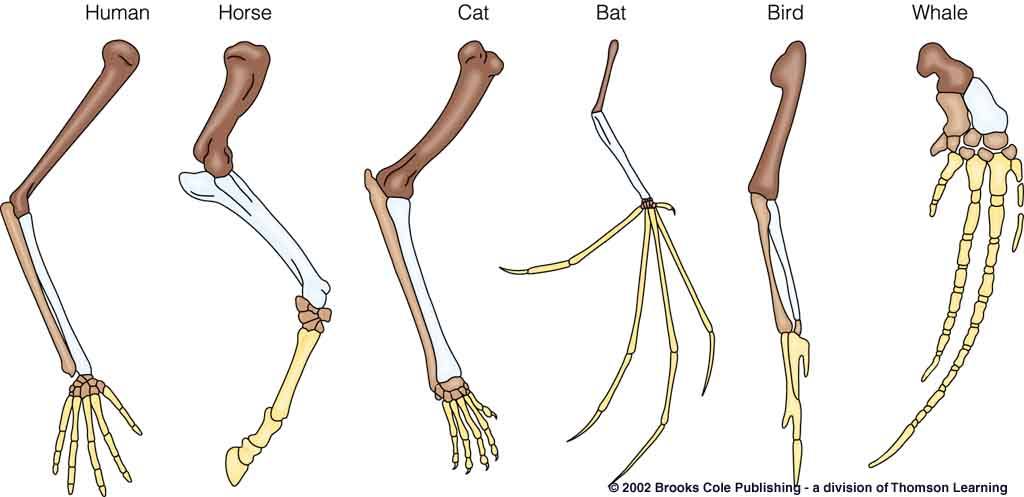
Examples of homologous structures include
the wings of a bat and a bird
the wings of a bat and the limbs of a cat
the limbs of a cat and the limbs of a tortoise
none of the above
Examples of analogous structures include
the wings of a bat and a bird
the wings of a bat and the limbs of a cat
the limbs of a cat and the limbs of a tortoise
all of the above
An example of a vestigial structure is
the forelimb of a whale
the wings of an eagle
the pelvic bone of a whale
the tail bone of a monkey
Biogeography _________
has taught us of the migration patterns of certain species
is the science of studying maps
was developed by Darwin during the voyage on the Beagle
proves that all camels came from Egypt and North Africa
Island biogeography_______
describes camel migration across the planet
describes the reasons for finch evolution in the Galapagos
was developed by Peter and Rosemary Grant
all of the above
The strongest evidence for evolution from a common ancestor is
similar DNA sequences
similar body structures
similar fossils
all of the above
________ anatomy is the study of the similarities and differences in the structures of different species
Human
Comparative
Relative
Similar __________________ are the strongest evidence for evolution from a common ancestor
structures
DNA Sequences
fossils
hair color
The hands of different animals are _________ structures
vestigial
homologous
analogous
Charles Lyell____________
argued that Earth must be far older than most people believed.
said that human populations grow faster than their resources.
developed the idea of the inheritance of acquired characteristics.
none of the above.



Gigantopithecus were very large primates that lived 500,000 years ago. Since none of these mammals are still today, they are said to be....
Extinct
Threatened
Endangered
Declining

Scientists have collected millions of fossils of different organisms, and have developed a timeline of life on Earth. What do we call this?
Mutation
Natural Selection
The theory of evolution
Fossil Record
A physical or behavioral trait that helps an organism survive and reproduce in its environment is called a what?
An adaptation
A response to a stimulus
A mutation
Evolution

Sometimes bones in the front limbs of animals are very similar in structure. What do we call similar bone structures that indicate a link to a common ancestor?
Adaptations
Gradualism
Homologous Structures
Extinction
What most likely caused the finches on the Galapagos Islands to have beaks that were different from the finches on the mainland?
There were different types of predators on the island.
There were different types of food available on the island.
The finches had no water to drink.
The finches on the mainland could not fly high enough.
When looking at two birds of the same species, you notice that one has darker feathers than the other one. You also notice that one has a beak that is just a little longer. These slight differences within members of the same species are called.....
Fossils
Extinction
Meiosis
Variations
What is the study of organisms at the early stages of development?
DNA studies
Comparative Embryology
Extinction
Fossil Record

Remnants of structures that had a useful role at one time but no longer do
ancestral traits
homologous structures
vestigial structures
analogous structures
How did Darwin explain how one species of finches had turned into many? What lead to the different shaped beaks?
Darwin believed that there was no explanation for the different shaped beaks.
Darwin determined every animal mus fight for survival. Those best adapted to their surroundings would survive.
Darwin determined that the beak of finches altered to fit their diet.
Darwin believed artificial selection led to the different shaped beaks.


Australia. Which of the following statements best describes this occurrence?
continental drift separated them.
that separated the continents.
world.


organisms. The similarities in embryonic development shown in the diagrams suggest that these organisms -
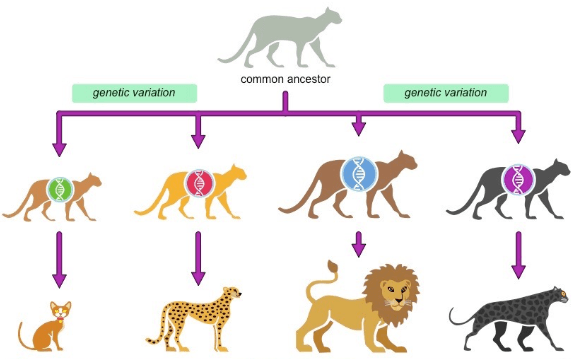
The process by which two populations of the same species become so different that they can no longer interbreed.
natural selection
artificial selection
speciation
fossilization

Which of the following is true regarding the evidence of evolution
Vestigial structures are not real evidence of evolution.
Homologous structures and fossils are the most dependable forms of evidence.
Comparing DNA is the most definitive and accurate method to show evolutionary relationships.
Embryology and Homologous structures do not support the theory of evolution.


Mammals are a dominant group in which era?
Cenozoic
Mesozoic
Paleozoic
Cambrianozoic

How old do Paleontologists believe the Earth is?
2019 years old
3.6 billion years old
4.6 billion years old
4.6 million years old

What type of event usually marks the end of an Era
A Mass Extinction
A Quinceanera
An earthquake
A Volcanic Eruption

What era did trilobites, fishes, and other marine organisms dominate?
Precambrian
Paleozoic
Mesozoic
Cenozoic

Scientists chose where units of geologic time began and ended based on the appearance or disappearance of life.
true
false

The dinosaurs and reptiles were dominant in which Era?
Precambrian
Mesozoic
Paleozoic
Cenozoic
Dinosaurs were living during Mesozoic, Triassic and Jurassic eras and eventually became extinct during the Cretaceous period. In all of these eras dinosaur fossils were found. What does this evidence tell scientists about how natural processes have changed Earth over time?
Dinosaurs fossils in varying rock layers show that as the population changed they were fossilized in different rock layers by Earth’s natural processes.
Dinosaur fossils take a long time to form and demonstrate how long the natural processes take to change the
Earth
Dinosaur fossils are formed within layers of sedimentary rock that were laid down by natural Earth processes which
no longer occur today showing how Earth has changed.

If we want to figure out the age of layers from two different locations what would be the best way to do so?
We can compare the fossils found in the layers of one location to the fossils in the other location
We can use the law of superposition to figure out the rate of layer formation
Radioactive dating to compare the age of the rocks in the layers
Compare the number of layers in each location
What is relative dating?
used to determine a fossils approximate age by comparing it to similar rocks and fossils of known ages.
used to determine the precise age of a fossil by using radioactive dating to measure.
Order of layers from oldest to youngest
Used to determine the location of the rocks around the world.
Why may fossil of the same organism be found on different continents?
Because the continents were once together
Similar fossils should not be found on different continents
Because fossils change over time
Because of the Evolution of the Earth

Which statement is correct
Layer 2 is younger than layer 4
Layer 1 is younger than layer 4
Layer 2 is older than layer 1
Layer 3 is younger than layer 1

Which of the following statements is incorrect?
Layer 4 is younger than 3
Layer 1 is older than 3
Layer 4 is older than 2
Layer 2 is older than 4

Age of bacteria
relative age
Permian extinction
precambrian era
Paleozoic era

Greatest mass extinction of all time - ended the Paleozoic era
extinction
Paleozoic era
geologic time scale
Permian extinction

a group of organisms that are closely related and can mate to produce fertile offspring
Fossil
Paleozoic
Era
Species

age of mammals that lasted from 65 million years ago to the present; the era of modern life
Cenozoic Era
Mesozoic Era
epoch
period

Age of reptiles (dinosaurs) Scientists believe that it ended due to a meteorite hitting the Earth, causing a thick layer of dust/dirt cloud (causing an ice age) due to the sun not being able to reach Earth's surface
Cenozoic Era
Paleozoic Era
Precambrian Time
Mesozoic Era
What is the eon, era, period, and epoch we are living in?
phanerozoic, quaternary, holocene, and cenozoic
phanerozoic, cenozoic, quaternary, and holocene
quaternary, cenozoic, holocene, and phanerozoic
quaternary, cenozoic, phanerozoic, and holocene
Which of the following is the correct sequence of geologic time from smallest to largest unit?
era, eon, period, and epoch
epoch, eon, era, and period
epoch, period, era, and eon
era, eon, epoch, and period
The first three eons were: Hadean, Archaean, and Proterozoic. They are better known as:
PreCambrian Time
Phanerozoic
Mesozoic
Cenozoic
What was the earth like during PreCambrian time?
tropical climate with warm shallow seas
vegetation and tectonic movement
cooler temperatures because of nuclear winter
intense volcanic activity, very warm temperatures
During the Mesozoic Era, volcanic activity was common because of:
plate tectonics
natural selection
climate change
meteor shower
During which era did seeds develop coverings:
Mesozoic
Paleozoic
Cenozoic
Industrial
Scientists think the continents once formed a large, single landmass that broke apart and the continents slowly drifted to their present locations. What is the name given to this hypothesis?
Continental rise
Continental drift
Continental shelf
Continental slope
. Which of these statements describes what happens during radioactive decay?
A Stable isotope interacts with an unstable isotope
A stable isotope breaks down and becomes unstable
An unstable isotope breaks down into a more stable isotope.
An unstable isotope interacts with another unstable isotope.
Directions: Read the passage "Wegener Observations" in the box below. Use the passage to answer any questions that follow.
In the 1900s, Alfred Wegner collected evidence about earth's past. He discovered belts of coal, which normally form in tropical regions, in Europe and Asia. He also foundglacial deposits and evidence of glacial scrapings on rocks in Africa and India.
Which scientific theory was supported by this evidence?
the theory of spontaneous generation, which states that matter can form and appear anywhere
the big bang theory, which states that at one point the universe was one confined to a single point
the continental drift theory, which states that all of the continents were once joined together and drifted apart to their current locations
the expanding Earth theory, which states that the position and movement of continents is dependent on the volume of the planet increasing
Limestone can be found at the top of the Himalayas, the highest mountain range in the world. Limestone is a rock that usually forms at the bottom of shallow, warm waters. What does this information show about Earth?
It shows that Earth has not changed much over the years as limestone has adapted to forming on mountain peaks.
It shows that Earth has evolved over time as areas of land that have once been covered in water, but no longer are.
It shows that Earth circulates its minerals so often that limestone always ends up on the peaks of mountains.
It shows that Earth has mostly convergent plate boundaries that push limestone from the ocean floor to the top of mountains.
At one time, several kinds of camels lived in Florida. The evidence comes from fossils found in Florida. Which of these objects would be a fossil that shows that camels once lived in Florida?
Sinkhole formed by a retreating glacier
sedimentary rock that formed a long time ago
crystal formation suspended from the ceiling of a cave
remains of an organism preserved by geologic processes
Radioactive dating measures the rate of decay of radioactive materials in rocks. A geologist determines the age of a rock by comparing the amount of radioactive material with the amounts of its decay products. How could a geologist best use information from one rock to learn about the time period over which a canyon formed?
The geologist could compare the age of one rock with the ages of rocks from another canyon.
The geologist could compare the age of one rock with the ages of many living plants.
The geologist could compare the age of one rock with the age of Earth.
The geologist could compare the age of one rock with the ages of many nearby rocks.

The timeline above shows changes that occurred in the Sahara Desert throughout history.
What does this timeline suggest about Earth?
It suggests that Earth has changed over time since human fossils became present in the Sahara after 9,000 years, indicating that the environment had been suitable enough to support human life at one time.
It suggests that Earth has not changed much over time since human fossils were present as early as 9,000 years ago, indicating that Earth's environment has almost always been suitable for the presence of life.
It suggests that Earth's deserts always receive monsoon rains every 1,000 years.
It suggests that Earth is only able to preserve fossils in environments that are desert like.
Directions: Read the passage " Heliobacter pylori". Use the passage to answer any questions that follow.
HELIOBACTER PYLORI
It was previously believed that gastritis leading to painful stomach ulcers was the result of anxiety, lifestyle, and diet. In 1989, Dr. Barry Marshal and Dr. Robin Warren discovered a bacterium in the stomach of affected people called Heliobacter pylori. Many trials were done on laboratory mice proved the bacterium was responsible for the illnesses, but ethical reasons did not allow for experiments on humans. Dr. Marshal did something unusual when he created a broth that contained the bacterium, drank it himself and became sick with
gastritis within days. Dr. Marshall and Dr. Warren's findings are now widely accepted, and they received the Nobel prize in 2005.
How were Dr. Marshal and Dr. Warren's results confirmed?
by the experiment being replicated by other scientists who experienced the same results
by Dr. Warren repeating his experiment to show that his results were accurate
by the experiment on the mice being repeated again multiple times by the original team
by Dr. Warren convincing other scientists to share his opinion about the results

Analyze the image Above. According to the Law of Superposition, which sequence of letters describes the rock layers in the diagram from oldest to youngest?
D,C,B,A
A,B,C,D
A,B,D,C
C,D,B,A

The diagram above is cross-section of Earth’s sedimentary rock. Based on the Law of Superposition, which statement best compares the relative age of two rock layers?
Layer 7 is older than layer 5
Layer 2 is older than layer 7
Layer 5 is younger than layer 3
Layers 3 and 4 are the same age


When did oxygen become "plentiful"
Mississippian
Permain
Cambrian
Ordovician
When did birds start to appear
Cretaceous
Triassic
Tertiary
Jurassic
When did the Cambrian Explosion happen
About 543mya
2.5mya
3.8mya
490mya
What happened during the Devonian time
Corals grouped together
Fishes evolved
Beginning of most life
Huge bugs

What happened when the Cambrian Explosion took place?
Everything dies
Trees appear
Things started to grow
Oxygen and most life began

The entire history of the Earth can be divided into the Precambrian (ancient) Eon and the Phanerozoic (current) Eon. Which of the following correctly represents the percent of Earth's history occupied by each?
88% Precambrian, 12% Phanerozoic
12% Precambrian, 88% Phanerozoic
81% Precambrian, 19% Phanerozoic
19% Precambrian, 81% Phanerozoic
Which of the following best describes Earth’s very first atmosphere?
helium and hydrogen gases left over from the formation of the planet
carbon dioxide and water vapor from volcanic outgassing
a 78%-21% nitrogen and oxygen gas mixture
methane and ammonia gases from Earth's interior
Earth’s most primitive life forms are represented by:
prokaryotic cells.
plants.
fungi.
tube worms.
Which segment of time is the smallest?
Eon
Era
Period
Epoch
This eras name means "ancient" or "early" life.

When did the first birds appear?
Cambrian
Permian
Cretaceous & Triassic
Mesozoic and Jurassic
The period of geologic time when the biodiversity of life on the planet increased dramatically was
Jurassic
Triassic
Permian
Cambrian
There have been how many major extinction events on planet Earth?
3
4
5
2

During which periods did the first land plants, vertebrates, and insects appear?
Jurassic-triassic
Ordovician-silurian
Hadean-acheon
Tertiary-quaternary

When did this creature live?
Triassic-Jurassic
Jurassic-Silurian
Cretaceous-Tertiary
Eocene-Oligocene
The period of time where conditions were harsh and no life forms existed was the
Pleistocene
Cambrian
Hadean
Holocene

The period when trilobites and eurypterids appeared was the
Hadean
Cambrian
Holocene
Jurassic

The time when the first jawed fishes and amphibians appeared
Devonian
Jurassic
Cambrian
Hadean

The period when huge land plants were dominant and eventually became the coal and oil we use today.
Cambrian
Carboniferous
Jurassic
Miocene

When large land reptiles first appeared.
Jurassic
Permian
Cambrian
Holocene

Known as the age of reptiles
Mesozoic
Cenozoic
Phanerozoic
Cambrian

A type of isolation in which two populations become separated by a physical barrier such as a canyon, river, lake, preventing the two populations from interbreeding.
Geographic isolation
Behavioral isolation
Temporal isolation

Scientists believe that the species Homo sapiens originated in Africa and migrated out of Africa to compete with existing hominid species in other territories. Which field of study would provide us with evidence that Homo sapiens came to what is now the Americas using a land bridge between Russia and Alaska that became covered with water when the Ice Age thawed?
Biogeography
Comparative Anatomy
Embryology
Molecular Biology

The animals in the picture do not live in the same population. They are found in different parts of the world, but are all still part of the camel family. What can be said about these animals?
They belong to the same species
It is difficult for them to find food to eat
They have a very similar skeletal structure
They descended from a common ancestor
Over a long period of time the organisms on an island can no longer interbreed with the organisms on a neighboring island. What is this inability to interbreed known as?
Hybridization
reproductive isolation
artificial selection
survival of the fittest
Which of the following is Thomas Malthus’ contribution to Charles Darwin’s theory of evolution?
The earth is of a very old age proven by the number of rock layers.
The earth’s geography has been shaped by slow processes
Organisms mutate new parts as they need them.
Populations tend to overpopulate and compete.
In the 1800s Jean-Baptiste Lamarck offered a hypothesis about evolution called the inheritance of acquired characteristics. Which of the following is an example of how Lamarck thought animals evolved?
Fish mutated the genes necessary to develop lungs and were able to eventually survive on land.
Giraffes once had short necks and stretched them reaching for leaves on trees, later passing the longer neck trait to their offspring.
Dark moths, once outnumbered by light moths, began to survive longer and reproduce more after the industrial revolution turned the trees black.
The earth has been here so long that animals have had plenty of time to adapt to their environment through natural selection.
Charles Lyell wrote a book called the Principles of Geology which Charles Darwin read during his famous voyage around the world. Lyell’s book contributed to Darwin’s Theory of Evolution by convincing Darwin that
natural selection was responsible for the acquisition of new traits within a population when there was competition between species.
giraffes had short necks until they stretched them while reaching for the higher leaves on trees and then passed these traits to their offspring.
the earth was old and formed by slow-acting processes which Darwin applied to the evolution of living things.
homologous structures, the fossil record, and vestigial structures were the best evidence for the evolution of species.
Which of the following men developed a theory of evolution very similar to Charles Darwin’s around the same time that Darwin developed his theory?
Malthus
Lyell
Lamarck
Wallace
Which of the following was a contribution of Thomas Malthus to Darwin's theory of evolution?
His book convinced Darwin that the earth was old and formed by slow-acting processes.
He presented a theory of evolution explaining how traits are acquired and passed down.
His work convinced Darwin that organisms overpopulate and compete for resources.
He wrote a letter encouraging Darwin to publish a book about his theory of evolution.
Which of the following best describes Jean-Baptiste Lamarck's contribution to the theory of evolution?
He published a book that convinced others that the earth is old and formed by slow-acting processes.
He suggested that organisms changed gradually in response to their environment, and passed on acquired characteristics.
His work convinced Darwin that organisms overpopulate and compete for resources.
He developed a theory of evolution very similar to Darwin's theory at about the same time.
Which of the following best describes Charles Lyell’s contribution to the theory of evolution?
He believed giraffe necks grew longer with each generation as they kept reaching for higher leaves.
He published a book that convinced others the earth is old and formed by slow-acting processes.
He developed a theory of evolution very similar to Darwin’s theory at about the same time.
His work convinced Darwin that organisms overpopulate and compete for resources.

Which X-ray crystallographer made contributions to the understanding of the molecular structure of DNA?
Marie Curie
Rosalind Franklin
Lise Meitner
Barbara McClintock

Which British molecular biologist is most noted for being a co-discoverer of the structure of the DNA?
Otto Hahn
Francis Crick
Michael Faraday
Alexander Fleming

Which American molecular biologist is best known for being a co-discoverer of the structure of the DNA?
Charles Darwin
Linus Pauling
Enrico Fermi
James Watson

Gregor Mendel's experiments established many of the rules of heredity. Which plant did he predominantly use?
Peas
Beans
Broccoli
Potatos

