
 Worksheets
Protein Synthesis Quiz Review
Total questions: 140
Worksheet time: 3hrs 35mins
What is the correct order to make a protein?
Protein, DNA, RNA
RNA, DNA, Protein
DNA, RNA, Protein
Protein, RNA, DNA
Where are proteins made?
smooth endoplasmic reticulum
nucleus
ribosomes in the cytoplasm
mitochondria
RNA contains which sugar?
deoxyribose
ribose
glucose
fructose
RNA has what base that is instead of thymine?
guanine
adenine
thymine
uracil
What enzyme does transcription use?
DNA polymerase
ligase
RNA polymerase
helicase
Which molecule carries amino acids to the ribosome during protein synthesis?
rRNA
tRNA
mRNA
RNA polymerase
What molecule is produced from a DNA template strand during transcription?
mRNA
amino acids
tRNA
proteins
Chunks of three bases on the mRNA that code for a specific amino acids are called
Missense
Anticodons
Mutations

What is the corresponding anticodon if the codon is "AAA"?
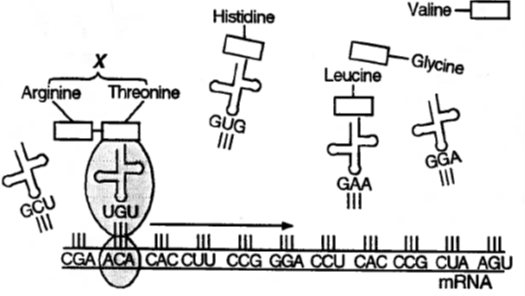
How many RNA bases are in two codons?


UGA
In protein synthesis, why do cells need mRNA?
DNA is too big to leave the nucleus
mRNA is more specific than DNA
DNA has inaccurate base pairing
mRNA better suited for the ribosome
Which of the following best explains the role of mRNA in protein synthesis?
mRNA carries the DNA message to the ribosome
mRNA reorders the DNA genes
mRNA changes proteins into their proper structure
mRNA carries amino acids to the ribosome
Which of the following shows the steps of protein synthesis in order?
Transcription, Translation
Translation, Transcription
Replication, Transcription, Translation
Replication, Transcription
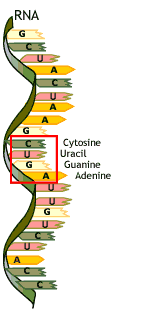
TGGCAAGTACGT

How many amino acids will 15 mRNA bases code for?
three
five
fifteen
thrity

Double stranded DNA is unzipped, and one strand is used as a template to form Messenger RNA.
Translation
Transcription
Replication
Mitosis

The reverse codon found on the tRNA.
Codon
Anticodon
Mitosis
Meiosis

Three nucleotide bases that code for the beginning
of a strand of protein.
Uracil
Stop Codon
Anticodon
Start Codon
Place the order of events for
creating a protein in order (1- 6)
____mRNA attaches to rRNA
____codons are continuously read by tRNA
____tRNA reaches a stop codon
____ tRNA connects second amino acid by peptide bond to Methionine
____Polypeptide chain is created
____ mRNA’s start codon AUG is translated by tRNA’s anticodon (Methionine)
1,5,4,3,6,2
2,4,5,3,6,1
1,2,3,4,5,6
1,4,5,3,6,2
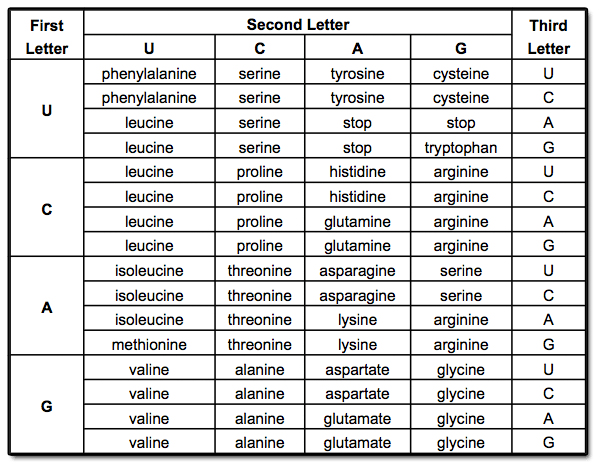
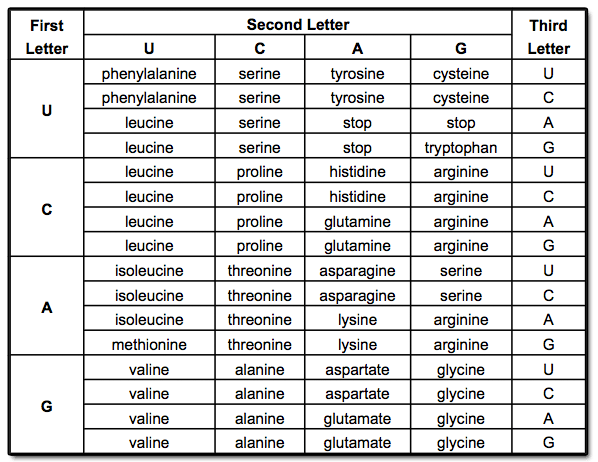
DNA Template: TAC CCC GTA CGA AAT ATC
What will be the amino acid sequence
MET GLY HIS ALA LEU STOP
MET PRO VAL ALA LEU ASP STOP
MET TYR VAL ALA LEU ASP STOP
TYR PRO VAL ARG ASP ILE
After mRNA editing, the mature mRNA strand should be
the same size
shorter, because introns are removed
shorter, because exons are removed
longer, because a poly-A tail is added at the 3' end
Coding regions of mRNA that are spliced together after mRNA editing are called
tRNA
introns
exons
anticodons
If a mutation in the DNA sequence of a gene does NOT change the sequence of amino acids during protein synthesis, the mutation is
silent
missense
nonsense
frameshift
When a mutation in the DNA sequence of a gene introduces an early STOP codon, this is called
translation
missense
insertion
nonsense
If a sequence of DNA reads GAC TAC ACT, which of the following represents a frameshift mutation?
GAC TAC
GAC TTA CAC T
GAC TAC ACT
GGC TAC ACT
If an amino acid sequence is changed from Met - Phe - Lys - Arg - STOP to Met - Trp - Lys - Arg - STOP, this is called
silent
nonsense
exon splicing
missense

Which mutation is demonstrated in the image above?
nonsense
substitution
insertion
frameshift
1 amino acid is coded by
1 codon
1 anticodon
1 mRNA
1 DNA
process of DNA to mRNA
DNA replication
transcription
translation
protein synthesis
Place the order of events for
creating a protein in order (1- 6)
____mRNA attaches to rRNA
____codons are continuously read by tRNA
____tRNA reaches a stop codon
____ tRNA connects second amino acid by peptide bond to Methionine
____Polypeptide chain (protein) is created
____ mRNA’s start codon AUG is translated by tRNA’s anticodon (Methionine)
1,5,4,3,6,2
2,4,5,3,6,1
1,2,3,4,5,6
1,4,5,3,6,2
Place the order of events for
creating a protein in order (1- 4)
____RNA Polymerase reaches a termination/stopping point
____Helicase attaches and unzips the desired gene
____mRNA leaves the nucleus
____RNA Polymerase adds new RNA nucleotides and makes mRNA
3,1,4,2,
1,2,3,4
2,1,4,3
3,1,2,4
What is the goal of protein synthesis?
to make DNA
to make more genes
to make proteins
to make 1 amino acid only
codons are found on
mRNA
tRNA
rRNA
DNA
anticodons are found on
mRNA
tRNA
rRNA
DNA
DNA Template: TAC CCC GTA CGA AAT ATC
What will be the tRNA sequence
AUG GGG CAU GCU UUA UAG
ATG GGG CAT GCT TTA TAG
UAC CCC GUA CGA AAU AUC
NONE OF THESE WORK
DNA Template: TAC CCC GTA CGA AAT ATC
What will be the amino acid sequence
MET GLY HIS ALA LEU STOP
MET PRO VAL ALA LEU ASP STOP
MET TYR VAL ALA LEU ASP STOP
TYR PRO VAL ARG ASP ILE
DNA Template: TAC CCC GTA CGA AAT ATC
What will be the mRNA sequence
AUG GGG CAU GCU UUA UAG
ATG GGG CAT GCT TTA TAG
UAC CCC GUA CGA AAU AUC
NONE OF THESE WORK
GTAGTCA
What is the correct order to make a protein?
Protein, DNA, RNA
RNA, DNA, Protein
DNA, RNA, Protein
Protein, RNA, DNA
Where are proteins made?
ER
nucleus
cytoplasm
mitochondria
RNA contains which sugar?
deoxyribose
Ribose
glucose
fructose
RNA has what base that is instead of thymine?
guanine
adenine
thymine
uracil
What enzyme does transcription use?
DNA polymerase
ligase
RNA polymerase
helicase
Which RNA brings amino acids?
rRNA
tRNA
mRNA
Which RNA forms part of the ribosomes?
tRNA
mRNA
rRNA
Which RNA carries the message?
mRNA
rRNA
tRNA
UGA
In protein synthesis, why do cells need mRNA?
DNA is too big to leave the nucleus
mRNA is more specific than DNA
DNA has inaccurate base pairing
mRNA better suited for the ribosome
Which of the following best explains the role of mRNA in protein synthesis?
mRNA carries the DNA message to the ribosome
mRNA reorders the DNA genes
mRNA changes proteins into their proper structure
mRNA carries amino acids to the ribosome
Which of the following best describes a codon?
3 mRNA bases that match to an amino acid
The 3 main types of amino acids
3 DNA bases that match to 3 mRNA bases
3 DNA bases that match to 3 proteins
Which of the following shows the steps of protein synthesis in order?
Transcription, Translation
Translation, Transcription
Replication, Transcription, Translation
Replication, Transcription
TGGCAAGTACGT

How many amino acids will FIFTEEN codons code for?
three
five
fifteen
thrity

DNA makes RNA → RNA makes proteins →
Proteins make life.
Homeostasis
Mendelian Genetics
Central Dogma
Myocardial Infarction
Double stranded DNA is unzipped, and one strand is used as a template to form Messenger RNA.
Translation
Transcription
Replication
Mitosis

Messenger RNA travels out of the nucleus to ribosomes
and is used as a template to assemble a protein.
Translation
Transcription
Replication
Homeostasis
The reverse codon found on the tRNA.
Codon
Anticodon
Mitosis
Meiosis
Three nucleotide bases that code for the beginning
of a strand of protein.
Uracil
Stop Codon
Anticodon
Start Codon
Place the order of events for
creating a protein in order (1- 6)
____mRNA attaches to rRNA
____codons are continuously read by tRNA
____tRNA reaches a stop codon
____ tRNA connects second amino acid by peptide bond to Methionine
____Polypeptide chain is created
____ mRNA’s start codon AUG is translated by tRNA’s anticodon (Methionine)
1,5,4,3,6,2
2,4,5,3,6,1
1,2,3,4,5,6
1,4,5,3,6,2
Place the order of events for
creating a protein in order (1- 4)
____RNA Polymerase reaches a termination/stopping point
____Helicase attaches and unzips the desired gene
____mRNA leaves the nucleus
____RNA Polymerase adds new RNA nucleotides and makes mRNA
3,1,4,2,
1,2,3,4
2,1,4,3
3,1,2,4
DNA Template: TAC CCC GTA CGA AAT ATC
What will be the amino acid sequence
MET GLY HIS ALA LEU STOP
MET PRO VAL ALA LEU ASP STOP
MET TYR VAL ALA LEU ASP STOP
TYR PRO VAL ARG ASP ILE
A mutation in which only one nucleotide is altered is called a:
Frameshift Mutation
Deletion Mutation
Point Mutation
Insertion Mutation
If a mutation codes for an early stop codon, it's called a:
Point mutation
Missense mutation
Nonsense mutation
Insertion mutation
Another name for a point mutation is:
Substitution
Frameshift
Insertion
Deletion

This figure is an example of a:
Silent mutation
Missense mutation
Nonsense mutation

This figure is an example of:
Missense
Nonsense
Silent
Frameshift
An insertion or deletion can also be described as a:
Point mutation
Selective Breeding
Frameshift mutation
Natural Selection
T-G-A-C-C-A
T-G-A-G-C-A
The mutated DNA segment is TTCGCAAG. This is an example of ___ mutation.
Original DNA: ATCGTC
Mutated DNA: AATCGTC
GTAGTCA
TGGCAAGTACGT
ATG GGA ACT CCA
What is the correct order to make a protein?
Protein, DNA, RNA
RNA, DNA, Protein
DNA, RNA, Protein
Protein, RNA, DNA
RNA contains which sugar?
deoxyribose
Ribose
glucose
fructose
What enzyme does transcription use?
DNA polymerase
ligase
RNA polymerase
helicase
Which RNA brings amino acids?
rRNA
tRNA
mRNA
Which RNA carries the message?
mRNA
rRNA
tRNA
In protein synthesis, why do cells need mRNA?
DNA is too big to leave the nucleus
mRNA is more specific than DNA
DNA has inaccurate base pairing
mRNA better suited for the ribosome
Which of the following best explains the role of mRNA in protein synthesis?
mRNA carries the DNA message to the ribosome
mRNA reorders the DNA genes
mRNA changes proteins into their proper structure
mRNA carries amino acids to the ribosome
Which of the following shows the steps of protein synthesis in order?
Transcription, Translation
Translation, Transcription
Replication, Transcription, Translation
Replication, Transcription
How many amino acids will FIFTEEN codons code for?
three
five
fifteen
thrity
DNA makes RNA → RNA makes proteins →
Proteins make life.
Homeostasis
Mendelian Genetics
Central Dogma
Myocardial Infarction
Place the order of events for
creating a protein in order (1- 6)
____mRNA attaches to rRNA
____codons are continuously read by tRNA
____tRNA reaches a stop codon
____ tRNA connects second amino acid by peptide bond to Methionine
____Polypeptide chain is created
____ mRNA’s start codon AUG is translated by tRNA’s anticodon (Methionine)
1,5,4,3,6,2
2,4,5,3,6,1
1,2,3,4,5,6
1,4,5,3,6,2
Place the order of events for
creating a protein in order (1- 4)
____RNA Polymerase reaches a termination/stopping point
____Helicase attaches and unzips the desired gene
____mRNA leaves the nucleus
____RNA Polymerase adds new RNA nucleotides and makes mRNA
3,1,4,2,
1,2,3,4
2,1,4,3
3,1,2,4


Different versions or forms of the same gene are called —
Sex Cells
Chromosomes
Alleles
Nitrogen Bases
How many haploid daughter cells are produced after meiotic division of one cell?
1
2
3
4
Are gametes (sex cells) haploid or diploid?
Haploid
Diploid


