
 Worksheets
Chapter 4-7 Test Review
Total questions: 131
Worksheet time: 2hrs 55mins
Name
Class
Date
1.
Discovered the nucleus
a)
Democritus
b)
Robert Millikan
c)
James Chadwick
d)
Ernest Rutherford
2.
Idea was of an indivisible particle of matter he called "atomos"
a)
John Dalton
b)
Aristotle
c)
Democritus
d)
Plato
3.
Discovered the electron using cathode ray tube
a)
Joseph Thomson
b)
John Dalton
c)
Ernest Rutherford
d)
Robert Millikan
4.
Believed matter was continuous and discredited Democritus' theory
a)
Plato
b)
Galileo
c)
Aristotle
d)
Democritus
5.
Atomic model was termed the "plum pudding model"
a)
Joseph Thomson
b)
Niels Bohr
c)
Ernest Rutherford
6.
Discovered the proton in 1920
a)
James Chadwick
b)
Ernest Rutherford
c)
John Dalton
d)
Niels Bohr
7.
His atomic model was depicted similar to a planetary/solar system
a)
Niels Bohr
b)
Joseph Thomson
c)
Ernest Rutherford
8.
This particle is found in the nucleus and has no charge
a)
Neutron
b)
Proton
c)
Electron
9.
This particle is found in the nucleus and has a positive charge
a)
Electron
b)
Proton
c)
Neutron
10.
This is a negatively charged particle found outside the nucleus
a)
Electron
b)
Proton
c)
Neutron
11.
This is the simplest of all atoms and contains only one proton and one electron
a)
Oxygen
b)
Hydrogen
c)
Water
12.
The first person to ever talk about an atom was
a)
Democritus
b)
Rutherford
c)
Dalton
13.
All matter is made of what?
a)
energy
b)
atoms
c)
electrons
d)
compounds
14.
How did Rutherford discover the proton?
a)
Cathode tube ray experiment
b)
Gold Foil Experiment
c)
Planetary Model
d)
Plum Pudding Model
15.
Who stated that all atoms of the same element are excacty alike?
a)
Democritus
b)
Dalton
c)
Thomson
d)
Borh
16.

What contribution did John Dalton make to atomic theory?
a)
He discovered that every atom was positively charged.
b)
He discovered that every element consisted of one type of atom.
c)
He discovered that atoms had nuclei.
d)
He discovered that atoms could be divided into smaller parts.
17.

Place the following scientists in order, from earliest to latest:
A) Ernest Rutherford
B) J.J. Thomson
C) John Dalton
A) Ernest Rutherford
B) J.J. Thomson
C) John Dalton
a)
B,C,A
b)
C,A,B
c)
A,C,B
d)
C,B,A
18.
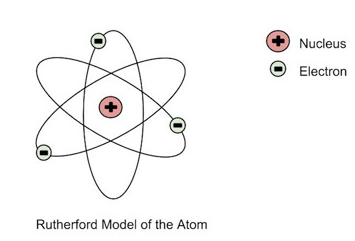
Rutherford's gold foil experiment provided evidence that...
a)
negative and positive charges are spread evenly throughout the atom.
b)
alpha particles have a positive charge.
c)
gold is not a dense as previously thought.
d)
there is a dense positively charged nucleus at the center of an atom.
19.
An atom's overall charge is ________.
a)
positive
b)
depends
c)
neutral
d)
negative
20.
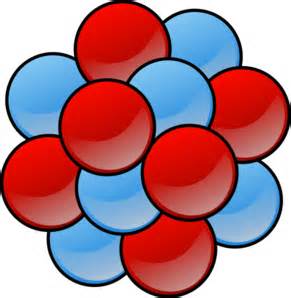
What does the nucleus of an atom contain?
a)
Electrons and neutrons
b)
Protons and neutrons
c)
Neutrinos and positrons
d)
DNA and RN
21.

Who came up with this model of an atom?
a)
J.J. Thompson
b)
Ernest Rutherford
c)
Neils Bohr
d)
James Chadwick
22.
True or False: The majority of an atom is made up of empty space
a)
True
b)
False
23.
The majority of an atom's mass exists where?
a)
In the nucleus
b)
In the electron cloud
c)
In the space between the nucleus and the electrons
d)
In the neutrons
24.
Neon has an atomic number of 10 and an atomic mass of 20.180. How many protons, electrons, and neutrons will it have?
a)
P=10 E=10 N=11
b)
P=5 E=5 N=10
c)
P=10 E=10 N=10
d)
P=10 E=5 N=5
25.
The atomic number for Oxygen is 8, so
a)
there are 8 protons in the atom
b)
the atomic mass is less than 8
c)
the mass of the atom is 8
d)
the atom is decaying
26.
Electrons can be found in
a)
The protons
b)
The nucleus
c)
Electron Clouds
27.
What are the two types of charge in an atom?
a)
Positive and Negative
b)
Neutral and Negative
c)
Positive and Neutral
28.
This particle is found in the nucleus and has no charge
a)
Neutron
b)
Proton
c)
Electron
29.
This particle is found in the nucleus and has a positive charge
a)
Electron
b)
Proton
c)
Neutron
30.
This is a negatively charged particle found outside the nucleus
a)
Electron
b)
Proton
c)
Neutron
31.
The weighted average of the masses of all naturally occurring isotopes of an element is
a)
Atomic number
b)
Atomic Mass
c)
Atomic weight
32.
This particle determines what element you have - the elements identity.
a)
electron
b)
proton
c)
neutron
d)
valence shell
33.
An electron has a _____ charge.
a)
negative
b)
positive
c)
neutral
34.
Describe an Electron Cloud?
a)
the mist outside of an atom
b)
home of the protons
c)
where electrons are located
d)
nucleus
35.
The particles of the atom you can find by knowing the atomic number.
a)
neutrons
b)
protons and electrons
c)
protons and neutrons
d)
atomic mass
36.
What charge does the nucleus have and why?
a)
positive - the neutrons do not have a charge
b)
positive - the neutrons and protons are positively charged particles
c)
neutral - the neutral charge dominates the positive charge
d)
neutral - electrons cancel out the positive charge of the atom
37.
An element with a mass number of 10 and an atomic number of 6 has how many protons?
a)
5
b)
8
c)
6
d)
10
38.
An element with a mass number of 11 and an atomic number of 5 has how many neutrons?
a)
11
b)
5
c)
6
d)
16
39.
An atom has 10 protons, 15 neutrons and 10 electrons what is its mass number.
a)
20
b)
10
c)
5
d)
25
40.
Matter that cannot be broken down into a simpler substance – building blocks of life.
a)
neutron
b)
atom
c)
electron
d)
quarks
41.
Elements on the periodic table increase by...
a)
atomic mass
b)
size
c)
mass number
d)
atomic #
42.
An atom has 13 protons, 15 neutrons and ___ electrons what is its mass number?
a)
13
b)
26
c)
28
d)
15
43.
What is the number that gives you the element and the number of protons contained in each elemental atom?
a)
atomic mass
b)
mass number
c)
symbol
d)
atomic #
44.

What is the number of protons that the element in this image contain?
a)
14
b)
7
c)
15
d)
18
45.
Protons and Electrons balance the charge of an atom.
a)
True
b)
False
46.
If an atom has 12 positively charged subatomic particles, which of the following must it also have to be considered a neutral atom?
a)
12 neutrons
b)
12 electrons
c)
12 protons
d)
24 protons and neutrons
47.

Which letter represents a neutron?
a)
A
b)
B
c)
C
d)
D
48.
Which letter represents a proton?
a)
A
b)
B
c)
C
d)
D
49.
Which letter represents an electron?
a)
A
b)
B
c)
C
d)
D
50.

What is the atomic number of the atom pictured?
a)
9
b)
10
c)
18
d)
19
51.
What is the atomic mass of the atom pictured?
a)
9
b)
10
c)
18
d)
19
52.
What is the element name of the atom pictured?
a)
Fluorine
b)
Neon
c)
Argon
d)
Potassium
53.
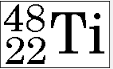
How many protons does this isotope of titanium have?
a)
48
b)
22
c)
26
d)
70
54.

In a correctly written symbol what would be located in the "A" position?
a)
number of neutrons
b)
atomic number
c)
number of electrons
d)
mass number
55.
A neutral atom of the isotope 2612Mg would consist of
a)
12 protons, 26 neutrons, 26 electrons
b)
26 protons, 12 neutrons, 26 electrons
c)
26 protons, 14 neutrons, 14 electrons
d)
12 protons, 14 neutrons, 12 electrons
56.
The atomic number of Uranium is:
a)
110
b)
16
c)
53
d)
92
57.
O is the symbol for what element?
a)
Orduvicium
b)
Oxygen
c)
Osmium
d)
Holonium
58.
The average atomic mass of Cesium is
a)
132.905
b)
55
c)
190.23
d)
Unknown
59.
The chemical symbol for Sulfur is:
a)
Su
b)
S
c)
Fr
d)
Sr
60.
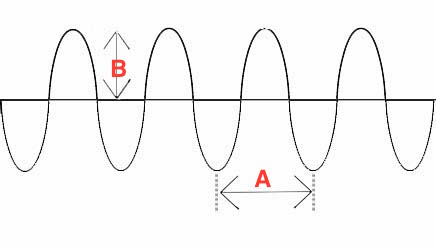
What property of the wave is represented by the letter "B"?
a)
amplitude
b)
crest
c)
trough
d)
wavelength
61.
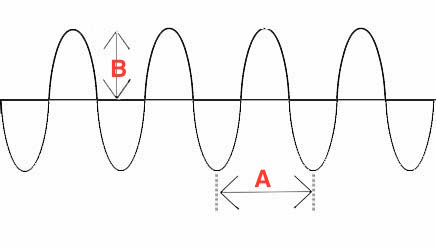
What property of this wave is represented by the letter "A"
a)
amplitude
b)
crest
c)
trough
d)
wavelength
62.
The highest point on a wave is:
a)
the crest
b)
the trough
c)
the top
d)
the coast
63.
The lowest point on a wave is the:
a)
Amplitude
b)
Crest
c)
Trough
d)
Wavelength
64.
The number of wavelengths that pass a point each per second is:
a)
frequency
b)
period
c)
longitudinal
d)
transverse wave
65.
When the frequency of a wave increases, what happens to the wavelength?
a)
The wavelength is not directly affected by the frequency of a wave.
b)
The wavelength increases.
c)
The wavelength decreases.
d)
More specific information is needed to form a conclusion about the wavelength.
66.
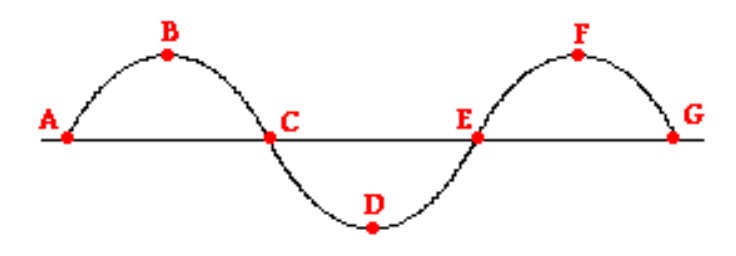
Which letter(s) represent the trough of the wave?
a)
A
b)
B & D
c)
D
d)
C & G
67.
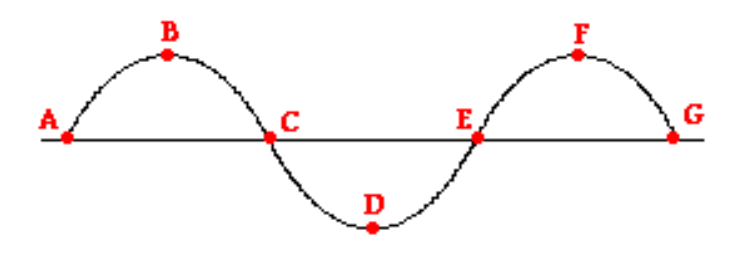
Which letter(s) represent the crest of the wave?
a)
A
b)
B & D
c)
B & F
d)
F
68.
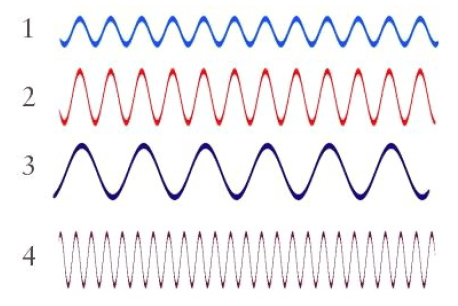
Which wave in the diagram has the greatest frequency?
a)
1
b)
2
c)
3
d)
4
69.
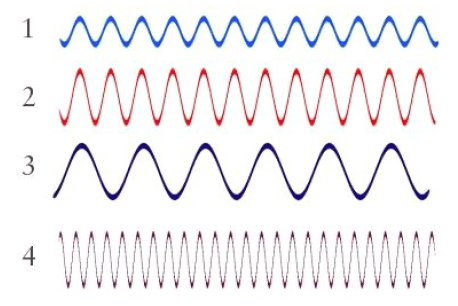
Which wave in the diagram has the greatest wavelength?
a)
1
b)
2
c)
3
d)
4
70.
crest to crest or trough to trough
a)
crest
b)
trough
c)
amplitude
d)
wavelength
71.
Electromagnetic waves include the following except
a)
radio waves
b)
X-rays
c)
doing the wave at a football game
d)
microwaves
72.
Solve this problems using the equation:
c = λν Calculate the wavelength of light that has a frequency of 5.2 x 10¹²/s. The speed of of light is 3.00 x 10⁸ m/s.
c = λν Calculate the wavelength of light that has a frequency of 5.2 x 10¹²/s. The speed of of light is 3.00 x 10⁸ m/s.
a)
5.8 x 10 -5 m
b)
5.8 x 10 -7 m
c)
5.19 x 10 14 m
d)
1.56 x 10 23 m
73.
Solve this problems using the equation:
C = λν
If an AM radio station broadcasts at
9.95 x 10⁵ Hz, what is the wavelength of this radiation?
C = λν
If an AM radio station broadcasts at
9.95 x 10⁵ Hz, what is the wavelength of this radiation?
a)
6.59 x 10⁻²⁸ m
b)
1.01 x 10⁻⁶ m
c)
3.32 x 10⁻³ m
d)
302 m
74.
A microwave oven emits radiation at a wavelength of 0.00500 m. What is the frequency of this radiation?
a)
6.67 x 10⁻⁷ Hz
b)
2.00 Hz
c)
1.50 x 10⁶ Hz
d)
6.00 x 10¹⁰ Hz
75.
What are the units of frequency?
a)
m/s
b)
s
c)
Hz
d)
m
76.
If an AM radio station broadcasts at 995 kHz, what is the wavelength of this radiation?
a)
6.59 x 10^-28 m
b)
1.01 x 10^-6 m
c)
3.32 x 10^-3 m
d)
301 m
77.

The ground state is the highest energy state of an atom.
a)
True
b)
False
78.
For an electron to change from ground state to an excited stated it must...
a)
Absorb energy
b)
Release energy
79.
The EM spectrum increases from left to right in________________.
a)
Wavelength
b)
Frequency
c)
Amplitude
d)
Height
80.
______waves can help sterilize medical equipment by killing bacteria.
a)
Infrared
b)
Visible
c)
Gamma
d)
Ultraviolet
81.

Cancer can be treated with_______________waves.
a)
Penicillin
b)
Radio
c)
Infrared
d)
Gamma
82.

_____________________light is the only type of EM wave detected by the human eye.
a)
Red
b)
Gamma
c)
Microwave
d)
Visible
83.

The acronym (letters) used to remember visible light is____________
a)
KTPERRY
b)
ROYGBIV
c)
DOGPOUND
d)
ROMERO
84.

The shortest wavelength in visible light is______.
a)
violet
b)
red
c)
blue
d)
yellow
85.
What is a photon?
a)
When radiation burst through electric waves
b)
The emission of electrons from a metal caused by light striking the metal
c)
The rate at which a waves energy flows through a given unit of area.
d)
packets of electromagnetic energy
86.
Emission of light from an atom occurs when an electron
a)
drops from a higher to a lower energy level.
b)
jumps from a lower to a higher energy level.
c)
moves within its atomic orbital.
d)
falls into the nucleus.
87.
As changes in energy levels of electrons increase, the frequencies
of atomic line spectra they emit
.
.
a)
increase.
b)
decrease.
c)
remain the same.
d)
cannot be determined.
88.
Which variable is directly proportional to frequency?
a)
wavelength
b)
velocity
c)
position
d)
energy
89.
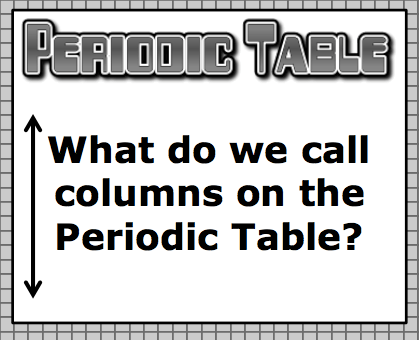
a)
Periods
b)
Groups
90.
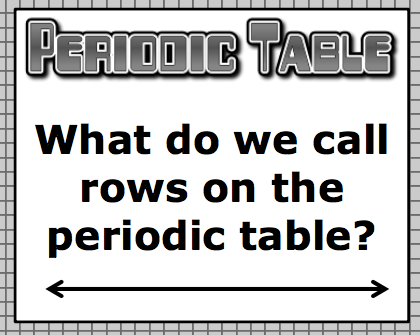
a)
Periods
b)
Groups
91.
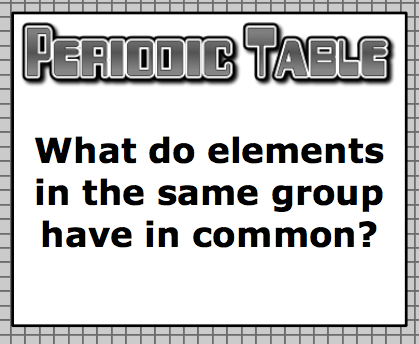
a)
energy levels
b)
valence electrons
c)
protons
d)
neutrons
92.
a)
Same group
b)
Same period
93.
a)
Group 1
b)
Group 17
c)
Group 2
d)
Group 18
94.
a)
Group 1
b)
Group 17
c)
Group 18
d)
Group 2
95.
a)
Group 1
b)
Group 17
c)
Group 18
d)
Group 2
96.

The horizontal row on the periodic table is called a
a)
group
b)
family
c)
period
d)
atomic number
97.

A vertical column is called...
a)
group
b)
tower
c)
period
d)
crew
98.

Which of the following is the most metallic element in period 3?
a)
Boron (B)
b)
Sodium (Na)
c)
Argon (Ar)
d)
Silicon (Si)
99.
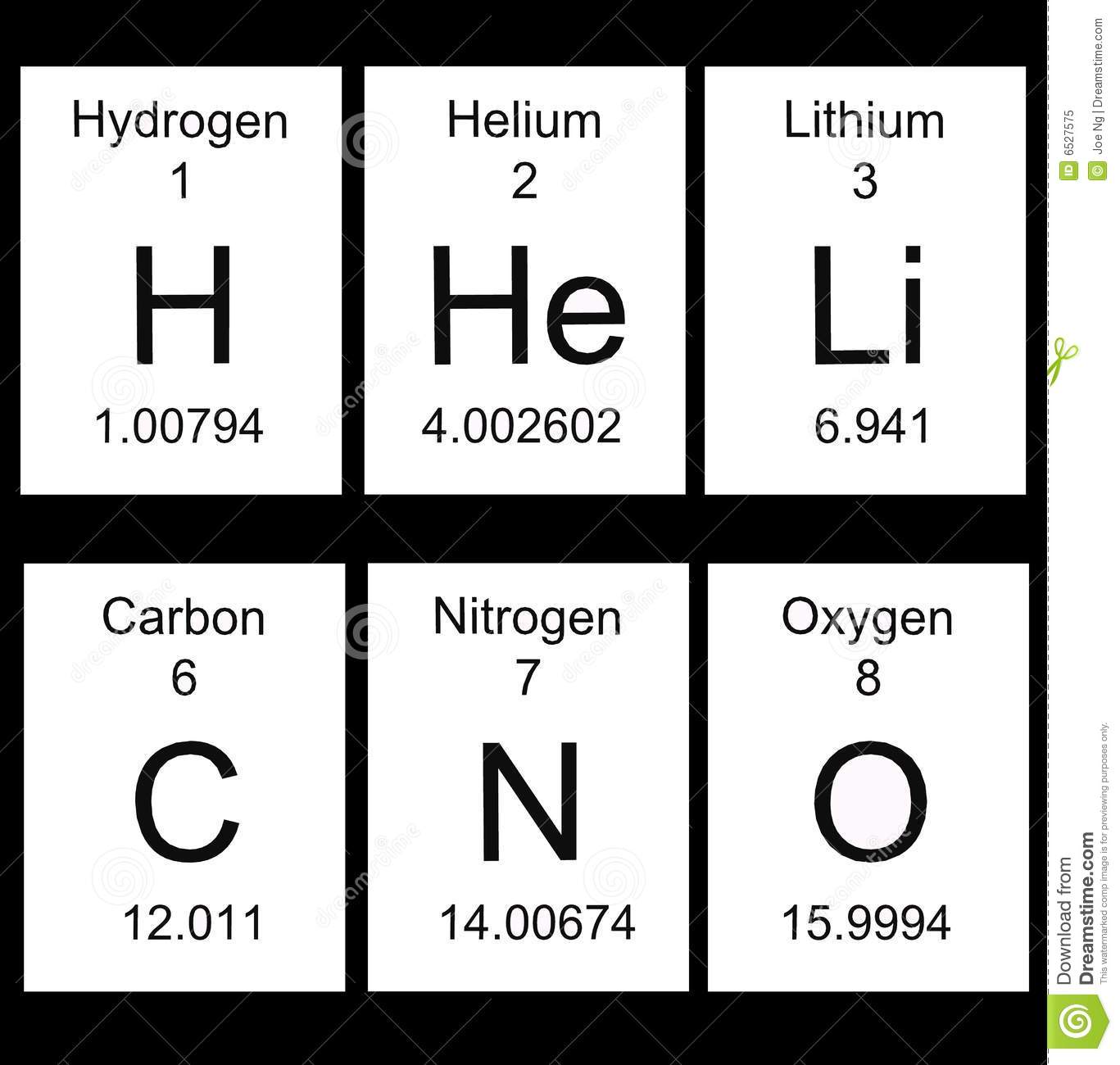
The number at the bottom of each square on the periodic table is the ...
a)
atomic number
b)
atomic mass
c)
chemical symbol
d)
element name
100.
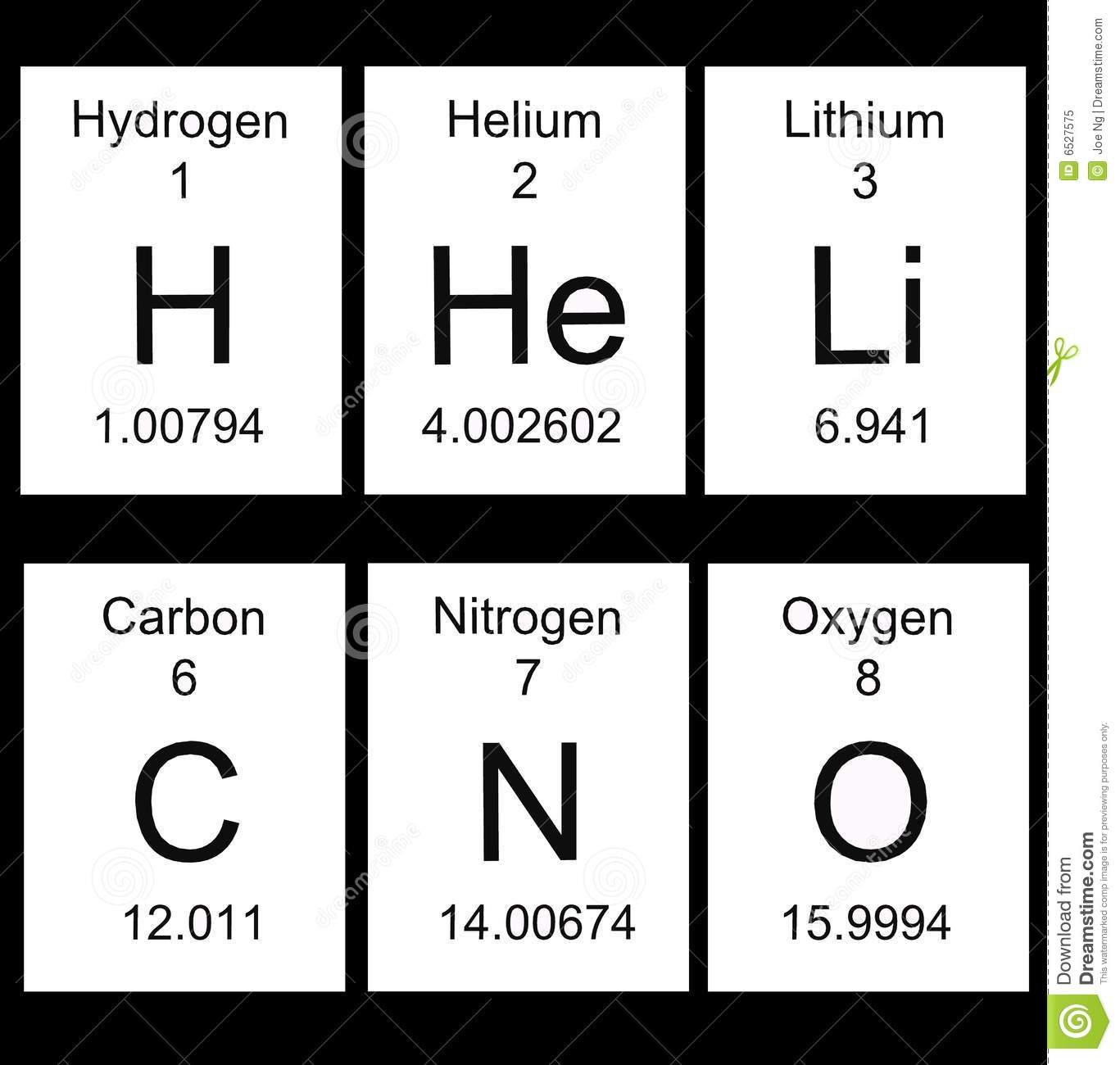
The number at the top of each square on the periodic table is the ...
a)
atomic number
b)
atomic mass
c)
Chemical Symbol
d)
Element Name
101.
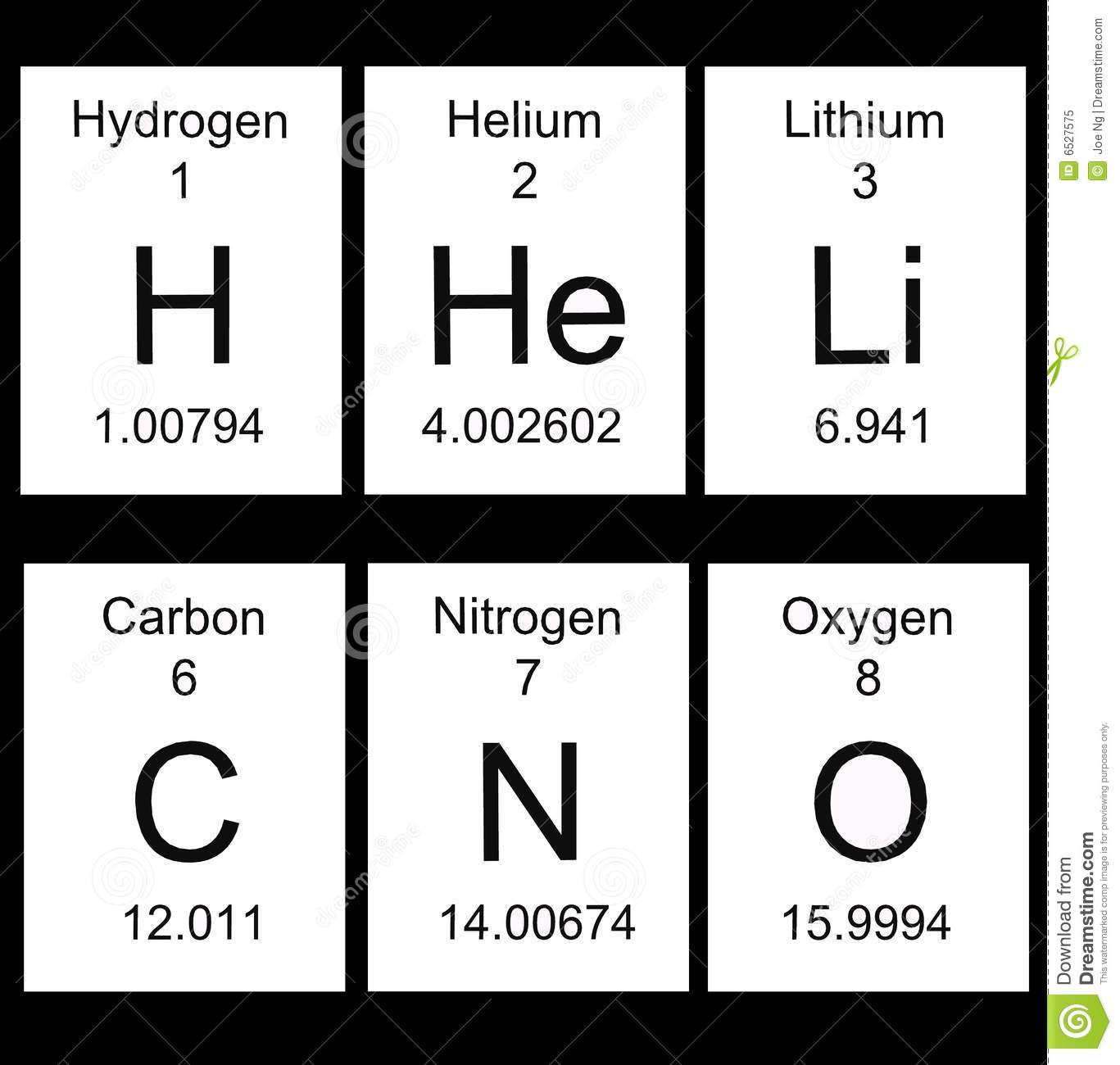
What is the chemical symbol for Lithium?
a)
H
b)
He
c)
Li
d)
N
102.

A rule that states that repeating chemical and physical properties of elements change periodically with the atomic number of the elements is the _________.
a)
periodic law
b)
alkaline-earth metals
c)
actinide
d)
group rule
103.

All of the actinides are ___________.
a)
stable
b)
radioactive
c)
shiny
d)
named after scientists
104.

Most of the elements on the periodic table are classified as _____.
a)
Metals
b)
Nonmetals
c)
Metalloids
d)
Periods
105.
A ___________ is an arrangement of elements in columns
a)
columns
b)
rows
c)
periodic table
d)
electron shell
106.
Which group of the periodic table is composed of inert (not reactive) gases?
a)
alkali metals
b)
alkaline earth metals
c)
halogens
d)
noble gases
107.
Elements which are shiny, conduct electricity and heat are called
a)
metal
b)
nonmetal
c)
metalloid
d)
nonexistent
108.

The atoms along the staircase are called
a)
metals
b)
nonmetals
c)
metalloids
d)
noble gases
109.
Which is a halogen?
a)
Helium
b)
Chlorine
c)
Oxygen
d)
Neptune
110.
Which is an alkali metal?
a)
Magnesium
b)
Iron
c)
Sodium
d)
Europium
111.
A horizontal row of elements in the periodic table.
a)
column
b)
group
c)
period
112.
A vertical column in the periodic table. Elements share similar properties.
a)
row
b)
group
c)
period
113.
Elements in a ..................have similar chemical properties.
a)
period
b)
group
c)
row
114.

In what section would Transition Metals be found?
a)
orange
b)
light blue
c)
blue
d)
white
115.
Elements on the left side of the periodic table are
a)
metals
b)
nonmetals
c)
metalloids
d)
noble gases
116.

What section is the least reactive?
a)
yellow
b)
red
c)
dark blue
d)
orange
117.

Which elements have the most similar chemical properties?
a)
K and Na
b)
K and Ca
c)
K and Cl
d)
K and S
118.

Which two families on the periodic table react aggressively?
a)
noble gases and alkali metals
b)
alkali metals and halogens
c)
noble gases and halogens
d)
metals and halogens
119.

What are the first two elements on the periodic table?
a)
hydrogen and helium
b)
hydrogen and lithium
c)
hydrogen and carbon
d)
nitrogen and helium
120.

Nonmetals are located in what section of this periodic table?
a)
Blue
b)
Yellow
c)
Pink
121.
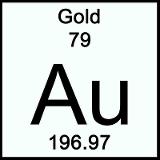
Which number is the atomic mass?
a)
79
b)
196.97
122.
In the modern periodic table elements are arranged by:
a)
atomic mass
b)
atomic number
c)
valence electrons
d)
number of isotopes
123.
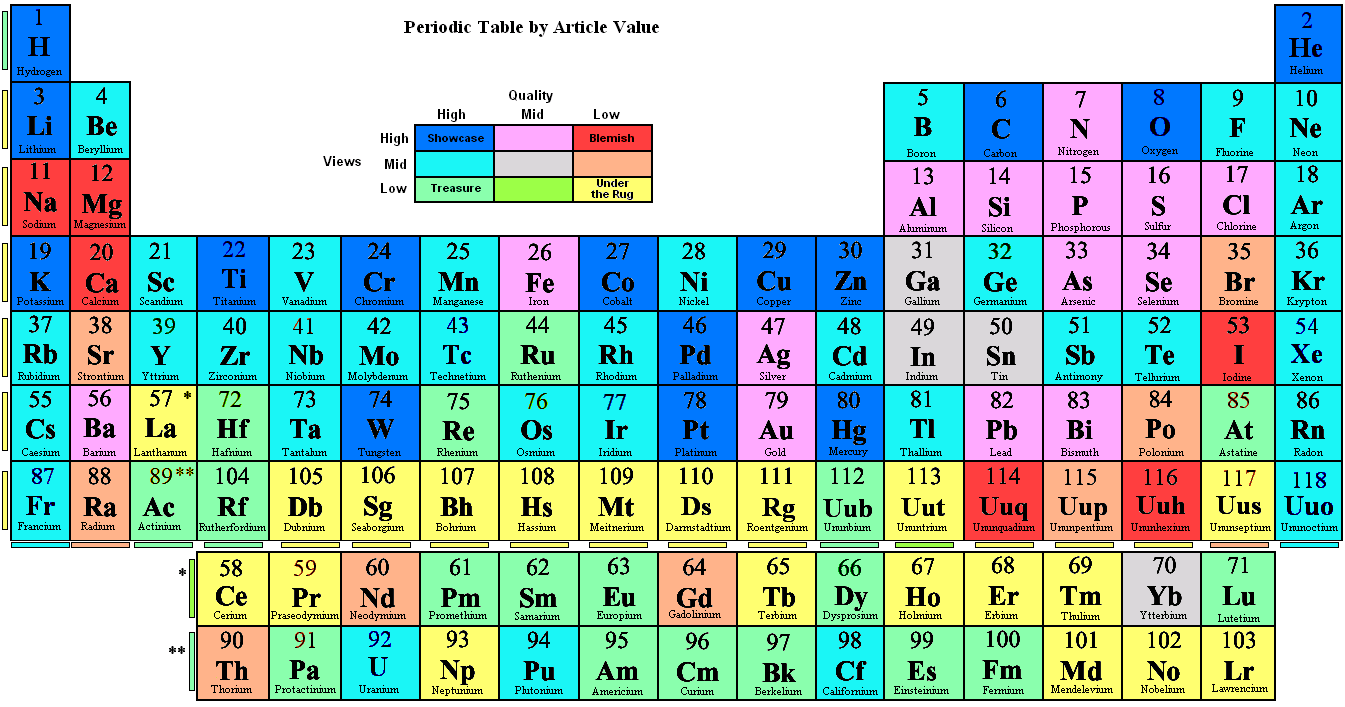
Beryllium is in group number______.
a)
Group 2
b)
Group 3
c)
Group 4
d)
Group 7
124.
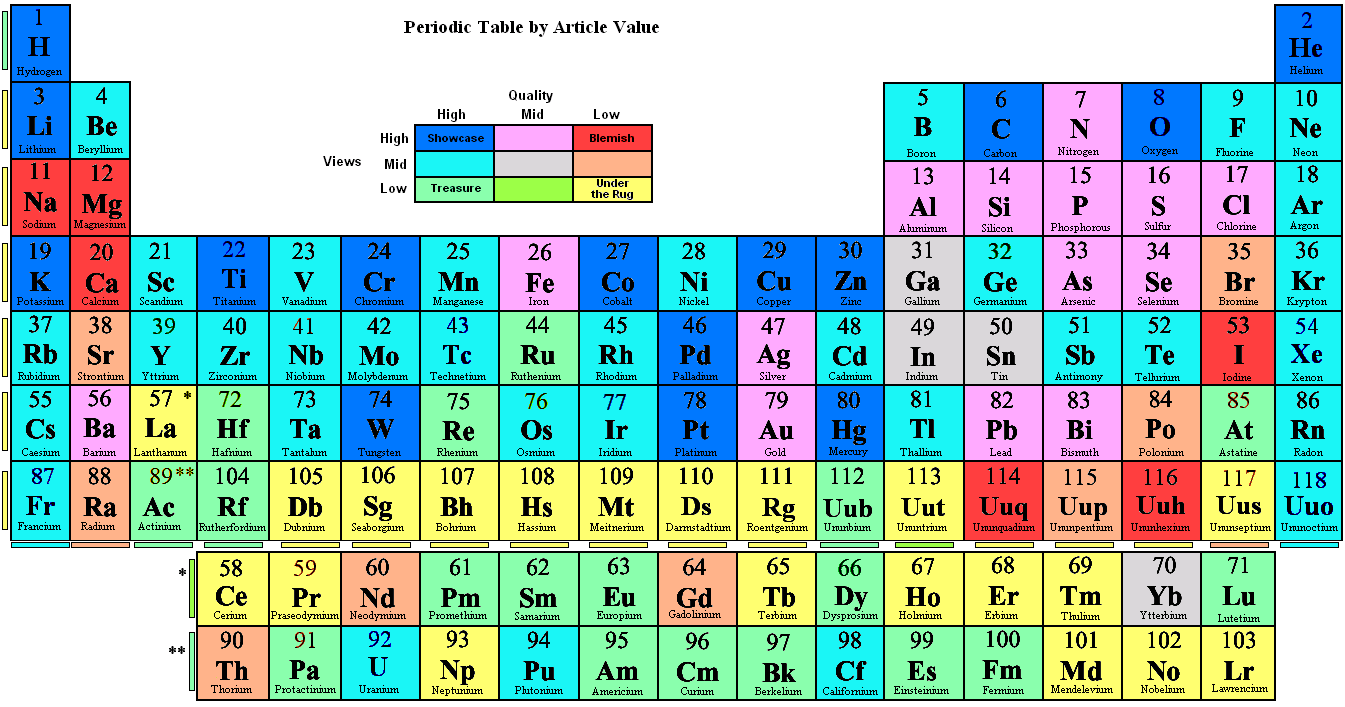
The period for Bromine is ___________.
a)
3
b)
2
c)
4
125.
The periodic table has __ periods.
a)
18
b)
8
c)
2
d)
7
126.
Group 18 elements are known as the _____ _____ and have full valence shells.
a)
royal gases.
b)
supreme solids.
c)
noble gases.
d)
legit liquids.
127.
Elements in the same ________ are more chemically similar.
a)
group
b)
period
c)
club
d)
table
128.
What period and group is Silver (Ag)?
a)
Period 2, Group 1
b)
Period 3, Group 16
c)
Period 5, Group 11
d)
Period 2, 14
129.
Which of the following is not a property of metals?
a)
brittle
b)
malleable
c)
lustrous
d)
conductive
130.
Rows on the period table are called _____ while columns are called _____.
a)
groups, families
b)
groups, periods
c)
periods, groups
d)
families, groups
131.
The periodic table has __ groups.
a)
8
b)
7
c)
18
d)
2
100 %

