
 Worksheets
More Earth Science Review
Total questions: 50
Worksheet time: 34mins
Name
Class
Date
1.
What would you be most likely to find at a transform boundary?
a)
Earthquakes
b)
Volcanoes
c)
Mountains
d)
Rift
2.
What would you be most likely to find at a convergent boundary between a continental and oceanic plate?
a)
Mountains
b)
Volcanoes
c)
Mid-Ocean Ridge
d)
Rift
3.
What would you be most likely to find at a divergent boundary between two pieces of oceanic crust?
a)
Rift
b)
Mid-Ocean Ridge
c)
Island Arc
d)
Flat land
4.
What would you be most likely to find at a convergent boundary between two pieces of oceanic crust?
a)
Mountains
b)
Rift
c)
Mid-Ocean Ridge
d)
Island Arc
5.
What would you be most likely to find at a divergent boundary between two pieces of oceanic crust?
a)
Rift
b)
Mid-Ocean Ridge
c)
Island Arc
d)
Flat land
6.
What would you be most likely to find at a divergent boundary between two pieces of continental crust?
a)
Mid-Ocean Ridge
b)
Mountain
c)
Rift
d)
Island Arc
7.
What would you be most likely to find at a convergent boundary between two pieces of continental crust?
a)
Volcano
b)
Mountain
c)
Rift
d)
Island Arc
8.
Which of the following statements is false?
a)
Oceanic crust is made of basalt
b)
Oceanic crust is thinner than continental crust
c)
Oceanic crust is less dense than continental crust
d)
Oceanic crust is younger than continental crust
9.
Plates slide past one another at ____________ boundaries.
a)
divergent
b)
convergent
c)
transform
d)
submergent
10.
The area where two or more plates meet is called a __________________.
a)
fault
b)
plate boundary
c)
plate edge
d)
ring of fire
11.
Plates move towards one another at ______________ boundaries.
a)
divergent
b)
convergent
c)
transform
d)
detergent
12.
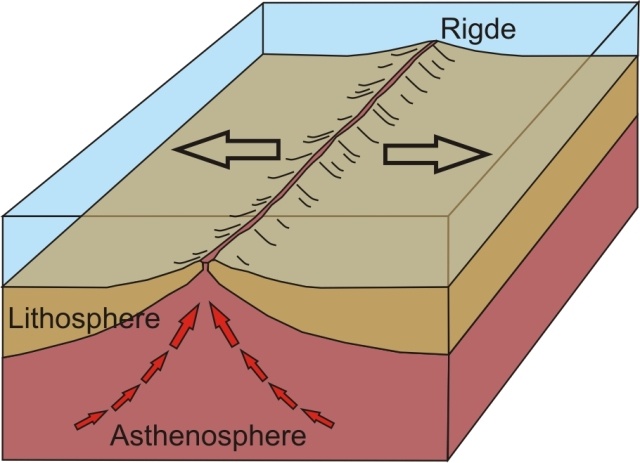
What kind of plate boundary is shown here?
a)
divergent
b)
convergent
c)
transform
d)
subducting
13.

What kind of plate boundary is shown here?
a)
divergent
b)
convergent
c)
transform
d)
submergent
14.
Volcanoes typically form _______________.
a)
along plate boundaries
b)
only under water
c)
only in hawaii
d)
where it is usually hot
15.
Plate movement is caused by ______________.
a)
the rotation of the Earth
b)
ocean tides
c)
convection currents in the mantle
d)
the moon's gravity
16.
The crust and the uppermost mantle make up the ________________.
a)
lithosphere
b)
asthenosphere
c)
atmosphere
d)
hydrosphere
17.
Plates move away from one another at ___________ boundaries.
a)
divergent
b)
convergent
c)
transorm
d)
submergent
18.
A deep crack in the Earth's crust is called a _______________.
a)
canyon
b)
trench
c)
fault
d)
plate
19.
Earthquakes typically occur _________________.
a)
In the middle of tectonic plates
b)
only in California
c)
only in the middle of the ocean
d)
along plate boundaries
20.

What kind of plate boundary is shown here?
a)
divergent
b)
convergent
c)
transform
d)
strike slip
21.
What is the shaking of the Earth’s crust caused by a release of energy?
a)
Earthquake
b)
Epicenter
c)
Fault
d)
Plate
22.
Where is the point at which the first movement occurs during an earthquake?
a)
Epicenter
b)
Focus
c)
Fault
d)
Plate
23.
Where is the point on the Earth’s surface directly above the focus of an earthquake?
a)
Epicenter
b)
Fault
c)
Hypocenter
d)
Tremor
24.
Which type of wave is the first to arrive after an earthquake occurs?
a)
P Wave
b)
Rayleigh Wave
c)
S Wave
d)
Shear Wave
25.
What is another term for P Wave?
a)
Compression Wave
b)
Principal Wave
c)
Shear Wave
d)
Secondary Wave
26.
P Waves can move through which of the following?
a)
Gas
b)
Liquid
c)
Solid
d)
All of these
27.
S Waves can move through which of the following?
a)
Gas
b)
Liquid
c)
Solid
d)
All of these
28.
What is an instrument that detects and records waves produced by earthquakes? (This piece of equipment can measure the magnitude of an earthquake.)
a)
Epicenter
b)
Fault
c)
Seismogram
d)
Seismograph
29.
What is the measure of the amount of energy released in an earthquake?
a)
Earthquake
b)
Epicenter
c)
Magnitude
d)
Seismogram
30.
Which scale rates earthquakes based on the amount of damage done?
a)
Mercalli Scale
b)
Richter Scale
c)
Seismogram Scale
d)
Bernoulli Scale
31.
Which scale measures the intensity of the ground movement?
a)
Mercalli Scale
b)
Richter Scale
c)
Seismogram Scale
d)
Bernoulli Scale
32.
What is a smaller earthquake that follows a larger earthquake?
a)
Aftershock
b)
Liquefaction
c)
Seismic Gap
d)
Tsunami
33.

This rock was formed when heat and pressure changed its minerals around into new minerals. What type of rock is it?
a)
Metamorphic Rock
b)
Igneous Rock
c)
Sedimentary Rock
d)
Boring Rock
34.
This rock was formed when molten rock cooled into a solid. What type of rock is it?
a)
Igneous Rock
b)
Metamorphic Rock
c)
Sedimentary Rock
35.

This rock formed when bits of other rocks became pressed into a solid. What type of rock is it?
a)
Sedimentary Rock
b)
Metamorphic Rock
c)
Igneous Rock
36.
What are the 3 major types of rocks?
a)
Igneous, Metamorphic, Sedimentary
b)
Metamorphic, Igneous, Cementation
c)
Brown, Red, Gray
d)
Streak, Hardness, Breakage
37.
The process where one type of rock can change into another type of rock is known as ____
a)
The rock cycle
b)
Sedimentation
c)
Igneous
d)
Composition
38.
The process by which water, wind, ice, and changes in temperature break down rock into fragments called sediments.
a)
Deposition
b)
Erosion
c)
Weathering
d)
Igneous Rock
39.

This rock started as molten magma. What type of rock is this?
a)
Sedimentary
b)
Igneous
c)
Metamorphic
40.
What does Mohs Chart measure?
a)
The Density of Liquid
b)
The Density of Air
c)
The Hardness of Minerals
d)
The Hardness of Atoms
41.
What mineral is the highest on the Mohs Scale?
a)
Topaz
b)
Feldspar
c)
Diamond
d)
Granite
42.
What is Luster?
a)
The color of a mineral when it is ground into a powder.
b)
A measure of how easily a mineral can be scratched.
c)
The way a mineral shines, or reflects light.
43.
What is Hardness?
a)
The tendency of a mineral to split easily along flat surfaces.
b)
A measure of how easily a mineral can be scratched.
c)
The way a mineral shines, or reflects light.
44.
This type of Rock is formed over time when layers of sand and mud turn into rock.
a)
Igneous
b)
Sedimentary
c)
Metamorphic
45.
Most fossils are found in this type of rock.
a)
Igneous
b)
Sedimentary
c)
Metamorphic
46.
Obsidian is an example of this type of rock.
a)
Igneous
b)
Sedimentary
c)
Metamorphic
47.
Sandstone is an example of this type of rock.
a)
Igneous
b)
Sedimentary
c)
Metamorphic
48.
Marble is an example of this type of rock.
a)
Igneous
b)
Sedimentary
c)
Metamorphic
49.
How does Igneous turn into Sediments?
a)
Heat and pressure
b)
Weathering and Erosion
c)
Minerals
d)
Mrs. Hicks ice powers
50.
What happens when an a rock is cooled extremely fast?
a)
it develops a glassy texture
b)
it develops a fine grained texture
c)
it develops a coarse texture
d)
it develops a molten liquid texture
100 %

